This step-by-step guide is exclusively available for Lead with AI PRO membership. 🚀 With Lead with AI PRO, you’ll get: ✅ Access to expert-crafted step-by-step guides ✅ AI-powered workflows to boost productivity ✅ Exclusive tools and resources for smarter work Upgrade to Lead with AI PRO and access all premium content instantly.
Mere days later, I came across two papers that paint a picture of a world where knowledge work is redundant and humans become ‘missable.’ Yet the bright thread running through both: people with purpose remain indispensable.
Too often (and understandably), the AI debate dwells on productivity.
But the more interesting question is impact: what change do we actually want to make in the precious time we spend on this planet?
If jobs of endless computer-bound busywork had never been invented, wouldn’t we have felt far more purpose already?
Instead of racing to automate today’s repetitive knowledge tasks, we should focus on amplifying our impact.
In fact, we may need a new metric: impact per hour.
Flagship AI Newsletter
The AI Newsletter That Makes You Smarter, Not Busier
Join over 30,000 leaders and receive our insights on AI platforms, implementations, and organizational change management.
Why “Impact per Hour” Matters
We have measured productivity in hours and outputs for too long.
For leaders and organizations, this is a flawed metric. Optimizing for “outputs” risks losing sight of what those outputs are meant to achieve.
In March 2023, I therefore argued for a shift toward “meaningful productivity,” focusing on work that drives real and meaningful outcomes.
AI accelerates the urgency of this shift.
When AI teammates can draft reports in seconds or summarize meetings in real time, what defines us is not the busywork but the impact we create.
That’s why I propose a new metric: Impact per Hour.
How much of your time actually moves the mission forward?
For leaders, this is the right lens for AI. Not to replace people, but to free them from the 30 to 40 percent of their time lost to low-value tasks, so they can concentrate on what creates real value.
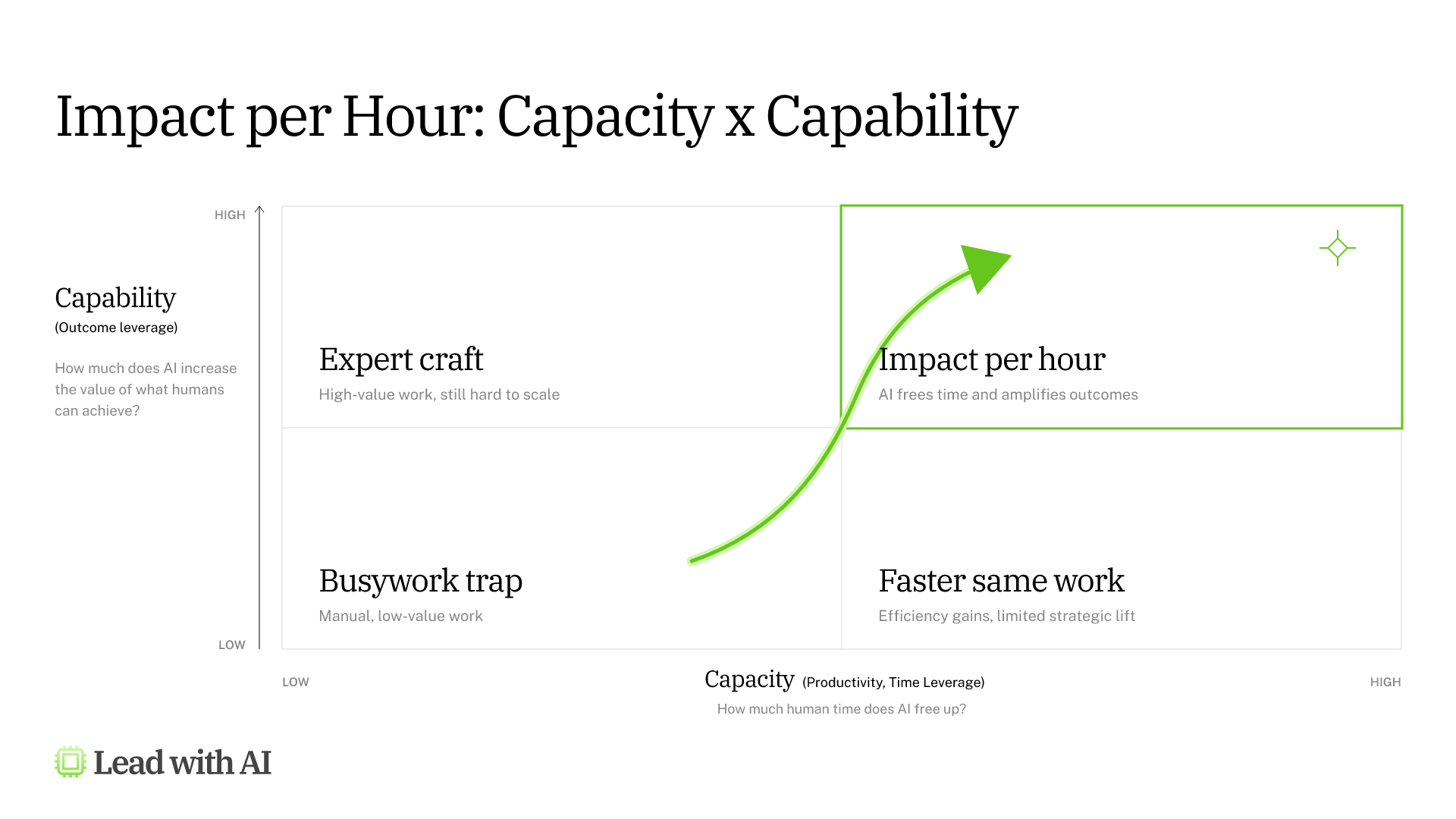
And we do this by increasing both capacity (how much AI frees human time from low-value work through automation) and capability (amplifying people’s ability to create higher-value outcomes by tapping AI as your writer, designer, analyst, and thinking partner).
Impact per Hour: the combination of expanded Capacity AND Capability
In OpenAI’s survey of 9,000 workers across almost 100 enterprises, 75 percent reported being able to complete tasks they previously could not perform at all. Not tasks they did faster. Tasks that were simply outside their reach before.
The examples OpenAI lists are telling: programming support and code review, spreadsheet analysis and automation, technical tool development, and designing custom GPTs and agents. Work that used to require a specialist is moving into the hands of people who never trained for it. Outside of engineering, IT, and research, coding-related messages grew by an average of 36 percent in six months.
Our first lesson in our AI Leader Advanced isn’t about LLMs or Agents; it’s about defining your ‘why’ to formulate a North Star.
Because if AI can one day do nearly everything, Impact per Hour becomes not just a management tool but a life question: how do we spend our hours on what brings meaning and fulfillment?
As I tell leaders in our boot camp: it doesn’t matter what percentage of work AI can replace. We’re hardwired to fill freed-up time with more busywork, a concept known as Parkinson's Law.
The real benefit comes from deciding (and acting on!) what you will do with the time saved.
Whether AI stalls at the LLMs of 2025 or eventually takes over, optimizing for impact is the move every leader and organization can make today.
1. Define Impact Clearly
Purpose is one of the strongest drivers of happiness at work, which in turn boosts engagement and reduces attrition.
Start by naming the outcomes that truly matter: customer satisfaction, product innovation, or cultural resilience.
Or beyond work: contributing to a cause, growing a side project, spending more time with family. Write down one to three outcomes that define your impact.
2. Audit Low-Meaning Work
Use our GED-RT model to mark the tasks in a typical week that drain energy but add little value, like status reporting, shallow meetings, routine analysis. These are prime candidates for AI.
3. Deploy AI Agents Where It Hurts Most
Pick your top three low-meaning tasks and set up AI agents to handle them, with human-in-the-loop review where needed.
Too many leaders say they “use AI” but treat it as a better Google rather than redesigning workflows.
Don’t get distracted by shiny AI experiments. Start where the pain is—and transform your work methodically. (Join us, and we’ll do this together.)
It sounds simple, but in practice, I see that most still spend more time chasing shiny AI objects than methodically reshaping their work.
The discipline is in focus, not novelty
Flagship AI Newsletter
The AI Newsletter That Makes You Smarter, Not Busier
Join over 30,000 leaders and receive our insights on AI platforms, implementations, and organizational change management.
From One Leader to a 10x Organization
Studies often find that companies with an integrated purpose strategy outperform their peers across several key business drivers, what Deloitte calls the ‘purpose premium.’
So when one leader applies the ‘impact per hour’ principle, it’s powerful. When a thousand people do it together, it’s transformative.
A mission-driven organization where every person optimizes for impact per hour and embraces AI as their co-pilot becomes a 10x organization. Not only in productivity, revenue, and the bottom line, but in the actual mission of the company.
Each person knows their outcomes, automates low-meaning work, and reinvests freed-up time into mission-driven impact.
The result is not only higher productivity, but a culture where people feel proud of their contribution. This is how AI helps us build companies that are both high-performing and deeply human
The Bottom Line: Impact Per Hour
It’s easy to think we already “know AI.”
But most leaders still dabble in prompts or use it to search faster.
But what matters is purposeful discipline. The real work is dissecting your role, applying AI where it frees time, and then spending that time meaningfully.
In the short term, leaders who optimize for impact per hour unlock capacity, engagement, and results, especially in the context of a 10x organization.
In the long term, they prepare themselves and their organizations for a future where busywork vanishes, and only meaningful contribution remains.
We need to stop thinking about AI as a productivity tool. The leaders and organizations that shift to impact will define what comes next.