
December 19, 2025

BCG: The Semi-Autonomous AI Inflection Point

The real AI inflection point isn’t usage. It’s when AI starts shaping workflows, decisions, and roles.
Daan van Rossum
By
Daan van Rossum
Founder & CEO

BCG: The Semiautonomous AI Inflection Point

Presented by

AI adoption inside organizations is accelerating. But AI impact is not.

According to BCG Henderson Institute research, most companies now report widespread employee usage of AI tools. Yet financial results remain uneven. Leaders sense that something is missing. They are right.

The issue is not model quality or tool access. It is how AI is being used inside workflows. BCG’s data shows that while employees adopt AI quickly, most never reach the stage where AI materially reshapes how work gets done.

The result is a widening performance gap. Over a three year period, companies classified as AI leaders achieved 1.7x revenue growth, 3.6x greater total shareholder return, and 1.6x stronger EBIT margins than peers. The difference comes from the depth, not the frequency, of AI use.

BCG’s five-stage adoption model makes this visible and uncomfortable.

Most Employees Are Stuck Before Value Creation

BCG finds that more than 85% of employees remain in stage two and stage three of AI adoption. These stages are task assistance and delegation.

At these levels, AI helps individuals work faster. It drafts documents, summarizes information, and generates near final outputs. But humans still plan the work, structure the tasks, and integrate results manually.

This is why AI feels helpful but not transformative. Productivity gains remain incremental. Organizational processes remain unchanged. AI is added onto existing workflows rather than built into them.

True value begins at stage four, called semiautonomous collaboration. Here, AI does more than respond. It helps plan, structure, and execute work. Humans set objectives, apply judgment, and intervene when needed. AI handles the flow.

BCG’s data shows fewer than 10% of employees operate at this level today. That small group explains the performance gap between AI leaders and laggards.

The Inflection Point Is a Workflow Shift, Not a Tool Upgrade
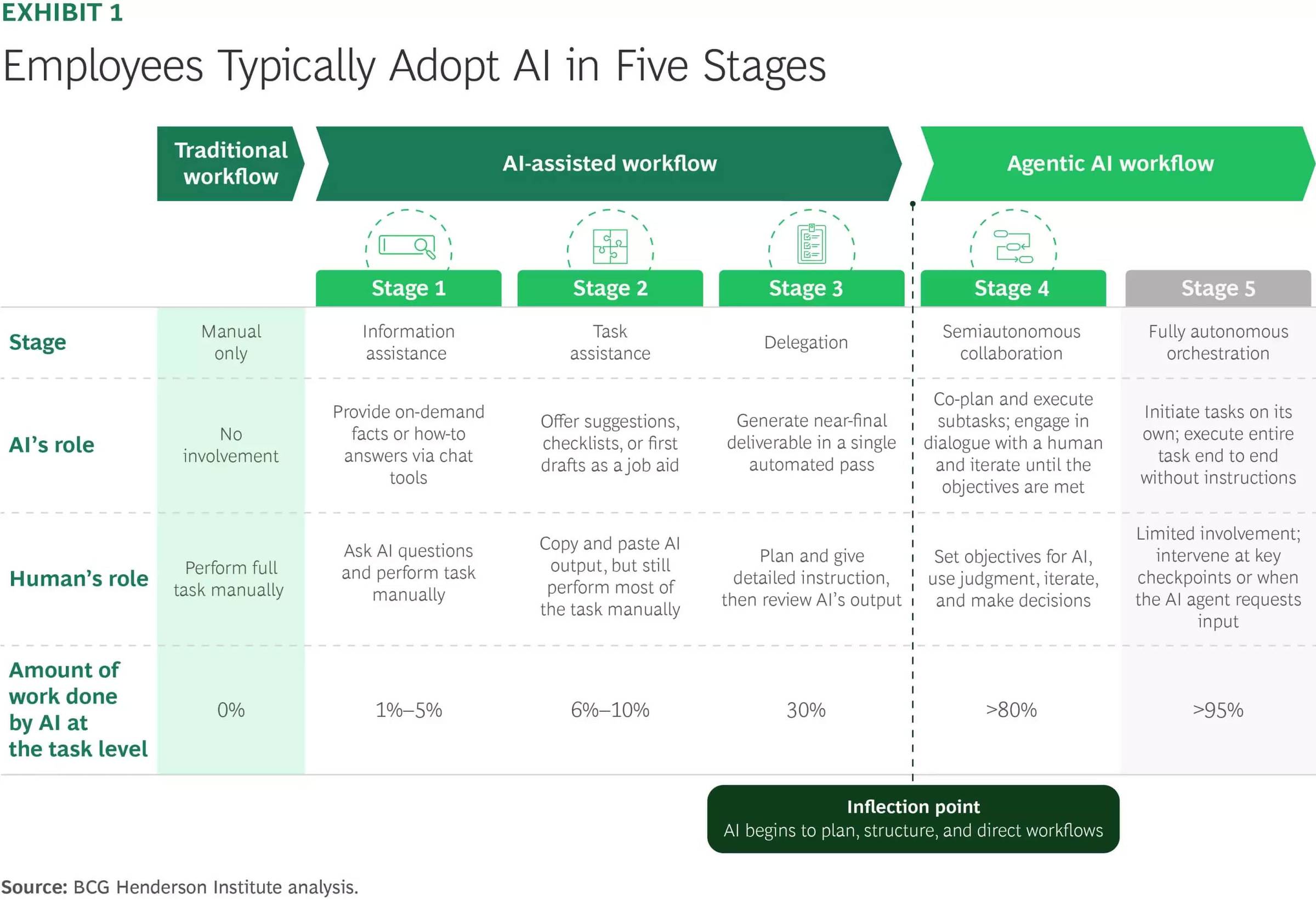
The most important insight from the BCG exhibit is the inflection point between stage three and stage four.

Up to stage three, AI supports tasks. At stage four, AI begins to direct workflows.

The image makes this explicit. At the task level, AI contribution jumps from around 30% to more than 80%. That jump does not come from better prompts. It comes from redesigned roles.

At stage four, humans stop managing tasks and start managing outcomes. AI co-plans subtasks, executes across systems, and iterates through feedback loops. The human role shifts to setting goals, applying judgment, and making decisions.

This is where organizations either break through or stall. Moving past this inflection point requires clarity around decision rights, trust boundaries, and escalation rules. Without those, AI adoption plateaus, no matter how powerful the models become.

Adoption Is a Personal, Psychological Journey
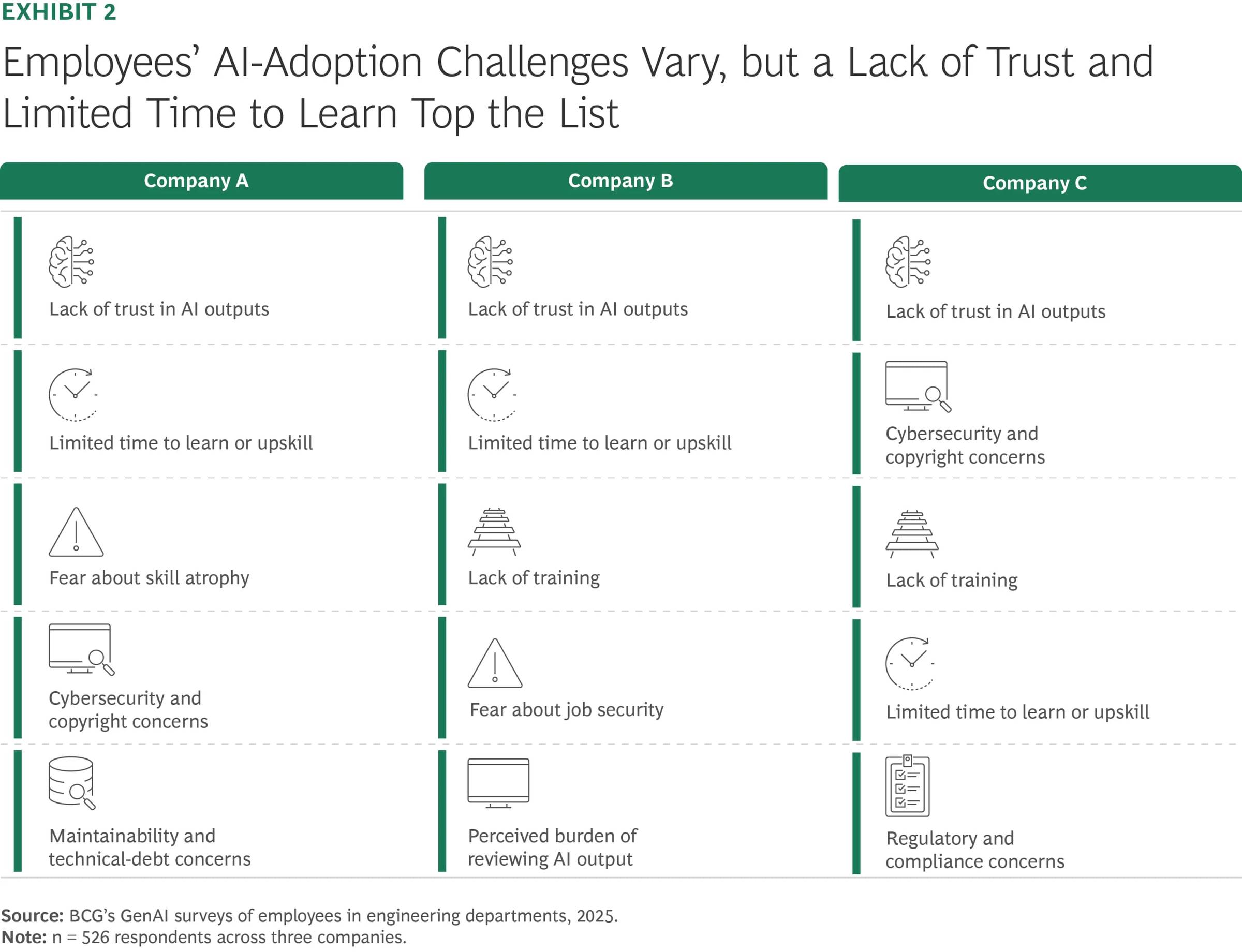
BCG’s research shows that AI adoption does not fail because the technology is weak. It stalls because people are uncertain.

Employees hesitate when the environment is unclear. Who owns the outcome if AI is wrong? How much autonomy is acceptable? Whether experimentation is rewarded or quietly penalized. These signals shape behavior far more than model capability.

BCG identifies recurring adoption personas, from AI champions to cautious skeptics. Each persona faces different psychological barriers. Champions want speed and freedom. Skeptics worry about trust, credibility, and role erosion. A single rollout approach fails because adoption friction is not uniform across employees.

This is where managers become decisive. Research from BCG and Columbia Business School shows that employee-centric organizations are 7x more likely to reach AI maturity. Not because they deploy better tools, but because they create conditions that reduce fear and build confidence.

Visible manager usage matters. Protected learning time matters. Clear ownership of AI-assisted workflows matters. These signals tell employees whether AI is safe to use, worth learning, and aligned with how success is measured.

AI adoption succeeds when organizations recognize it as a personal change journey, not a technical upgrade. People do not adopt AI because it exists. They adopt it when trust, clarity, and permission are built into how work actually happens.

The Bottom Line: How Organizations Reach Semiautonomous AI

  1. Redesign one core workflow end-to-end: Start with a high-value process and redesign it assuming AI participates in planning and execution, not just output generation.
  2. Clarify human decision ownership: Define where humans must intervene, approve, or override. Ambiguity slows adoption and erodes trust.
  3. Shift managers from oversight to orchestration: Managers must learn to lead hybrid human-AI workflows, not just review deliverables.
  4. Create protected time for AI practice: BCG data shows most learning happens outside work hours. Allocate time explicitly or progress stalls.
  5. Train teams for semiautonomous collaboration: Move beyond prompt training. Invest in role-based training that teaches employees how to supervise AI, set objectives, and manage outcomes inside real workflows.

This is where AI stops being a productivity aid and becomes organizational infrastructure.

And this is where the separation between AI leaders and laggards accelerates.

Flagship AI Newsletter
The AI Newsletter That Makes You Smarter, Not Busier
Join over 30,000 leaders and receive our insights on AI platforms, implementations, and organizational change management.
FlexOS Course - AI Content Accelerator - Testimonial Badge

Build Your Personal Team of AI Assistants in Just 2 Weeks.​​ Final 42 hours to join at 50% off. After that, the price increases to $799

We just launched a fully redesigned program: ​​AI Leader Advanced​​: 5 AI Assistants in Two Weeks for Non-Technical Leaders. Enrollment is now open.

In just 2 weeks, you’ll design, build, and deploy at least five AI Assistants tailored to your role, workflows, and industry. No code. No theory overload.

Just 30 minutes a day focused on real output.

✅ A fully personalised learning system powered by LeadOS. We tailor the program to your role, goals, and industry using LeadOS, our AI personalisation engine for leaders:

  • Intake™: a 15-minute, 24/7 executive interview that captures your role, goals, constraints, and working style.
  • Blueprint™: your intake is transformed into a dynamic personal AI leadership profile.
  • Pathways™: turns your Blueprint and prioritized workflows into a personalized 2-week plan to deploy 5+ AI assistants.

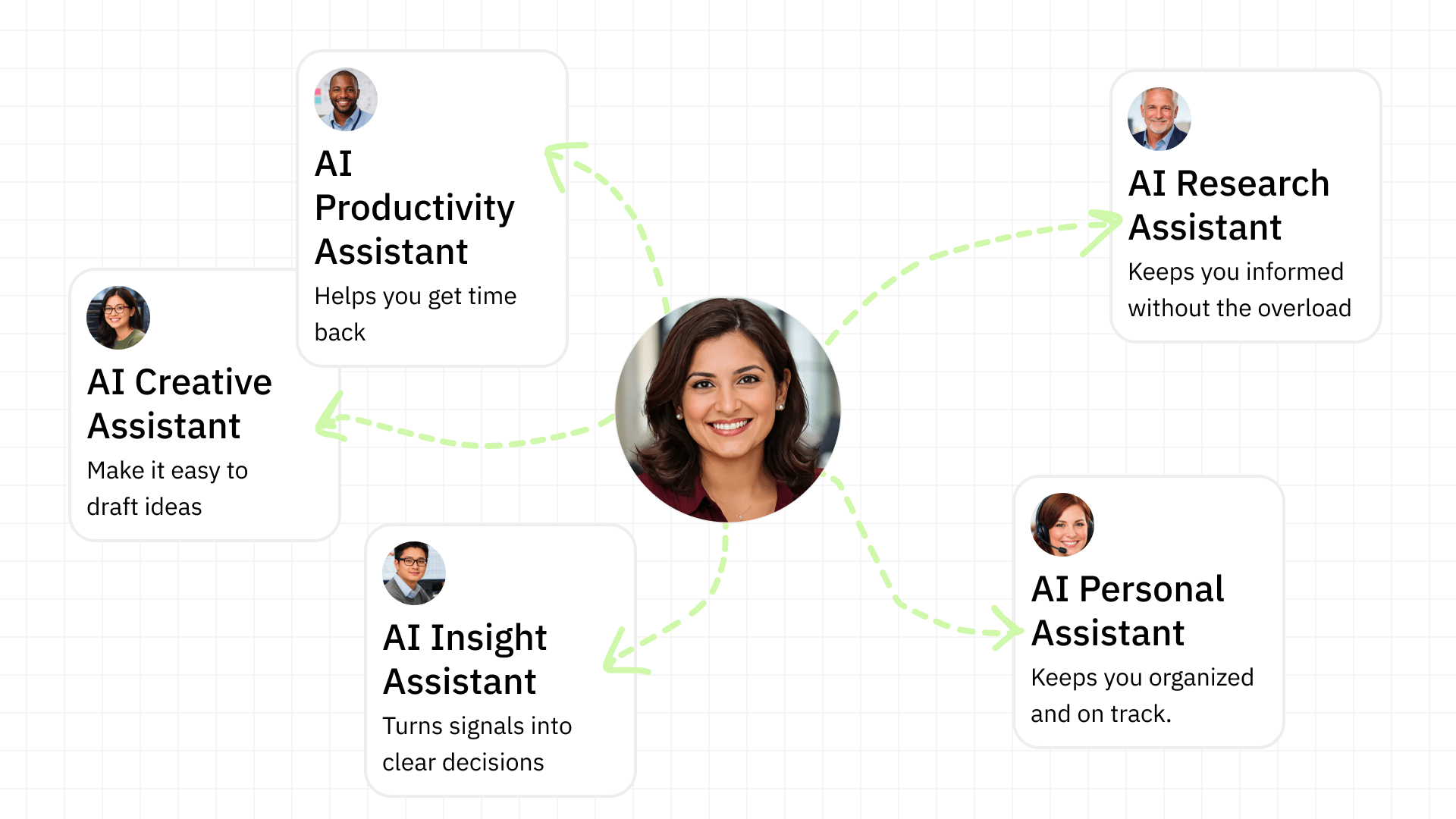
Build at least 5 business-ready AI Assistants in just 30 minutes per day. You’ll create agents for: productivity, creative work, analysis, intelligence, and a fully custom agent built live with expert guidance.

AI Fundamentals Primer Included. Every purchase comes with a free AI Fundamentals Primer valued at $199 (history, LLMs, challenges, context windows, practical use cases).

Want to reach 30,000+ business leaders applying AI in their work, teams, and organizations?​ ​Advertise with us​​.

Want to reach 30,000+ business leaders applying AI in their work, teams, and organizations?​
Advertise with us​​.

AI in Organizations Roundup 🗞️

I track how AI is reshaping organizations, bringing you the news and updates that matter most for scaling AI successfully.  

This week:

AI CAPABILITY OVERHANG

​Sam Altman: Why AI Impact Lags Intelligence​

  • Exploding Capability: GPT-5.2 reaches expert-level performance on 70–74% of knowledge work tasks across 40+ business verticals, yet most users still interact as if it were GPT-4.
  • The Overhang Problem: AI capability is compounding faster than organizations can redesign workflows, creating a widening gap between what models can do and how they’re used.
  • False Comfort: Even if model progress is paused today, Altman argues most companies could extract multiple times more value simply by changing how work is structured.
📍 Pick one high-volume knowledge task (reports, analysis, customer responses) and redesign it so AI owns execution and humans review.

AI AT SCALE

​MIT Sloan: How P&G Actually Scaled AI​

  • Factory Model: P&G built an internal “AI Factory” that cut model deployment time by ~6 months and eliminated fragile, one-off AI projects by standardizing data, tools, and governance.
  • GenAI as Interface, Not Value: Most business impact still comes from analytical AI in supply chain, R&D, and media. GenAI works as a front end that lets employees interact with complex systems, not as the core value engine.
  • Teams > Individuals: In a 776-person experiment, individuals with AI matched non-AI teams, but AI-enabled teams performed best and broke down R&D–commercial silos.
📍 Create one shared AI platform and require new AI use cases to plug into it instead of building custom tools per team.

KNOWLEDGE AS SYSTEM

​MIT Sloan: Rewiring Organizational Knowledge​

  • Why Pilots Fail: Gartner estimates 30% of GenAI initiatives will be abandoned by 2025, largely due to fragmented, untrusted organizational knowledge.
  • Workflow-Embedded Knowledge: GenAI succeeds when knowledge moves dynamically inside meetings, onboarding, customer support, and daily execution, not static repositories.
  • Human Curation Still Matters: Leading organizations pair GenAI with rigorous document validation, metadata hygiene, and human-in-the-loop governance.
📍 Start by automating meeting notes or onboarding Q&A using internal documents to surface knowledge where work already happens.

ADOPTION REALITY CHECK

​Every: What Actually Works in AI Adoption​

  • The Real Blocker: Companies don’t fail at AI because of tools, but because they lack clarity on what they want to automate and why.
  • Champion-Led Scaling: Successful adoption starts with small, empowered groups building real workflows peers want to use, not company-wide rollouts.
  • The SOP Moment: AI adoption forces organizations to finally document how work actually gets done, exposing decades of tacit process debt.
📍 Nominate 3–5 AI champions with time and permission to build one workflow that saves others hours every week.

FROM HYPE TO EVALUATION

​Stanford HAI: The Era of AI Evangelism Is Ending​

  • Rigor Replaces Optimism: Stanford researchers predict 2026 will focus on benchmarks, ROI, and real-time dashboards tracking productivity and labor impact.
  • Measurement Over Claims: AI’s value will increasingly be judged by task-level outcomes, not model size or announcements.
  • Human Impact Center Stage: Workforce disruption, skills erosion, and trust will become executive metrics, not side conversations.
📍 Define one AI metric you will review monthly (hours saved, cycle time, error reduction) and tie it to a business decision.

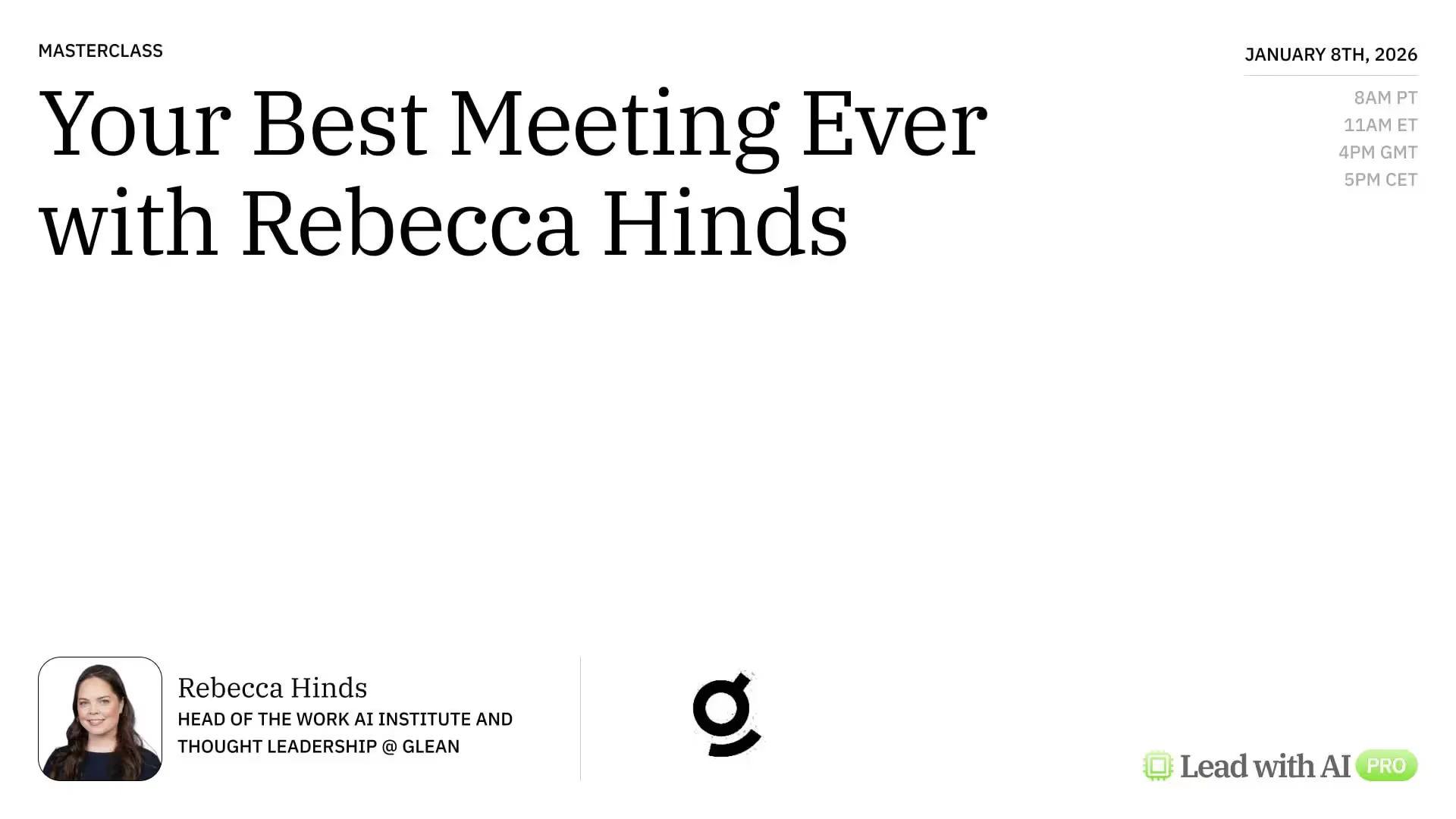
Exclusive for PRO Members: Your Best Meeting Ever With Rebecca Hinds

Rebecca Hinds, Ph.D., one of the leading experts on organizational behavior and the future of work, will lead our next Masterclass on How to Have Your Best Meeting Ever.

If you’ve been wondering:

  • What roles should AI actually play in meetings?
  • Where does AI help, and where does it cross the line into harmful?
  • How can AI improve meeting design instead of making bad meetings worse?
  • How do you introduce AI into meetings without sparking resistance?
  • When (and whether) to send your digital twin to a meeting, and what the research shows about when that backfires?

This Masterclass is for you.

The session takes place on January, 8 at 8 AM PT/11 AM ET/4 PM GMT/5 PM CET.

Want to reach 30,000+ business leaders applying AI in their work, teams, and organizations?​
Advertise with us​​.