
January 29, 2026

The Questions That Actually Matter

If AI isn’t saving your team time this week, why are you funding it at all?
Henrik Järleskog
By
Henrik Järleskog
Co-founder & Managing Director, Europe

Presented by

I have spent the last month in front of rooms I would not have access to five years ago.

Conference stages. Executive briefings. Board sessions. The audiences vary, including technology, logistics, manufacturing, and financial services, but the questions do not.

These are not the questions you see in vendor decks or industry reports. These are the questions leaders ask when the slide deck ends and the room empties. The ones that reveal what is actually happening inside organizations right now.

What strikes me is not the questions themselves. It is the pattern underneath them.

Leaders are no longer asking whether AI matters. They are asking how to make it work when their people are overwhelmed, their budgets are fixed, and their boards want proof by quarter-end.

So here is what I have been hearing. And what we have been saying back.

Let’s dive in!

​Henrik​

PS: We have the very last ticket left for Cohort 2 of AI Leader Advanced.

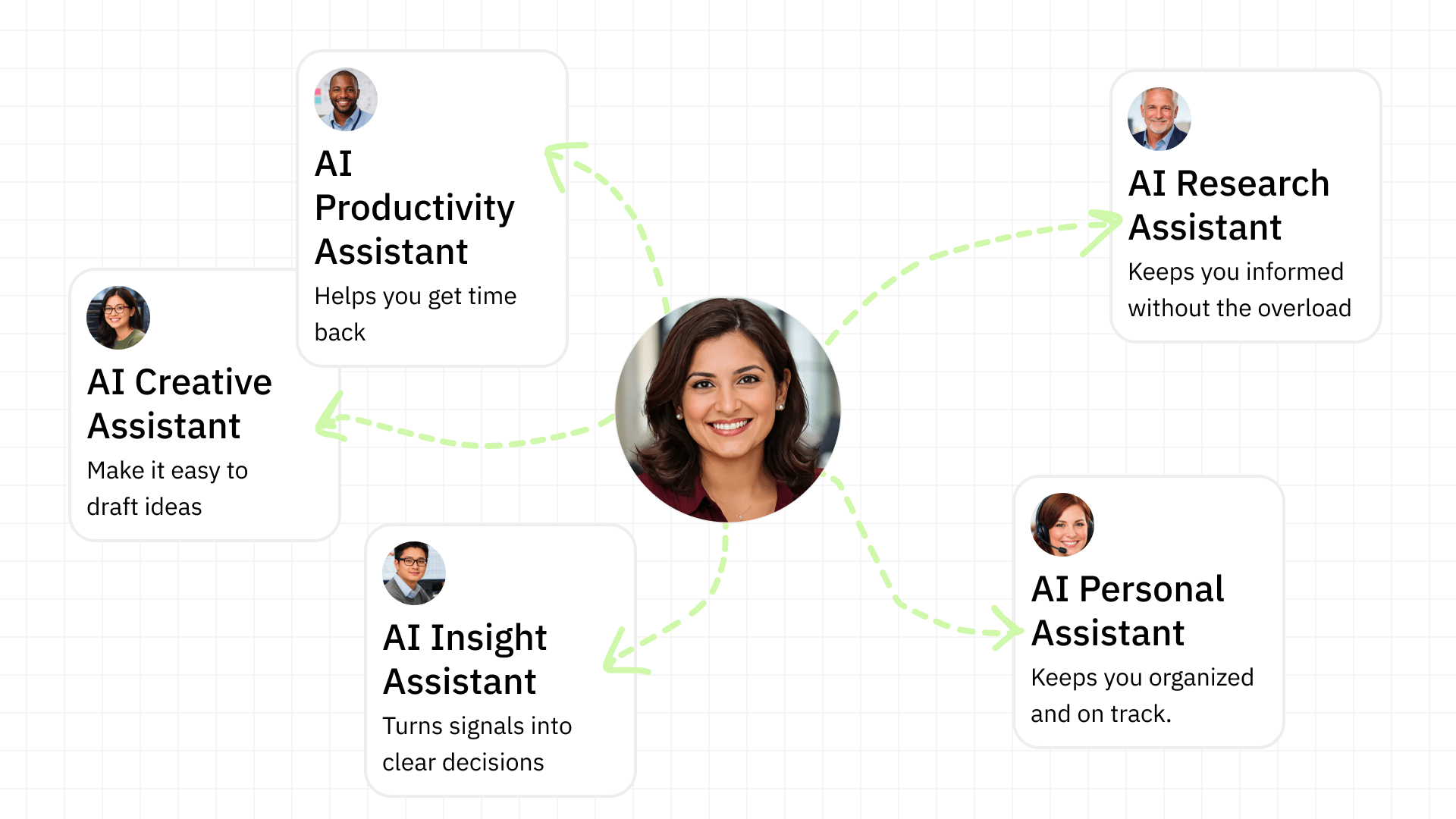
Will you join your non-technical peers from Harvard, Google, PepsiCo, and more to implement five AI assistants in under 10 hours over two weeks?

​Apply now​, and I'll see you on February 6!

Flagship AI Newsletter
The AI Newsletter That Makes You Smarter, Not Busier
Join over 30,000 leaders and receive our insights on AI platforms, implementations, and organizational change management.
FlexOS Course - AI Content Accelerator - Testimonial Badge

"How do we know if AI has earned the right to be taken seriously yet?"

The answer is not about the technology. It is about the pressure you are under.

Teams across every industry are being asked to deliver higher expectations with the same or fewer resources.

AI becomes serious the moment it ​gives people time back​ and reduces cognitive load. The ROI is not a platform in your stack. The ROI is fewer micro-decisions, clearer priorities, better follow-through, and less firefighting.

When people feel it in their day, it earns the right to stay. Before that, it is just another tool nobody opens.

"Where is AI already showing up in our organization, even if we do not call it AI?"

It is showing up anywhere someone gets a recommendation, a prediction, or a prioritized list instead of starting from scratch.

But the bigger shift is not in your systems. It is in your workforce.

People are already using AI informally to write, plan, summarize, and prepare. They are ​doing it on personal accounts, using free tools, and not telling anyone​.

The organizations that win are the ones that make this safe, consistent, and measurable, helping everyone to reach ​Level 1 AI Fluency​.

The ones that lose are the ones pretending it is not happening.

The quiet AI revolution is not in your enterprise software. It is in the behavior change already underway.

(Aritcle continue after this break)

🚨 LAST TICKET: BUILD 5 AI ASSISTANTS IN TWO WEEKS FOR NON-TECHNICAL LEADERS

Never before have we sold out so quickly as for the February 6 cohort of the new flagship ​AI Leader Advanced​ program.

If you want to:

  • Deploy 5+ AI assistants in 2 weeks (built for your real workflows)
  • Get a personalized plan that adapts to your role, goals, and industry
  • Study alongside a curated group of global senior leaders from companies including PepsiCo, Harvard, Google, and more

Then now is the time.

In just 2 weeks, you’ll design, build, and deploy at least five AI assistants tailored to your role, workflows, and industry.

No code. No theory overload.

Want to reach 30,000+ business leaders applying AI in their work, teams, and organizations?​
Advertise with us​​.

"What jobs are most likely to change over the next two to three years?"

The jobs that change first are the ones with coordination, communication, and administrative overhead wrapped around them. The frontline work remains human.

What changes is the layer on top: writing updates, preparing reports, chasing follow-ups, documenting work, searching for information.

Those tasks get lighter. So the role becomes more human, not less. More presence. More judgment. More quality focus. More coaching. The risk is not replacement. The risk is that we do not ​reskill people​ fast enough to take advantage of the leverage, now popularized as the '​capability overhang​.'

If you are ​a manager​ today, your job in 2027 looks less like administration and more like leadership. That is not a threat. That is an upgrade. But only if we prepare people for it.

"How do we avoid the 'solution looking for a problem' trap?"

You avoid it by starting with pain, not technology.

The fastest way to create skepticism is to start with a platform and then hunt for a use case. People can smell that instantly.

The opposite is when you start with work that drains teams, slows response times, creates rework, or burns out leaders. When AI is embedded into a real workflow and paired with training, it stops being hype and becomes relief.

​Adoption is emotional​. People adopt what makes their week better. They ignore what feels like another initiative.

"What does it take to scale from pilot to enterprise?"

Scaling is 80% people and the operating rhythm. You need three things: capability, clarity, and consistency.

Capability means training people to use AI safely and effectively. Not a one-hour webinar. Real enablement. Clarity means knowing ​which workflows matter and what good looks like​.

Not everything. Just the work that moves the business. Consistency means making it part of the cadence: weekly briefs, standard templates, common practices.

Governance matters. But the most common failure is that people were never actually enabled, so the pilot never becomes a habit. If it does not become a habit, it does not scale.

"How do we articulate value to the CFO?"

Do not promise transformation on day one. Sell it as a measured upgrade in leadership capacity and operational consistency.

CFOs fund what they can measure. So define a baseline, a target, and a timebox. Then use a metric they immediately understand: impact per hour.

If a team recovers even two hours per person per week, that is real capacity you can redeploy into service quality, risk reduction, or growth.

Make it a controlled experiment, not a leap of faith. Pilots earn a budget. Proof earns scale.

"What topic is the industry not ready for yet?"

The human side of ​the co-pilot economy​.

We are not ready for what it means when some people become dramatically more effective because they know how to work with AI, and others do not. That gap will show up as performance inequality inside organizations. The uncomfortable topic is not the technology. It is the capability distribution.

If we do not build fluency broadly, we create a two-tier workforce: the AI-fluent and the AI-left-behind. That is not a future scenario. That is happening now.

What This Tells Us

After a month of these conversations, the pattern is clear.

Leaders are not confused about whether AI is real. They are uncertain about how to move from awareness to adoption without creating chaos.

The organizations that will be ahead six months from now will not be the ones with the most pilots. They will have the most people who are fluent.

Because fluency is what turns tools into habits. And habits are what turn experiments into outcomes.

The questions are getting better.

That means the thinking is getting sharper. And that is exactly where enterprise AI needs to go next.

More soon,

Want to reach 30,000+ business leaders applying AI in their work, teams, and organizations?​
Advertise with us​​.