
May 22, 2025

Why the Best AI Strategy Starts with a Thousand Experiments (+How)

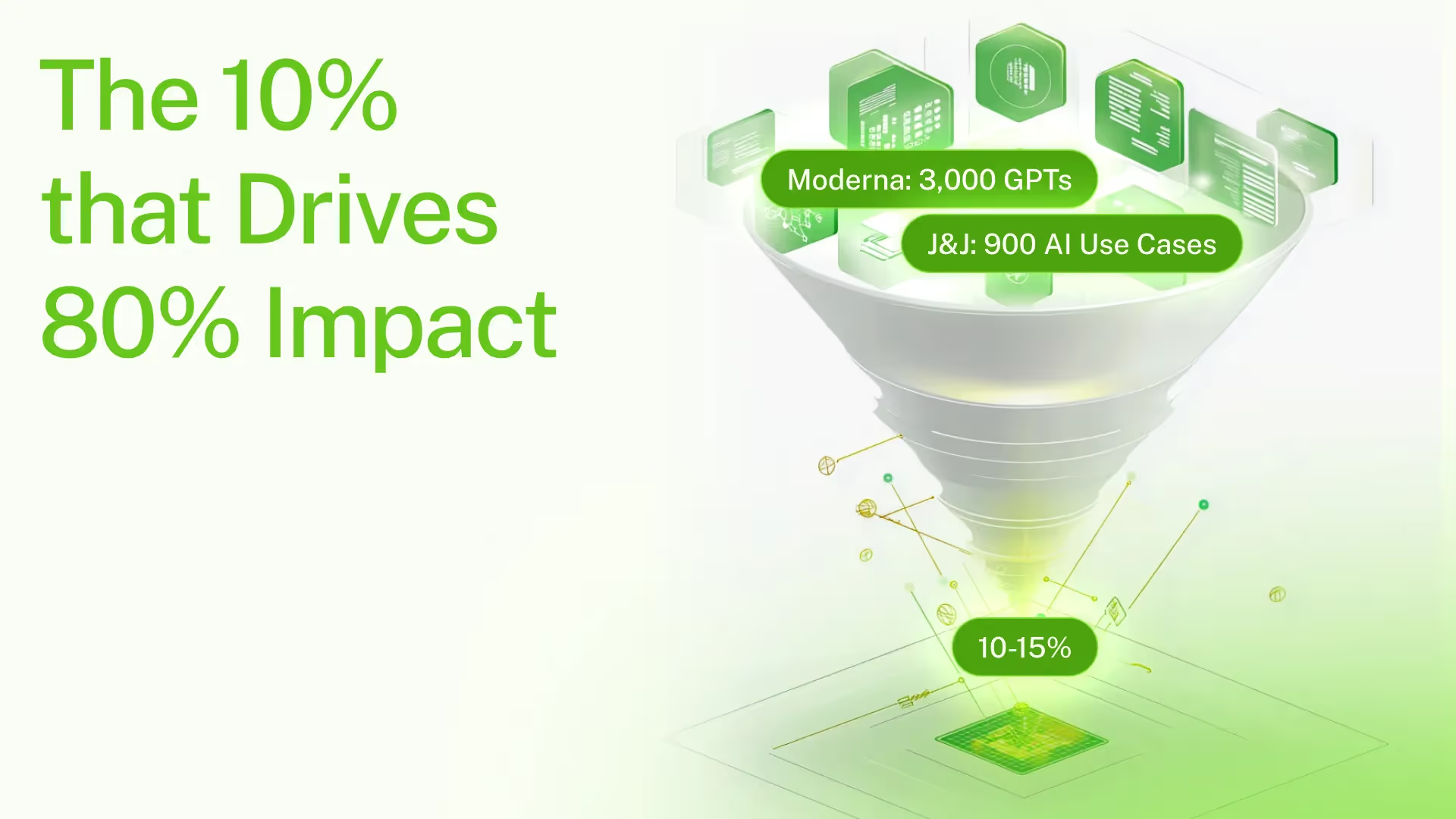
Moderna built 3,000 GPTs. J&J tested 900 use cases. Only a fraction delivered impact, and that’s the point. Here’s how pioneers let AI chaos bloom before scaling success.
Daan van Rossum
By
Daan van Rossum
Founder & CEO, Lead with AI

Presented by

Let a Thousand AI Projects Bloom—Then Pick the Best

One of the results that stood out from last week’s ​Moderna HR & IT integration story​ was the creation of their 3,000+ GPTs.

This is quite a jump from the 750 AI assistants we heard about in ​last year’s Moderna case study​, which familiarized us with the pharma giant’s AI ambitions and is now a permanent case study for ​AI implementation​ in our ​Lead with AI Executive Bootcamp​.

Central to Moderna’s approach is not to build big AI applications top-down but rather to let individual employees and teams discover where AI makes most sense for them.

(👉 If you’re interested, I’m happy to share our “AI Change Management” lesson from the course that includes my view on Moderna’s approach – just reply and I’ll send it to you.)

This approach, one of my “7 AI Mega-Shifts,” focuses on front-line workers who know their work best and are ideally positioned to identify the most significant opportunities for AI.

Transforming every employee into a “SuperWorker” and letting them build a team of AIs to support them where they need the most help is an ​AI change management​ best practice that is finally being adopted.

J&Js “Thousand Flowers”

While preparing for our “​AI Beyond the Surface​” event, Sodexo’s Head of Future of Work, ​Henrik Jarleskog​, shared ​another case study​ along the same lines.

It’s the case study of Johnson & Johnson, which ​made headlines​ recently when it stopped company-wide AI experimentation and focused its efforts on the most valuable projects.

Saliently, this ‘focusing’ happened after the company let employees experiment widely, resulting in 900 individual use cases.

After studying results, the company found that “many that were redundant or simply didn’t work” and that “only 10% to 15% of use cases were driving about 80% of the value.”

Some leaders (not yourself, of course) may walk away from reading this article thinking, “Experimenting with AI doesn’t work; just look at J&J.” But that would be the wrong lesson. J&J was able to hone in on the top few AI projects because it experimented.

No beautiful bouquet without first letting those “thousands of flowers bloom.”

The lesson here is that you should first familiarize yourself with AI, then experiment by building a custom AI team that fits your particular workflows, and then build assistants, automation, and agents that can support teams, departments, and entire companies.

Leaving as much as possible to those doing the work remains crucial.

One very clever move J&J made in its recent pivot was, for example, dismantling a centralized “AI governance board " and letting corporate functions, including commercial, supply chain, and research, decide which initiatives should be prioritized.

Flagship AI Newsletter
The AI Newsletter That Makes You Smarter, Not Busier
Join over 30,000 leaders and receive our insights on AI platforms, implementations, and organizational change management.
FlexOS Course - AI Content Accelerator - Testimonial Badge

A New Operating Rhythm

I’ve spoken at length about the need (and the way!) to transform ourselves into AI leaders.

I personally experience this journey every day. And yes, with the fast advances in AI and the avalanche of new tools and features we experience daily, it’s a dizzying one.

But no matter how overwhelming, it’s still a journey we must take. The future is one where AI is simply the way we work.

In a ​recent article​, Henrik describes his personal experience with a corporate process that’s “valuable but inefficient.” Such processes will not exist in the future. Instead, we’ll direct our AI teams to the task and spend our time on “collaborative refinement, communication, organizational alignment, and prioritization decisions.”

This is a true game-changer, because “the most meaningful outcomes emerged not from the final deliverables but from the collaborative conversations they facilitated.”

Henrik adds how tapping AI in this manner will create a ‘new operating rhythm”:

  1. Broad Accessibility – Universal access to language models paired with permission to experiment, with curiosity actively encouraged
  2. Individual Augmentation – Employees constructing personalized AI teams comprising multiple specialized agents working in concert
  3. Pattern Identification – Leadership observing which applications consistently generate measurable improvement
  4. Organizational Scaling – Systematic expansion of the most effective solutions (those critical 10–15%) through platform development and codified practices
  5. Compressed Timeframes – Fundamental acceleration of strategic cycles, planning processes, and reporting mechanisms, shifting organizational focus from coordination to impact

The company of the future, where we will ​worry less about where work happens​ and more about how, will look very different from what we know today.

And it often just takes one individual to start creating the momentum toward this future.

Are you the one?

Want to reach 30,000+ business leaders applying AI in their work, teams, and organizations?​
Advertise with us​​.

Want to reach 30,000+ business leaders applying AI in their work, teams, and organizations?​
Advertise with us​​.