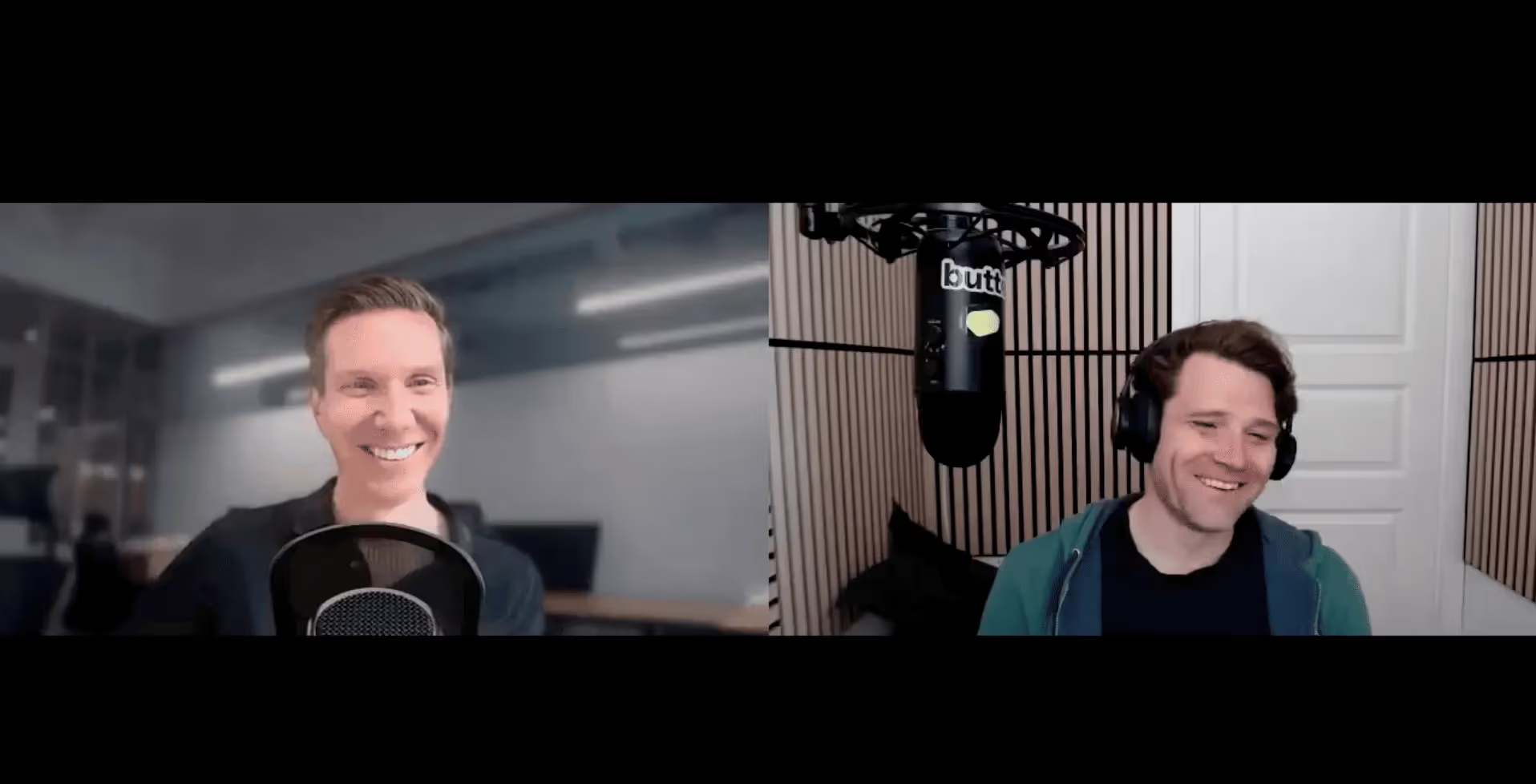
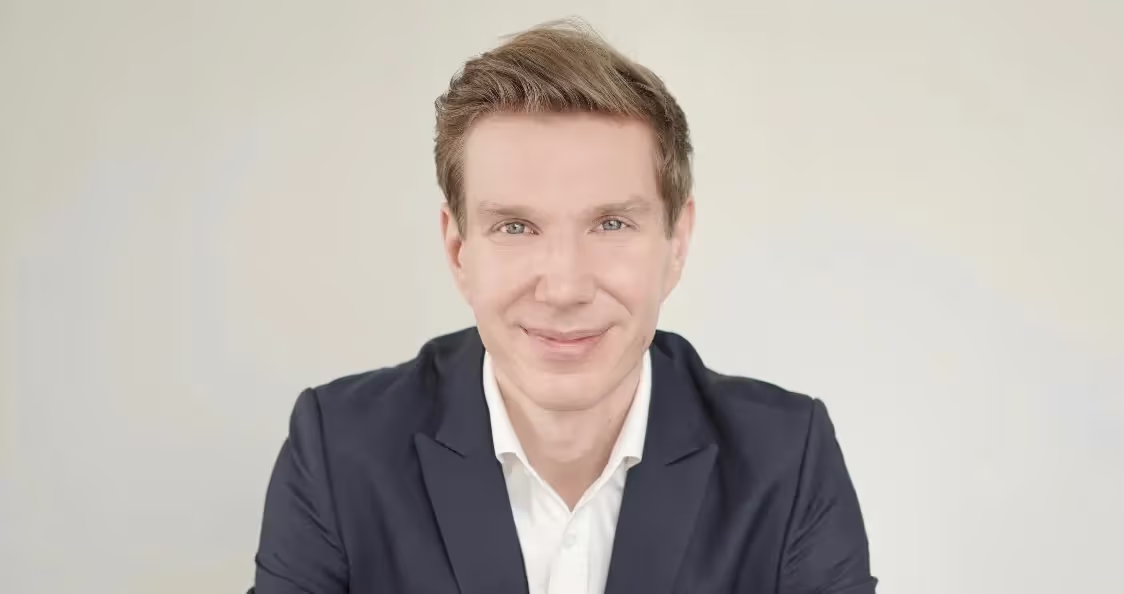

Based on the April 16, 2026 Lead with AI PRO live session with Jakob Knutzen, Solutions GM, Workshops at Miro. (Full recording here.)
Miro GM Jakob Knutzen went from running three standing meetings a week at a 10-person startup to three standing meetings a day at one of the world's largest collaboration platforms.
His solution: spend Sunday afternoons deleting meetings from his calendar for the week ahead, and use AI at every stage of whatever's left.
His before, during, and after framework for AI in meetings hasn't changed since he first articulated it two years ago; what's changed is how concrete the applications have become.
It's a model worth studying for anyone thinking seriously about AI in the workplace and the kind of systematic habit that separates performative AI use from genuine AI fluency; the difference between knowing what tools exist and building them into how work actually gets done.
Should this meeting even exist?
The first and most important use of AI in meetings happens before anyone opens a calendar invite. Knutzen uses Claude to pressure-test whether a meeting is even necessary.
"I very often discuss with especially Claude: I have this problem, I'm trying to solve it. Should I have a meeting about it? Yes, no? And if I should have a meeting about it, what should the outcome of that meeting be? And based on that outcome, how could I structure the agenda?"
This is especially important when more than two or three people are involved. "If you pull that many people into a meeting, you better know what it is you're doing with that time," Knutzen explained.
For him, the AI acts as a sounding board that forces clarity on purpose and outcome before the meeting even gets scheduled.
The second pre-meeting habit is creating pre-reads. Knutzen sends a short Slack summary of what the meeting will cover, then a longer AI-assisted memo for people who want to dig deeper.
The principle is blunt: "Making sure everyone's on the same page. Man, it still happens in at least 50%, if not 70% of the meetings that I'm in," where half the session is spent presenting context that could have been shared in advance.
He is deliberate about sending pre-reads where people already are. At Miro, that means Slack. "Communicate where people are. Don't try to send people somewhere else where they're not, if you want them to read stuff."
Why AI note-takers are killing your meetings
Knutzen's strongest opinion about AI in meetings is about what not to do: don't bring in visible AI note-takers.
"You really fuck up the psychological safety and the whole dynamics of the meeting by having it so much in your face."
He described the experience of customer calls at Miro where Gong's AI note-taker joins as a visible participant. "It always starts the meeting with this AI voice saying, 'this meeting will be recorded for coaching purposes.' Firstly, you know it's bullshit, because it's not coaching purposes, what does that even mean? And secondly, it just disrupts the flow of the meeting from the get-go."
The beginning of a meeting, Knutzen argued, is critical for establishing rapport and psychological safety. The note-taker takes up a full tile in a five- or six-person meeting, then interjects its robotic announcement at a random moment within the first minute.
"You can't even wait to start the meeting until it interjects this robotic voice. I have very strong opinions about this. I think it really fucks up conversations from the beginning."
His recommendation: record and transcribe meetings, but do it in the background.
He uses Granola extensively because it captures audio from the device without joining as a visible participant. "There's something about having it just recording, or not even recording, transcribing, because it's really the transcriptions you need, transcribing in the background; that's just incredibly helpful."
Why meeting transcripts are the single most powerful AI tool
Knutzen considers transcripts the most important development AI has brought to meetings. Not summaries, not action items; raw transcripts.
"Transcriptions is probably the most powerful meeting tool. Being able to take a transcription afterwards and both query it, or use it in connection with your own write-ups; that's very powerful."
He walked through a concrete example. Earlier that week, Miro's entire leadership team had met to discuss the launch of Miro Engage, a new product. The session produced a flood of comments, questions, and competing directions from senior leaders.
After the meeting, Knutzen took the transcript and loaded it into Claude (Opus 4.6 with extended thinking) alongside his existing strategy document and the slide deck from the session.
He then wrote his own strategy document first and used AI to refine it against the transcript. "It would say, 'Hey, Jakob, actually, this question that Andre asked at that point, you haven't actually caught that or answered that in your document, so maybe you should add these things.'"
The result wasn't AI writing a document for him. It was AI ensuring nothing fell through the cracks. "It's not just about hours. The document I can write based on this is so much better."
He then used AI again to transform the full memo into a short, digestible Slack message with clear next steps, linking back to the complete document. The same logic applies to AI for email; context-rich, output-first prompting beats asking AI to just write a message.
"Because the Slack message drove enough curiosity, then they jumped into the memo and they started commenting on the memo."
The pipeline, from transcript to strategy doc to Slack message, is one he now uses repeatedly.
For the transcript source, Knutzen pulls from Google Meet's built-in Gemini transcription because it has better speaker identification than Granola, since participants are logged in. He then drops the transcript directly into Claude.
"The fact that you know exactly what context it has when you just drop it directly into Claude is very helpful when you're processing something that you want in isolation."
How transcripts fight confirmation bias
One of the session's most striking insights came from a question about whether AI helps leaders notice things they'd naturally miss. Knutzen's answer reframed the question entirely.
"I don't think AI is the thing that helps me miss the things that I would naturally miss. I think it's people that help me do that, and AI catches the fact that people do that."
In other words, the valuable observations are already in the room; they're spoken by other participants. The AI's role is to capture them faithfully so they don't get lost to distraction or selective memory.
"A one-hour conversation with a lot of people in there; there's just so much there. It's such a dense piece of data. Having the transcript from that helps me."
He added:
"I would have missed a lot of things in that meeting that were said, or would just not recall them, maybe also because of my personal propensity towards remembering some things, or wanting to remember some things, versus others. AI will not let me forget that."
One participant, Lisa Cotton, put it precisely: using transcripts this way helps leaders avoid confirmation bias. "We see what we're looking for. And we sometimes miss the things that we're not looking for."
The facilitation fundamentals that AI can't replace
Before discussing AI tools for facilitation, Knutzen grounded the conversation in the principles that make any session work, whether online or in-person.
Energy management is his top priority.
"Be extremely mindful about energy management throughout the entire session. Starting on a high is critical, because then it's just very hard to climb back up when energy levels drop."
He pointed to the session itself as an example: the casual chatting as people joined created warmth before the formal discussion began. The alternative, cameras off and silence before a stiff introduction, is what he called "just shit."
State change is the facilitation concept Knutzen is most passionate about.
The idea, which he attributed to someone connected to Seth Godin's altMBA, is that a meeting should be broken into distinct time units, each using a different mode of engagement.
"The opposite of state change is staying in a PowerPoint deck for 60 minutes, just one person talking. That is just doing one thing for a very long time."
Instead, he suggested thinking in five-minute increments: a short presentation, then individual reflection, then a poll, then breakout rooms, then group discussion.
"Anything that changes the state of how the session is at any given time; that's an incredibly important way to keep energy up, because otherwise it will just slowly decline."
He was honest that AI tools don't handle state change well during live sessions. "You want to be in control as a facilitator."
Where AI can assist during a meeting is as a co-facilitator: monitoring chat, surfacing audience questions, helping participants with technical issues, and feeding important context to the human facilitator in real time.
Feeling the room, Knutzen acknowledged, remains far harder online.
In a physical workshop, "you know that that person down there in the back is nodding off." Online, that signal is largely invisible, which is why pre-session one-on-ones with key stakeholders become essential for understanding tensions or dynamics before the group convenes.
Using AI transcripts in recruiting (without losing the human)
Knutzen has applied the same transcript-first approach to recruiting, and his experience surfaced both the power and the ethical boundaries of AI in hiring.
For screening, the numbers forced his hand. A remote content lead position at Miro drew 2,000 applicants.
"There's no way that a human can fairly process 2,000 applications. And the issue is that it's gotten so freaking easy to write a cover letter and apply that you get so much AI slop applications. There's no other way that you can fight AI than with AI when it comes to this stuff."
He used AI to filter on three concrete prerequisites (native English, professional services experience, EMEA time zone) rather than making subjective judgments at scale. The deeper evaluation came further down the funnel.
For interviews, Knutzen uses Granola to transcribe every conversation and takes his own notes alongside the transcription.
Crucially, he does his own assessment first, then feeds the transcripts, his notes, and the job description into Claude to stack-rank candidates and identify gaps.
"There you really also saw: hey, there's some confirmation bias. I really like this person, but actually they didn't really answer these different questions."
The most revealing use was comparing candidates against a structured case interview, where everyone completed the same exercise. That produced apples-to-apples transcript data that AI could evaluate more objectively than memory-based recall.
But the discussion also surfaced strong convictions about where AI should not go.
One attendee shared a story about a candidate who discovered he'd be interviewed by an AI agent and sent his own AI avatar instead, making the point: "If you can't be invested enough in me to give me a face-to-face interview, then why should I be invested in you?"
Knutzen agreed emphatically. "People are in a vulnerable position here. At least show them the respect of showing up."
He compared it to the social dynamics of Calendly links: technically efficient, but sending one to someone you're asking a favor of communicates "you're not worth my time to look into my calendar."
The same applies to AI interviews. Efficiency without empathy erodes trust.
Key takeaways
- Use AI before scheduling any meeting with more than two or three people to clarify the outcome, agenda, and whether the meeting should happen at all.
- Send pre-reads where people already are (Slack, Teams) rather than asking them to check a separate document.
- Transcribe in the background using tools like Granola rather than intrusive, visible AI note-takers that damage psychological safety.
- Write your own document first, then use AI with the transcript to refine, fill gaps, and reformat for different audiences (full memo, Slack summary, next steps).
- Break sessions into five-minute blocks using state changes (polls, breakouts, reflection, discussion) to maintain energy and engagement throughout.
Leaders looking to build these habits systematically may want to explore a structured AI leadership program that goes beyond individual tools.
Jakob Knutzen is Solutions GM, Workshops at Miro, and co-founder and former CEO of Butter, the online workshop platform acquired by Miro in 2025. This article is based on his live session hosted by Lead with AI PRO.