
McKinsey: How the AI Reckoning Changes Strategy

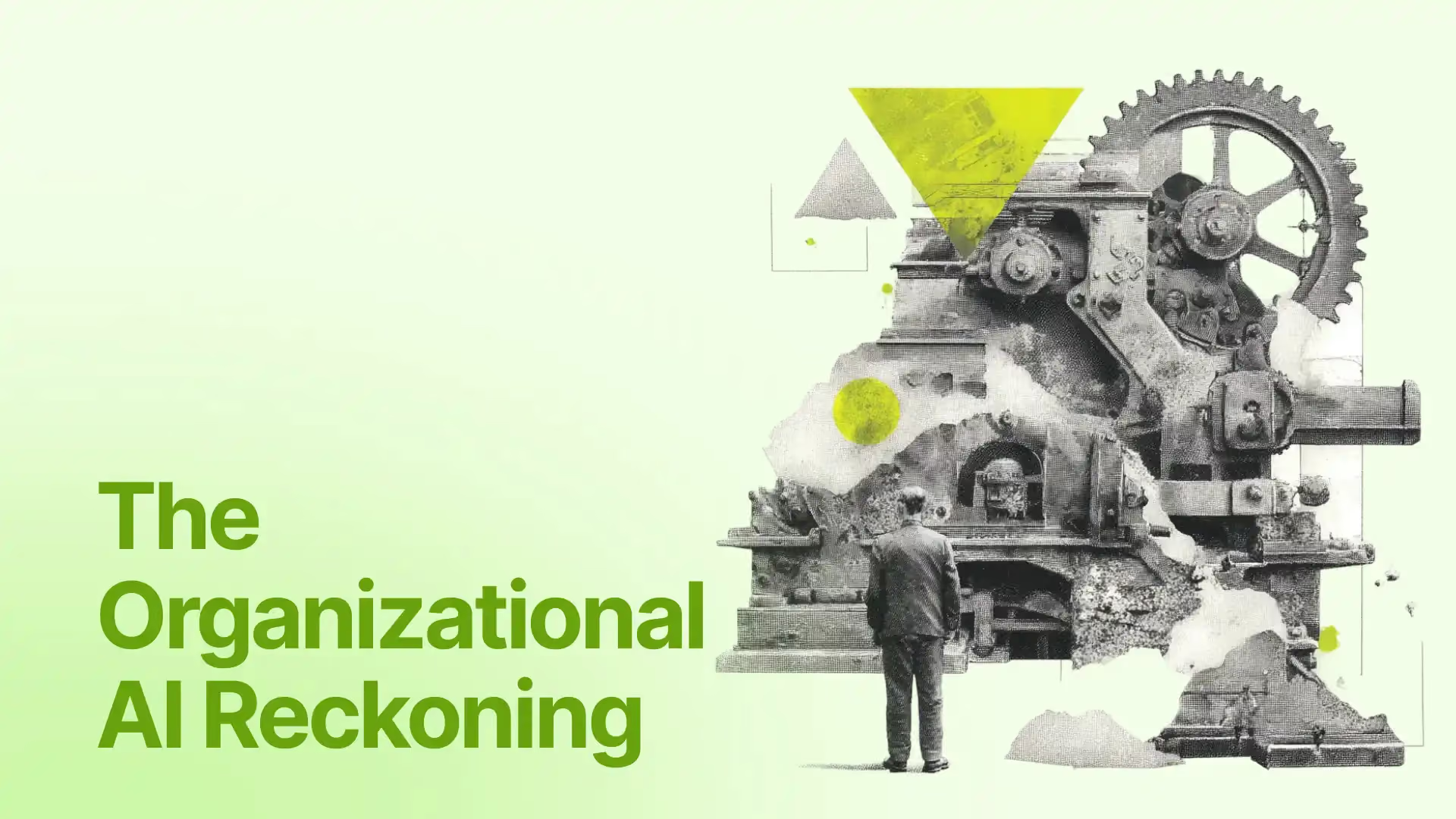
I read this new McKinsey research on how boards are confronting AI, and it may be relevant to you. It describes something bigger than a technology curve or a platform race. It is a moment of organizational reckoning. A point where strategy, leadership, and capability all get tested at once.
The headline numbers are startling. 88% of companies use AI somewhere, yet only 39% of Fortune 100 boards have any formal AI oversight, and 66% of directors report limited or no understanding of AI at all. Meanwhile, companies with AI-savvy boards outperform peers by 10.9 percentage points in return on equity, while those without fall 3.8% below their industry average.
This is the readiness gap that defines the moment.AI is not waiting for organizations to catch up. It is reorganizing work beneath them.
Here are the forces that explain why leadership is now the real bottleneck.
1. Strategy Fractures Without a Clear AI Posture
McKinsey introduces a concept I wish more leadership teams used. Every organization has an AI posture. Most simply have not named it. And without naming it, they drift from pilot to pilot with no strategic center.
Two dimensions shape that posture.
- Source of value. Will AI help the company move beyond its core model into new products, experiences, and revenue streams, or will its impact come primarily from optimizing the existing business.
- Degree of adoption. Will AI be embedded holistically across the enterprise or applied in selective, high ROI use cases?
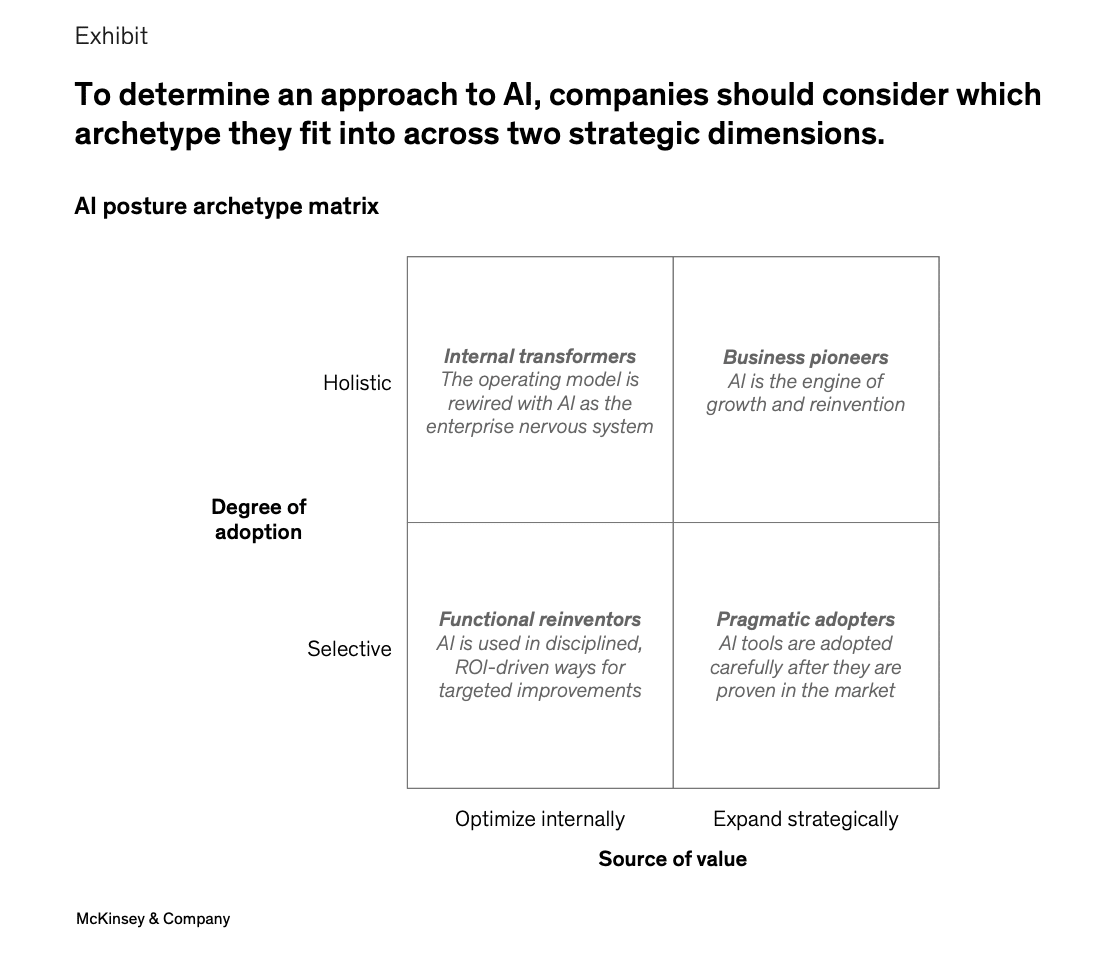
The research outlines four archetypes that sit at the heart of the AI reckoning.
- Business pioneers use AI to create new markets and new models. Think diagnostic AI platforms replacing hardware sales. Boards here must understand data moats, regulatory exposure, and whether leadership can run an AI-driven business.
- Internal transformers rebuild the operating model. AI becomes the nervous system for planning, supply chain, maintenance, and customer operations. Boards must verify that gains are structural. They ask whether systems are observable, interoperable, and resilient.
- Functional reinventors modernize targeted workflows with a focus on ROI. Scheduling. Transcription. Forecasting. Logistics. Their risk is fragmentation. Pilots multiply without scaling. Boards push for consolidated maps and disciplined execution.
- Pragmatic adopters wait for evidence, then move fast. Their danger is falling behind. Boards scan adjacent industries to anticipate when the organization needs to pivot before competitive erosion starts.
A company cannot govern AI well until it decides who it is in this model.
2. AI Is Rewiring the Operating Model Faster Than Companies Expect
Once posture becomes clear, a second realization hits. AI does not settle neatly into existing structures. It changes them.
Most companies still layer AI onto old workflows and then wonder why productivity stalls. It is the same pattern seen in the Stanford x CMU agent workflow study, where full automation slowed teams by 17.7%, while targeted augmentation increased performance by 24.3%. Technology accelerates only when workflows do.
McKinsey’s interviews with directors reveal the same dynamics across enterprises. Internal transformers cannot scale until architecture matures. Functional reinventors cannot deliver value without governance. Pragmatic adopters cannot pivot without a real-time view of market moves.
AI forces leadership teams to ask unfamiliar questions.
- Are decisions traceable?
- Are processes interoperable?
- Is risk visible?
- Can managers orchestrate people–agent workflows?
- Are we building systems for scale or systems for noise?
Beneath every workflow is a capability stack. AI exposes whether that stack is modern or brittle. Many organizations are discovering weaknesses they did not know were there.
3. Governance Becomes the New Competitive Advantage
McKinsey finds that fewer than 25% of companies have board-approved AI governance policies, and only 15% of boards receive metrics like ROI, override rates, explainability indicators, or reskilling progress.
This is the striking part.AI governance is becoming as important as capital allocation.
Strong governance clarifies:
- Which pilots scale
- When humans must review outputs
- How vendors are evaluated
- Which risks escalate to the board
- How AI ties to business value
And the biggest shift is this.Boards must become AI fluent.Not technical. Fluent. Enough to challenge assumptions. Enough to understand capability, risk, and competitive dynamics. Enough to partner with management at the right altitude.
“Director education should become an ongoing dialogue with internal and external experts, and boards must ensure they have AI-literate voices at the table.” — Abel Sanchez, Research Scientist at MIT
The next era of leadership is not about who understands models. It is about who understands how AI changes the business.
The Bottom Line: How Organizations Become AI Ready
Across every transformation we support, the same behaviors separate companies that accelerate from those that stall.
- Learn Out Loud: Leaders model learning so teams adopt confidently instead of fearfully.
- Name Your AI Posture: It creates alignment and eliminates noise across the entire organization.
- Build Role-Based Learning Journeys: Training becomes targeted, measurable, and tied to real workflows.
- Use Simple Governance for Use Cases: Clear scoring ensures teams focus on meaningful wins.
- Build a Distributed Network of AI Champions: Adoption spreads faster when ownership is shared.
If your organization wants to move from scattered experiments to real transformation, our Enterprise AI Enablement program is built for exactly this moment.
We help every employee learn to work confidently with your approved AI platforms through mobile-first, in-workflow lessons. Teams follow role-specific tracks so Sales, HR, Operations, Finance, and Marketing build fluency in the tools that matter most. Leaders get visibility, consistency, and a rollout plan that scales across the workforce. By the end, your organization leaves with an AI-fluent team and working assistants already embedded into daily work.



.avif)