
Published Date:
August 28, 2025

Why 95% of AI Implementation Fails, and What to Do Instead

Discover why 95% of enterprise AI projects fail, key pitfalls derailing success, and strategies leaders can adopt for measurable, scalable AI impact.
Daan van Rossum
By
Daan van Rossum
Founder & CEO, FlexOS

Earlier today, when I delivered a workshop on “What’s Best, and What’s Next for AI” to over 50 senior leaders from Nordic companies, the topic of ​AI implementation​ came up.

How is it that company-wide AI transformation is so hard to pull off?

A report from MIT’s Media Lab NANDA initiative, titled The GenAI Divide: State of AI in Business 2025,” gives us a few valuable insights.

Data drawn from 300 publicly disclosed AI initiatives, 150 structured interviews with leaders, and a survey of 350 employees, the paper made headlines through its crucial finding that 95% of enterprise generative-AI pilots deliver no measurable ROI.

But this is not a story about how the technology is flawed. It’s one of the organizational and operational integration issues, like broken workflows, lack of feedback loops, and poor alignment with business needs.

MIT Paper: Why Most Projects Falter

So why do so many AI implementations fail? The paper found 5 key reasons:

1. The “Learning Gap”

Most deployments use generic tools like ChatGPT that don’t adapt or learn from context, so they don’t integrate into workflows or retain business- or role-specific knowledge.

Many of us expected AI to become smarter over time, but quickly learned that memory, if any, was very limited.

This is what the paper calls “the primary factor” that keeps organizations from winning with AI.

And this is in big part because ‘consumer AI’ is so stellar in its experience and quality of outputs that enterprise-sanctioned tools disappoint right away.

2. Build vs. Buy

Building internal AI solutions shows a much lower success rate (~33%), while purchasing from specialized vendors or partnerships succeeds ~67% of the time.

This is remarkable and highlights how the user experience is crucial in real AI impact.

While we have seen remarkable success stories of in-house tools, like in the case of ​McKinsey’s Lilli​, the truth is that while data privacy and security matters, not everyone can pull off a successful AI platform.

3. Budget Misalignment

Over 70% of generative AI budgets flow into sales and marketing tools, with low ROI. Higher-impact areas, like back-office automation, logistics, and fraud detection, are underfunded.
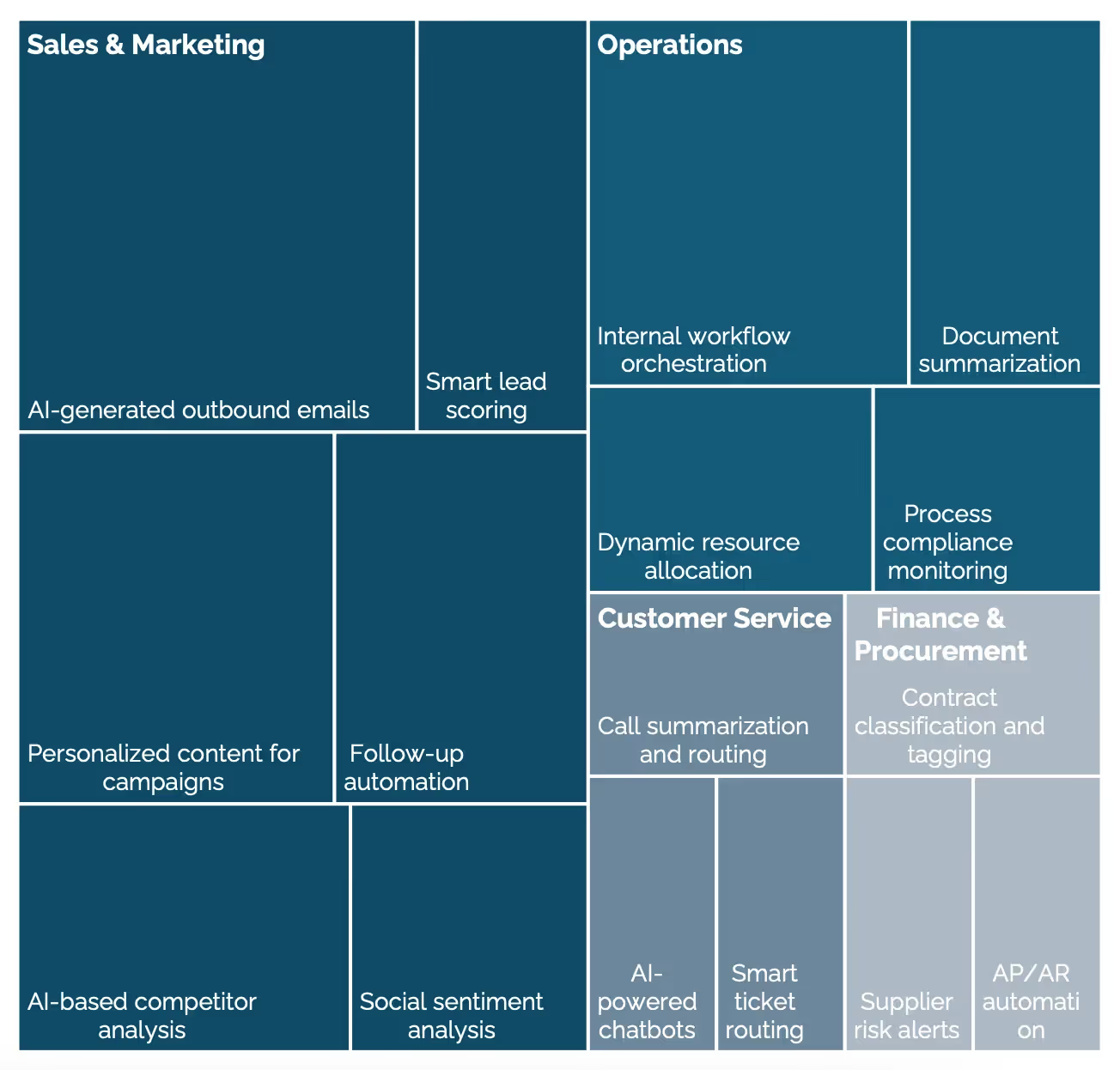
I know, it’s tempting to buy into shiny tools, but this is a good reminder that AI excels at rote tasks in unsexy workflows. Even though it’s not always easy to measure impact.

A VP of Procurement commented on the challenge of where to place AI bets: "If I buy a tool to help my team work faster, how do I quantify that impact? How do I justify it to my CEO when it won't directly move revenue or decrease measurable costs? I could argue it helps our scientists get their tools faster, but that's several degrees removed from bottom-line impact."


4. Shadow AI

Even when official adoption stalls, employees are using consumer AI tools informally, creating a “shadow AI economy” that bypasses governance but may actually be delivering productivity.

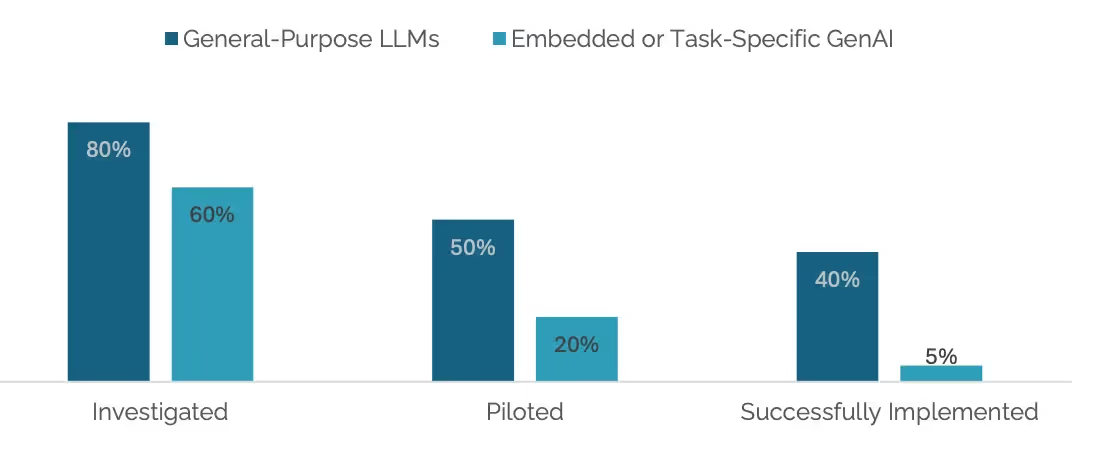
In fact, according to the paper, 90% of employees are using AI personally, but only 40% of firms have bought official licenses.

This is a tough one for companies to balance, as I shared with workshop attendees today.

While we can’t go about this transformation without any policy, being overly restrictive leads to people adopting their own tools.

And way worse than employees not using a company-approved AI tool is them emailing data between company and personal laptops, where they enter the very data the company is trying to protect into a free ChatGPT account.

5. Pilots Stuck in “Purgatory”

So now to that stat.

According to the researchers, most pilots don’t make it to production. According to the data in this survey, only about 5% scale with the rest remaining experimental, failing to make any real impact.

This is especially true for specialized AI tools built on top of the core LLMs like ChatGPT or Gemini. While companies are being pitched nonstop by vendors for tools that “will change everything,” the reality is that without user-backed adoption, positive impact will be limited.

A CIO quoted in the paper mentioned that “We've seen dozens of demos this year. Maybe one or two are genuinely useful. The rest are wrappers or science projects."

Notable Exceptions: Why the 5% Succeed

We could continue to focus on the 95%, but to reap the benefits of AI and continue to compete in a marketplace where more AI-centric companies challenge us for market share, a look at the successful 5% could be more helpful.

Success stories in the paper, frequently from nimble startups or focused teams, share these traits:

  • They focus on one well‑defined pain point, executed with precision and purpose. (We do this in our ​Executive AI Boot Camp​ from the very start.)
  • They partner with external specialists rather than build from scratch. Trying to do it all yourself can be counterproductive.
  • They empower line managers, not centralized AI labs, to pick and adapt tools to the workflow. I wrote about this in “​The AI Implementation Sandwich​.”
  • They deploy in structured, data‑rich domains like finance, logistics, and back-office functions where AI can plug into existing metrics.

In other words, success isn’t about building the flashiest AI; it’s about focusing on one pain point, executing relentlessly, and making AI invisible by embedding it where the work actually happens.

The Bottom Line: Driving Successful AI Adoption

Employees are quietly side‑stepping official AI platforms in favor of consumer AI tools that actually serve them.

No number of policies and mandates is going to change this.

If a personal ChatGPT account with all its unrestricted features turns me into a “Superworker,” I’d be hard-pressed to imagine tools like those don’t exist.

That friction between policy and practicality shows “shadow AI” is an unresolved alignment that will pester us for years to come, unless we get concrete on how to achieve AI success.

And that could start today.

Until next week,

- Daan

New Lead with AI Boot Camp in October:Lead the GPT-5 Era and Get Certified

The newly launched ChatGPT-5 will change the way leaders work with AI significantly, so upskilling has never been more important. Build the skills now and turn GPT-5 + Agents into measurable results.

Here’s your shortcut to confidently lead with AI, and be ready to lead the AI adoption in your organization:

  • Build 5+ custom AI assistants for your role
  • 4 live, hands-on coaching sessions (two time options)
  • 15 bite-sized lessons, fully updated for GPT-5 + Agent mode
  • Verified AI Certification to signal the skills you’ve earned

Enroll now and learn alongside global leaders. Only 40 seats per cohort so you get real one-on-one coaching and personalized solutions.

Enroll Now for the October 3 Cohort