
Presented by

Below are 200+ AI Statistics and Trends as of September 2026.
We will update this article frequently to ensure you have the most current insights and data available!
1. AI Adoption
- Organizational AI adoption jumped to 47% of U.S. employees in Q2 2026, up from 41% the prior quarter — the sharpest quarterly jump Gallup has recorded. (Gallup via Lead with AI, July 2026)
- Going from zero AI super users to one raised a team’s likelihood of a top-scoring outcome by 18 percentage points, across 1,271 teams studied during an internal hackathon; adding a second and third super user showed diminishing returns. (Atlassian Teamwork Lab via Lead with AI Executive Briefing, August 2026)
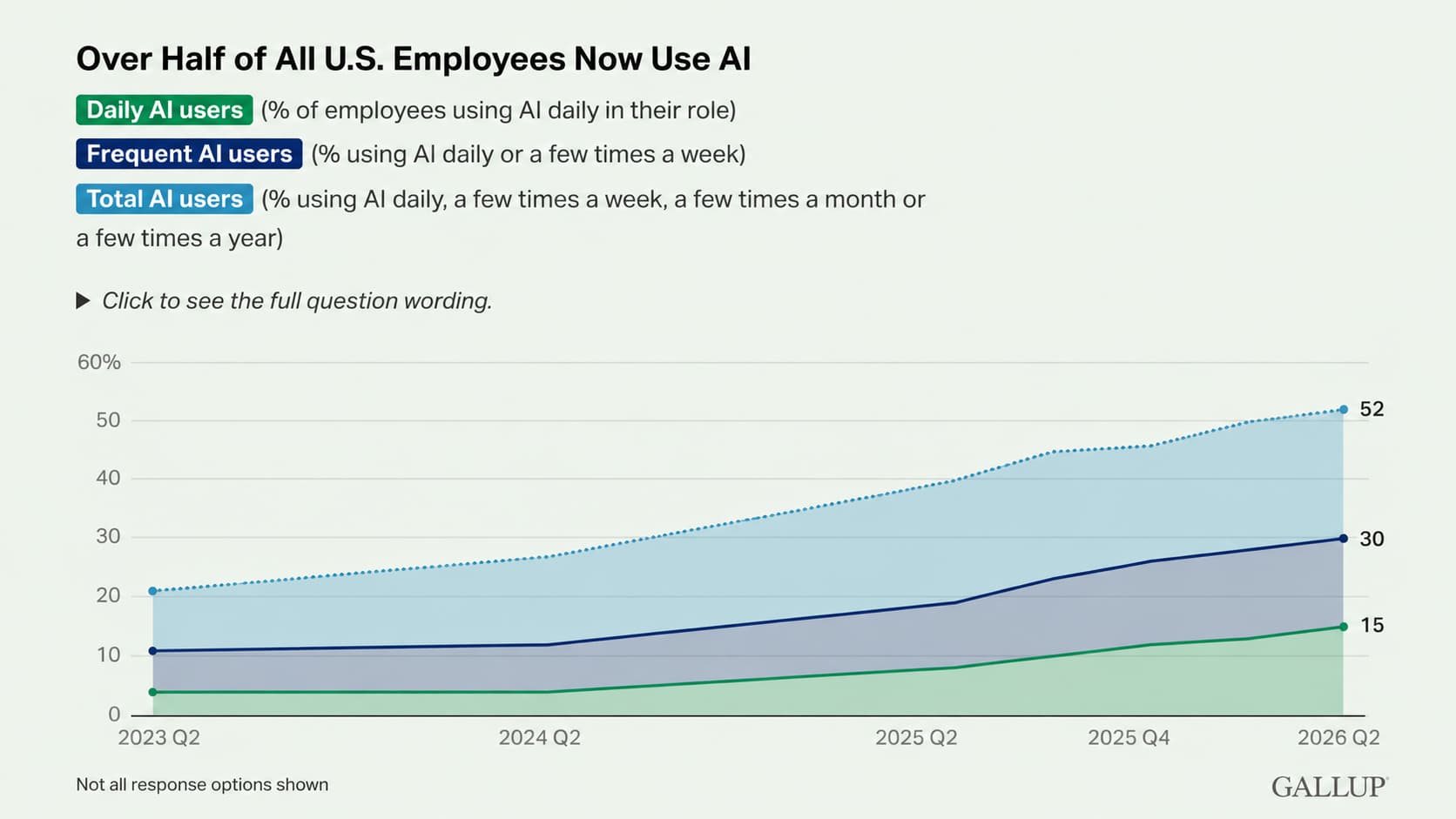
- 52% of U.S. employees now use AI at work, with 30% using it at least a few times a week and 15% every day. (Gallup via Lead with AI, July 2026)
- Output tokens across enterprise ChatGPT use rose roughly sevenfold in under a year, based on more than 17 million messages across 1,500 organizations, with firms still “actively learning how to integrate AI into organizational workflows.” (OpenAI, How Organizations Use AI via Lead with AI Executive Briefing, August 2026)
- Frontier firms (the top 10% of enterprises using ChatGPT) use plugins at 21% of weekly active users against 9% at typical companies, and skills at 19% against 3% — a more than sixfold gap on skills. (OpenAI, Signals from the Enterprise via Lead with AI Executive Briefing, August 2026)
- 43.5% of occupation-specific AI messages involve tasks that historically belonged to a different occupation, or 16.8% across all work-related messages, based on more than 800,000 messages from U.S. ChatGPT users whose occupation could be identified. (OpenAI, Work at the Frontier, July 2026)
- Work-related AI messages break down as 61.5% generic work such as email and scheduling, 21.8% tasks tied to the sender’s own occupation, and 16.8% tasks associated with another occupation entirely. (OpenAI, Work at the Frontier, July 2026)
- Cross-occupation work is now the majority of occupation-specific AI use in 5 of 8 functions: customer experience 77%, design 75%, HR 69%, legal 56%, and marketing 53%. (OpenAI, Work at the Frontier, July 2026)
- Designers borrow most: 35.2% of their messages involve another occupation’s work (sales 32.1%, HR and customer experience 30.4%), yet design tasks make up only 1.7% of messages sent by everyone else. (OpenAI, Work at the Frontier, July 2026)
- Engineering runs the other way: only 18.5% of engineering messages reach outside the field, but engineering tasks account for 7.4% of messages from other occupations. Marketing does both, with marketers spending 24.3% of messages on other occupations’ work while marketing tasks appear in 8.9% of everyone else’s — the highest share in the sample. (OpenAI, Work at the Frontier, July 2026)
- Smaller teams cross job boundaries more: cross-occupation use falls from 18.9% in workspaces of 2–5 seats to 16.3% in workspaces of 101 or more. (OpenAI, Work at the Frontier, July 2026)
- Among AI users, the most common uses are writing and editing (51%), search and research (49%), and general problem-solving (39%), mostly ask-and-answer tasks that help without changing how the work itself gets done. (Gallup via Lead with AI, July 2026)
- Citi built a network of 4,000+ AI Accelerators across 182,000 employees in 84 countries, reaching over 70% adoption of firm-approved AI tools. (Lead with AI, 2026)
- Frontier workers (95th percentile of adoption intensity) send 6x more messages than the median worker, rising to 17x for coding. (OpenAI, The State of Enterprise AI, 2025)
.jpg)
- 66% of adults across 21 countries have used an AI tool in the past 12 months, up 18 pp from 2024 and 28 pp from 2023. (Google/Ipsos, January 2026)
- Regular AI use now reaches 74% of frontline employees (up 23 percentage points from 2025), 88% of managers, and 93% of leaders; India, the Middle East, and Australia lead adoption while France, Italy, and the U.S. trail the average. (BCG AI at Work, June 2026)
- Organizations integrating AI agents into workflows more than doubled since 2025, and 61% of respondents believe agents could perform at least half their job within three years. (BCG AI at Work, June 2026)
- Invent initiatives (building new business models and products) nearly doubled in a year, from 22% to 42%; Reshape initiatives (end-to-end workflow redesign) rose from 50% to 72%. (BCG AI at Work, June 2026)
- Generative AI reached 53% global adoption in just 3 years, outpacing the PC and the internet at the same stage. (Stanford HAI, April 2026)
- 20.2% of firms reported using AI in 2025, up from 14.2% (2024) and 8.7% (2023). (OECD, January 2026)
- Enterprise-size gap: 52.0% of large firms vs. 17.4% of small firms use AI. (OECD, January 2026)
- AI firm adoption >35% in Denmark, Finland, and Sweden; EU enterprise adoption: 19.95% (2025). (OECD, January 2026)
- 36.8% of individuals across OECD countries used GenAI tools in 2025; students 16+: ~75%; employed: 41.1%; retired/inactive: 12.5%. (OECD, January 2026)
- 34% of companies now use AI to "deeply transform" their business (2× the 12% from a year ago). (Deloitte, January 2026)
- Worker access to sanctioned AI tools rose from <40% to ~60% (+50% YoY). (Deloitte, January 2026)
- ~75% of companies plan to deploy agentic AI within 2 years; only 21% have a mature agent-governance model. (Deloitte, January 2026)
- 58% already use physical AI (projected 80% within 2 years). (Deloitte, January 2026)
- Organizational AI adoption reached 88% in 2025; 4 of 5 university students use GenAI. (Stanford HAI, April 2026)
- AI adoption per capita (web + mobile): #1 Singapore, #2 UAE, #3 Hong Kong, #4 South Korea; U.S. ranked 20th. (a16z, March 2026)
- 49.9% of the top 1% of firms have adopted AI vs. just 1.3% of the smallest third. (Indeed Hiring Lab, January 2026)
- Only 25% of companies have moved ≥40% of AI pilots into production; 54% expect to reach that level within 3–6 months. (Deloitte, January 2026)
- Regional CEO confidence AI will pay off: ~75% in India and Greater China vs. 44% UK, 52% U.S., 61% Europe. (BCG, January 2026)
- 90% of global CEOs expect to increase AI investment in 2026 (94% in Ireland). (Accenture, January 2026)
- Nearly 40% of Indian respondents report "significant or full" AI use, vs. 28% global average. (Deloitte India, January 2026)
- The share of Claude conversations classified as personal use rises from around 35% on weekdays to just under 50% on weekends, with the shift largest in high-income countries. Weekday work skews to business correspondence, marketing copy, and slide decks, while weekends skew to emotional support, medical questions, and investment advice. (Anthropic Economic Index, June 2026)
- Conversations about starting a business peak on Saturday and Sunday in every country measured, while job application activity drops along with other work tasks. The side venture gets built on weekends. (Anthropic Economic Index, June 2026)
- Tax-related conversations ran eight times higher on April 14 than on an average day in May, then dropped sharply on April 16. Recipe requests peak at 2.3 times their average rate at 6 p.m., news requests at 7 a.m., and sleep advice in the hours before dawn. (Anthropic Economic Index, June 2026)
2. AI Productivity & ROI
- Each instance of AI-generated “workslop” costs the colleague who receives it nearly two hours of rework — low-effort AI output that looks polished but lacks substance simply shifts the work to someone else. (BetterUp Labs and Stanford Social Media Lab via Harvard Business Review, September 2025)
- More than 80% of firms report no impact from AI on either employment or productivity over the past three years, across representative surveys of nearly 6,000 CFOs, CEOs, and executives in the US, UK, Germany, and Australia. Around 70% of those firms actively use AI, so the gap is between adoption and result rather than access. It lands close to MIT NANDA's 95% finding elsewhere in this section, from a very different sample and method. (Atlanta Fed, Bank of England, and Bundesbank, Firm Data on AI, March 2026)
- Frontier firms generate 8.3 times more output tokens per active user than typical enterprises, up from 2.6 times in January. (OpenAI, Signals from the Enterprise via Lead with AI Executive Briefing, August 2026)
- 93% of Claude conversations produce an identifiable artifact. The most common are explanations and answers (17%), documents and reports (15%), and guidance (11%). Conversational outputs and written deliverables each account for about a third of conversations, and code and technical work for about a sixth. Gallup asked people what they use AI for and got writing and editing at 51%, search and research at 49%, and problem-solving at 39%. One measures the intent, the other measures the output, and they line up. (Anthropic Economic Index, June 2026)
- Work conversations most often produce documents and reports (20%), followed by explanations (9%), email drafts (7%), and analyses or summaries (6%). Only 6% of personal conversations produce a document, where the most common outputs are explanations (25%) and recommendations (22%). (Anthropic Economic Index, June 2026)
- The most work-dominated outputs are database queries (82% work), blogs and articles (81%), and marketing content (80%). More than 80% of conversations producing creative writing, guidance, or recipes are personal. Plans and strategies split almost evenly at 44% work and 49% personal. (Anthropic Economic Index, June 2026)
- Conversations mapped to top-wage-third occupations consume 2.07 times the tokens of bottom-third ones, with 1.53 times the turns and 1.34 times as much Claude output per turn. Extended thinking is enabled in 34% of top-third conversations against 31% of bottom-third, and output mix explains 44% of the gradient. Read it against OpenAI’s finding that frontier firms generate 8.3 times more output tokens per active user: token intensity is becoming a shared proxy for AI maturity across both labs. (Anthropic Economic Index, June 2026)
- The median chat conversation producing a blog post involves 13 rounds of back-and-forth, while the median Claude Code session producing one contains a single human prompt. Set that beside the MIT and Wharton finding that AI coding tools raised lines of code 741% but releases only 20%, and Glean’s 6.4 hours a week of botsitting. Deeper delegation raises volume, and the bottleneck moves to review. (Anthropic Economic Index, June 2026)
- Claude Code sessions run 0.37 points higher on AI autonomy than chat sessions on a 1 to 5 scale, rising to 0.53 points for scripts and code snippets. The gap holds at 0.26 points when comparing sessions served by the same model, which means the product shapes how much people delegate more than the model does. (Anthropic Economic Index, June 2026)
- Claude’s response sits roughly one year of education above the reading level of the prompt that produced it. The gap is widest where users describe something to be built, at +2.6 years for images and graphics, +1.9 for games, and +1.7 for apps and websites, and close to zero for audience-facing writing (blogs −0.1, academic papers 0.0, email +0.3). (Anthropic Economic Index, June 2026)
- An agent-plus-human workflow cut task time by 87% and cost by 94%, with the agent working autonomously for 26 minutes on tasks where an AI assistant had 33 seconds of machine time. (Harvard Business Review via Lead with AI Executive Briefing, August 2026)
- Roughly 23% of agent queries involved job tasks that never appeared in those same users’ assistant queries at all — work that was not worth giving to AI until AI could execute it. (Harvard Business Review via Lead with AI Executive Briefing, August 2026)
- Of the total time workers spend with AI each week, 37% goes to supervising and fixing its output versus 36% actually producing work with it, with the remaining 27% spent learning the tools and building agents. (Glean, Work AI Index 2026)
- 95% of companies studied saw no measurable P&L impact from their generative AI work — the authors attribute this to a learning gap rather than model quality, since generic tools do not adapt to how the work actually gets done. (MIT Project NANDA, The GenAI Divide: State of AI in Business 2025)
- 75% of surveyed enterprise workers report being able to complete tasks they previously could not perform, including programming support and code review, spreadsheet analysis and automation, and custom GPT or agent design. (OpenAI, The State of Enterprise AI, 2025)
- 75% also report that AI improved either the speed or quality of their output, with ChatGPT Enterprise users attributing 40 to 60 minutes of time saved per active day to AI. Data science, engineering, and communications workers save more, at 60 to 80 minutes. (OpenAI, The State of Enterprise AI, 2025)
- Coding-related messages outside of engineering, IT, and research grew by an average of 36% in six months, as non-technical teams took on coding and data-analysis work previously confined to specialist roles. (OpenAI, The State of Enterprise AI, 2025)
- Productivity gains rise sharply with breadth of use: 45% report a gain when using AI for one or two tasks, rising to 66% for three or four, 78% for five or six, and 90% for seven or more tasks. (Gallup via Lead with AI, July 2026)
- OpenAI’s enterprise data lands on the same threshold: workers who engage AI across roughly seven task types report five times more time saved than those using it for about four. Two independent datasets converging on breadth as the driver. (OpenAI, The State of Enterprise AI, 2025)
- Worth noting on both: Gallup cautions that this relationship does not prove causation, since employees who already see value in AI are more likely to find additional ways to use it, and some roles simply offer more opportunities than others. (Gallup, July 2026)
- The AI uses that drive the biggest productivity gains are coding and automation (77%), presentation and slide creation (76%), and data and analytics (75%) — ahead of the most common use, writing (68%), and search and research (65%). (Gallup via Lead with AI, July 2026)
- Leaders are 5.3× more likely to report real enterprise value when they redesign workflows instead of leaving them in place (32% vs 6%). (McKinsey via Lead with AI, July 2026)
- Organizational readiness explains 48% of the gap between companies that capture value from AI and those that do not, versus 25% for personal readiness, making it nearly 2× as important. (McKinsey via Lead with AI, July 2026)
- Enterprise value climbs with AI maturity: 13% of leaders see it at the enablement stage, 24% at automation, and 48% at reinvention. (McKinsey via Lead with AI, July 2026)
- A study of 100,000+ developers found AI coding tools increased lines of code by 741% and pull requests by 65%, but software releases rose only 20% — the gap concentrates at the steps where humans still decide what ships. (MIT/Wharton NBER study via Quartz, 2026)
- AI used to augment a task keeps the underlying workflow 76.8% intact and speeds people up by 24.3%; used to fully automate a task without that workflow understanding, alignment drops to 40.3% and people actually slow down. (Lead with AI, July 2026)
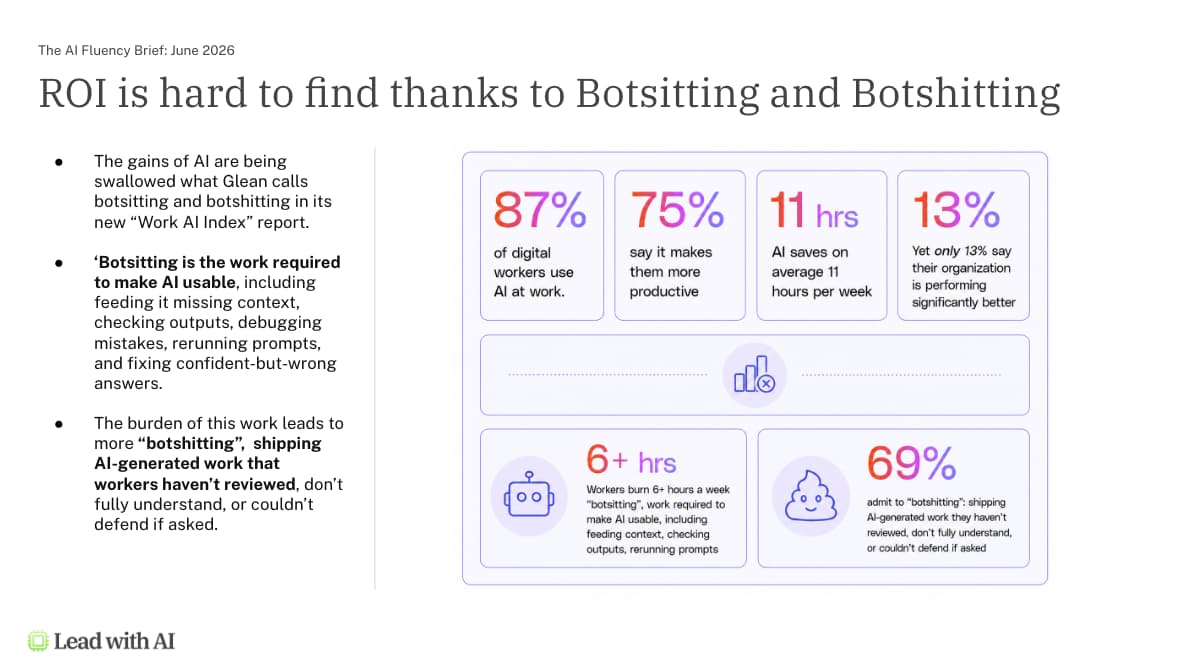
- 87% of digital workers use AI and report saving 11 hours per week — yet only 13% say their organization is performing significantly better as a result. (Glean via Lead with AI Executive Briefing, June 2026)
- The average knowledge worker spends 6.4 hours per week “botsitting” — feeding AI context, checking outputs, and fixing mistakes — more time than they spend actually producing work with AI. (Glean via Lead with AI Executive Briefing, June 2026)
- 69% of AI users admit to “botshitting” — shipping AI-generated work they haven’t reviewed. (Glean via Lead with AI Executive Briefing, June 2026)
- Only 12% of CEOs say AI has delivered both cost and revenue benefits; 33% report gains in either; 56% report no significant financial benefit to date. (PwC, January 2026)
- Companies applying AI widely to products and CX achieved nearly 4 percentage points higher profit margins than non-adopters. (PwC, January 2026)
- CEOs with strong Responsible-AI frameworks + enterprise-wide integration are 3× more likely to report meaningful financial returns from AI. (PwC, January 2026)
- 96% of AI-investing organizations report some productivity gains; 57% say gains are significant. (EY, January 2026)
- Companies with $10M+ AI budgets are 71% likely to report significant productivity gains vs. 43% for smaller budgets. (EY, January 2026)
- Companies allocating 50%+ of IT budget to AI set to rise from 3% today to 19% next year. (EY, January 2026)
- 66% of companies report productivity/efficiency gains from AI. (Deloitte, January 2026)
- 78% of leaders now see AI as more beneficial to revenue growth than cost reduction (up from 65% in 2024). (Accenture, January 2026)
- 94% of CEOs will continue investing in AI even without near-term ROI; ~90% believe AI agents will deliver measurable returns in 2026. (BCG, January 2026)
- Top-performing commercial-workflow-redesigners achieve 2× AI-driven revenue growth and 1.8× greater cost efficiency than peers. (Bain, April 2026)
- Industrial AI deployments at scale are yielding 30%–50% productivity gains and up to 35% maintenance-cost reductions. (Bain, April 2026)
- 25% of global financial services CEOs say AI is delivering significantly ahead of expectations. (EY, February 2026)
- One large financial-services firm freed 65%–70% of operations time via specialized AI research agents. (Harvard Business Review, March 2026)
- AI users worked faster, took on a broader range of tasks, and extended work into more hours — AI intensifies rather than reduces work. (HBR/UC Berkeley study, February 2026)
- 80% of CEOs are more optimistic about AI’s ROI than a year ago. (BCG, January 2026)
- Adaptive, human-centric organizations are 2.4× more likely to report better financial results. (Deloitte Human Capital, 2026)
- AI-leading firms are nearly 3× more likely (49% vs. 17%) to report AI meeting or exceeding expectations. (Oliver Wyman/NYSE, April 2026)
- Nearly 25% of CEOs report zero revenue impact from AI so far; 53% say it’s too early to evaluate (up from 41%). (Oliver Wyman/NYSE, April 2026)
- Anthropic Economic Index: 9× speedup for high-school-level tasks; 12× for college-level tasks. (Anthropic, January 2026)
- About 49% of jobs have seen ≥25% of their tasks performed using Claude. (Anthropic, March 2026)
- Employees with strong strategic clarity but limited tool access report more measurable impact (80%) than those with strong tool access but limited strategic clarity (60%) — direct evidence that strategy beats tools. (BCG AI at Work, June 2026)
- At companies pursuing Reshape or Invent initiatives, 67% of employees see measurable business improvement, versus 43% at Deploy-only companies; 53% save at least a day per week versus 31%. (BCG AI at Work, June 2026)
- Time savings are real but unmanaged: 60% of leaders save at least a workday per week, versus 52% of managers and 42% of frontline employees, yet 66% of those frontline users get limited or no guidance on what to do with the time and more than half do not redirect it to strategic work. (BCG AI at Work, June 2026)
3. Executive & Leadership Sentiment
- Only 27% of leaders say their organization is ready for the shifts an agentic future requires, even though 70% of employees feel personally ready. (McKinsey via Lead with AI, July 2026)
- Top executives use AI an average of only 1.5 hours a week, and a quarter of them report no AI use at all, even though more than two-thirds say they use it regularly. Set that beside the 72% of CEOs who say they are the main decision-maker on AI, and the gap between owning the AI agenda and using it is hard to miss. (Atlanta Fed, Bank of England, and Bundesbank, Firm Data on AI, March 2026)
- Management made up 23% of respondents in Anthropic’s linked-usage survey against 7% of US employment, yet only 4% of observed Claude sessions. Managers use Claude heavily, but for tasks other than management itself, and they named judgment and management as the capabilities AI lacks. Deloitte found the same gap from the other side, with 60% of executives using AI in decision-making and only 5% saying they manage it well. (Anthropic Economic Index, June 2026)
- Among those survey respondents coded as management, 48.1% are employed at a company, 24.4% are business owners with employees, and 21.7% are self-employed or contractors. The AI-forward management population is considerably more entrepreneurial than headcount data suggests. (Anthropic Economic Index, June 2026)
- Leadership teams with high AI fluency are 3.9× more likely to capture enterprise value than those with low fluency (35% vs 9%). (McKinsey via Lead with AI, July 2026)
- 84% of enablement-stage leaders and 68% of automation-stage leaders say their organization is not ready for the people and culture shifts an agentic future needs, and so do 44% of reinvention-stage leaders. (McKinsey via Lead with AI, July 2026)
- Only 11% of organizations have reached the reinvention stage of AI maturity; nearly 90% remain in the first two. (McKinsey via Lead with AI, July 2026)
- 72% of CEOs say they are the main decision-maker on AI (double last year’s share). (BCG, January 2026)
- Only 33% of frontline employees say leadership communicates clearly about AI, and just 28% see strong alignment between what leaders say and what the organization actually does. (BCG AI at Work, June 2026
- 50% of CEOs believe their jobs are on the line if AI doesn’t pay off. (BCG, January 2026)
- 65% say accelerating AI is a top-3 priority; “Trailblazing CEOs” spend 8+ hours/week on their own AI upskilling. (BCG, January 2026)
- 87% of CFOs predict AI will be extremely or very important to their finance department in 2026; only 2% say it won’t be important. (Deloitte CFO Signals, January 2026)
- 58% of CEOs expect AI to be a major growth engine in the next 2 years. (EY, January 2026)
- CEO confidence in revenue growth hit a 5-year low — only 30% (down from 38% in 2025); 42% cite “transforming fast enough” (including AI) as their #1 concern. (PwC, January 2026)
- 46% of executives would increase AI investments even during a market correction. (Accenture, January 2026)
- 95% of tech leaders say AI spending will increase next year (up from 92%). (EY, March 2026)
- 97% of tech leaders view autonomous AI as a “high” or “essential” priority. (EY, March 2026)
- CEOs have committed >30% of 2026 AI investment to agentic AI. (BCG, January 2026)
- 94% of CEOs plan M&A in the next 1–2 years; 43% plan to deprioritize junior-role hiring (up from 17%). (Oliver Wyman/NYSE, April 2026)
- 83% of sovereign AI is seen as strategically important by enterprise leaders; 77% factor country-of-origin into AI vendor selection. (Deloitte, January 2026)
4. AI & the Workforce
- AI-adopting firms have grown headcount 27% more than non-adopters since late 2022 — companies leaning hardest into AI are hiring more people, not fewer. (Revelio Labs, AI Labor Market Tracker, July 2026 via Lead with AI Executive Briefing, August 2026)
- Executives predict AI will cut employment by 0.7% over the next three years, while employees predict it will add 0.5%, a gap between the people making workforce decisions and the people affected by them. The same firms forecast AI will raise productivity by 1.4% and output by 0.8% over that period. (Atlanta Fed, Bank of England, and Bundesbank, Firm Data on AI, March 2026)
- A note on the Gen Z figures below. They come from a Harris Poll survey of 1,007 U.S. adults aged 18 to 25, fielded August 24 to 28, 2026, accurate to within plus or minus 3.1 points. They measure what young people expect and feel about AI, not what has happened to them yet. (Just Capital / The Harris Poll, September 2026)
- 47% of recent graduates are concerned AI will reduce their ability to get an entry-level job in their field, which is the employee-side mirror of the 43% of CEOs who plan to deprioritize junior-role hiring. (Just Capital / The Harris Poll, September 2026)
- 42% of 18 to 25 year olds say AI will do more good than harm for them personally, and 27% expect an equal amount of both, but the balance flips when they are asked about the country as a whole, where 42% expect more harm against 32% who expect more good. (Just Capital / The Harris Poll, September 2026)
- Nearly one in four recent graduates (24%) are starting or considering starting their own business because of concerns about AI, and 36% say they would use AI-freed time to start something on the side. (Just Capital / The Harris Poll, September 2026)
- A note on the survey behind the figures below. They come from roughly 9,700 Claude users whose responses were linked to their actual observed usage, which makes this one of the only datasets comparing what people say AI can do against what they are observed handing to it. Anthropic states plainly that the sample is not representative of the general workforce: computer and mathematical occupations are about 30% of respondents against 4% of US employment, and management 23% against 7%. Read them as a signal of where heavy AI users are heading, not as a national average. (Anthropic Economic Index, June 2026)
- Close to 6 in 10 respondents expect AI to handle a larger share of their work tasks within 12 months, and over a third expect AI to be able to do most or nearly all of their work tasks next year. BCG found 61% believe agents could perform at least half their job within three years, and Anthropic separately observed that about 49% of jobs already have a quarter or more of their tasks performed using Claude. Three measures, three timelines, the same rough magnitude. (Anthropic Economic Index, June 2026)
- Expectations about the pace of future AI progress are close to uniform across occupation, country income, and experience level. A software engineer and a construction manager anticipate roughly the same increment of progress within their own profession, a pattern Anthropic calls a rising tide. (Anthropic Economic Index, June 2026)
- Workers with at least 15 years of experience report the share of their tasks AI can do roughly 10 percentage points lower than those in their first year. Asked what AI will never be able to do, they pointed to judgment, contextual awareness, situational reasoning, and the relational parts of the job: building trust and managing people. (Anthropic Economic Index, June 2026)
- 10% of respondents rated losing their own job in the next year as likely or very likely, but over a third said a junior colleague faces a greater than 60% probability. Of those forecasting their own job loss, 38% attributed it to AI, which Anthropic notes is an upper bound. US layoffs and discharges averaged about 1.1% of employment per month over the year through April 2026, roughly 13.4% annualized, so the 10% self-forecast sits slightly below the realized rate. Respondents were consistently more worried about others than themselves, and 43% of CEOs separately told Oliver Wyman they plan to deprioritize junior hiring. (Anthropic Economic Index, June 2026)
- Across all six dimensions measured, the people who use Claude in the most automated ways are the most optimistic about AI’s effect on their own job outcomes. Pay, job security, ability to find a new job, meaning, autonomy, and human interaction all move the same direction, with the largest effects on expected pay and job-finding, and heavy delegators report learning at the same rate as everyone else. These are self-assessments, and Anthropic notes the data cannot rule out skill erosion even where people report their skills becoming more valuable. Proximity to AI predicts optimism, and distance predicts fear. (Anthropic Economic Index, June 2026)
- Self-reported productivity gains run at 86% for speed, 82% for scope, and 69% for quality of work, with 27% reporting savings on services they would otherwise buy. 68% say they learn more with AI and 57% say AI has made their skills more valuable. (Anthropic Economic Index, June 2026)
- Share of respondents expecting a positive impact from AI over the next year: autonomy 70%, meaning 59%, pay 56%, finding a new job 52%, job security 42%, human interaction 36%. Note the shape. People are optimistic about how work will feel and pessimistic about job security and human contact, which tracks the BCG finding that 67% of regular AI users enjoy work more while 41% report increased mental strain. (Anthropic Economic Index, June 2026)
- Women made up only 12% of the linked respondent sample, and even after controlling for occupation their share of sessions in Claude Code ran 6.3 percentage points lower and their automation share 7.3 points lower than men’s. Women logged more active time in chat, a signal of more iterative engagement. (Anthropic Economic Index, June 2026)
- Asked what they hope an AI-shaped economy looks like in ten years, the most common answer was human and AI collaboration where work still matters (around 65%), followed by less work with drudgery automated away (around 51%) and shared prosperity (around 33%). People want collaboration, and Deloitte found only 6% of leaders say they are actively designing human-AI interactions. (Anthropic Economic Index, June 2026)
- Employment at AI-adopting firms grew 31% in senior roles against only 6% in junior roles, concentrating growth at the top and putting real pressure on entry-level pathways. (Revelio Labs, AI Labor Market Tracker, July 2026 via Lead with AI Executive Briefing, August 2026)
- Employees with low trust in their organization are 1.5× more likely to feel anxious about AI-related change, and 1 in 4 middle managers report real concern, more than any other group. (McKinsey via Lead with AI, July 2026)
- 67% of regular AI users enjoy work more since adopting AI, but 41% report increased mental strain — the "joy paradox" of AI making work both better and harder, a tension explored in my interview with BCG senior partner Debbie Lovich. (BCG AI at Work, June 2026)
- 72% of respondents say the skills expected for their role have changed because of AI, and nearly half say their role has shifted toward managing and directing AI rather than doing the work itself. (BCG AI at Work, June 2026)
- Half of employees (50%) say their company has no clear guidance for managing human-AI teams, and 47% rank AI-driven accountability as a top-three concern for the next two to three years. (BCG AI at Work, June 2026)
- Manager engagement dropped from 27% to 22% between 2024 and 2025, its largest year-over-year fall. (Gallup, State of the Global Workplace 2026)
- Employees whose manager actively supports the team’s AI use are 8.7× more likely to say AI has transformed how work gets done. (Gallup, State of the Global Workplace 2026)
- AI could reshape 50%–55% of U.S. jobs over the next 2–3 years; 10%–15% (~16–25 million positions) could be eliminated within 5 years. (BCG, April 2026)
- 60% of jobs in advanced economies will be affected by AI; ~40% globally. (IMF/WEF Davos, January 2026)
- March 2026: AI was the #1 cited reason for U.S. layoffs — 15,341 of 60,620 cuts (25% of all March layoffs). (Challenger Gray & Christmas, April 2026)
- Q1 2026 tech-sector layoffs: 52,050 (+40% YoY), the highest Q1 total since 2023. (Challenger/DIGIT, Q1 2026)
- AI has already added 1.3 million new jobs globally in just two years. (LinkedIn/WEF, January 2026)
- U.S. roles requiring AI literacy grew 70% YoY. (LinkedIn/WEF, January 2026)
- AI-related job postings surged >130% since pre-pandemic baseline, while total postings are only ~6% above baseline. (Indeed Hiring Lab, January 2026)
- Share of firms with at least one AI-mentioning job posting rose from ~2% (2018) to nearly 6% (end of 2025). (Indeed Hiring Lab, January 2026)
- UK: ~7.5% of all job postings mention AI as of end-February 2026. (Indeed Hiring Lab UK, March 2026)
- Employment of U.S. software developers aged 22–25 is down ~20% since 2024, even as older cohorts’ headcount grew. (Stanford HAI, April 2026)
- 53% of U.S. employees plan to proactively learn AI skills within 6 months; 48% believe AI skills will accelerate their careers. (LinkedIn/WEF, January 2026)
- LinkedIn learning time on AI courses: +92% YoY; AI-related posts: +66% YoY. (LinkedIn/WEF, January 2026)
- 67% globally predict AI will lead to many new job losses in their country (up from 64%). (Ipsos, January 2026)
- 43% only predict AI will create many new jobs. (Ipsos, January 2026)
- 60% of executives use AI in decision-making, but only 5% say they manage it well. (Deloitte Human Capital, 2026)
- 65% of organizations believe their culture needs to change significantly because of AI; only 6% of leaders say they are making progress in designing human-AI interactions. (Deloitte Human Capital, 2026)
- 42% of workers say their organizations aren’t evaluating AI’s impact on people at all. (Deloitte Human Capital, 2026)
- Computer programmers have the highest observed AI exposure at 74.5%; customer-service reps: 70.1%. (Anthropic Economic Index, March 2026)
- 52% of department-level AI initiatives in tech companies operate without formal approval or oversight. (EY, March 2026)
- 45% of tech companies had a suspected or confirmed data leak from unauthorized GenAI use in the past 12 months. (EY, March 2026)
- Nearly 80% of people feel unprepared to find a job in 2026; two-thirds of recruiters say it’s harder to find quality talent. (LinkedIn, 2026)
- Young men are more likely than young women to say they are not concerned about AI cutting entry-level jobs in their field (56% against 45%), and gender predicted optimism about entry-level work more strongly than area of study did. (Just Capital / The Harris Poll, September 2026)
5. Top AI Tools & Usage
- Claude Fable 5 scores 80% on SWE-Bench Pro against GPT-5.6 Sol’s 64.6%, on OpenAI’s own benchmark tables — a gap wide enough to matter if engineering is your primary use case. (OpenAI, GPT-5.6, July 2026)
- 54% of Claude Code sessions are served by Opus, against 10% of chat conversations. Across output types, mean autonomy and median token use rise together (r = 0.68). The heaviest delegation and the heaviest compute land on the same work. (Anthropic Economic Index, June 2026)
- An average query resulting in an academic paper requires more than 16 years of education to understand, and 15% of those conversations sit at PhD level or above. At the other end, recipes and guidance require fewer than 10 years. (Anthropic Economic Index, June 2026)
- Anthropic interviewed 81,000 Claude users about their experience of AI at work. Respondents reported large productivity gains alongside worry about displacement, with concern concentrated among early-career workers and occupations where Claude is observed doing the most work. (Anthropic, December 2025)
- Claude Opus 5 ships with a 1 million token context window as both default and maximum, extended reasoning always on, and five Effort levels from Low to Max — at the same price as Opus 4.8 ($5 per million input tokens, $25 per million output). (Anthropic, Introducing Claude Opus 5, July 2026)
- Zapier CEO Wade Foster reported Claude Opus 5 scored 100% running an end-to-end churn-prevention sequence from a raw account-health workbook — flagging at-risk accounts, alerting the owner, and summarizing for retention operations — a test previous models did not pass. (Wade Foster via Lead with AI, July 2026)
- More than 150 million people use ChatGPT Voice and Dictation every week. (OpenAI, July 2026)
- GPT-Live-1 was preferred over the previous Advanced Voice Mode roughly 76% of the time in head-to-head testing (the smaller mini version ~69%), across naturalness, interruptions, and conversational flow. (OpenAI, July 2026)
- OpenAI Codex passed 5 million weekly active users (June 2026), up more than 6× since its February 2026 desktop launch, with roughly 20% now non-developer knowledge workers. (Constellation Research, June 2026)
- Anthropic analyzed 1.2 million Claude Cowork sessions (across 600,000+ organizations): coding made up just 8.7%, while business process & operations was the largest category at 33.4% and content creation second at 16.4%. (VentureBeat, July 2026)
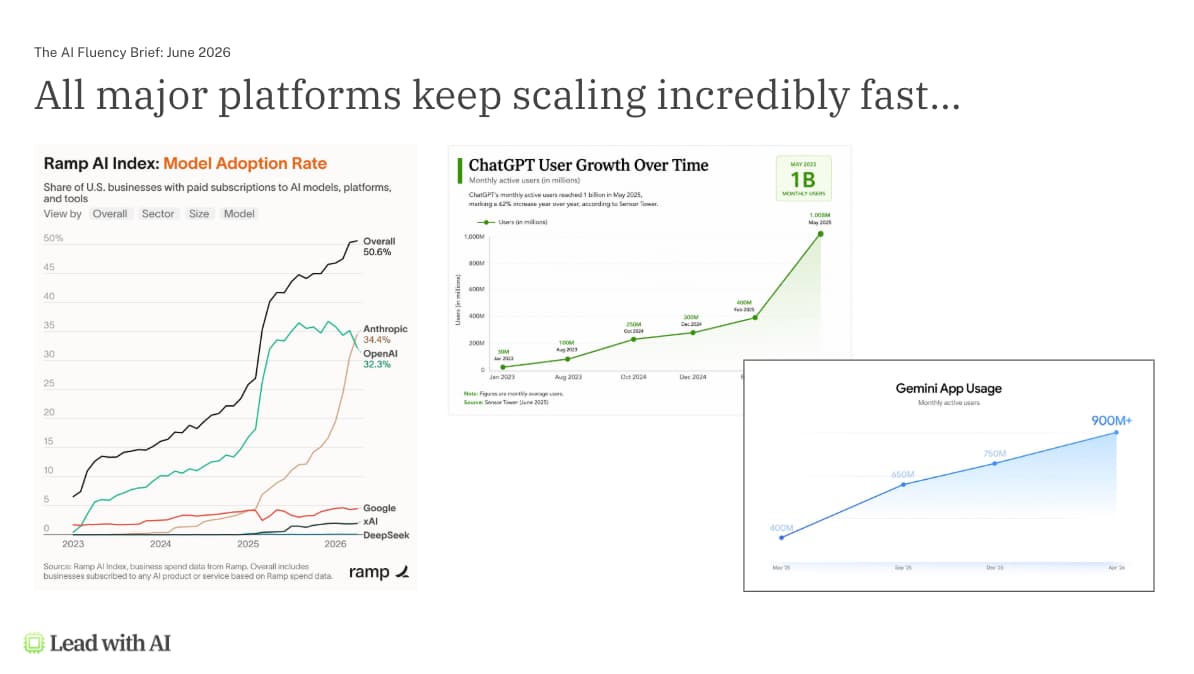
- ChatGPT: 1 billion monthly active users (June 2026), up from 400M a year prior. (Sensor Tower data via Reuters as shared at the Lead with AI Executive Briefing, June 2026)
- Gemini reached 900 million active users (Google I/O, June 2026); grew 157% between April–September 2025 to 1.1B monthly visits. (Lead with AI Executive Briefing, June 2026)
- Anthropic overtook OpenAI in U.S. business AI adoption for the first time:
- Anthropic 34.4% vs. OpenAI 32.3% of businesses.
- Anthropic quadrupled adoption YoY while OpenAI grew just 0.3%.
- Overall U.S. business AI adoption: 50.6%. (Ramp via the Lead with AI Executive Briefing, June 2026)
- ChatGPT is 2.7× larger than #2 Gemini on web traffic and 2.5× larger on mobile MAU. (a16z, March 2026)
- ChatGPT is 8× larger than Claude and 4× larger than Gemini in U.S. consumer paid subscribers. (a16z/Yipit Data, March 2026)
- ChatGPT: 50 million consumer paying subscribers; 9M+ paying business users. (OpenAI, 2026)
- ChatGPT mobile in-app purchase revenue: $227M in February 2026 alone. (OpenAI, 2026)
- ChatGPT holds ~79% of global GenAI web traffic. (Similarweb AI Brand Visibility Index, 2026)
- U.S. paid-subscriber growth: Claude +200% YoY, Gemini +258% YoY. (a16z/Yipit Data, March 2026)
- Claude: 157 million monthly website visits; Claude DAU averages 34.7 minutes per day — the highest engagement among major AI apps. (Apptopia/Similarweb, January 2026)
- Claude Code: $1 billion annualized revenue run rate in 6 months. (a16z, March 2026)
- Perplexity: 34 million MAU (March 2026); 2.0% AI-chatbot market share. (Similarweb, March 2026)
- Notion AI paid attach rate jumped from 20% to >50% in a single year; AI features now account for half of Notion’s ARR. (a16z, March 2026)
- 52% of Claude interactions are augmentation; 48% are automation. (Anthropic Economic Index, January 2026)
- Computer & Mathematical occupations = 35% of all Claude.ai conversations. (Anthropic Economic Index, March 2026)
For more, see our guide to the top AI websites.
6. AI Certifications & Training
- Employees who get real training and support as their work changes are 3.3× more likely to report enterprise value (30% vs 9%). (McKinsey via Lead with AI, July 2026)
- 49% of students and recent graduates say school did not prepare them to use AI, including 18% who say it was never addressed, across a Harris Poll sample of 1,007 U.S. adults aged 18 to 25. That is the same gap BCG finds inside the workforce, where 88% say they need major upskilling but only 36% feel properly trained. (Just Capital / The Harris Poll, September 2026)
- 65% of students and recent graduates say knowing how to work with AI tools will matter more to employers in five years, against 53% for knowing how to think strategically, 52% for working well with people, and only 38% for college degrees and formal credentials. (Just Capital / The Harris Poll, September 2026)
- 88% of respondents believe they need major upskilling in the next five years, but only 36% feel properly trained — a gap unchanged from 2025. (BCG AI at Work, June 2026)
- A worker’s first job-relevant credential is associated with a 3.8% wage premium vs. workers with no credentials; each additional relevant credential adds ~1.0%. (Brookings Institute as covered in Are AI Certifications Worth It?)
- Only 12% of credentials (out of 23,000 analyzed) deliver significant wage gains — relevance to the worker’s actual job is the deciding factor, not credential quantity. (Brookings Institute as covered in Are AI Certifications Worth It?)
- The share of workers listing at least one credential grew 35% in a single year (2024→2025); over 1.5 million unique non-degree credentials now exist in the United States. (Brookings Institute as covered in Are AI Certifications Worth It?)
- Workers without a bachelor’s degree see a 6.8% wage premium from their first job-relevant credential (vs. 3.4% for college graduates); early-career workers gain 2.32% per additional relevant credential vs. 0.52% for experienced workers. (Brookings Institute as covered in Are AI Certifications Worth It?)
7. AI Cost & Token Budget Strategies
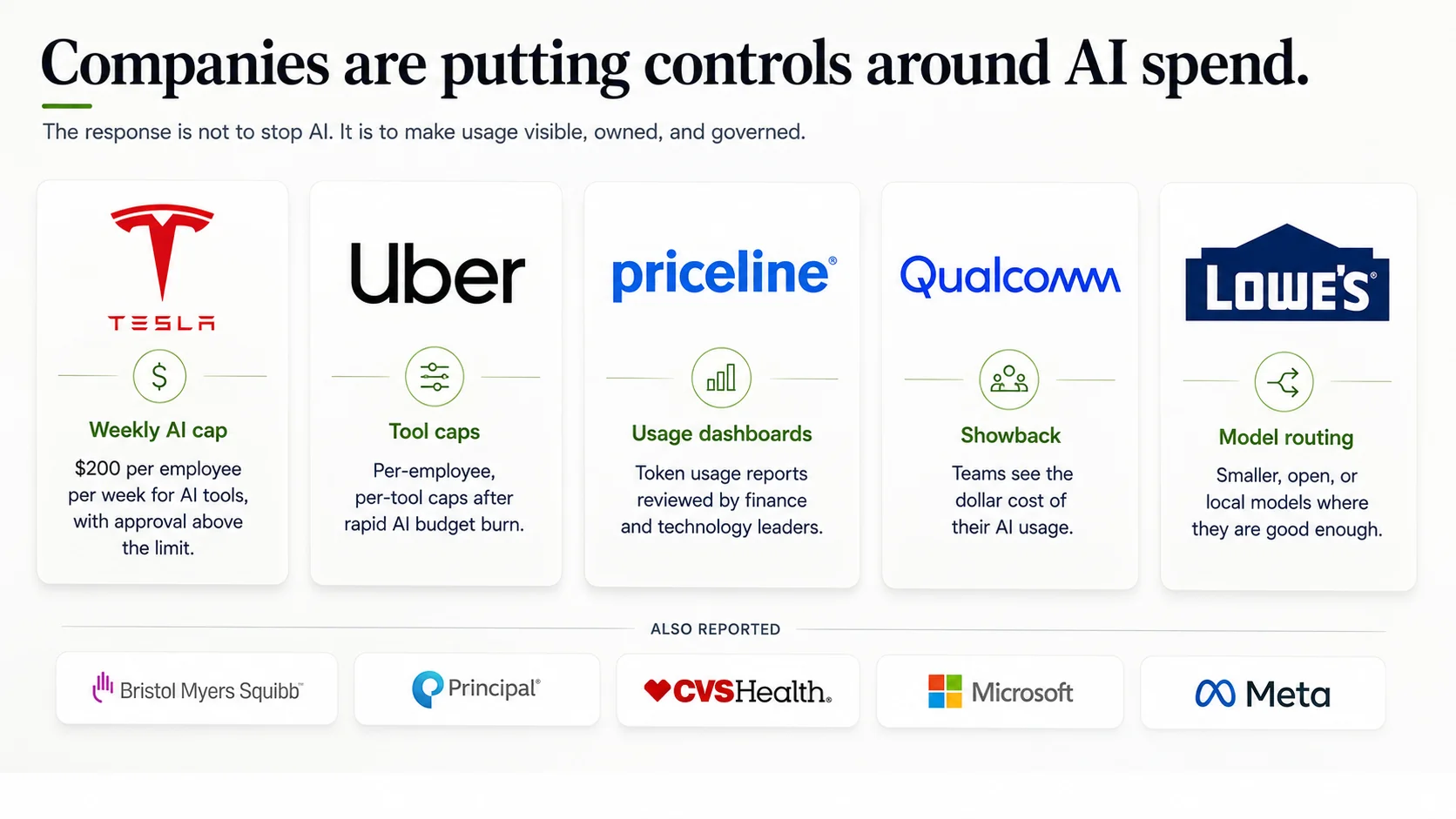
- Uber burned through its entire 2026 AI budget in four months — by April — then capped employee AI-tool spending at $1,500 per month per person. (TechCrunch, June 2026)
- Tesla capped employee AI spending at $200 per week, with sign-off required to exceed it — a hard ceiling where there previously was none. (Electrek, July 2026)
- Model routing cut cost by roughly 20% on Terminal-Bench 2 while holding pass rate at close to 99% of what the frontier model alone would score. (Lead with AI, July 2026)
- Cursor trained its own coding model on the open Qwen 2.5 Coder and runs it in-house at close to frontier quality, at a fraction of the cost and latency of calling a foundation model each time. (Cursor)
- Anthropic is subsidizing agentic usage at around 50% off, letting users watch their token budget tick down in real time as agents work. (Lead with AI, July 2026)
8. AI Savings Case Studies
- Asana removed a deprecated testing framework threaded through its entire codebase in about two calendar weeks for around $12,000 in model and infrastructure costs, work previously scoped at five years and roughly six million dollars, with engineers reviewing agent changes twice a day. (Asana and OpenAI via Lead with AI Executive Briefing, August 2026)
- NVIDIA’s GTC planning workflow in ChatGPT Work saves roughly 16 hours per week across the 12-week planning cycle, covering account lists, registrations, and hundreds of post-event meeting transcripts. (OpenAI, How NVIDIA scales expertise with ChatGPT Work, 2026)
- RingCentral used ChatGPT Work to let one employee go from supporting one product manager to roughly 50, turning a manual monthly launch check into an automated, source-backed workflow. (OpenAI, July 2026)
- NVIDIA used ChatGPT Work to automate preparation for its GTC conference, a process that used to consume 40% of the pre-event workload. (Lead with AI, July 2026)
- Klarna’s AI assistant handled two-thirds of customer service chats, 2.3 million conversations, in its first month, doing the work of roughly 700 full-time agents. (Klarna, press release)
- Inside OpenAI, ChatGPT Work turned a single discovery call into a tailored proof of concept within 24 hours, a process that normally takes weeks. (Lead with AI, July 2026)
9. AI Market Size & Investment
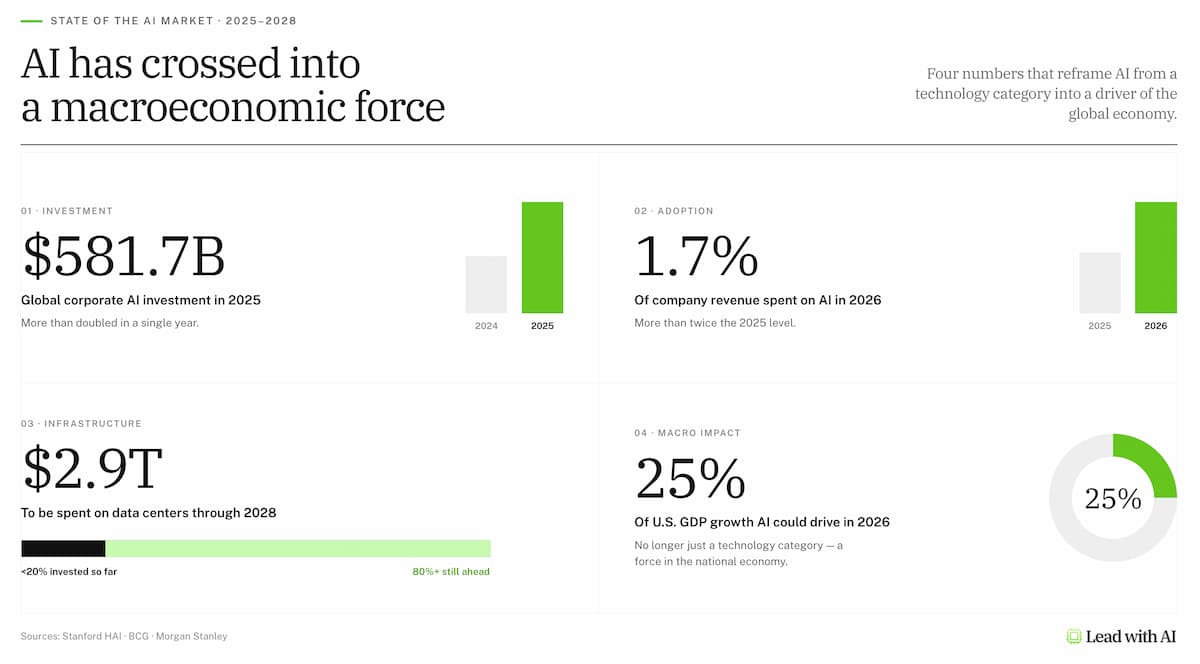
- Global corporate AI investment hit $581.7B in 2025 (+130% YoY); private investment alone reached $344.7B (+127.5%). (Stanford HAI, April 2026)
- Generative AI private investment grew 200%+ and captured nearly half of all private AI funding in 2025. (Stanford HAI, April 2026)
- U.S. private AI investment in 2025: $285.9B — 23.1× China's $12.4B and 48.5× the UK's $5.9B. (Stanford HAI, April 2026)
- California alone = $218B (>75% of U.S. total AI investment). (Stanford HAI, April 2026)
- U.S. led with 1,953 newly funded AI companies in 2025 — more than 10× the next country (China: 161). (Stanford HAI, April 2026)
- U.S. consumer surplus from generative AI: $172B annually by early 2026 (up from $112B a year earlier); median value per user tripled. (Stanford HAI, April 2026)
- Companies plan to double AI spending in 2026, to ~1.7% of revenues. (BCG AI Radar, January 2026)
- 84% of companies are increasing AI budgets. (Deloitte State of AI, January 2026)
- 83% of CFOs plan to increase enterprise-wide AI spending by >15% over the next two years; 42% plan 30%+ increases. (Bain, April 2026)
- Top-5 U.S. tech companies' 2026 capex expected at $667B (+62% YoY), revised up 24% from start of earnings season. (Goldman Sachs via Fortune, March 2026)
- ~$2.9 trillion in global data-center construction cost through 2028, with >80% of spending still ahead. (Morgan Stanley, early 2026)
- Data-center-related investment accounted for 25% of annual U.S. GDP growth in 2025. (Morgan Stanley, February 2026)
- AI data center power capacity reached 29.6 GW globally — enough to power New York State at peak demand. (Stanford HAI, April 2026)
- The U.S. hosts 5,427 AI data centers (10× any other country). (Stanford HAI, April 2026)
- NVIDIA Q4 FY2026 revenue: $68.1B (+73% YoY); full FY2026: $215.9B (+65%). (NVIDIA Earnings, February 2026)
- NVIDIA Data Center revenue Q4: $62.3B (+75% YoY) — 91% of total NVIDIA revenue. (NVIDIA Earnings, February 2026)
- NVIDIA Networking revenue: $11.0B (+263% YoY). (NVIDIA Earnings, February 2026)
10. AI Funding & Startup Trends
- Granola raised $125M (Series C) at a $1.5B valuation in early 2026, following 250% revenue growth, as it expanded from meeting notetaker to enterprise AI app. (TechCrunch, March 2026)
- Global startup investment hit $300B in Q1 2026 — an all-time quarterly record (+150% QoQ); AI captured $242B (~80% of total). (Crunchbase, April 2026)
- Three frontier labs captured $172B of global Q1 2026 VC: OpenAI $122B, Anthropic $30B, xAI $20B. (Crunchbase, April 2026)
- Private AI companies raised $226B in Q1'26 — surpassing all of 2025 ($217B) in a single quarter (+216% QoQ). (CB Insights, April 2026)
- $100M+ mega-rounds accounted for a record 94% of AI funding; average deal size $160M (4× 2025's $38M). (CB Insights, April 2026)
- 266 AI M&A deals closed in Q1'26 (+90% YoY); 21 AI IPOs (record). (CB Insights, April 2026)
- U.S./Canada Q1 2026 venture funding: $252.6B (largest quarterly total ever); 87% went to AI. (PitchBook-NVCA, April 2026)
- 47 seed/early-stage companies became unicorns in Q1 2026 — a record pace, virtually all AI-focused. (Crunchbase, April 2026)
- European Q1 2026 VC: $17.6B (+30% YoY); AI >50% of European VC for the first time ($9.2B). (Dealroom, March 2026)
- European Commission committed €20B to InvestAI for up to five AI gigafactories across the EU. (Dealroom/Lakestar, March 2026)
- Humanoid robot companies on pace for $10B in 2026 funding. (CB Insights, April 2026)
- Autonomous vehicle startups raised a record $21.4B in 2026 YTD (+262% vs. all of 2025). (Crunchbase, April 2026)
- Perplexity valuation: $22.6B; ARR $450M+; committed $750M to Microsoft Azure in January 2026. (Similarweb/press, March 2026)