This step-by-step guide is exclusively available for Lead with AI PRO membership. 🚀 With Lead with AI PRO, you’ll get: ✅ Access to expert-crafted step-by-step guides ✅ AI-powered workflows to boost productivity ✅ Exclusive tools and resources for smarter work Upgrade to Lead with AI PRO and access all premium content instantly.
5 Key Questions Every AI Leader Needs to Ask Themselves
A condensed view of AI changes that actually affect leadership.
By
Daan van Rossum
Founder & CEO, Lead with AI
Presented by
Working at ‘the speed of AI’ is not for the faint of heart.
To track everything that matters and share it with you and our community, myself and the team produce three weekly briefings covering platform updates and transformation insights, tutorials, and new on-demand lessons.
Our PRO community, with hundreds of global AI leaders from small startups to enterprises like Apple and Atlassian, adds a valuable layer with 20-100 WhatsApp messages a day on anything from prompts to change management.
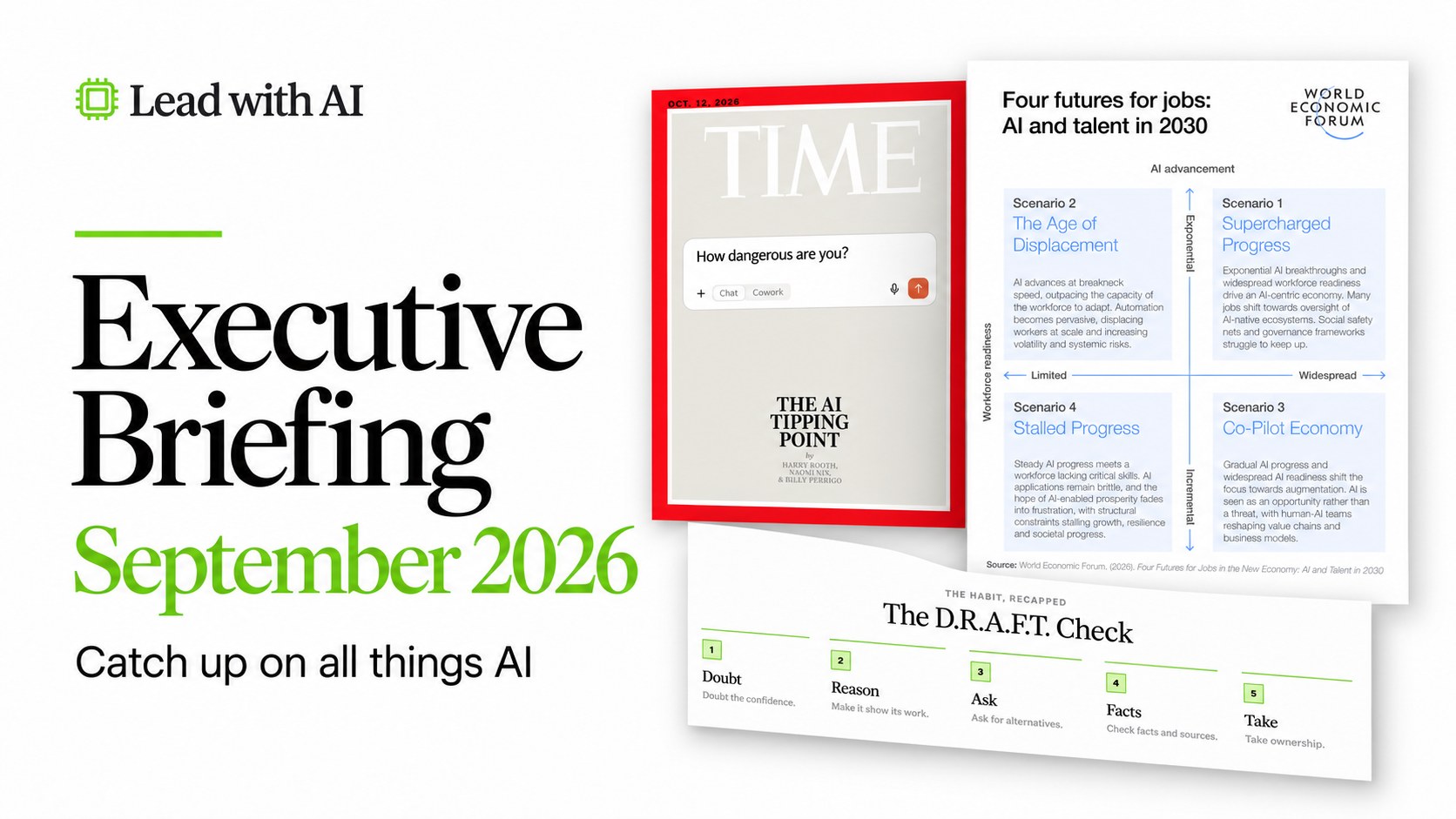
But we know leaders like yourself are busy, so today we organized our first monthly executive briefing, where we compressed a month's worth of analysis, insights, and training materials into half an hour.
In it, we highlighted how all the latest data, capabilities, and studies are triggering five key questions every AI leader should be asking themselves:
Are we effectively redesigning our workflows to unlock the potential of AI, or are we simply overlaying new tools onto old processes and risking the "productivity slowdown?
Are we building a culture of learning that starts at the Board level, or is AI fluency treated as a mandate only for the workforce?
Are we equipping our managers to lead hybrid teams of "people, agents, (and robots)," or are they still managing based on human-only metrics and expectations?
Is our proprietary data actually accessible to AI tools, or is it locked in silos and "people's heads" where AI cannot reason over it?
Do we have a clear mechanism to encourage development and identify local experiments and scale them across the enterprise?
(Article continues after this break....)
Flagship AI Newsletter
The AI Newsletter That Makes You Smarter, Not Busier
Join over 30,000 leaders and receive our insights on AI platforms, implementations, and organizational change management.
AI is changing every function, and HR is next in line. From hiring and onboarding to performance and retention, leaders who know how to use AI to scale people's impact will define the next decade of HR.
In just 4 weeks, you’ll learn to identify where AI drives real ROI in HR, design adoption workflows that stick, and build an HR-led AI roadmap your execs will back.
You’ll walk away with: ✅ A live AI pilot connected to a real HR use case ✅ An adoption playbook with comms, training, and measurement tools ✅ A 90-day rollout plan ready to launch
Led by Johannes Sundlo, former HR leader at Spotify, this is practical, non-technical training built for HR leaders driving transformation.
Only 25 seats at 50% off. Cohort starts January 8, 2026. 👉 Reserve Your Seat
Or join the Info Webinar to see how it works 👉 Sign Up Here
Why Organizations Are Not Unlocking the Potential of AI
The AI platform wars have escalated into a full-blown arms race.
OpenAI’s ChatGPT 5.1 brought dynamic thinking time and tone-based personalization.
Anthropic’s Claude Opus 4.5 arrived optimized for multi-hour, multi-agent projects.
Google’s Gemini 3 Pro is not just leading the LLM leaderboard but delivering a one-million-token context window and deep Workspace integration.
But even as models clear new performance ceilings every month, organizational productivity is flattening.
The McKinsey analysis we highlighted recently shows that today’s AI can already automate 57% of U.S. work hours—a potential $2.9 trillion value that could be unlocked by 2030.
Yet, fewer than 40 percent of companies report measurable gains. And the constraint isn’t the tech itself, but us and our organizations.
So how do you ensure your organization ends up on the right side of the emerging productivity divide?
Let’s walk through the five questions every AI leader should ask themselves in a bit more detail.
The Five Questions
1. Are we effectively redesigning our workflows to unlock the potential of AI, or are we simply overlaying new tools onto old processes and risking the "productivity slowdown?
Every transformation either accelerates or slows down, depending on where you start.
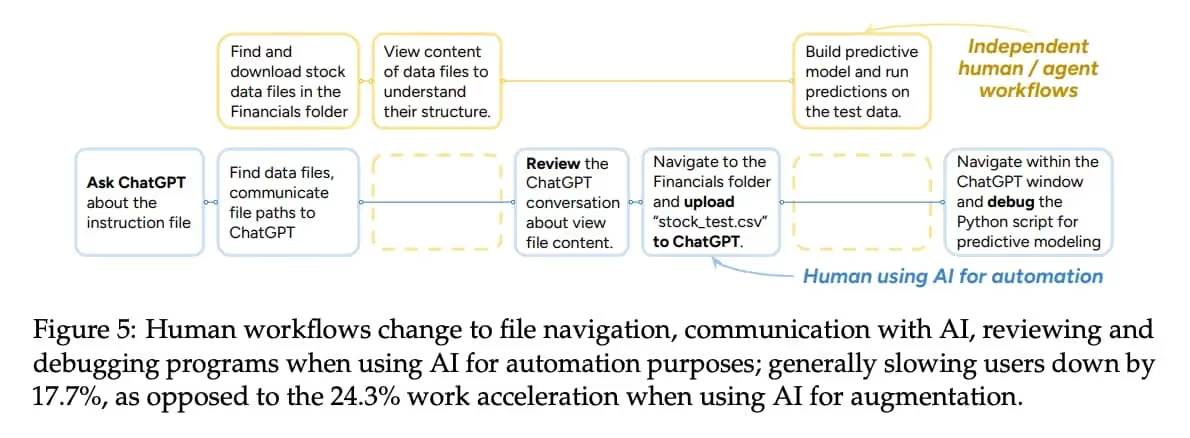
Stanford’s recent comparison of human versus AI-agent workflows captured the danger well: full automation attempts slow human teams down by 17.7% due to errors, hallucinated data, and misused tools that require extensive human verification.
On the other hand, targeted augmentation, like delegating specific steps, accelerates work by 24.3%.
But to get there, we need ‘workflow literacy,’ we need to understand how work actually happens.
The McKinsey study mentioned above echoes the same pattern.
When organizations focus on tools rather than workflows, impact stalls, but when they redesign around people–agent–robot partnerships, value accelerates.
They analyzed 7,000 skills and found that non-physical knowledge work, dominant in modern enterprises, is overwhelmingly automatable by agents.
But the bottleneck is the redesign itself.
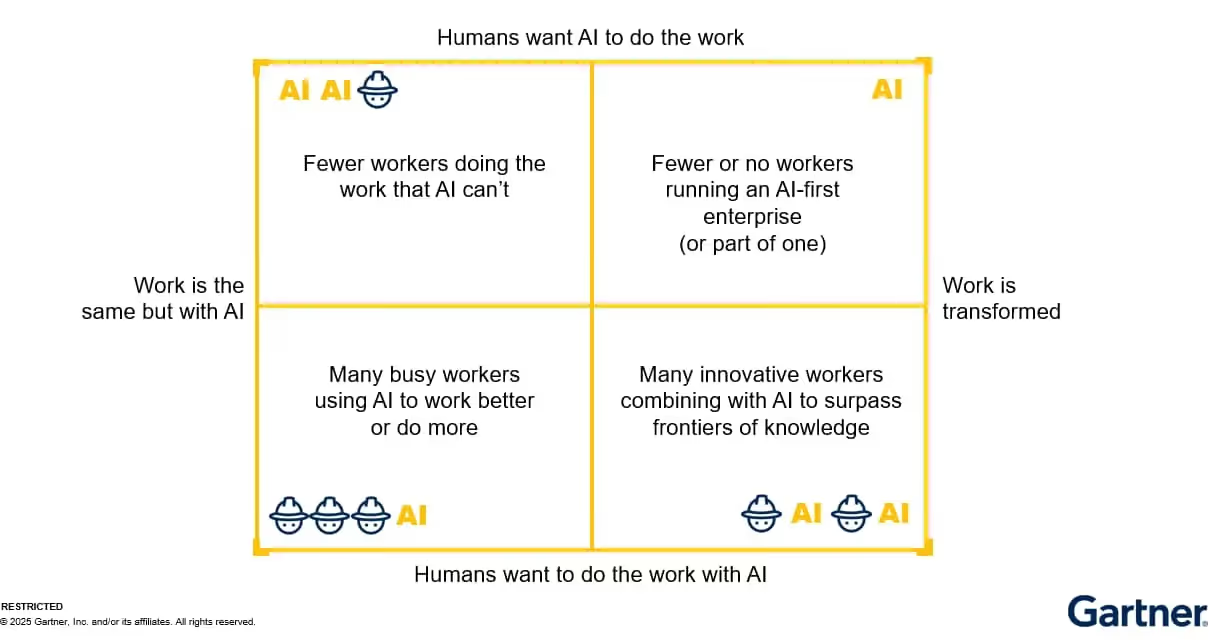
As Gartner warns in a new framework, staying on the left side (simple automation or augmentation) will deliver incremental gains. The right side (transformation) is where long-term advantage emerges.
Figuring out which company you want to be, and then designing your change processes toward it, is an exercise every leadership team should undertake. (I’ll be on the right side with our company.)
2. Are we building a culture of learning that starts at the Board level, or is AI fluency treated as a mandate only for the workforce?
Culture comes from the top, and ServiceNow provides the clearest case study of the moment.
CHRO Jacqui Canney described their approach as a “capability, confidence, and leadership shift,” and operationalized this by having the Board take the same AI capability assessment as all 28,000 employees.
The broader environment is shifting quickly as well: demand for AI fluency has grown roughly seven-fold in two years and now appears across seven million U.S. jobs.
Despite this surge, many leadership teams still assume AI literacy is something “the staff” must figure out.
The companies pulling ahead (and we love working with) are flipping the script: learning starts at the top.
3. Are we equipping our managers to lead hybrid teams of "people, agents, (and robots)," or are they still managing based on human-only metrics and expectations?
Managerial capability is the least discussed yet most impactful way to drive AI transformation.
We are entering a world where managers will orchestrate hybrid teams whose members include full-time employees, part-time contractors, model-driven agents, and soon, physically embodied robots.
Yet most managers still operate with human-only metrics and expectations.
That mismatch will widen quickly.
Google’s Gemini 3 Pro ecosystem, which now includes ultra-high-accuracy image generation via Nano Banana Pro, research-grade automation through NotebookLM.
Especially end-to-end workflows made possible via Workspace Flows, show what "agentic teammates" will soon contribute: deep research, multi-step reasoning, live data retrieval, and autonomously generated outputs (like the real-time city-weather visual or Eric Pores’s career storyboard below).
As Claude Opus 4.5 demonstrates with its multi-hour task leadership and new computer-use capabilities, these agents are no longer “assistants.” They are colleagues operating programmatically and at scale. Managers need new playbooks—how to scope work, verify outputs, benchmark agent performance, and redesign roles in real time.
4. Is our proprietary data actually accessible to AI tools, or is it locked in silos and "people's heads" where AI cannot reason over it?
A new report from Superintelligent put numbers to a problem every leader feels: nearly 45 percent of companies lack documented workflows, and even more suffer from severe data fragmentation.
And, this is crucial: agents cannot automate what only exists in our memory.
This is why Superintelligence frames 2026 as “the year of context”: clean data, unified access, and documented workflows as preconditions for agentic automation.
It’s also why Google’s Workspace-native ecosystem (as does Microsoft with Copilot) poses such a strategic threat to third-party platforms like ChatGPT.
When your data already lives inside Workspace, Gemini 3 Pro can reason over it natively, no integrations required.
If your data is locked in PDFs, scattered across legacy systems, or stored in the heads of veteran employees, you can’t be an AI-ready company.
5. Do we have a clear mechanism to encourage development and identify local experiments and scale them across the enterprise?
Most enterprises still treat AI as a glorified Q&A interface.
But the frontier has moved. Claude Opus 4.5 can now lead multi-agent, multi-hour projects. NotebookLM generates full research dossiers with citations, auto-builds slide decks, and synthesizes PDFs, Sheets, images, and URLs.
As mentioned above, Workspace Flows allows no-code automation linking Gmail, Docs, Sheets, and Meet into live agentic workflows, like my pre-meeting research agent that autonomously prepares a deep-dive client brief 10 minutes before every call.
The question is no longer whether (agentic) AI workflows work, but whether you have a mechanism to identify promising local experiments and scale them across the enterprise.
In the ServiceNow case study, we saw how they crowdsourced 1,000+ use cases, then narrowed them to 27 high-value projects.
You need to build an AI projectpipeline like this, too.
Flagship AI Newsletter
The AI Newsletter That Makes You Smarter, Not Busier
Join over 30,000 leaders and receive our insights on AI platforms, implementations, and organizational change management.
The Bottom Line: Leading with the Five Questions
The research we shared should show that the gap between winners and laggards will not be determined by who has access to the best model but by who can redesign work, culture, and data flows fast enough to capitalize on them.
If you’re answering “no” to any of these, reply, and I’ll share ways to quickly make progress toward a yes.
Did the research trigger even more questions? Get in touch as well – we love to keep working at the speed of AI.
Exclusive for PRO Members: AI Sales Without The Spam
With AI rapidly transforming how organizations attract, convert, and engage customers, the real question becomes: how can sales and marketing leaders harness these tools to achieve measurable results without losing the human touch?
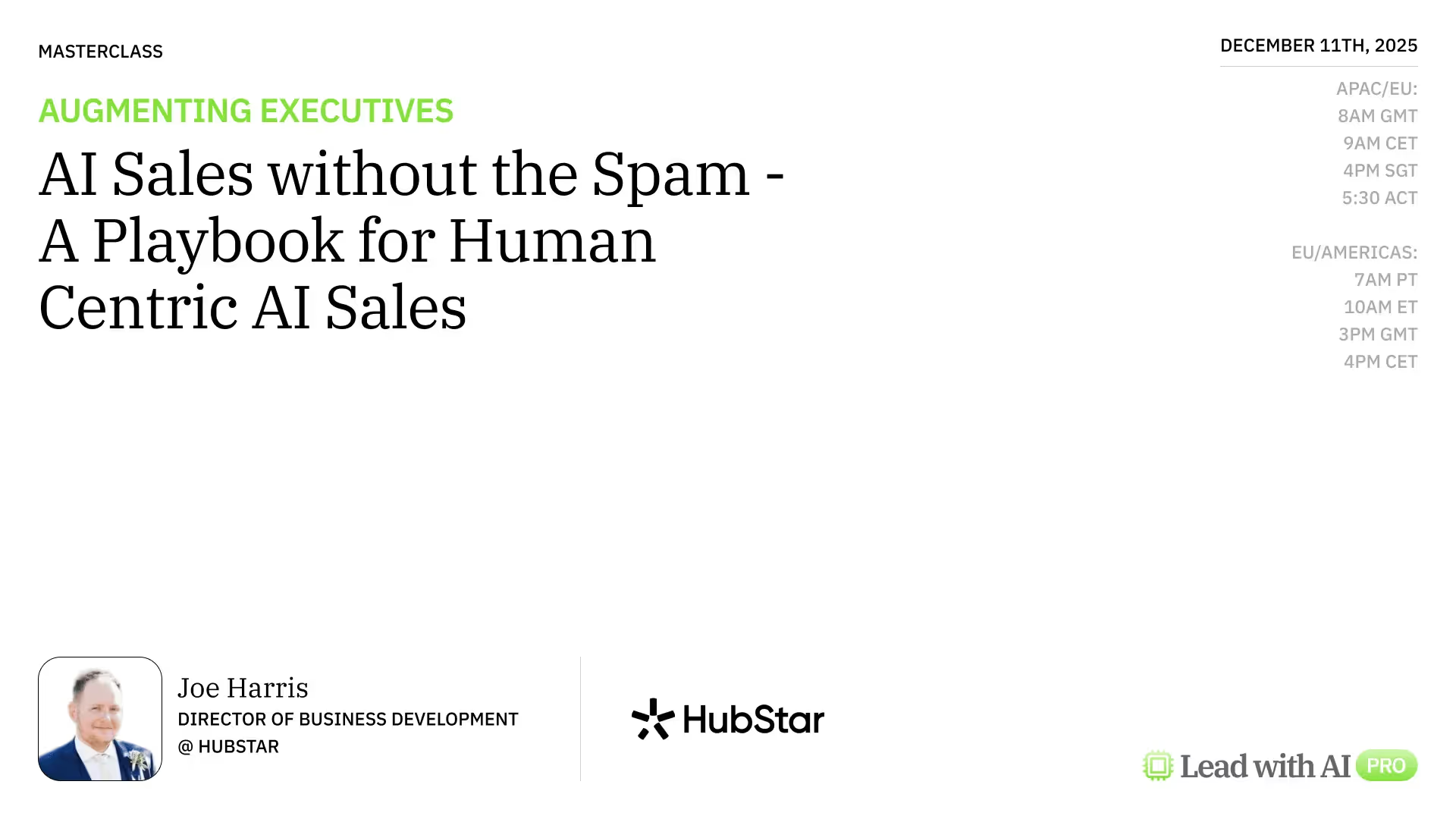
Joe Harris, Director of Business Development at HubStar, will lead our next Masterclass: AI Sales without the Spam to help answer that question.
What you’ll take away (and use immediately)
Supercharge efficiency: Discover how to automate lead qualification, data entry, and follow-up, freeing teams to focus on closing deals.
Empowering humans: See how AI can enhance human connection by crafting messages and interactions that feel more personal.
Unlock smarter insights: See how AI surfaces patterns in HubSpot data that help you prioritize leads and optimize campaigns.
Stay ahead of the curve: Understand the opportunities and limitations of AI in customer-facing roles, so you can guide your teams with confidence.
To ensure global access, the Masterclass will run twice on December 11th
APAC/EU: 8AM GMT/ 9AM CET/ 4PM SGT/ 5:30PM ACT
EU/Amercias: 7AM PT/ 10AM ET/ 3PM GMT/ 4PM CET
Members, the invite is on your calendar.
Not a member yet and want to join this exclusive Masterclass?
Or get a 14-day free trial of the world's leading executive AI community here.