

November 28, 2026

AI in Banking to 2030: The Fight for the Customer Relationship

Five strategic moves for banks facing AI-mediated customer relationships, changing workflows and entry-level jobs through 2030.
BBVA AI strategy editorial cover
Daan van Rossum
By
Daan van Rossum
Founder & CEO, Lead with AI

The economics of AI in banking

Presented by

Your main bank has a built-in advantage. Your salary arrives there, your bills leave from there, and it is the first place you look for a mortgage. Banks turned that habit into $1.3 trillion of net income in 2025, according to McKinsey's Global Banking Annual Review 2026.

AI is starting to sit between the bank and that habit. McKinsey found that 74% of consumers who use AI for banking tasks do so through ChatGPT, Claude or Gemini, about twice the share who use their own bank's chatbot. Once assistants can compare rates and act with permission, part of the relationship moves to whoever controls the assistant.

We read the strategies of the banks in our AI Strategy Index against industry data and the World Economic Forum's four futures for 2030. Five moves stand out:

  1. Defend the relationship before agents shop for it.
  2. Rebuild the core workflows end to end.
  3. Decide where the freed capacity goes.
  4. Keep people on the hard cases and the sign-off.
  5. Protect the entry rung.

What does AI change in banking?

AI changes banking in two directions at once: it lowers the bank's cost of serving each customer, and it lowers each customer's cost of leaving. Which moves faster decides who keeps the margin. McKinsey's 2025 review estimates that banks that do not reposition could see global profit pools fall by $170 billion, or 9%, over roughly a decade.

How banks make money today

Banks earn on the spread between funding and lending, fees from payments, cards and advice, and keeping service costs and losses below both.

Global banking net income reached $1.3 trillion in 2025, up 7%, with net interest margin of 1.63%. The FDIC reported $295.6 billion net income across 4,336 US insured banks, up 10.2%, with return on assets of 1.20% and Q4 net interest margin of 3.39%. ECB supervisory statistics put euro-area supervised banks' Q4 return on equity at 9.53% and net interest margin at 1.52%.

Net interest margins

US FDIC-insured banks, Q4 2025: 3.39%

Euro-area supervised banks, Q4 2025: 1.52%

Sources: FDIC and ECB. Regulatory measures are calculated differently; comparison is indicative.

With less margin to work with, a cost saving from AI can matter relatively more to a European bank. Challengers are now profitable: McKinsey reports Revolut has 80 million customers and return on equity of about 35%, against about 13% globally.

1. Defend the relationship before agents shop for it

Of the world's $70 trillion in consumer deposits, $23 trillion sits in checking accounts paying close to zero. McKinsey estimates that if just 5% to 10% of those balances moved to top-of-market rates, deposit profits would fall by 20% or more.

Consumer deposits exposed to rate shopping

Near-zero-rate checking balances: $23 trillion

All consumer deposits: $70 trillion

Source: McKinsey Global Banking Annual Review 2025.

On October 20, 2026, Visa, BILL and Billtrust launched a live pilot of AI agents paying approved business invoices end to end. Visa Intelligent Commerce and Mastercard Agent Pay let merchants accept purchases from verified agents.

BBVA warns that competitors could use AI agents to position themselves between banks and customers. Its answer is Blue, an agentic personal advisor live in Peru, with retail and commercial customers in Spain and Mexico planned for 2027.
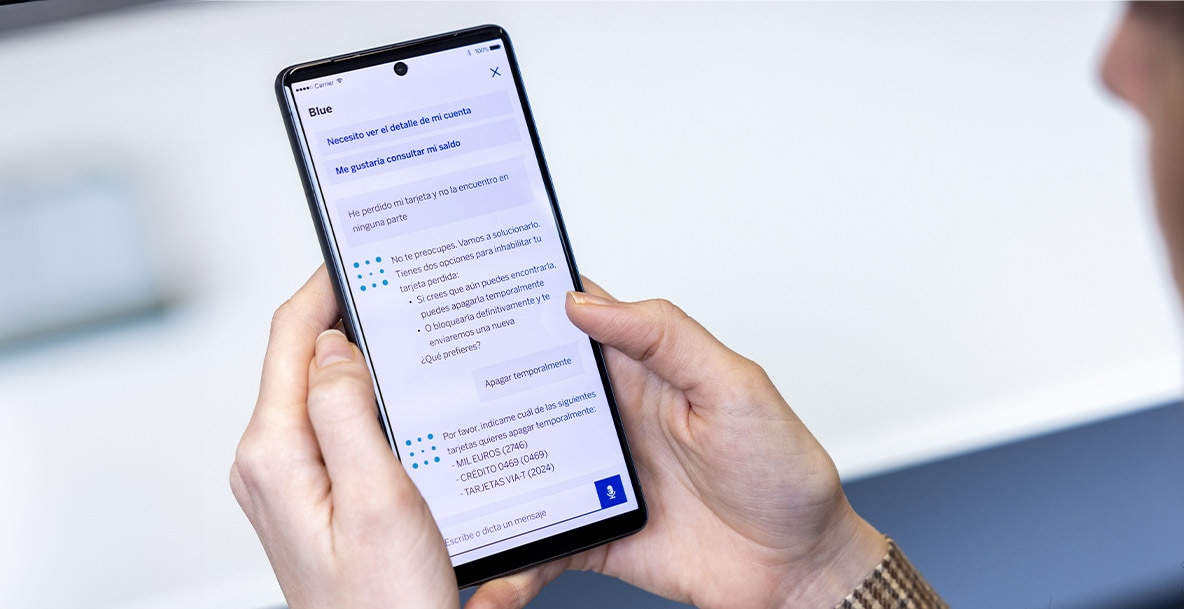
BBVA Blue assistant on a phone
Blue in the BBVA app. Image: BBVA.

European rules already require banks to open account data to authorized third parties. In the US, the CFPB open banking rule was blocked by a federal court and sent back for reconsideration.

What to plan for: Map products whose margins depend on customers not comparing offers, and how each would hold up if an assistant did the comparing.

Flagship AI Newsletter
The AI Newsletter That Makes You Smarter, Not Busier
Join 35,000 leaders and receive our insights on AI platforms, implementations, and organizational change management.
FlexOS Course - AI Content Accelerator - Testimonial Badge

How banks are rebuilding their operating models

2. Rebuild the core workflows end to end

Large banks in our index are converging on AI for onboarding, financial crime, service and code, with a human signing off. BBVA is the only one in this group to present a dedicated AI strategy with a dated roadmap.

JPMorgan Chase

AI-connected enterprise; about 50 of nearly 1,000 use cases really matter. Workforce signal: Jobs reduced 30% to 40% in discrete areas; most staff offered roles elsewhere.

Bank of America

End-to-end process redesign; Erica for clients and staff. Workforce signal: About 1,000 positions removed through attrition.

Citigroup

About 100 manual processes rebuilt with AI and automation. Workforce signal: 2024 restructuring could remove up to 20,000 roles.

Goldman Sachs

OneGS 3.0, an AI-powered operating model. Workforce signal: Headcount growth constrained from October 2025.

HSBC

Focus on use cases worth more than $100 million each. Workforce signal: FT reported plans to cut about half of UK wealth management and specialist roles.

Lloyds Banking Group

Agentic AI moves from promise to practice. Workforce signal: Over 1,000 AI roles in 2026, more than 700 filled internally.

BBVA

AI-native banking; ChatGPT Enterprise for 120,000+ staff. Workforce signal: About 10,000 operations roles and 12,000 developers shift toward supervision.

ING

Five AI domains under the COO. Workforce signal: About 1,250 operational roles cut in 2026.

These are disclosed directions and reported workforce changes, not evidence that every reduction was caused by AI.

Bank of America expects $250 million to $300 million in AI benefits in 2026. ING's due diligence agent answers 70 to 80 of about 100 standard questions from existing data, turning checks that took a day into seconds. Lloyds reports about £50 million from generative AI in 2025. These are company-claimed figures.

What to plan for: One core workflow, such as small business onboarding, with its end-to-end completion time measured today.

3. Decide where the freed capacity goes

McKinsey expects AI to cut up to 70% from certain cost categories, for a net 15% to 20% reduction in total bank costs. It also expects most savings to pass to customers as rivals match them.

Bank of America CEO Brian Moynihan described the choice in October 2026:

“We are 10% more efficient, so next year we get 10% more work for the same cost.”

The segments that open up are those previously too expensive to serve: small businesses, affordable advice and service in more languages. ING aims to handle more work without matching growth in staff or cost.

If AI gives a team back a quarter of its onboarding time, it could serve customers it turns away today, improve decisions on complex applications or replace fewer people as they leave. Each choice implies a different staffing and skills plan.

What to plan for: A stated reinvestment choice for freed capacity, reported to the board alongside savings.

The future of banking jobs

4. Keep people on the hard cases and the sign-off

When AI clears straightforward work, people keep a larger share of complex ownership structures, suspected fraud, vulnerable customers and disputed decisions. A bank can process routine cases faster and still see its worst delays grow.

The Bank of England and FCA's 2026 survey of 196 firms found 86% use AI and 80% have agents deployed, yet only 2% give agents broad autonomy.

AI adoption versus autonomy in UK financial services

Use AI: 86%

Have agents deployed: 80%

Give agents broad autonomy: 2%

Source: Bank of England and FCA, 2026 survey of 196 firms.

Agents that approve customer outcomes, initiate payments or change limits stay at 9% or less, even including planned use. Bank of America requires a person to approve money movement by Erica. ING's mortgage agent prepares Dutch applications, and an employee makes the final decision.

In the EU, credit scoring is a high-risk use under the AI Act, with human oversight obligations. The source reports that lawmakers agreed to move those obligations to 2 December 2027 (Forvis Mazars).

What to plan for: Measure time to resolve complex cases, reopened files and reviewer workload alongside average handling time.

5. Protect the entry rung

Revelio Labs found that US banks employed 4.7% fewer junior staff in mid-2026 than in October 2022, while mid-level and senior headcount grew. Junior hiring fell from about 10.5% of junior headcount annually to about 8.5% in 2024 and 2025, while attrition returned to normal after 2023.

Annual junior hiring as a share of junior headcount

Earlier rate: ~10.5%

2024–2025: ~8.5%

Source: Revelio Labs. US banking; bars scaled to 12%. This is not a causal estimate of AI impact.

Revelio also points to the rate cycle and digital banking; the most and least AI-exposed junior roles shrank at similar rates. The US Bureau of Labor Statistics projects teller jobs to fall 13% from 2025 to 2035, yet expects about 26,800 openings annually.

Investment banks reportedly discussed cutting analyst classes by up to two-thirds. Goldman Sachs executive Kevin Sneader described the new starting point in October 2026:

“When our young folks now start work, they're managing agents.”

Around three quarters of senior roles at US banks are filled internally, according to Revelio. McKinsey's Debasish Patnaik told Fortune: “Senior judgment cannot be manufactured laterally.”

The fix is supervised ownership of real cases: juniors interview borrowers, challenge AI-drafted credit memos and explain what would change their decision. Lloyds is moving more than 700 existing colleagues into AI roles in 2026.

What to plan for: An apprenticeship design tracked through junior hiring, case ownership, time to independent judgment and internal promotions. No comparable European dataset was identified; this section rests on US data and European bank disclosures.

Four futures for banking in 2030

The World Economic Forum's Four Futures for Jobs crosses two uncertainties: how fast AI advances and how ready workforces are to use it. These are scenarios, not predictions. The banking interpretations below are ours.

Four futures for banking in 2030

Workforce readiness: widespread (top), limited (bottom). AI advancement: incremental (left), exponential (right).

Co-Pilot Economy

Incremental advancement · widespread readiness

AI assists bankers with onboarding, advice and risk decisions; people retain ownership.

Supercharged Progress

Exponential advancement · widespread readiness

Agentic banking scales, customers compare and switch more easily, and staff move into higher-value work.

Stalled Progress

Incremental advancement · limited readiness

Legacy systems and skills gaps constrain adoption; pilots deliver uneven returns.

Age of Displacement

Exponential advancement · limited readiness

Routine work and junior hiring compress faster than banks can develop or redeploy talent.

Source: Lead with AI interpretation of the WEF Four Futures framework.

Workforce readiness is the axis a bank can act on. Most banks in our index describe a Co-Pilot model, while announced role reductions and weaker junior hiring raise concerns associated with the Age of Displacement. These workforce signals do not establish that AI caused the reductions.

Plan for more than one quadrant. WEF's Co-Pilot scenario assumes an AI bubble bursts and shifts the focus to practical integration. A bank that plans only for that is exposed if agents start moving customers faster than expected.

Your first 90 days

  1. Days 1 to 30: pick one workflow. Choose an onboarding team, collect role descriptions and measure completion time, review time, hiring and attrition.
  2. Days 31 to 60: check the work with the people doing it. Sort tasks into what AI already handles, what needs judgment and what nobody owns.
  3. Days 61 to 90: test the four futures against your numbers. Decide which work to redesign, where people could move and which early-career experience to protect.

Ten questions to ask about a bank's AI future

  1. Which of our products depend on customers not comparing offers?
  2. What share of new accounts or applications already arrives through third-party apps or agents?
  3. Which workflow are we rebuilding end to end, and what is its completion time today?
  4. Which AI value figures would we report publicly, and how are they measured?
  5. Where will the capacity AI frees up go: new customers, better decisions or lower hiring?
  6. Which customers do we turn away today that AI could make profitable to serve?
  7. Where does a person still sign off, and is that by choice or by regulation?
  8. How long do our most complex cases take to resolve, and is that number rising?
  9. How many juniors are we hiring compared with three years ago?
  10. How will a junior learn credit judgment when AI writes the first memo?

Frequently asked questions

Will AI replace bank jobs?

US junior bank headcount is 4.7% below its October 2022 level while senior headcount keeps growing. US teller jobs are projected to fall 13% by 2035. These trends have multiple causes, and the evidence does not isolate the impact of AI.

How are the largest banks using AI today?

The largest US and European banks apply AI first to onboarding, financial crime, customer service and software development, with a person approving consequential decisions. Few publish a standalone AI strategy, and most report job reductions more readily than AI value figures.

What is the biggest AI risk for banks?

One major strategic risk is losing the customer relationship to AI assistants that compare offers and move money with customer permission. McKinsey estimates banks that do not reposition could lose $170 billion, or 9%, of global profit pools over roughly a decade.

Scope: US and Western European banking. Bank figures come from the company profiles in the AI Strategy Index and are company-claimed unless noted. The scenario readings are Lead with AI's interpretation of the WEF framework.

Explore our AI Strategy Index, Future of Retail guide and AI transformation for financial services.