September 28, 2026

What Makes AI Training Stick? A Learning Design Framework From a Former Chief Learning Officer

Former IRS Chief Learning Officer Kirstin Austin on what makes AI training stick: a safe sandbox to practice together, and change management that outlasts the course.
What Makes AI Training Stick? A learning design framework from a former Chief Learning Officer, with Kirstin Austin, Impact Partner at Lead with AI
Jasmine Tran
By
Jasmine Tran
Analyst, Lead with AI

Presented by

Based on the July 31, 2026 Lead with AI PRO live session with Kirstin Austin, Impact Partner at Lead with AI and former Chief Learning Officer at the IRS.

Many organizations send team members to AI training, wait for behavior to change, and then wonder why nothing changed.

Kirstin Austin, a retired federal executive who most recently served as Chief Learning Officer at the Department of the Treasury's Internal Revenue Service, has spent decades designing and implementing training programs that drive real behavior change on the job.

Her answer to what makes AI training stick starts with a simple reassurance: you already know more than you think.

"All of the frameworks you learned pre-AI about learning and development, adult learning, and change management still apply," said Austin.

AI doesn't require a new science of learning.

Among all the instructional design and learning techniques, Austin emphasizes doing two things well: 1. giving people a safe place to practice together, and 2. building change management that holds once the training ends.


Slide titled Elements of Success: Adult Learning and Change Management. Three core elements of adult learning are didactics, practice and learning community. Change management has three elements: communications, leaders' role and sustainment. The elements support the learning, and change management supports the organization.
Flagship AI Newsletter
The AI Newsletter That Makes You Smarter, Not Busier
Join over 30,000 leaders and receive our insights on AI platforms, implementations, and organizational change management.
FlexOS Course - AI Content Accelerator - Testimonial Badge

Build a Sandbox for Real Learning

Austin's first pillar comes down to one idea: people need a judgment-free place to learn, and a group to learn alongside.

That starts with a corporate sandbox. Teams need a "corporate sandbox and safe places where they can do this," Austin said. One example would be guided practice built in 30-minute daily increments, so learnings and conversations can build on each other.

For teams that want to build this shared practice, see our team AI training.

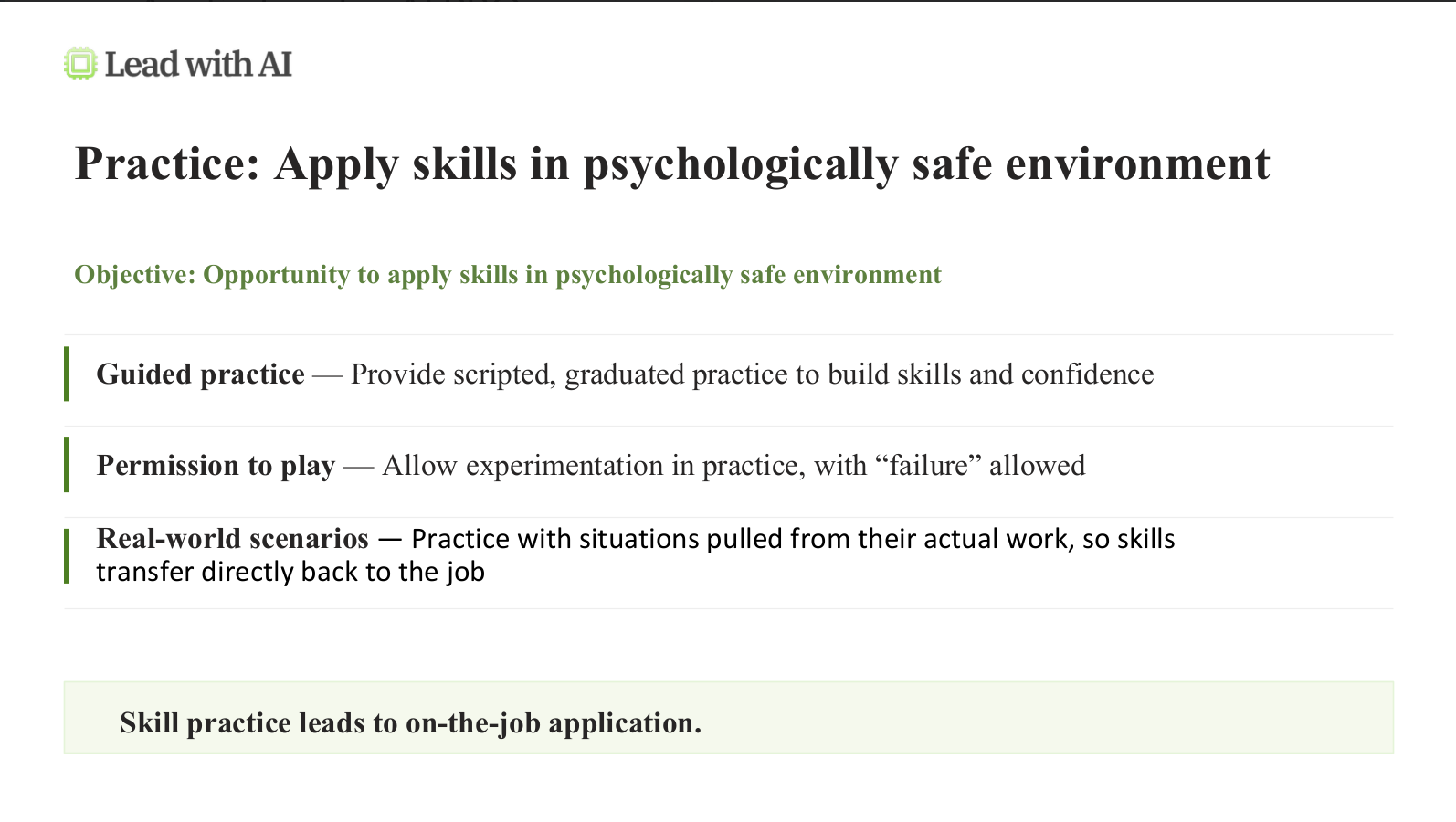
Slide titled Practice: Apply skills in a psychologically safe environment. Guided practice provides scripted, graduated practice to build skills and confidence; permission to play allows experimentation with failure allowed; real-world scenarios use situations from participants' actual work. Skill practice leads to on-the-job application.

The sandbox only works if it fosters a learning community. In Austin's view, even people who'd rather learn alone still need to return to a group to see how others apply what they learned.

Some of that pull is simply social. People respond to "a little bit of peer pressure, a little bit of competitiveness," Austin said, and a healthy dose of both keeps a cohort moving instead of stalling out after week one.

The clearest proof came from a small-business owner cohort Austin facilitated. Participants arrived afraid of AI, running their own small businesses with little background in the tools at all.

By the end, what they credited for getting them through wasn't just the curriculum; it was having peers "to bounce ideas off, and to demonstrate, too, to encourage and support their learning."

"You're gonna get the behavior you pay attention to," said Austin. Groups where sharing your AI experiments is normal produce more of that behavior. Individual learners or groups left alone don't.

This is also part of the key idea on AI fluency: skills only compound when people keep practicing together after the course ends.

Change Management: The Water Everyone Swims In

Training alone fails, Austin said, if "nothing has changed in the environment" around it. That’s the gap between adoption and AI transformation: training changes what people know, while transformation changes how the work gets done.

She breaks the fix into three parts:

  • Leadership messaging: Leaders have to be seen using AI, not just talking about it. "Maybe they have an agent that creates charts and summaries for them that they use in a meeting," Austin offered as an example. Visible use solidifies the message.
  • Direct communication: That visibility only lands if it's paired with conversations about what AI means for people's jobs. People might quietly worry that trying something new puts their role at risk. Communicate directly about how these tools can empower them and how AI integration and innovation support the individual performer and the mission of the organization.
  • Process redesign: Austin said doing process redesign at the team level first is "one of the most important ways you can empower the team members to not feel afraid." People end up contributing to the conversations around building the change. This collaboration welcomes people to AI integration and helps them overcome the resistance and anxiety of feeling that AI is being done “to them”.

So, What Resources Should Be in Place?

None of this holds if leaders are asked to carry it without support. Here’s Austin's warning: organizations tell frontline leaders to support a rollout, but they might not give them the proper resources to do it.

Give leaders governance support, budget, and visibility, not just a mandate to make it happen.

Slide titled Leaders' Role: define what leaders must do to make AI adoption stick. Sponsorship, not just attendance; visible use; governance decisions; and resource allocation. Leaders don't just approve AI adoption, they model and fund it.

The resourcing model Austin points to is cascaded learning. Frontline employees get baseline training plus reference material, such as "e-manuals and electronic support."

Leaders get a separate track built around what leading the change actually requires: how to model it, how to talk about it, and a peer group of other leaders to compare notes with. It's close to what a formal AI champion program model looks like: the people responsible for sustaining the change get enhanced support to “champion” it across their organization.

The last resource is structural: build touchpoints into what is being developed. A place to share prompts and assistants people have built, a fast approval process, and AI as a standing item in staff meetings and comms, not a one-time announcement.

The Bottom Line

Austin's framework reminds us that the fundamentals of how people learn and change together just need intentionality to be useful in the age of AI. Give people a real sandbox and a community to practice in, and the skills compound on their own.

The same is true of change management. It succeeds or fails based on whether leaders are willing to be seen learning in public. A leader who shares their own AI experiment, imperfect prompts, and so on, drives adoption more than any policy memo ever could.

Build the sandbox, support the community, and pay attention to the right things, and the training will stick.

To see how this framework played out against a real department with reservations about AI and jobs, read the companion case study: how Harvard's School of Public Health piloted AI fluency, with Kirstin Austin's fellow presenter, Bryn Austin.


Kirstin Austin is an Impact Partner at Lead with AI and a retired federal government executive who most recently served as Chief Learning Officer at the IRS. This article is based on her July 31, 2026 Lead with AI PRO session, "Designed to Stick," co-presented with Bryn Austin.