
September 21, 2026

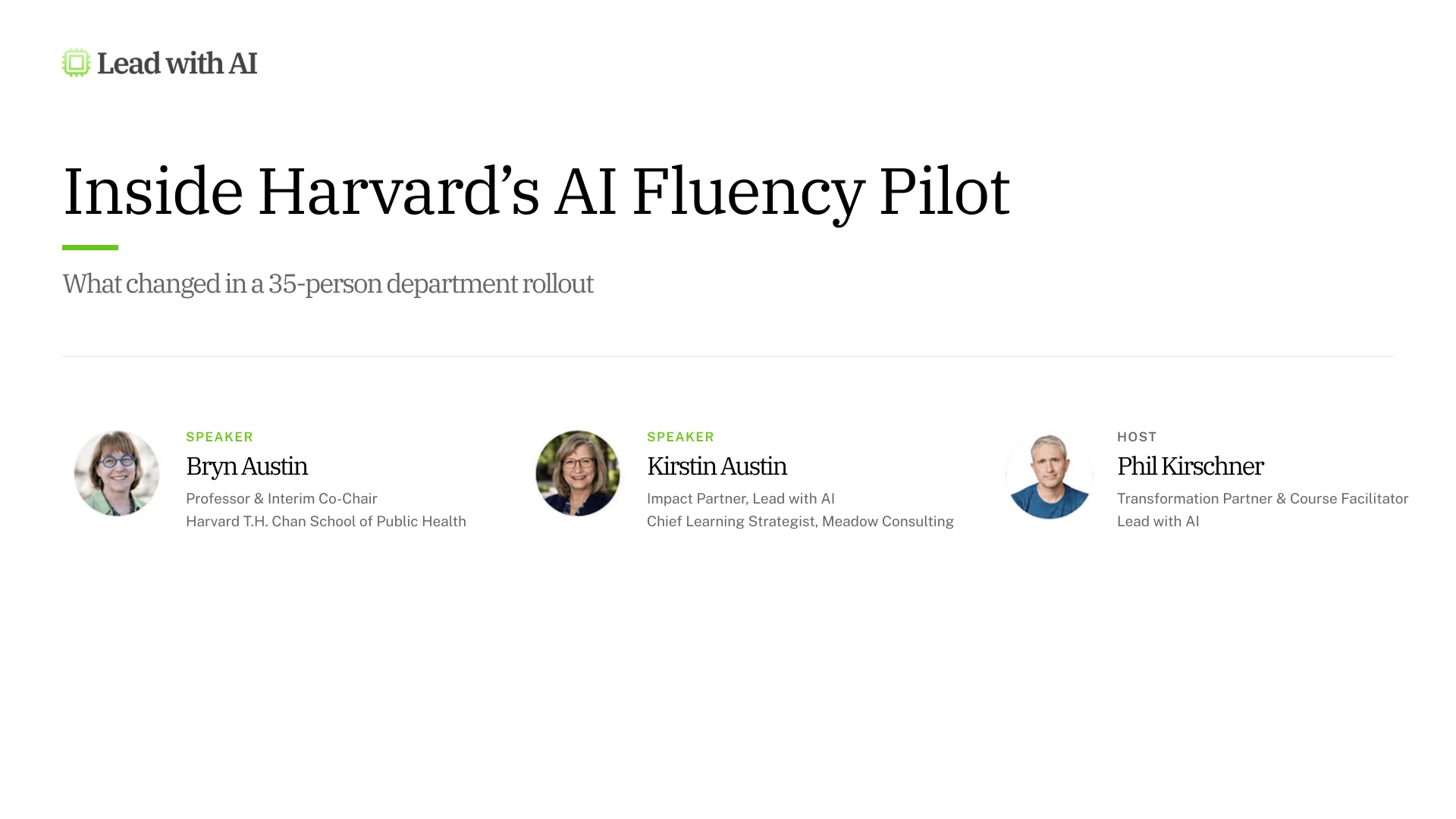
Inside Harvard's AI Fluency Pilot: Bryn Austin's Case Study for the School of Public Health

How Harvard's School of Public Health ran a 35-person AI fluency pilot: what the intake survey found, the three-week course, and the results that moved.
Inside Harvard's AI Fluency Pilot: what changed in a 35-person department rollout, with Bryn Austin, Kirstin Austin and Phil Kirschner. Lead with AI
Daan van Rossum
By
Daan van Rossum
Founder & CEO, Lead with AI

Presented by

Based on the July 31, 2026 Lead with AI PRO live session with S. Bryn Austin, ScD, interim co-chair of the Department of Social and Behavioral Sciences at the Harvard T.H. Chan School of Public Health.

Austin had watched AI’s development for years without doing much about it.

That changed in December, when she saw a Shakespeare quote app Kirstin Austin had built for fun in a Lead with AI course.

"I was blown away," Austin said. She took the course herself in January 2026; by April, it was a 35-person department pilot.

That pilot is the case study Austin walked a Lead with AI PRO audience through, and it builds directly on the learning design framework Kirstin Austin laid out earlier in the session.

The North Star Guiding the Rollout

Before recruiting anyone, Austin's department set four principles:

  • Individual empowerment flipped "the administrative burden into fluency," so AI use freed people from grunt work rather than adding another tool to learn.
  • Organizational cohesion aimed to move the department "from fragmented experimentation to shared language and standardized workflows.” This effort replaced the scattershot workshops Austin had tried before.
  • Academic excellence kept the bar on integrating AI responsibly into classrooms and research, not just administration.
  • Thought leadership pushed the school to build "a credible voice in global discourse on ethical AI adoption," in this case, public health.

Flagship AI Newsletter
The AI Newsletter That Makes You Smarter, Not Busier
Join over 30,000 leaders and receive our insights on AI platforms, implementations, and organizational change management.
FlexOS Course - AI Content Accelerator - Testimonial Badge

What the Intake Survey Found

Before the course, Austin's team surveyed the volunteers. The good news: 92% already intended to keep experimenting with AI.

The more urgent finding: two-thirds weren't using Harvard-approved tools at all. They weren't in the school's secure sandbox because they didn’t recognize its importance.

Under both numbers was a real confidence gap: people willing to keep learning but unsure of their own competence. The course aimed to close that gap.

Inside the Three-Week Course

The program itself was deliberately short: a 3-week build.

Week one covered the foundations: how large language models work and how to prompt effectively.

Week two moved into applied skills for everyday work: email, writing, data analysis.

Week three was a showcase, where each learner presented what they'd built to their peers.

The Numbers That Moved

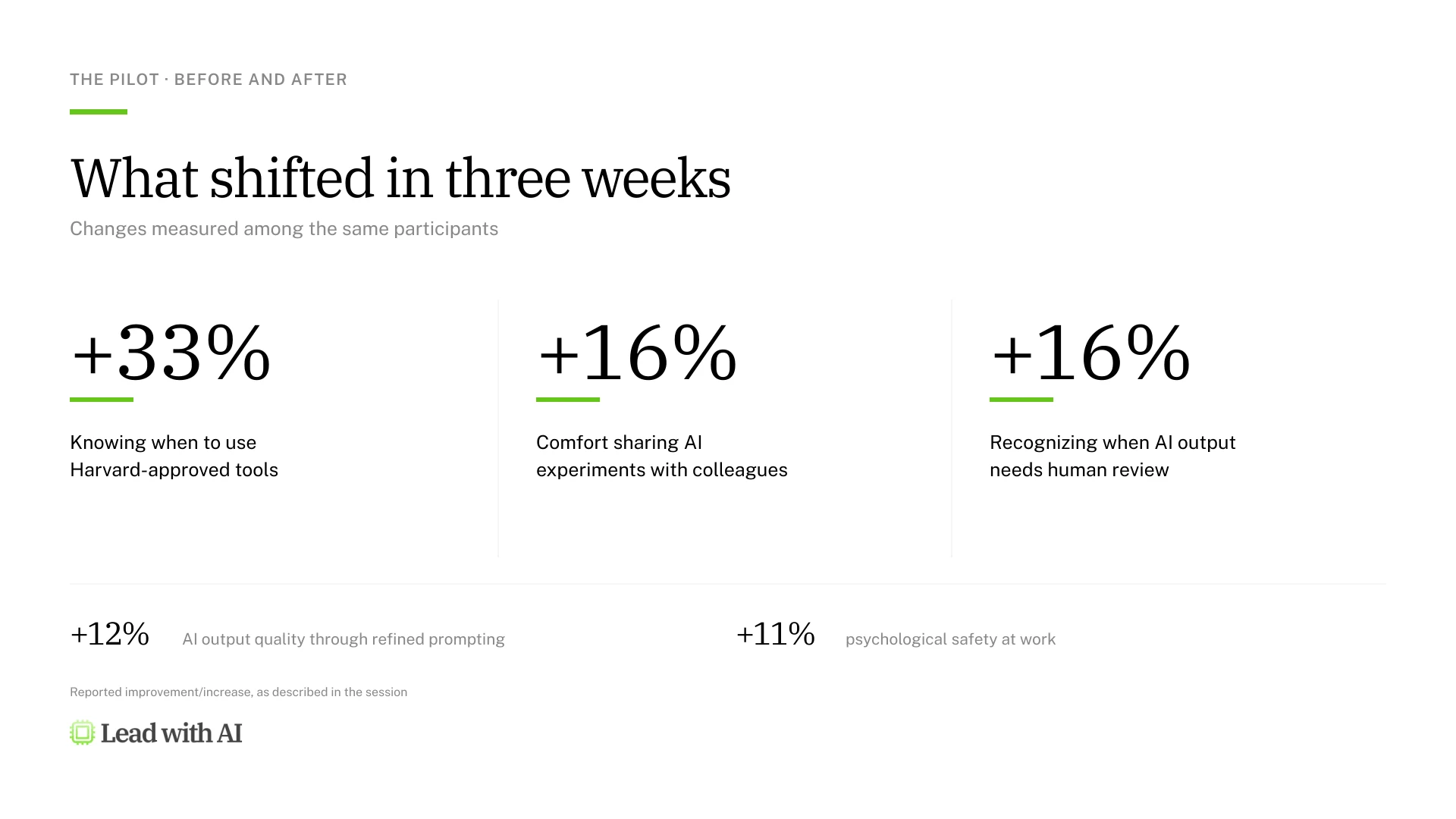
Before-and-after results of Harvard's AI fluency pilot: +33% knowing when to use Harvard-approved tools, +16% comfort sharing AI experiments, +16% recognizing when AI output needs human review, +12% output quality, +11% psychological safety

Tracking the same individuals from before the course to after, Austin's team measured five specific shifts:

  • 33% improvement in knowing when to use Harvard-approved tools, the most basic and most urgent gap to close.
  • 16% increase in feeling comfortable asking colleagues about AI and sharing experiments, even ones that failed.
  • 16% increase in correctly identifying when AI output needs human review rather than being trusted outright.
  • 12% improvement in AI output quality through more systematic, refined prompting.
  • 11% improvement on a separate measure of psychological safety at work.

By the end, 88% of the cohort had built at least one AI assistant for their own job, and 38% had built three or more.

Intentions to keep using AI, already high going in, reached 97%.

Based on that adoption rate, Austin estimates the department could reclaim 1,300 to 1,400 hours a year for higher-value work.

Turning a Three-Week Course Into a Habit

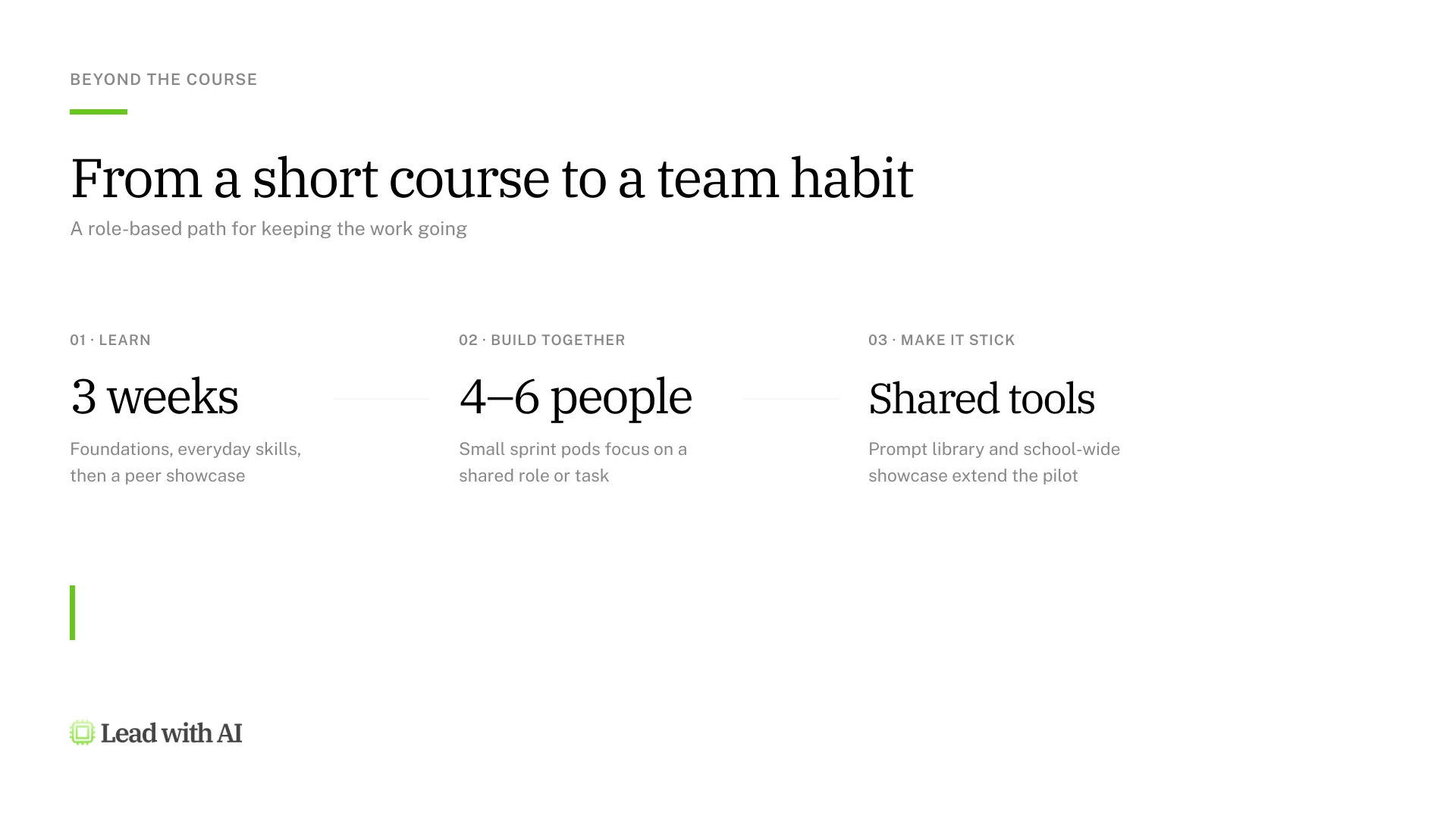
The course didn’t end after the showcase. This summer, her department launched Summer Sprint Pods, smaller groups of four to six people building one shared assistant for a specific role.

One pod serves grants managers working through dense spreadsheets and complex award terms. A second is building a custom GPT that helps faculty modify a single assignment to build AI skills without derailing their existing course objectives.

From a short course to a team habit: a 3-week course, then 4 to 6 person sprint pods, then shared tools like a prompt library and school-wide showcase

This aligns with the cascaded learning and peer-group structure Kirstin Austin described earlier in the session: a separate, role-specific track instead of one course for everyone.

A shared prompt library launches next month. An August faculty and staff retreat will showcase what the pods built to the wider school. These are parts of intentional planning to make AI integration stick.

S. Bryn Austin, ScD, is a professor and interim co-chair of the Department of Social and Behavioral Sciences at the Harvard T.H. Chan School of Public Health. This article is based on her July 31, 2026 Lead with AI PRO session, "Designed to Stick," co-presented with Kirstin Austin, whose companion piece covers the learning design and change management framework behind this case study.