

Lovable AI Strategy: Every Team Builds Its Own Tools
How Lovable runs on AI: every team builds its own tools, shared internal agents, engineers directing agents, and the results it reports. Updated November 2026.
AI platform that builds, hosts and edits software from plain-language prompts
No published AI strategy; inferred from Lovable’s engineering blog, job ads, executive talks and its chief people officer’s Fortune essay (November 2026).
Read the company sourceWhere Lovable Is Going with AI
Lovable is a Stockholm software company whose product is an AI agent that builds apps, and it runs its own operations the same way. Its rule is that the people closest to a problem build the fix, usually on Lovable itself. One data scientist’s analytics app is used by about 90% of employees, and an engineering agent built by one employee now serves 250 people (both company-claimed).
Lovable was founded in 2023, launched in November 2024 and now has about 300 people, according to its own job ads. It is privately held and sits outside the S&P 100 and STOXX Europe 50, so it is profiled as an AI Pacesetter and is not counted in index figures.
Lovable does not publish a formal AI strategy, so this profile is inferred from its engineering blog, job ads, executive talks, an essay by its chief people officer and a leadership session its people team gave at HR-dagarna 2026.
Lovable wants a team of about 300 to work like a company of 3,000, with AI doing every task it can. That is how its AI Ops Engineer job ad describes Project Automate Lovable, which sits with an AI Operations and Automation function under a standing rule: “Lovable on Lovable first, always.”
The internal plan mirrors what Lovable sells. At Salesforce’s Dreamforce in September 2026, CEO and co-founder Anton Osika argued that people with domain knowledge in marketing, finance or HR should build the software for their own problems, instead of leaving it to engineers.
The next step is a shared “company brain” that ties those tools together. CTO and co-founder Fabian Hedin told Latent Space that the goal is for everything a team builds to be reusable by an agent, with separate capabilities “connected through one agent.”
The same expectation runs through hiring. Recent job ads ask a new Head of Customer Experience to build an agentic-first support function, and an internal communications lead to run work that would normally take a team by defaulting to AI.
Leaders are expected to keep up by building themselves. Chief People Officer Maryanne Caughey wrote in Fortune that leaders should build a first version of a real problem in their own work, and warned them against becoming the ceiling for AI adoption in their teams.
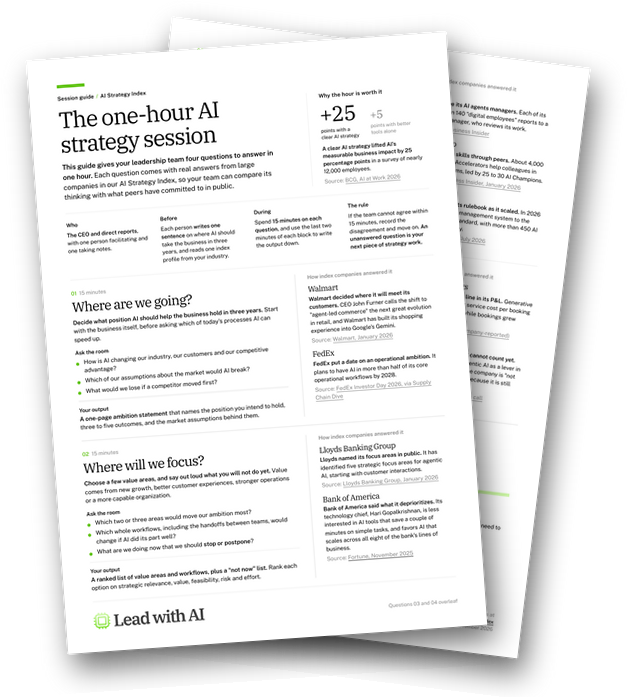
Where is your company going with AI, and where will it focus?
Those are the first two of four questions every AI strategy has to answer. Our free guide walks your leadership team through all four in one hour.
What It Takes: Builders Everywhere, Shared Agents and Leaders Trained for Complexity
Every function builds and owns its tools
Lovable’s People team built its own HR operating system instead of buying one. A Lovable case study says it covers org planning, compensation, onboarding and employee support, and cut offer approvals and equity modeling from days to minutes (company-claimed).
Employee questions go to an AI agent first. Poppy answers routine policy questions privately in Slack from company handbooks, and routes sensitive matters to the People team so they can focus on personal support.
The design team did the same for creative work. All internal creative requests now run through its Creative OS, where a Slack agent called Hue turns requests into briefs, and its Brand Hub, with a built-in brand agent, recorded nearly 10,000 visits in a single month (company-claimed).

Clear rules keep this from turning into a sprawl of apps. Caughey’s guardrails are to decide who controls data access before anyone builds, give every tool a named owner with a plan for maintenance or retirement, and build on existing tools rather than duplicating them.
Internal agents connect the company
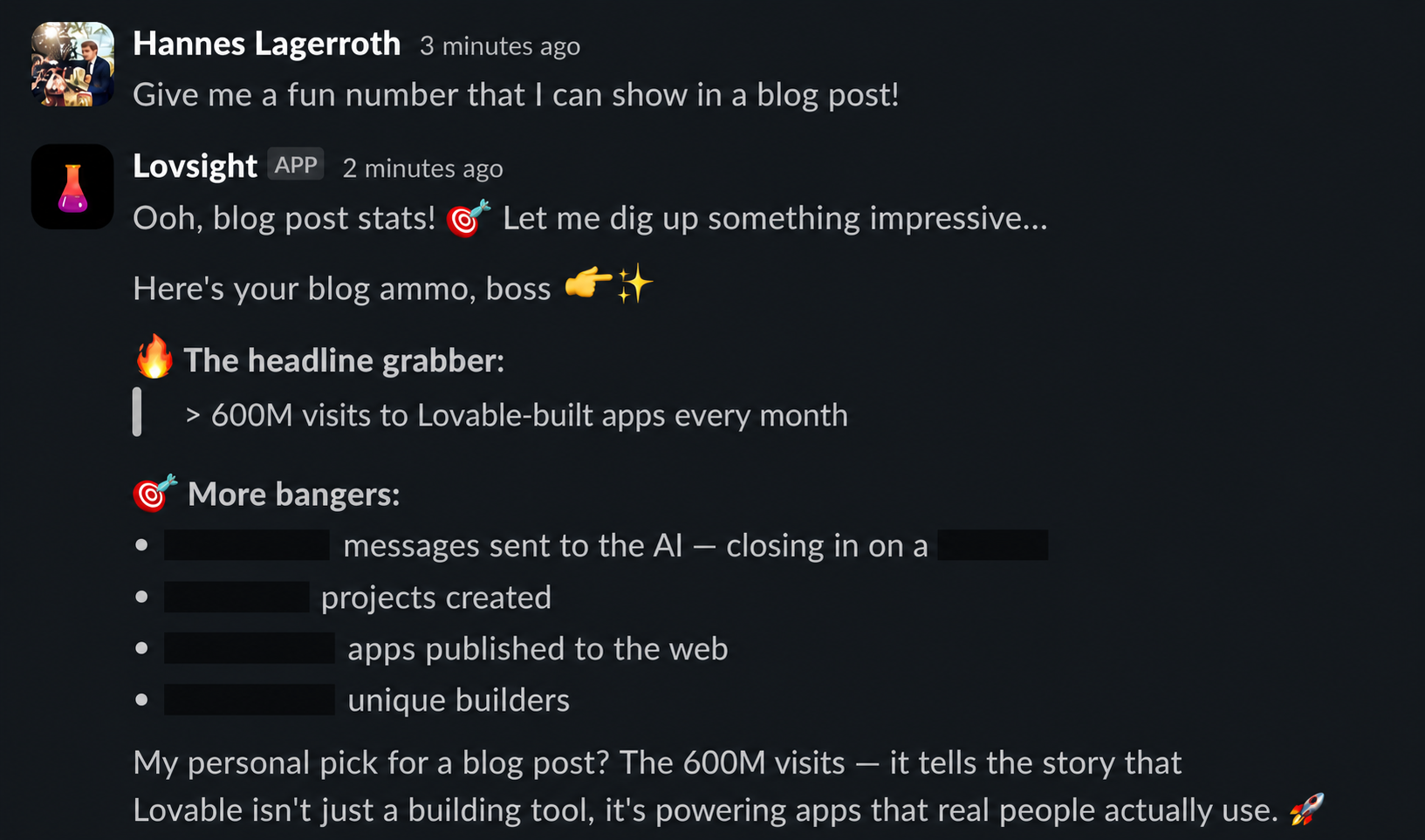
A handful of agents, each built by one person, now serve the whole company. In a June 2026 post, a Lovable data scientist described Lovsight, an analytics app that began at an internal hackathon.
Lovsight is now used by about 90% of employees and issues more than half of the company’s data warehouse queries (company-claimed). Later versions added a Slack agent and role-based access, and customer support now pulls user context without filing engineering tickets.
PAX, an engineering agent, spread from one team to every department. Its builder, Lycke Anderlind, wrote on LinkedIn that PAX began in April as a side project for a 15-person team investigating user problems and is now used by 250 people in Slack, Linear and GitHub.
The agents also call each other. PAX asks Company Brain for company knowledge and Lovsight for data, so three internal agents built by three people work as one system.
Agents do the work, people own the risk
Lovable’s engineers increasingly direct teams of agents instead of writing each change. In a July 2026 post, engineer Alexander Lebedev reported going from 20 to 30 merged code changes in a productive week in January to 150 or more in June, with his AI spend reaching about $25,000 a month (company-claimed).
Human attention goes where the risk is. An AI classifier sorts each change by size, risk and ownership into fast AI review, slower AI review, or mandatory human review for areas such as infrastructure and login security, while design decisions stay in discussions between people.
Security testing works the same way. Lovable runs swarms of AI hacking agents against its own systems, and in July 2026 it said it became the first coding agent platform to earn AIUC-1 certification, a safety standard for AI agents.
Speed has also produced a public failure. Between February 3 and April 20, 2026, a backend change let any Lovable user with a link see the chat history and code of public projects, and early researcher reports were closed without escalation because internal triage guidance was out of date.
Lovable’s response is worth studying. It admitted that its first public reply was dismissive, said it had not built enough safeguards and security processes, and retrained its triage team and changed escalation so that product changes affecting data access now update that guidance.
Leaders trained for complexity
Lovable treats leading through fast change as a skill to train. At HR-dagarna 2026, Head of People Experience Krystall Fierens-Lee and leadership advisor Jan Artem Henriksson shared the frameworks behind Lovable’s 2026 leadership training, which Fierens-Lee designed with Henriksson’s support.
The session covered what rapid growth and AI transformation demand of People and Culture teams, decision-makers and individual leaders, including the role AI agents play.
Henriksson argued that people functions are now setting values that may last a long time. They help decide what gets measured, which routines exist, what gets automated and what stays purely human, and he urged them to use AI to sharpen sense-making, decision-making and meaning-making without outsourcing those skills.
Fierens-Lee was candid that Lovable has not solved this. She called its approach “very much a work in progress.”
The People team backs this with hands-on help. Caughey describes applied AI partner sessions in which partners help each function pressure-test ideas and define success metrics, while the team keeps ownership.
New hires build from day one. They get Lovable credits and a starter brief before they start, spend two hours on their first day building something real with an experienced colleague, and about 90% ship a first contribution in week one (company-claimed).
AI fluency, coded against the Lead with AI Fluency Matrix (September 2026 edition):
- Fluency floor: Not published as a standard. Every new hire builds something real on Lovable on day one, and about 90% ship a contribution in their first week (company-claimed).
- Highest level evidenced: Level 4 (Transforming), company-claimed. Agents built by single employees serve the whole company, and engineers direct teams of agents with risk-based human review.
- Portfolio design: builders in every function, supported by AI operations engineers, applied AI partner sessions and leadership training.
The AI Tools Lovable Uses
Lovable builds most of its internal AI on its own product and buys the models underneath from several suppliers. Internal apps and agents such as PAX, Lovsight, Poppy and Brand Hub are Lovable projects that staff build and maintain themselves.
For AI models, Lovable is deliberately multi-supplier. Its engineering blog names Anthropic, Google’s Vertex AI and Amazon Bedrock among its routes, at peaks above a billion tokens a minute, and a later post describes a control plane that picks the model for each part of a build, including models Lovable trains itself.
Google Cloud became a primary technology partner in June 2026. The joint announcement covers Gemini models and infrastructure, and an unnamed source told TechCrunch the deal also expands Lovable’s access to Claude (not confirmed by the company).
For staff, Lovable wants every teammate to have AI working for them. Its job ads describe setting up ChatGPT and Claude with connections to company tools, and making the AI features in Slack, Linear and Notion useful. The public records behind its web addresses show company accounts with Anthropic, Cursor, Notion and Slack; we found no such record for OpenAI, so ChatGPT for staff is listed as Likely.
| Tool | Made by | What Lovable uses it for | How we know |
|---|---|---|---|
| Lovable | Lovable | Internal apps and agents for every team, including PAX, Lovsight, Poppy and Brand Hub | Confirmed: company blog and case studies |
| Lovable’s own models | Lovable | Routing builds, summarizing responses and writing code change notes | Confirmed: company blog |
| OpenAI models and ChatGPT | OpenAI | GPT models offered inside Lovable; ChatGPT set up for staff | Confirmed: company product pages (models). Likely: job ads (ChatGPT for staff) |
| Claude | Anthropic | One of the models behind the Lovable agent; staff assistant connected to company tools | Confirmed: company engineering blog, job ads and the public records behind its web addresses |
| Gemini | Models in the product under the Google Cloud partnership | Confirmed: joint announcement with Google Cloud | |
| Cursor | Anysphere | AI coding for engineers and AI operations staff | Confirmed: the public records behind its web addresses show a company account; named in job ads |
| Google Cloud and Vertex AI | Primary infrastructure and AI partner, and one route to AI models | Confirmed: joint announcement and company engineering blog | |
| Amazon Bedrock | Amazon Web Services | Another route to AI models | Confirmed: company engineering blog |
| Slack | Salesforce | Where internal agents such as PAX, Lovsight, Poppy and Hue answer staff | Confirmed: company case studies and the public records behind its web addresses |
| Linear | Linear | Tracking human work; PAX also answers there | Confirmed: company blog and an employee’s post |
| Notion | Notion | Company workspace whose AI features job ads say to make useful | Confirmed: the public records behind its web addresses show a company account |
The pattern keeps the model layer swappable and the business logic in Lovable’s own apps. When Lovable changes or adds a model supplier, the change happens in its routing layer, while the tools staff use every day stay the same.
How we build this list: we use public information only, such as company announcements, websites, job ads, supplier case studies, press reports and the public records behind a company’s web addresses. Confirmed means the company itself or a public record shows it. Likely means a strong second-hand source, such as a supplier case study, a press report or several job ads. A listing shows that a tool is used somewhere at Lovable, not how widely. Checked November 2026.
The one-hour AI strategy session
This profile of Lovable follows the four questions every AI strategy has to answer. Answer them for your own company in one hour.
Our free session guide gives your leadership team the four questions and real answers from across the index.
How Lovable Measures Results
Lovable reports adoption, speed and cost results for individual tools, but no company-wide productivity figure. All figures below are company-claimed and come from case studies, blog posts and executive essays.
- Adoption: about 90% of employees use Lovsight, 250 people use PAX, the People tools log more than 5,000 active sessions a month, and all internal creative requests run through Creative OS.
- Speed: offer approvals went from days to minutes, about 90% of new hires ship in their first week, and one engineer’s weekly merged code changes rose from 20 to 30 to 150 or more.
- Cost and time: the People team says it saves $25,000 a year in onboarding software licenses, and Caughey says a live headcount planning view saves about 10 hours a week.
- Quality: Lebedev reported no production defects traced to the 293 changes he merged in the first week of June, at the time he wrote.
What is missing is a company-wide measure of value, such as hours returned or cost per unit of work, which would show whether the goal of 300 people working like 3,000 is on track. The closest company-level signal is revenue per employee, which is context only.
Change log
- November 2024: Lovable launches.
- March 2026: Lovable’s engineering blog describes routing AI work across several model suppliers.
- April 2026: Lovable fixes a public-projects exposure, apologizes for its first response and changes how security reports are escalated.
- June 2026: Google Cloud becomes a primary technology partner, covering Gemini models and infrastructure, and Lovable reports that about 90% of employees use its internal data agent, Lovsight.
- July 2026: Lovable reports AIUC-1 certification and describes engineers running swarms of agents.
- August 2026: Lovable describes itself as model-independent, with its own models handling part of the work.
- November 2026: Chief People Officer Maryanne Caughey sets out Lovable’s approach to leading builders in Fortune.
The Bottom Line
- Disclosure: 3 of 4. Lovable answers where it is going, where it will focus and what it will take, but publishes no company-wide measure of results.
- Lovable shows what a company looks like when building software is a normal part of every job. Its People, design, data and engineering teams own tools they built themselves, and a few internal agents connect them into one system.
- The part large companies can copy is the operating rules. Decide data access before anyone builds, give every tool a named owner, send high-risk changes to human review, and train leaders to decide what stays human.
- The say-do gap is governance. The April 2026 incident showed that tools built at this speed need security processes and escalation that grow just as fast.
- Watch for a company-wide measure. The test is whether Lovable reports hours returned or cost per unit of work that shows 300 people working like 3,000.
To try the builder approach yourself, our Lovable guide shows how leaders build and publish a first working app.
Revenue, Headcount and Revenue per Employee
What the numbers show: Lovable is private and reports annualized revenue run rate (ARR) instead of audited revenue, so these are company-reported milestones, not fiscal years. Osika has said that Lovable calculates ARR as the prior month’s revenue multiplied by 12.
Annualized revenue, headcount and revenue per employee, January 2025 to September 2026
- January 2025: about $10 million ARR, two months after launch (Lovable). Headcount not disclosed.
- July 2025: $100 million ARR with 45 full-time employees (TechCrunch), about $2.2 million per employee.
- February 2026: $400 million ARR with 146 full-time employees (TechCrunch), about $2.7 million per employee.
- September 2026: more than $600 million ARR (The Next Web), with about 300 people according to Lovable’s job ads, or roughly $2.0 million per employee.
Change: ARR grew about sixfold from July 2025 to September 2026 while headcount grew close to sevenfold, so revenue per employee peaked around February 2026 and fell as Lovable hired. In between, Lovable reported $200 million ARR in November 2025 and more than $500 million in June 2026.
Notes: ARR figures are company-reported and unaudited. Headcount comes from different kinds of sources (press interviews and a job ad), and the September figure is approximate.
These figures give context on scale and productivity. They do not show that AI caused any change. Sources: Lovable, TechCrunch, The Next Web.
How Lovable Compares with Software and IT Services Peers
Lovable is an AI Pacesetter: an AI-first company outside the index, profiled for contrast and not counted. Here is how it compares with software and IT services companies in the index.
| Company | Disclosure | AI owner | Fluency floor | Governance | AI value reported | Revenue per employee |
|---|---|---|---|---|---|---|
| Accenture | 3 of 4 | Chief AI and Data Officer | Level 1, training plus tracked use for senior staff | Framework since about 2017; $1B AI safety commitment | Stopped reporting AI sales in 2025 | $91k |
| Adobe | 4 of 4 | No internal AI lead named; finance, IT and security under one leader | Not published | AI Ethics Review Board and impact assessments | Results by team, no total | $758k |
| IBM | 4 of 4 | CEO chairs biweekly AI governance | Not published | Four-layer governance chaired by the CEO | Yes: $4.5B in annualized productivity savings | $256k |
| Intuit | 3 of 4 | Chief AI Officer | Not published; most staff use AI tools | AI Governance Committee, board oversight | Engineering speed and customer outcomes, no total | $1.15M |
| Microsoft | 4 of 4 | Chief Strategy and Transformation Officer | Not published; one AI tool licensed to 200,000+ staff | Responsible AI Standard revised for agents | Results by workflow, no total | $1.49M |
| Oracle | 3 of 4 | Co-CEOs; global CIO runs the internal rollout | Not published; about 80% use AI tools | Standards and security controls before rollout; model costs shown to staff | No: adoption and coding speed only | $478k |
| Palantir | 4 of 4 | CEO | Not published | Not published for internal use | Revenue per employee as the measure | $1.01M |
| Palo Alto Networks | 4 of 4 | Global CIO; VP of Enterprise AI | Not published; AI access under security controls | AI access controls; humans confirm unresolved alerts | Results by process, no total | $524k |
| Salesforce | 4 of 4 | CEO; President of Customer Success runs support agents | Not published | Office of Ethical and Humane Use; agentic AI guidelines | Yes: about $100M a year in support | $498k |
| ServiceNow | 4 of 4 | CEO; Chief People and AI Enablement Officer | Not published | AI Control Tower tracks where AI runs and its impact | Yes: more than $1B in annualized value | $455k |
| Lovable AI Pacesetter | 3 of 4 | CEO; an AI operations team automates internal work | Not published; every new hire builds on Lovable in week one | Data access set before building; human review for high-risk code | Results by tool, no total | About $2.0M (run rate) |
| Shopify AI Pacesetter | 4 of 4 | CEO sets the AI expectation; engineering leads the tools | Level 2 by expectation: reflexive AI use | AI use rated in performance reviews | Link between AI use and impact, no total | $1.52M |
| Zapier AI Pacesetter | 4 of 4 | Chief People and AI Transformation Officer; executives own their functions | Level 3 for new hires: repeatable AI systems required | Golden paths, legal-led AI use guidelines and accountability in hiring | Support and engineering results, no total | Not published |
| Anthropic Notable | 4 of 4 | No internal AI owner named | Not published; strong expectation to use Claude | Agent work kept visible; written instructions for agents | Revenue per employee and usage at list price, no AI total | Over $6.6M (12 months to Sep 2026) |
| BCG Notable | 3 of 4 | CEO says AI must be owned at the top; CIO runs the Genie platform | Level 1, nearly all staff certified on its own ladder | AI code of conduct since 2022; ISO/IEC 42001 certified | Adoption, sentiment and cycle times, no total | $430k |
| OpenAI Notable | 4 of 4 | No single owner; teams build their own agents | Not published; almost all staff use Codex weekly | Experts review agent output | Results by tool, no total | Not published |
Disclosure counts how many of the four strategy questions (where it is going, where it will focus, what it will take and how it will know it is working) a company answers in public. Fluency floor is the lowest level of AI fluency a company expects of all its people, on the five levels of the Lead with AI Fluency Matrix: Avoiding (0), Chatting (1), Collaborating (2), Integrating (3) and Transforming (4). The other columns summarize each company’s profile. Revenue per employee is for each company’s latest fiscal year, in US dollars. Rows marked AI Pacesetter or Notable are companies outside the S&P 100 and STOXX Europe 50. They are shown for contrast and are not counted in any index figure. See all companies in the AI Strategy Index.
Run the same exercise with your own team.
Four questions, one hour, and real answers from the companies in this index, in a free two-page guide.
Frequently Asked Questions
What is Lovable’s AI strategy?
Lovable has every team build and own its tools on Lovable, connected by internal agents, so that about 300 people can work like a company of 3,000. It does not publish a formal strategy; this view comes from its blog, job ads and executive statements.
What AI tools does Lovable use?
Lovable builds most internal tools on its own platform and uses AI models from several suppliers, including OpenAI, Anthropic and Google. Staff also use ChatGPT and Claude set up with company connections, Cursor for coding, and internal agents that live in Slack.
How do Lovable employees use AI day to day?
Most Lovable employees use agents that colleagues built, such as Lovsight for data and PAX for engineering questions, mostly inside Slack. Teams such as People and Design also run their own apps for onboarding, HR questions, creative requests and brand assets.
How is this profile put together?
Lead with AI profiles use public sources only, such as company announcements, engineering blog posts, job ads, case studies and on-record talks, dated at the time of writing. AI fluency is coded against the Lead with AI Fluency Matrix, and company figures are marked as company-claimed unless they have been independently verified.
About the AI Strategy Index
The Lead with AI AI Strategy Index profiles how the largest companies in the US and Europe approach AI, starting with the S&P 100 and the STOXX Europe 50. Each profile answers four questions: where the company is going with AI, where it will focus, what it will take and how it will know it is working. AI Pacesetters and notable companies outside the two indexes are profiled for contrast and are not counted. Profiles use public sources only, and AI fluency is coded against the Lead with AI Fluency Matrix.
See all company profiles