

Zapier AI Strategy: AI Fluency as a Hiring Requirement
How Zapier uses AI on its own work: an AI fluency bar for every new hire, a company-wide AI hackathon and 100% AI adoption across teams. Updated November 2026.
Automation platform that connects thousands of apps and lets teams build AI workflows and agents
Zapier publishes its AI fluency rubric for hiring, raised in March 2026, and describes its AI adoption program on its blog.
Read the company sourceWhere Zapier Is Going with AI
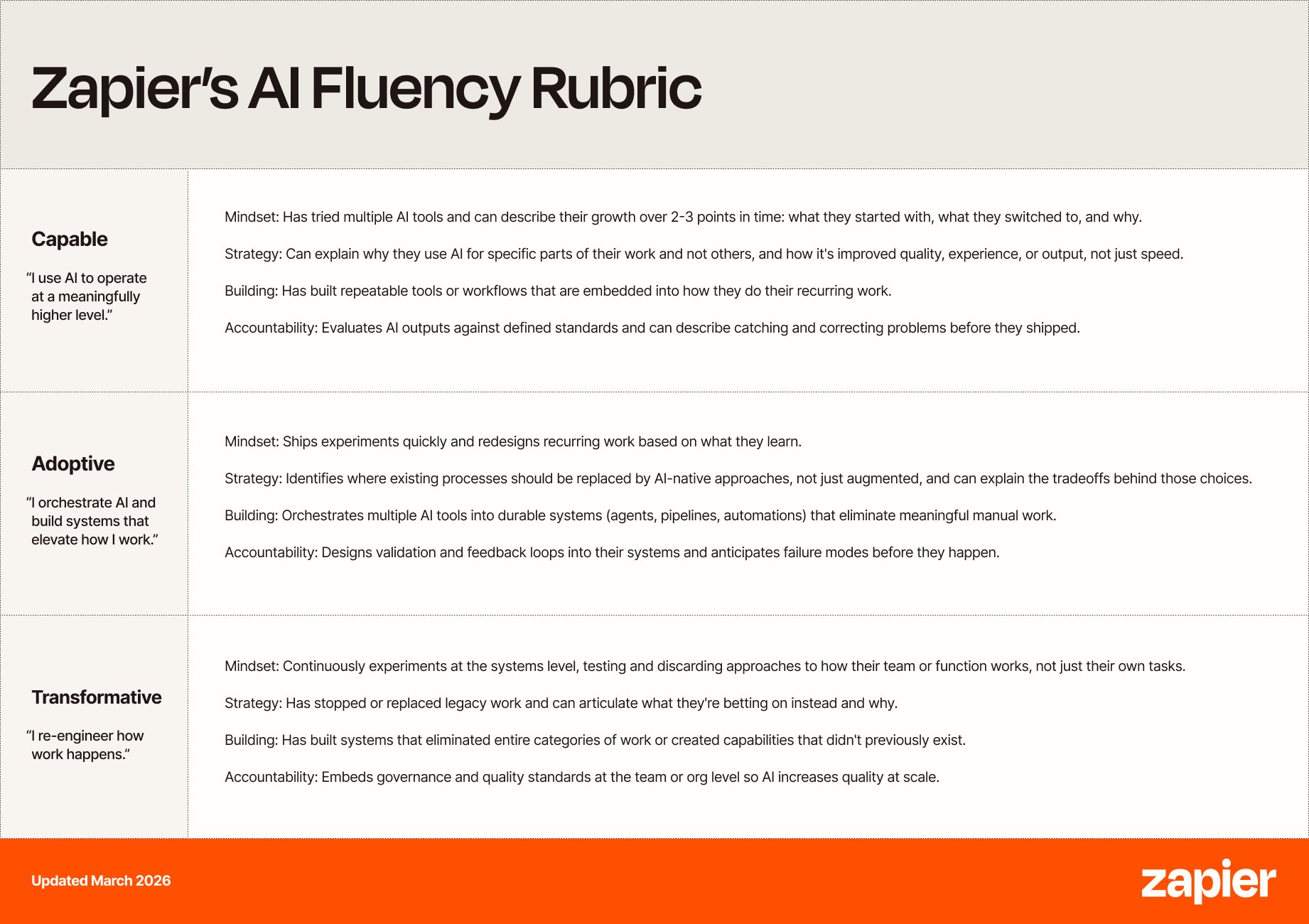
Zapier makes AI fluency a condition of joining. Every new hire has had to meet a minimum AI fluency bar since May 2025. In March 2026 Zapier raised the bar to “Capable”: “I use AI to operate at a meaningfully higher level”, according to Zapier.
Zapier publishes its AI fluency rubric and its approach. Zapier is privately held and sits outside the S&P 100 and STOXX Europe 50, so it is profiled as an AI Pacesetter and is not counted in index figures.
The focus has three parts.
- Hiring: an AI fluency rubric that every candidate is assessed against
- Everyday work: AI built into core work across every function
- Culture: hands-on leadership, easy access to tools and hackathons for all staff
What It Takes: A Fluency Rubric, Hackathons and Hands-On Leadership
A week-long hackathon changed habits. After GPT-4 arrived, CEO Wade Foster declared a company-wide “code red” and paused work for a week so everyone built something with AI, according to Zapier. The approach mirrors an AI strategy that starts with a thousand experiments.
Adoption jumped in a week. Foster said: “We went from just under 10% of people using AI weekly in their job to over 50% in one week.”
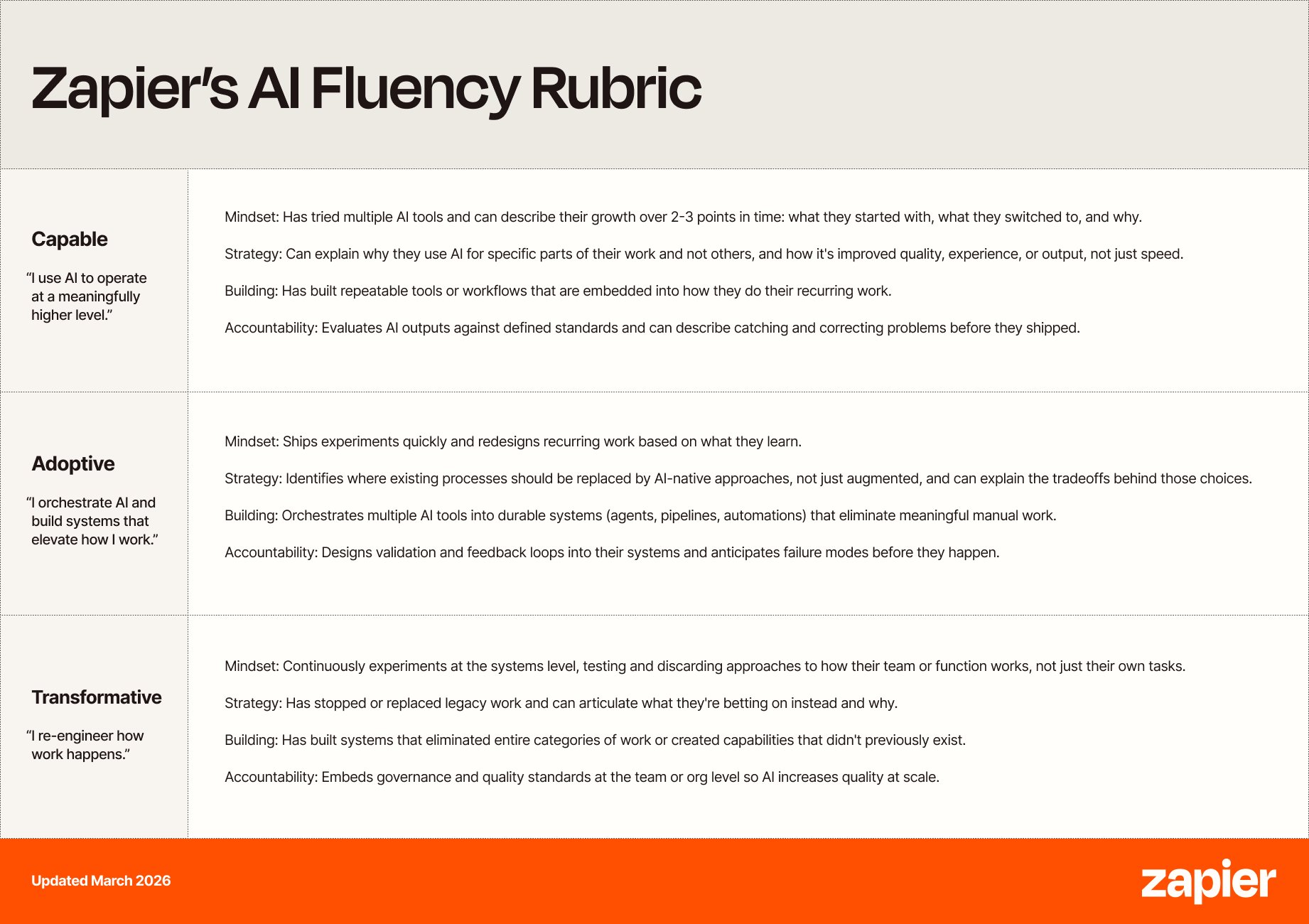
The rubric has four levels. Candidates are rated Unacceptable, Capable, Adoptive or Transformative across AI mindset, strategy, building and accountability, and are tested at four points from application to executive interview.
Zapier reports 100% AI adoption across its teams. It does not publish revenue or headcount.
AI fluency, coded against the Lead with AI Fluency Matrix (September 2026 edition):
- Fluency floor: Level 2 (Collaborating), for new hires. The Capable bar requires AI built into core work with repeatable systems.
- Highest level evidenced: Level 2 (Collaborating), company-claimed. All teams use AI in their work.
- Portfolio design: Zapier raises the floor for everyone through hiring and hackathons.
How Zapier Measures Results
Zapier reports adoption and no value figures. The figures below are company-claimed:
- Adoption: 100% AI adoption across teams in every function
- Hackathon: weekly AI use rose from just under 10% to over 50% of staff in one week
Gaps remain. Zapier measures who uses AI and publishes nothing on what AI delivers. Reporting results is the step from AI adoption to AI value.
Next markers: results linked to the rubric, value figures from AI in daily work and the next version of the hiring bar.
Change log
- 2023: Foster declares a code red and runs a week-long AI hackathon.
- May 2025: Every new hire must meet an AI fluency bar.
- March 2026: Zapier raises the bar to Capable and adds accountability to the rubric.
The Bottom Line
- Disclosure: 4 of 4. Zapier answers all four questions, the last in part, with adoption figures and no value figures.
- AI fluency is a hiring requirement for every role.
- 100% adoption across teams, on company figures.
- Level 2 is evidenced across the company, on company-claimed statements.
- The say-do gap is measurement. Zapier tracks adoption and publishes no results.
- Watch the rubric. The test is whether Zapier shows that higher fluency produces better results.
Revenue, Headcount and Revenue per Employee
What the numbers show: Zapier is privately held and does not publish revenue or headcount figures.
Notes: This profile shows no four-year trend or revenue per employee for Zapier. Sources: Zapier.
How Zapier Compares with Software and IT Services Peers
Zapier is an AI Pacesetter: an AI-first company outside the index, profiled for contrast and not counted. Here is how it compares with software and IT services companies in the index.
| Company | Disclosure | AI owner | Fluency floor | Governance | AI value reported | Revenue per employee |
|---|---|---|---|---|---|---|
| Accenture | 3 of 4 | Chief AI and Data Officer | Level 1, training plus tracked use for senior staff | Framework since about 2017; $1B AI safety commitment | Stopped reporting AI sales in 2025 | $91k |
| Adobe | 4 of 4 | No internal AI lead named; finance, IT and security under one leader | Not published | AI Ethics Review Board and impact assessments | Results by team, no total | $758k |
| IBM | 4 of 4 | CEO chairs biweekly AI governance | Not published | Four-layer governance chaired by the CEO | Yes: $4.5B in annualized productivity savings | $256k |
| Intuit | 3 of 4 | Chief AI Officer | Not published; most staff use AI tools | AI Governance Committee, board oversight | Engineering speed and customer outcomes, no total | $1.15M |
| Microsoft | 4 of 4 | Chief Strategy and Transformation Officer | Not published; one AI tool licensed to 200,000+ staff | Responsible AI Standard revised for agents | Results by workflow, no total | $1.49M |
| Oracle | 3 of 4 | Co-CEOs; global CIO runs the internal rollout | Not published; about 80% use AI tools | Standards and security controls before rollout; model costs shown to staff | No: adoption and coding speed only | $478k |
| Palantir | 4 of 4 | CEO | Not published | Not published for internal use | Revenue per employee as the measure | $1.01M |
| Palo Alto Networks | 4 of 4 | Global CIO; VP of Enterprise AI | Not published; AI access under security controls | AI access controls; humans confirm unresolved alerts | Results by process, no total | $524k |
| Salesforce | 4 of 4 | CEO; President of Customer Success runs support agents | Not published | Office of Ethical and Humane Use; agentic AI guidelines | Yes: about $100M a year in support | $498k |
| ServiceNow | 4 of 4 | CEO; Chief People and AI Enablement Officer | Not published | AI Control Tower tracks where AI runs and its impact | Yes: more than $1B in annualized value | $455k |
| Shopify AI Pacesetter | 4 of 4 | CEO sets the AI expectation; engineering leads the tools | Level 2 by expectation: reflexive AI use | AI use rated in performance reviews | Link between AI use and impact, no total | $1.52M |
| Zapier AI Pacesetter | 4 of 4 | CEO leads; AI hackathons for all staff | Level 2 for new hires: Capable or above | Accountability built into the AI fluency rubric | Adoption figures, no value | Not published |
Disclosure counts how many of the four strategy questions (where it is going, where it will focus, what it will take and how it will know it is working) a company answers in public. Fluency floor is the lowest level of AI fluency a company expects of all its people, on the five levels of the Lead with AI Fluency Matrix: Avoiding (0), Chatting (1), Collaborating (2), Integrating (3) and Transforming (4). The other columns summarize each company’s profile. Revenue per employee is for each company’s latest fiscal year, in US dollars. Rows marked AI Pacesetter or Notable are companies outside the S&P 100 and STOXX Europe 50. They are shown for contrast and are not counted in any index figure. See all companies in the AI Strategy Index.
Frequently Asked Questions
What is Zapier’s AI strategy for its own work?
Zapier hires only people who meet an AI fluency bar and builds AI into every function. It reports 100% AI adoption across its teams.
What is Zapier’s AI fluency rubric?
The rubric rates candidates as Unacceptable, Capable, Adoptive or Transformative. Since March 2026 every new hire must reach at least Capable.
How did Zapier raise AI adoption?
Zapier paused work for a week-long AI hackathon after GPT-4 arrived. Weekly AI use rose from just under 10% to over 50% of staff in that week.
Who leads AI at Zapier?
CEO Wade Foster leads Zapier’s AI push. He declared the company-wide code red that started it.
How is this profile put together?
Lead with AI profiles use public sources only, such as annual reports, earnings materials, filings and on-record interviews, dated at the time of writing. AI fluency is coded against the Lead with AI Fluency Matrix, and company figures are marked as company-claimed unless they have been independently verified.
About the AI Strategy Index
The Lead with AI AI Strategy Index profiles how the largest companies in the US and Europe approach AI, starting with the S&P 100 and the STOXX Europe 50. Each profile answers four questions: where the company is going with AI, where it will focus, what it will take and how it will know it is working. AI Pacesetters and notable companies outside the two indexes are profiled for contrast and are not counted. Profiles use public sources only, and AI fluency is coded against the Lead with AI Fluency Matrix.
See all company profiles