

Anthropic AI Strategy: Claude Writes the Code, People Steer
How Anthropic uses AI on its own work: Claude writing more than 90% of its code, internal AI use worth more than payroll at list price, and fewer junior hires. Updated November 2026.
AI research and products: Claude models, Claude Code and an API for developers and businesses
Anthropic has published no AI strategy document for its own work. This profile is inferred from its October 2026 IPO filing, as reported, and its December 2025 and October 2026 workforce studies.
Read the company sourceWhere Anthropic Is Going with AI
Anthropic runs its own work on Claude. In its October 2026 IPO filing, Anthropic said Claude wrote more than 90% of contributions to its codebase in September 2026 (company-claimed), as reported by Forbes.
Internal AI use now exceeds payroll at list price. The list-price value of Anthropic’s internal Claude use first passed its monthly personnel costs, excluding stock-based compensation, in April 2026. It grew more than 250 times from January to September 2026, according to Gadget Review via Yahoo Finance. These are the prices Anthropic charges customers, not its own cost.
Human attention is the new limit. Anthropic’s October 2026 study of its own workforce says: “This acceleration makes human attention the bottleneck for agent output.” One engineer described “an army of Claudes, with every one asking for my attention.”
Anthropic has published no AI strategy for its own work. This profile is inferred from its IPO filing, as reported by the press, and two internal studies. Anthropic sits outside the S&P 100 and STOXX Europe 50, so it is profiled as a Notable company and is not counted in index figures.
The focus has three parts.
- Engineering: Claude writes most of the code, and engineers review and direct it
- Every function: staff shift from doing work to managing agents
- Workforce: fewer junior technical hires and more internal moves
It is one of the clearest examples of an AI-native organization.
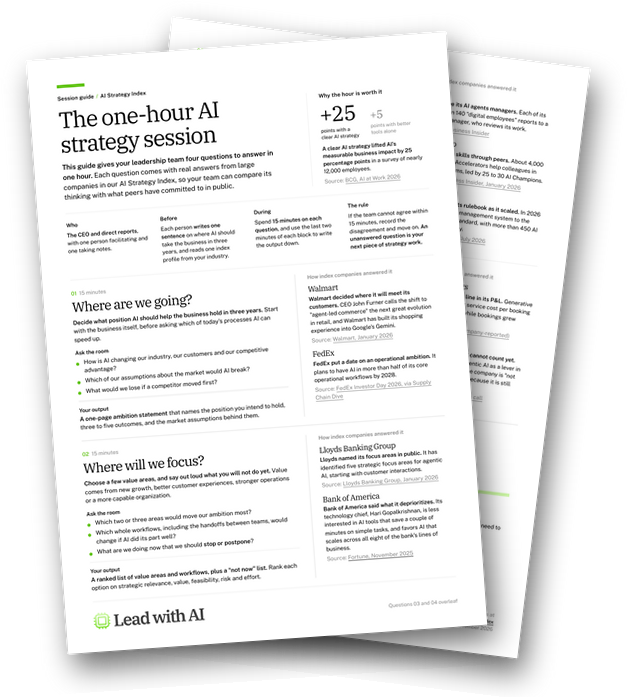
Where is your company going with AI, and where will it focus?
Those are the first two of four questions every AI strategy has to answer. Our free guide walks your leadership team through all four in one hour.
What It Takes: Agents for Everyone, Fewer Junior Hires and Internal Moves
Engineers adopted coding agents first. In August 2025, 132 engineers and researchers said Claude did 59% of their work, up from 28% a year earlier, and estimated a 50% productivity gain (December 2025 study). Merged pull requests per engineer per day rose 67% (company-claimed).
Quality held up in Anthropic’s own data. The October study compared 192 engineers using coding agents with 74 who did not. It found no difference in how much of their code was later removed or reverted.
Anthropic is hiring fewer juniors. The junior share of technical hires fell from 27% to 9% since early 2025, and the junior share of technical staff from 21% to 14%. About a third of machine learning managers and a fifth of software engineering managers said they hire less because of AI.
It moves people instead of cutting them. Anthropic is setting up an “early warning system” for jobs facing AI-driven change and prioritizes internal redeployment. Employees with at least a year of tenure were 50% more likely to move departments each month in 2026 than in 2025.
Headcount still grew fast. Anthropic went from about 940 employees at the end of 2024 to about 5,300 on September 30, 2026, according to the IPO filing as reported by Mostly Metrics.
Visible work is the main rule. The October study says: “Private work, in unlogged meetings and direct messages, is invisible, confusing and discouraged in an AI-heavy workplace.” Written standing instructions for agents grew from a few hundred in July 2025 to 8,500 a year later.
No owner for internal AI is named. The sources reviewed name no executive for internal AI use, and Anthropic has published no staff AI policy.
AI fluency, coded against the Lead with AI Fluency Matrix (September 2026 edition):
- Fluency floor: Not published. One employee described “eternal pressure at Anthropic to move as fast as possible and use Claude for everything,” but no standard is published.
- Highest level evidenced: Level 4 (Transforming), company-claimed. Roles are being redesigned around managing agents, and 20% of staff described that shift in April 2026.
- Portfolio design: Company-wide and engineering-first, with hiring and internal moves adjusted for AI.
The one-hour AI strategy session
This profile of Anthropic follows the four questions every AI strategy has to answer. Answer them for your own company in one hour.
Our free session guide gives your leadership team the four questions and real answers from across the index.
How Anthropic Measures Results
Anthropic publishes detailed measures of its own AI use. It reports these figures, all company-claimed:
- Code: Claude wrote more than 90% of code contributions in September 2026, and daily contributions per engineer in the third quarter of 2026 were more than 45 times the 2024 average
- Usage: internal Claude use at list price passed monthly personnel costs in April 2026
- Speed: commits per engineer at five times their pace of six months earlier, as of October 2026
- Staff view: the share of staff who say their work processes make them productive rose from 44% in late 2024 to 75% in April 2026
One figure is missing: a financial return on that usage. About 80% of interactive Claude session time is agents waiting for human input, so the limit is people, not tools. A return figure would be the step from AI adoption to AI value.
Next markers: quarterly disclosures after the IPO, whether junior hiring recovers, and a value figure for internal AI.
Change log
- December 2025: Anthropic publishes its first study of how AI changes work inside the company.
- April 2026: Internal Claude use at list price passes monthly personnel costs.
- September 2026: Claude writes more than 90% of code contributions.
- October 2026: Anthropic publishes its employment study and files for an IPO.
The Bottom Line
- Disclosure: 4 of 4. Anthropic answers all four questions through its studies and IPO filing, but publishes no strategy document.
- Claude does most of the engineering work, and staff direct and review it.
- The workforce is changing shape, with fewer junior hires and more internal moves.
- The say-do gap is value. Anthropic measures usage in detail but reports no financial return, and its usage figure is at list price.
- Watch people. The test is whether human attention keeps up with the agents.
Revenue, Headcount and Revenue per Employee
What the numbers show: Anthropic’s revenue rose from $1.2bn in the first half of 2025 to $16.3bn in the first half of 2026, while headcount rose from about 940 at the end of 2024 to about 5,300 in September 2026. These figures do not show that AI caused any change.
Revenue and headcount, as reported from the October 2026 IPO filing
- End of 2024: about 940 employees
- First half of 2025: $1.2bn revenue
- First half of 2026: $16.3bn revenue
- 12 months to June 2026: $19.7bn revenue
- September 30, 2026: about 5,300 employees
Notes: Anthropic was private until its October 2026 IPO filing, so four years of audited figures are not available. These figures come from press reports of the filing and have not been checked against the filing itself. Revenue per employee of about $3.7M divides revenue for the 12 months to June 2026 by September 2026 headcount. Press reports that use average headcount give a higher figure.
These figures give context on scale and productivity. They do not show that AI caused any change. Sources: Anthropic IPO filing, as reported by Mostly Metrics and Yahoo Finance.
How Anthropic Compares with Software and IT Services Peers
Anthropic is a notable company outside the index, profiled for contrast and not counted. Here is how it compares with software and IT services companies in the index.
| Company | Disclosure | AI owner | Fluency floor | Governance | AI value reported | Revenue per employee |
|---|---|---|---|---|---|---|
| Accenture | 3 of 4 | Chief AI and Data Officer | Level 1, training plus tracked use for senior staff | Framework since about 2017; $1B AI safety commitment | Stopped reporting AI sales in 2025 | $91k |
| Adobe | 4 of 4 | No internal AI lead named; finance, IT and security under one leader | Not published | AI Ethics Review Board and impact assessments | Results by team, no total | $758k |
| IBM | 4 of 4 | CEO chairs biweekly AI governance | Not published | Four-layer governance chaired by the CEO | Yes: $4.5B in annualized productivity savings | $256k |
| Intuit | 3 of 4 | Chief AI Officer | Not published; most staff use AI tools | AI Governance Committee, board oversight | Engineering speed and customer outcomes, no total | $1.15M |
| Microsoft | 4 of 4 | Chief Strategy and Transformation Officer | Not published; one AI tool licensed to 200,000+ staff | Responsible AI Standard revised for agents | Results by workflow, no total | $1.49M |
| Oracle | 3 of 4 | Co-CEOs; global CIO runs the internal rollout | Not published; about 80% use AI tools | Standards and security controls before rollout; model costs shown to staff | No: adoption and coding speed only | $478k |
| Palantir | 4 of 4 | CEO | Not published | Not published for internal use | Revenue per employee as the measure | $1.01M |
| Palo Alto Networks | 4 of 4 | Global CIO; VP of Enterprise AI | Not published; AI access under security controls | AI access controls; humans confirm unresolved alerts | Results by process, no total | $524k |
| Salesforce | 4 of 4 | CEO; President of Customer Success runs support agents | Not published | Office of Ethical and Humane Use; agentic AI guidelines | Yes: about $100M a year in support | $498k |
| ServiceNow | 4 of 4 | CEO; Chief People and AI Enablement Officer | Not published | AI Control Tower tracks where AI runs and its impact | Yes: more than $1B in annualized value | $455k |
| Shopify AI Pacesetter | 4 of 4 | CEO sets the AI expectation; engineering leads the tools | Level 2 by expectation: reflexive AI use | AI use rated in performance reviews | Link between AI use and impact, no total | $1.52M |
| Zapier AI Pacesetter | 4 of 4 | CEO leads; AI hackathons for all staff | Level 2 for new hires: Capable or above | Accountability built into the AI fluency rubric | Adoption figures, no value | Not published |
| Anthropic Notable | 4 of 4 | No internal AI owner named | Not published; strong expectation to use Claude | Agent work kept visible; written instructions for agents | Code share and usage at list price, no total | $3.7M |
| OpenAI Notable | 4 of 4 | No single owner; teams build their own agents | Not published; almost all staff use Codex weekly | Experts review agent output | Results by tool, no total | Not published |
Disclosure counts how many of the four strategy questions (where it is going, where it will focus, what it will take and how it will know it is working) a company answers in public. Fluency floor is the lowest level of AI fluency a company expects of all its people, on the five levels of the Lead with AI Fluency Matrix: Avoiding (0), Chatting (1), Collaborating (2), Integrating (3) and Transforming (4). The other columns summarize each company’s profile. Revenue per employee is for each company’s latest fiscal year, in US dollars. Rows marked AI Pacesetter or Notable are companies outside the S&P 100 and STOXX Europe 50. They are shown for contrast and are not counted in any index figure. See all companies in the AI Strategy Index.
Run the same exercise with your own team.
Four questions, one hour, and real answers from the companies in this index, in a free two-page guide.
Frequently Asked Questions
What is Anthropic’s AI strategy for its own work?
Anthropic runs its own work on Claude. Claude writes most of its code, and staff are shifting from doing work to managing agents.
How much of Anthropic’s code does Claude write?
More than 90% of code contributions in September 2026, according to Anthropic’s IPO filing as reported by the press.
Is Anthropic cutting jobs because of AI?
No. Headcount grew to about 5,300 by September 2026, but Anthropic hires fewer junior technical staff and prioritizes moving people between teams.
How much does Anthropic spend on AI for its own staff?
At list price, its internal Claude use passed monthly personnel costs in April 2026. Anthropic has not disclosed what that use actually costs it.
How is this profile put together?
Lead with AI profiles use public sources only, such as annual reports, earnings materials, filings and on-record interviews, dated at the time of writing. AI fluency is coded against the Lead with AI Fluency Matrix, and company figures are marked as company-claimed unless they have been independently verified.
About the AI Strategy Index
The Lead with AI AI Strategy Index profiles how the largest companies in the US and Europe approach AI, starting with the S&P 100 and the STOXX Europe 50. Each profile answers four questions: where the company is going with AI, where it will focus, what it will take and how it will know it is working. AI Pacesetters and notable companies outside the two indexes are profiled for contrast and are not counted. Profiles use public sources only, and AI fluency is coded against the Lead with AI Fluency Matrix.
See all company profiles