

BCG AI Strategy: An AI Fluency Ladder for All 33,000 Employees
How BCG runs AI on itself: an AI Fluency Ladder for its 33,000-plus staff, 45,000 custom GPTs, AI-native case teams and a $3 billion AI plan. Updated November 2026.
Management consulting firm: strategy and transformation work, plus BCG X, its tech build and design unit, and BCG U, its learning business
BCG set out its internal AI transformation in “Client Zero: Inside BCG’s AI Transformation” in November 2026, alongside its 2030 strategy, “Where Strategic Clarity Meets Applied AI,” from June 2026.
Read the company sourceWhere BCG Is Going with AI
BCG treats itself as “client zero” for the AI transformation it sells. Nearly all of its 33,000-plus employees have passed level 1 of its own AI Fluency Ladder, more than 20% have reached the technical level 4, and the firm plans to invest more than $3 billion in AI over the next three years. AI- and tech-focused services now bring in more than 40% of its revenue.
BCG has published its AI strategy. In November 2026, it set out how it uses AI on its own work in Client Zero: Inside BCG’s AI Transformation, built around three moves it calls Deploy, Reshape and Invent. In June 2026, CEO Christoph Schweizer named the firm’s 2030 strategy “Where Strategic Clarity Meets Applied AI.”
The focus has three parts, which BCG says developed in parallel.
- Deploy: put AI in everyone’s hands, with the fluency and safeguards to use it well
- Reshape: redesign workflows, knowledge and the organization around what AI makes possible
- Invent: expand what BCG delivers to clients, and how it delivers and charges for that work
AI is now a large share of what BCG sells. Revenue rose 7% to $14.4 billion in 2025, and BCG says AI- and tech-focused services made up more than 40% of it, with AI services up 25% in a year. Bloomberg reported that AI work alone brought in a quarter of 2025 revenue, up from about 20% in 2024 by BCG’s own count.
Schweizer frames AI as a gain for the firm. He told Bloomberg that AI “has turned out to be highly value accretive and not dilutive for BCG.” He also told The Wall Street Journal that BCG ended 2025 with more people than it started with and has not cut junior hiring, while 1.7 million people applied to join.
BCG moved early. When we interviewed Matt Kropp, then CTO of BCG X, in 2024, he told us: “We were very early to roll out ChatGPT Enterprise to all of our employees.” That was about 30,000 people at the time, and he said the real value would come from consultants working out for themselves how to use it.
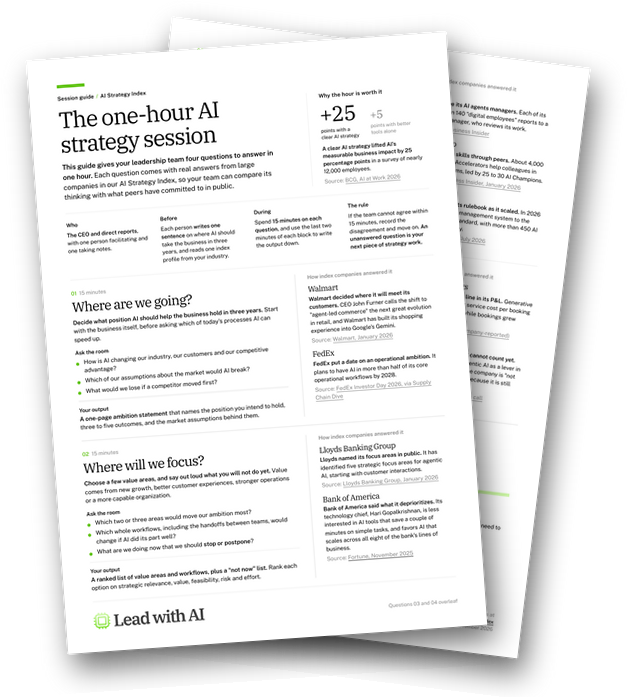
Where is your company going with AI, and where will it focus?
Those are the first two of four questions every AI strategy has to answer. Our free guide walks your leadership team through all four in one hour.
What It Takes: A Fluency Ladder, AI-Native Case Teams and a Shared AI Platform
Access came with a structured enablement program. BCG calls it Amplify Impact: tool access combined with structured learning, peer support, role-specific help and responsible-use standards. By early 2026, more than 90% of BCGers used AI and about 60% used it habitually. More than 11,000 people had built about 45,000 custom GPTs, which BCG notes did not mean 45,000 lasting applications.
Peer learning carries much of the load. Global People Chair Alicia Pittman says that seeing a respected colleague do something remarkable with AI persuades people more than any training program. In December 2025, BCG described a 1,400-person enablement network and more than 100 upskilled team coaches across the firm.

The AI Fluency Ladder measures whether people can use AI well. Its premise is that having access to a tool and using it well are different things, and that different roles need different levels of fluency. Nearly 100% of employees reached level 1 voluntarily within four months, and more than 20% completed the highly technical level 4 training and certification. BCG U, the firm’s learning business, now sells the ladder to clients, where it has become one of its most requested programs.
People are tested first and trained only on their gaps. Alessandro Ghirardi, a BCG principal in applied AI, wrote on LinkedIn in November 2026 that the ladder is an assessment-based upskilling and certification program. It runs from AI Explorer at level 1, expected of all BCGers, through AI Practitioner, AI Automator and AI Multiplier, to expert AI Builder levels. He said levels 1 and 2 should cover almost the whole workforce, levels 3 and 4 should reach 20% to 40% of people, and the expert levels stay small.

The ladder also decides who gets the most powerful tools. Ghirardi wrote that BCG came to use it to manage access to tools and frontier models and to control costs and risks, because it could finally see who was skilled enough for more powerful tools. Testing combines proctored assessments with measures that show real use, and some levels are tailored to specific roles.
AI is part of how consultants are judged. Since about 2024, BCG has built AI expectations into the competencies it uses to assess consultants, and Pittman told Business Insider there is no separate box for AI use: “It is an expectation.” AI now sits inside problem solving and insight, the competencies that drive reviews and promotions. That puts BCG close to the Accenture AI strategy, which ties senior promotions to regular AI use.
Managers are learning to run AI-native case teams. These teams work from a shared case knowledge base of documents, meeting notes and transcripts, consultants use AI for a first pass, and project leaders orchestrate people and AI as one team. Nearly 1,000 managers completed AI-first team bootcamps in the first three months, and teams now set AI norms at kickoff and hold regular retrospectives.
Managers set the pace from the start. When we interviewed BCG Managing Director and Senior Partner Debbie Lovich in 2024, she described the firm’s first generative AI rollout to its administrative staff. Some teams already used the tools four times as much as others, and the difference came down to managers who used AI themselves, showed they cared about their people and explained why the tools mattered.
BCG is open about the limits. Faster first answers can create more review work for senior team members, and clients cannot always make decisions or absorb change at the same speed.
A shared platform lets good ideas travel. BCG is highly decentralized, so it built common architecture and standards that let teams build, find and reuse AI tools without rebuilding the technology. CIO Merim Becirovic told CIO.com in November 2026 that BCG Genie, its platform to build, govern and scale AI agents, runs more than 100 use cases from HR to tech support, with security standards “there from the start.” Genie won a 2026 CIO 100 Award.
Reusable agents are the next step. The Applied AI Marketplace is one internal destination for trusted agents, and assets from the first wave were used in more than 1,500 cases and proposals within months. BCG’s Operating Model Agent cut cycle times two to three times for some organization design work (company-claimed), and a cost diagnostic agent returns peer benchmarks and a mapped client P&L within an hour.
BCG drops its own builds when better tools appear. It built its own technology to connect AI models to internal data when nothing on the market fit, then abandoned some of those programs as external tools caught up. Domain experts increasingly own AI-enabled workflows while engineers run the technology, which BCG describes as its 10-20-70 rule applied to itself: 10% of the effort on algorithms, 20% on technology and data, and 70% on people, processes and ways of working.
Governance has been written down since 2022. BCG published one of the industry’s first AI codes of conduct that year, set rules for all staff in its AI Core Standard commitments and keeps people accountable for AI output. It also made an AI TALENT Promise on how it uses AI in recruiting, reviews and staffing, and it was among the first 100 organizations certified to ISO/IEC 42001 for AI management.
Invent is changing how BCG gets paid. About three quarters of BCG’s largest AI cases now use variable fees tied to client outcomes, though outcome-based pricing covers well under a third of all its projects, Schweizer told the Journal. BCG is also testing AI-first offers for work such as large system migrations, where a senior partner asks whether a job for 100 people over ten years could be done by 20 in five.
AI fluency, coded against the Lead with AI Fluency Matrix (September 2026 edition):
- Fluency floor: Level 1 (Chatting), backed by certification. Nearly all staff have passed level 1 of BCG’s ladder and more than 90% use AI, but about 40% do not yet use it habitually, so Level 2 is not evidenced for everyone. BCG’s ladder levels are its own scale and do not map one to one onto the Matrix.
- Highest level evidenced: Level 3 (Integrating), company-claimed. Nearly 4,000 employees build and scale AI workflows with code and automation, and reusable agents have run in more than 1,500 cases. Case teams are being redesigned around AI, but BCG keeps expert review on agent output and reports no process that AI runs end to end, so Level 4 is not evidenced.
- Portfolio design: Multi-level by design. Levels 1 and 2 for almost everyone, levels 3 and 4 for 20% to 40% of people, a small expert tier, and access to the most powerful tools tied to proven skill.
The AI Tools BCG Uses
BCG gives everyone one broad assistant and builds its own tools on top. ChatGPT Enterprise has been available to all staff since BCG’s early rollout, and Pittman told Business Insider in 2025 that BCG had more custom GPTs than any other OpenAI customer. The public records behind BCG’s web addresses also show a company account with OpenAI.
Its own tools handle BCG-specific work. Deckster, an AI slide builder trained on 800 to 900 BCG templates, was used weekly by about 40% of associates in 2025, according to the same Business Insider report. GENE is a conversational assistant with its own voice, built on an OpenAI model and used for brainstorming, podcasts and live demos. Ava answers internal IT and HR questions, and PRIME and ChatPDG help managers write feedback and year-end reviews.
Claude has been in use since 2023. When BCG and Anthropic announced their collaboration in September 2023, BCG said its teams would use Claude to synthesize research and analyze data. BCG has not said since how widely staff use it. Its June 2026 CEO letter lists Anthropic, AWS, Google, IBM, Microsoft, OpenAI, Salesforce and SAP among its technology partners.
Public records show more company accounts. The public records behind BCG’s web addresses show company accounts with Cursor, an AI code editor, DeepL, an AI translation service, and Magnific, an AI image upscaler.
| Tool | Made by | What BCG uses it for | How we know |
|---|---|---|---|
| ChatGPT Enterprise | OpenAI | AI assistant for all staff; about 45,000 custom GPTs built by more than 11,000 people | Confirmed: BCG report, public records |
| Claude | Anthropic | Research synthesis and data analysis in BCG teams (announced 2023) | Confirmed: BCG announcement |
| Deckster | BCG | AI slide builder trained on BCG templates | Confirmed: BCG leaders’ interviews, press reports |
| GENE | BCG | Conversational assistant for brainstorming, podcasts and demos | Confirmed: BCG podcasts, press reports |
| BCG Genie | BCG | Platform to build, govern and scale agents; more than 100 use cases | Confirmed: CIO interview |
| Applied AI Marketplace | BCG | Internal destination for trusted agents and digital assets | Confirmed: BCG report |
| Operating Model Agent and cost diagnostic agent | BCG | Organization design and cost benchmarking for client work | Confirmed: BCG report |
| PRIME and ChatPDG | BCG | Feedback and year-end review writing | Confirmed: BCG article |
| Ava | BCG | Internal help for IT and HR questions | Likely: press report |
| Cursor | Anysphere | Company accounts for an AI code editor | Confirmed: public records |
| DeepL | DeepL | Company accounts for AI translation | Confirmed: public records |
| Magnific | Freepik | Company accounts for AI image upscaling | Confirmed: public records |
BCG’s pattern is one broad assistant plus a growing shelf of its own agents. OpenAI is its main outside bet, inside BCG and with clients: BCG became an OpenAI Elite Partner in July 2026. The open question is how much daily work now runs through BCG’s own agents rather than ChatGPT, which BCG has not published.
How we build this list: we use public information only, such as company announcements, websites, job ads, supplier case studies, press reports and the public records behind a company’s web addresses. Confirmed means the company itself or a public record shows it. Likely means a strong second-hand source, such as a supplier case study, a press report or several job ads. A listing shows that a tool is used somewhere at BCG, not how widely. Checked November 2026.
The one-hour AI strategy session
This profile of BCG follows the four questions every AI strategy has to answer. Answer them for your own company in one hour.
Our free session guide gives your leadership team the four questions and real answers from across the index.
How BCG Measures Results
BCG reports adoption, skills, sentiment and AI revenue. It does not publish what AI saves in its own work. All figures below are company-claimed:
- Adoption: more than 90% of staff use AI and about 60% use it habitually, up from about half using it daily in September 2025; BCG reached its 50% adoption goal in May 2025, months ahead of plan (Business Insider)
- Skills: nearly all staff at level 1 of the Fluency Ladder, more than 20% at level 4, and nearly 4,000 people building AI workflows with code and automation
- Sentiment: in the 2026 People Survey, 81% said generative AI helps them create more value and 73% said it makes their work more enjoyable
- Productivity: two to three times faster cycle times for some Operating Model Agent work; a review-writing tool cut writing time by 40% and lifted quality scores by 20%; staff reinvest about 70% of saved time in higher-value work (Business Insider)
- Revenue: AI- and tech-focused services above 40% of revenue, with AI services up 25% in 2025
Schweizer puts the people goal plainly. He told the New York Times DealBook newsletter in April 2026: “This is about more joy and less toil.”
There is no firmwide value figure. BCG reports no total time saved, cost avoided or revenue gained from AI in its own delivery. That gap matters, as our analysis of BCG’s research on AI usage and impact shows: wide usage does not by itself produce financial results.
Next markers: whether the $3 billion plan comes with published targets, how many people move from levels 1 and 2 to levels 3 and 4, and whether revenue per employee keeps rising while headcount stays almost flat.
Change log
- 2022: BCG publishes one of the industry’s first AI codes of conduct.
- 2023: BCG rolls out ChatGPT Enterprise to all employees.
- September 2023: BCG and Anthropic announce a collaboration that includes Claude for BCG’s own teams.
- September 2025: BCG says AI is built into the competencies used to assess consultants.
- February 2026: BCG and OpenAI expand their partnership through OpenAI’s Frontier Alliance.
- April 2026: BCG reports 2025 revenue of $14.4 billion, with AI- and tech-focused services above 40%.
- June 2026: Schweizer sets out the 2030 strategy, “Where Strategic Clarity Meets Applied AI.”
- July 2026: BCG becomes an OpenAI Elite Partner.
- November 2026: The Client Zero report shares AI Fluency Ladder results and a plan to invest more than $3 billion in AI over three years.
- November 2026: BCG’s CIO describes the Genie platform and its more than 100 use cases.
The Bottom Line
- Disclosure: 3 of 4. BCG answers where it is going, where it will focus and what it will take in its own report. How it will know is answered in part, with adoption, skills, sentiment and AI revenue share, but no internal value figure.
- BCG measures fluency directly. A tested ladder with role-specific levels, used to decide who gets the most powerful tools, is one of the most explicit fluency systems in the index.
- The firm is willing to drop its own tools. It abandoned bespoke programs once external tools were better, which keeps its effort on knowledge, context and ways of working.
- Revenue per employee rose 10% from 2022 to 2025, to about $430k, while headcount grew by only 500 people in 2025. These figures give context and do not show that AI caused the change.
- The say-do gap is measurement and value. BCG says AI has been highly value accretive for the firm, but it publishes adoption and sentiment rather than what AI saves or earns in its own work.
- Watch the middle of the ladder. The test is whether the share of people at levels 3 and 4 moves toward the 20% to 40% that BCG’s own people describe as the goal.
Revenue, Headcount and Revenue per Employee
What the numbers show: Revenue rose 23% from 2022 to 2025 and headcount 12%, so revenue per employee rose 10%, to about $430k. In 2025, revenue grew 7% while headcount grew by 500 people, the smallest increase in the series. CEO Christoph Schweizer says BCG has not cut junior hiring. These figures do not show that AI caused any change.
Revenue, headcount and revenue per employee, 2022 to 2025
- 2022: $11.7bn revenue, 30,000 employees, $390k per employee
- 2023: $12.3bn revenue, 32,000 employees, $384k per employee
- 2024: $13.5bn revenue, 33,000 employees, $409k per employee
- 2025: $14.4bn revenue, 33,500 employees, $430k per employee
Change, 2022 to 2025: revenue up 23%, headcount up 12%, revenue per employee up 10%.
Notes: BCG is privately held and reports rounded figures, so revenue per employee is approximate. Revenue is as reported in US dollars, and BCG reported 2022 growth of 11% at constant exchange rates. Headcount is the global workforce at year end, and BCG’s fiscal year is the calendar year. BCG also changed how it reports its AI share: about 20% “AI-related advisory” in 2024 and more than 40% “AI- and tech-focused services” in 2025, so the two figures are not comparable.
These figures give context on scale and productivity. They do not show that AI caused any change. Sources: BCG annual results releases, 2023 to 2026.
How BCG Compares with Software and IT Services Peers
BCG is a notable company outside the index, profiled for contrast and not counted. Here is how it compares with software and IT services companies in the index.
| Company | Disclosure | AI owner | Fluency floor | Governance | AI value reported | Revenue per employee |
|---|---|---|---|---|---|---|
| Accenture | 3 of 4 | Chief AI and Data Officer | Level 1, training plus tracked use for senior staff | Framework since about 2017; $1B AI safety commitment | Stopped reporting AI sales in 2025 | $91k |
| Adobe | 4 of 4 | No internal AI lead named; finance, IT and security under one leader | Not published | AI Ethics Review Board and impact assessments | Results by team, no total | $758k |
| IBM | 4 of 4 | CEO chairs biweekly AI governance | Not published | Four-layer governance chaired by the CEO | Yes: $4.5B in annualized productivity savings | $256k |
| Intuit | 3 of 4 | Chief AI Officer | Not published; most staff use AI tools | AI Governance Committee, board oversight | Engineering speed and customer outcomes, no total | $1.15M |
| Microsoft | 4 of 4 | Chief Strategy and Transformation Officer | Not published; one AI tool licensed to 200,000+ staff | Responsible AI Standard revised for agents | Results by workflow, no total | $1.49M |
| Oracle | 3 of 4 | Co-CEOs; global CIO runs the internal rollout | Not published; about 80% use AI tools | Standards and security controls before rollout; model costs shown to staff | No: adoption and coding speed only | $478k |
| Palantir | 4 of 4 | CEO | Not published | Not published for internal use | Revenue per employee as the measure | $1.01M |
| Palo Alto Networks | 4 of 4 | Global CIO; VP of Enterprise AI | Not published; AI access under security controls | AI access controls; humans confirm unresolved alerts | Results by process, no total | $524k |
| Salesforce | 4 of 4 | CEO; President of Customer Success runs support agents | Not published | Office of Ethical and Humane Use; agentic AI guidelines | Yes: about $100M a year in support | $498k |
| ServiceNow | 4 of 4 | CEO; Chief People and AI Enablement Officer | Not published | AI Control Tower tracks where AI runs and its impact | Yes: more than $1B in annualized value | $455k |
| Lovable AI Pacesetter | 3 of 4 | CEO; an AI operations team automates internal work | Not published; every new hire builds on Lovable in week one | Data access set before building; human review for high-risk code | Results by tool, no total | About $2.0M (run rate) |
| Shopify AI Pacesetter | 4 of 4 | CEO sets the AI expectation; engineering leads the tools | Level 2 by expectation: reflexive AI use | AI use rated in performance reviews | Link between AI use and impact, no total | $1.52M |
| Zapier AI Pacesetter | 4 of 4 | Chief People and AI Transformation Officer; executives own their functions | Level 3 for new hires: repeatable AI systems required | Golden paths, legal-led AI use guidelines and accountability in hiring | Support and engineering results, no total | Not published |
| Anthropic Notable | 4 of 4 | No internal AI owner named | Not published; strong expectation to use Claude | Agent work kept visible; written instructions for agents | Revenue per employee and usage at list price, no AI total | Over $6.6M (12 months to Sep 2026) |
| BCG Notable | 3 of 4 | CEO says AI must be owned at the top; CIO runs the Genie platform | Level 1, nearly all staff certified on its own ladder | AI code of conduct since 2022; ISO/IEC 42001 certified | Adoption, sentiment and cycle times, no total | $430k |
| OpenAI Notable | 4 of 4 | No single owner; teams build their own agents | Not published; almost all staff use Codex weekly | Experts review agent output | Results by tool, no total | Not published |
Disclosure counts how many of the four strategy questions (where it is going, where it will focus, what it will take and how it will know it is working) a company answers in public. Fluency floor is the lowest level of AI fluency a company expects of all its people, on the five levels of the Lead with AI Fluency Matrix: Avoiding (0), Chatting (1), Collaborating (2), Integrating (3) and Transforming (4). The other columns summarize each company’s profile. Revenue per employee is for each company’s latest fiscal year, in US dollars. Rows marked AI Pacesetter or Notable are companies outside the S&P 100 and STOXX Europe 50. They are shown for contrast and are not counted in any index figure. See all companies in the AI Strategy Index.
Run the same exercise with your own team.
Four questions, one hour, and real answers from the companies in this index, in a free two-page guide.
Frequently Asked Questions
What is BCG’s AI strategy?
BCG treats itself as “client zero” for the AI transformation it sells. It follows three moves, Deploy, Reshape and Invent: it puts AI in everyone’s hands with fluency and safeguards, redesigns case teams and workflows around AI, and uses AI to expand what it delivers. It plans to invest more than $3 billion in AI over three years.
What AI tools does BCG use?
BCG gives all staff ChatGPT Enterprise, and more than 11,000 people have built about 45,000 custom GPTs. It also uses Claude, which it announced in 2023, and its own tools, including the Deckster slide builder, the GENE assistant and the Genie platform for agents. Public records show company accounts with Cursor, DeepL and Magnific.
What is BCG’s AI Fluency Ladder?
It is BCG’s own assessment-based program for AI skills, running from AI Explorer at level 1 through AI Practitioner, AI Automator and AI Multiplier to expert AI Builder levels. Staff are tested, then trained on their gaps. Nearly all of BCG’s 33,000-plus employees have passed level 1, and more than 20% have completed the technical level 4. BCG U now offers the ladder to clients.
Does BCG require consultants to use AI?
In effect, yes. Since about 2024, AI has been built into the problem-solving and insight competencies that drive consultant reviews and promotions. Global People Chair Alicia Pittman says there is no separate box for AI use because it is an expectation.
How much of BCG’s revenue comes from AI?
BCG says AI- and tech-focused services made up more than 40% of its $14.4 billion revenue in 2025, with AI services growing 25%. Bloomberg reported that AI work alone accounted for about a quarter of revenue.
Is BCG cutting junior hiring because of AI?
No, according to CEO Christoph Schweizer. He told The Wall Street Journal that BCG ended 2025 with more employees than it started with and has not reduced junior hiring. Headcount grew by 500, to 33,500.
How is this profile put together?
Lead with AI profiles use public sources only, such as annual reports, earnings materials, filings and on-record interviews, dated at the time of writing. AI fluency is coded against the Lead with AI Fluency Matrix. Company figures are marked as company-claimed unless they have been independently verified.
About the AI Strategy Index
The Lead with AI AI Strategy Index profiles how the largest companies in the US and Europe approach AI, starting with the S&P 100 and the STOXX Europe 50. Each profile answers four questions: where the company is going with AI, where it will focus, what it will take and how it will know it is working. AI Pacesetters and notable companies outside the two indexes are profiled for contrast and are not counted. Profiles use public sources only, and AI fluency is coded against the Lead with AI Fluency Matrix.
See all company profiles