
In last week's newsletter, I discussed how AI would make us more productive, especially in remote organizations.
Early research shows that employees can be up to 35% more effective, with more significant boosts in specific roles.
This productivity boost leads to the question: how to use AI? How many jobs will AI in the workplace replace? And which jobs are most at risk? That's what we'll dive into this week.
Read on and find out that I'm definitely screwed as a CEO-researcher-writer!
(Note: AI is developing rapidly. Take a look at our six must-know AI trends in 2024.)
How is AI able to replace jobs?
Artificial Intelligence (AI) can perform tasks that typically require human intelligence, like language processing, pattern recognition, and decision-making. With the incredible uptake of ChatGPT, AI is now more widely adopted than ever.
With AI being more accessible and able to do everyday tasks like taking meeting notes, sending emails, and writing documents, work is becoming easier and more efficient. This leads to jobs being automated and becoming redundant.
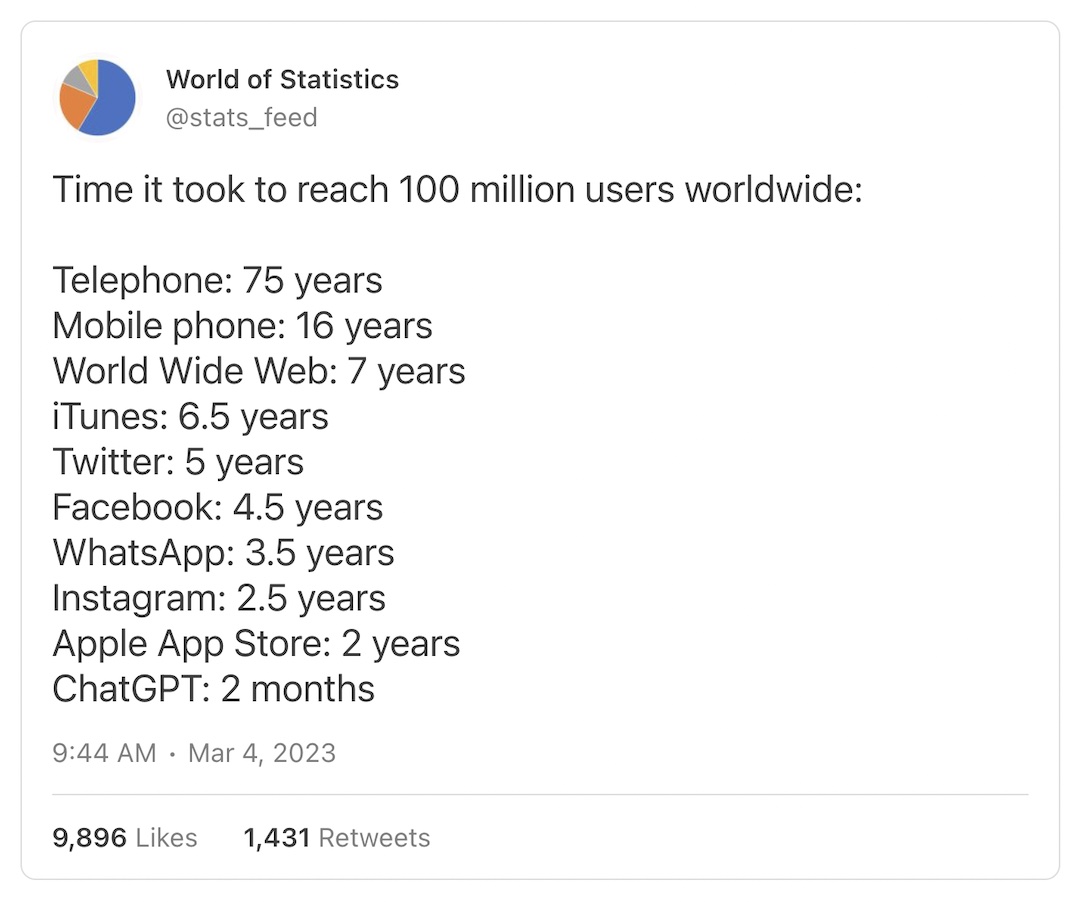
AutoGPT, an AI that can take action autonomously and 'may surpass ChatGPT' according to Forbes, further increases the amount of work we can offload. Some examples of AutoGPT include:
- Creating an entire website from scratch. It can search the internet for sources and sample code to build a site.
- Maintaining a to-do list that launches another ChatGPT agent to handle the task each time a new job is added.
- Performing market research. GPT can list the top five manufacturers in a specific field and then extract the pros and cons from many reviews.
If that wasn't enough, in another bout of rapid AI innovation, Google presented its AI assistant Bard last week. Bard has full access to the live internet.
This makes Bard, like Microsoft's ChatGPT-powered Bing, even more effective than ChatGPT, which only has access to files until May 2021.
With already-powerful ChatGPT, up-and-coming AutoGPT, and the introduction of AI connected to the live internet, the implications for reductions in the workforce seem apparent.
What percentage of jobs will be replaced by AI?
In a new report, Goldman Sachs found that roughly two-thirds of current jobs are exposed to some degree of AI automation and that generative AI could replace a significant share of their workload (25-50%.)
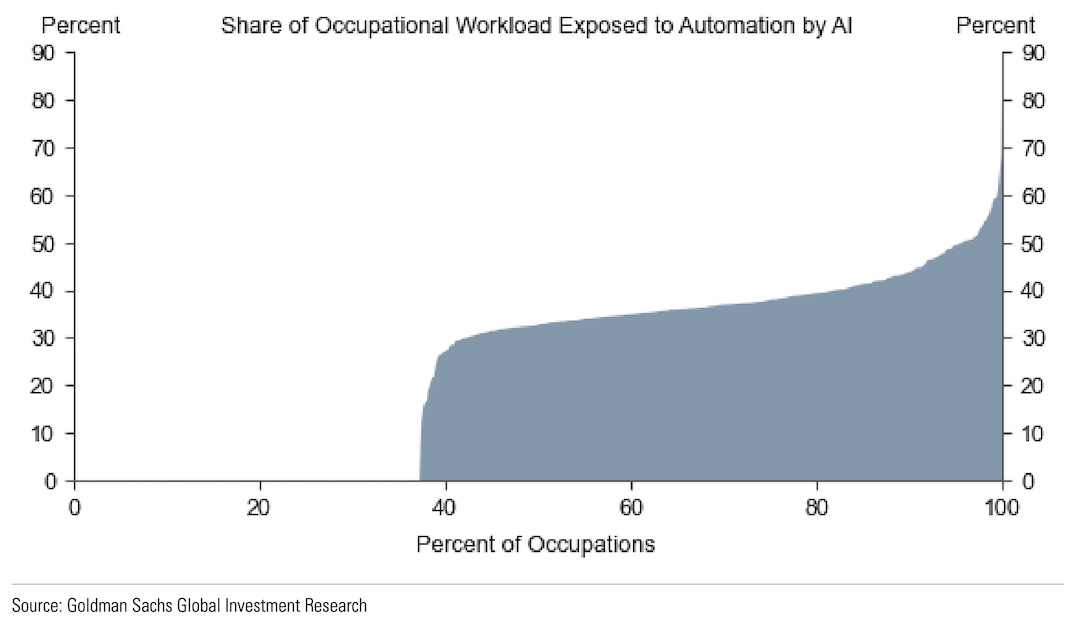
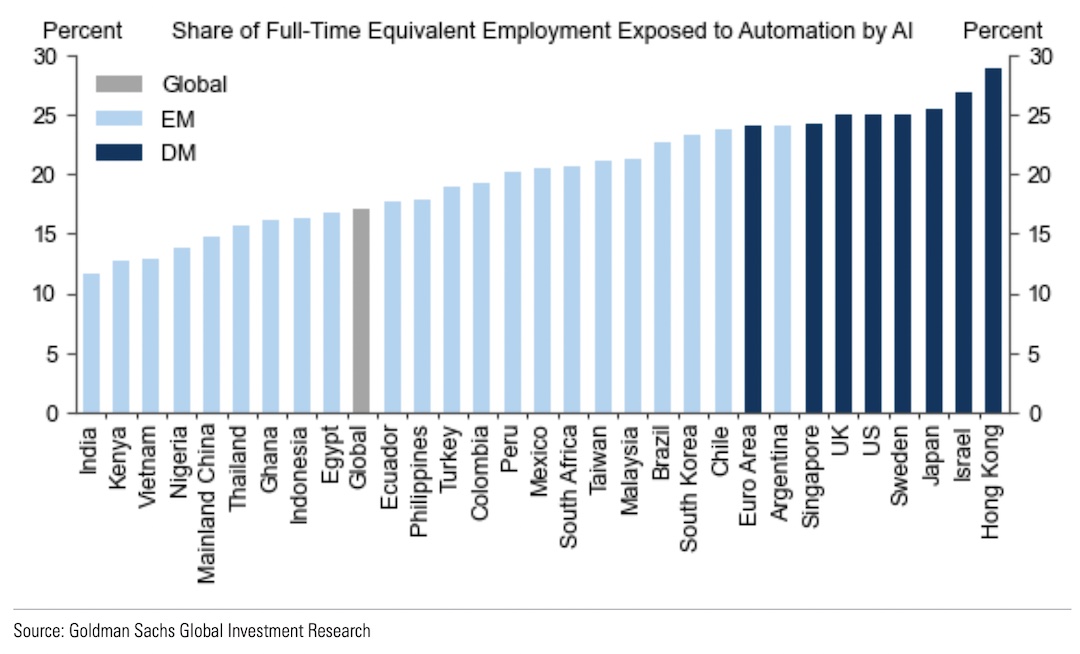
The analysts who wrote the report predict that AI can lift productivity growth by 1.5 percentage points over ten years, eventually eliminating 18% of jobs globally, the equivalent of 300 million full-time jobs.
These displacements will especially happen in more developed markets, with Hong Kong and Singapore leading in the APAC region.
In recent interviews on This Week in Startup's incredible series on AI, Dropbox's Aaron Levi, Airbnb founder Brian Chesky, and LinkedIn founder all agreed that AI can remove 30% of tasks.
We're already seeing the first signs of companies laying off parts of their teams due to AI like IBM pausing hiring for jobs AI could do.
🔄 2026 update: BCG's April 2026 microeconomic study; the most rigorous analysis of AI's labor market impact to date; sharpens this picture. They found that over the next two to three years, 50-55% of US jobs will be reshaped by AI, while only 10-15% face outright elimination over four to five years. The key insight: task automation doesn't automatically equal job loss. Whether a role disappears depends on whether AI substitutes for or augments human judgment, and whether demand for the output expands when the cost of delivering it falls.
What kinds of jobs will be displaced by AI?
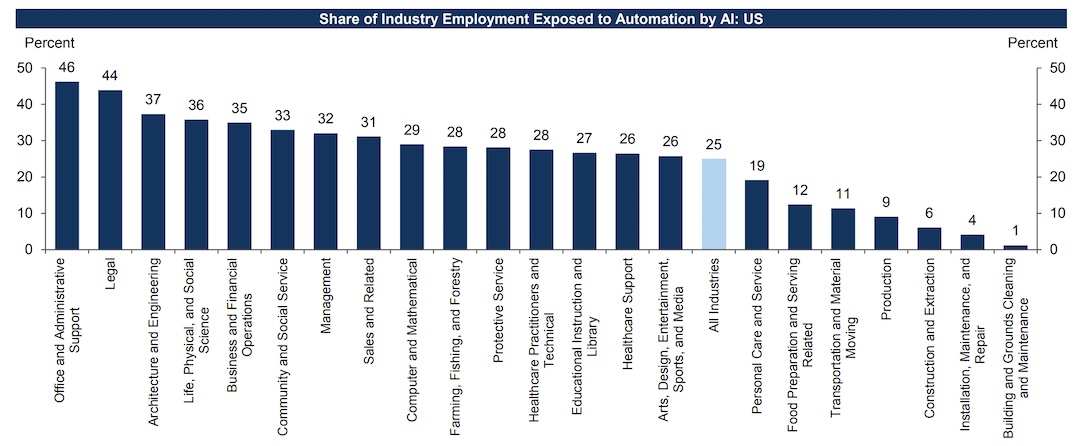
Based on the Goldman Sachs report, the effects of AI will vary across industries: AI could automate almost half of the administrative and legal tasks but only a small percentage of tasks in the construction and maintenance industries.
So what are some jobs that AI could replace? I've compiled a list with the help of articles from Insider, BBC, the Goldman Sachs report, and of course, ChatGPT.
Coders
AI can displace software developers as ChatGPT can produce code faster than humans, which means fewer employees are needed. Case in point: ChatGPT maker's OpenAI is considering replacing software engineers with AI.
"Our designer is now in charge of our static website - we no longer have our junior web developer. Even for our main project, we've reduced staffing plans. AI also allowed us to renegotiated content freelancer rates," Abhishek Dadoo, founder of micro-access platform for online media fewcents, shared with me.
In a C-suite study on ChatGPT adoption, software engineering leads the pack, with 58% of CEOs saying they require GPT knowledge. This contrasts with 33% in software engineering, 33% in customer service, 32% in HR, 31% in marketing, 28% in data entry, and 23% in sales and finance.
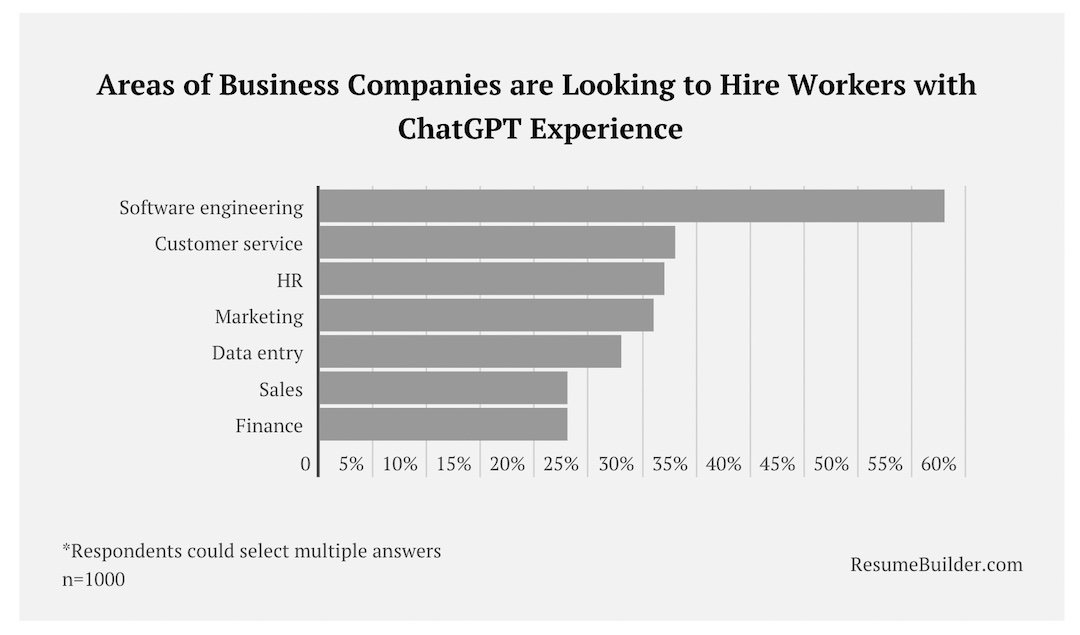
This early adoption of coders is partly due to GitHub Copilot, an AI-powered coding assistant developed with OpenAI that started gaining traction after its launch in October 2021. The tool helps developers write code more efficiently by providing real-time code suggestions and auto-completions.
🔄 2026 update: Perhaps surprisingly, software engineering headcount has actually increased since ChatGPT launched, according to BCG's 2026 research. As AI lowers the cost to build software, organizations simply build more of it; expanding demand. The risk is concentrated at the junior level, not the profession as a whole. That said, BCG flags this as one of the roles most likely to shift if agentic AI continues improving at system-level judgment. One to watch closely.
Customer service representatives
Both in chat and voice, AI can quickly find the correct answer to customers' questions.
In a recent study of call-center workers, AI delivered value by analyzing the calls with the highest satisfaction score and working backward to upvote the best answers in real-time and continuously learning. Especially lower-skilled employees saw a boost of up to 35%.
AI can increase efficiency by offering up real-time answers and help customer service representatives handle more calls and resolve customer issues faster. Soon, it will be able to take all first- and second line help desk questions, eliminating the need for some human agents.
🔄 2026 update: BCG's research is unambiguous here: call center representative is their clearest example of a fully substituted role. AI has taken over first and second-line inquiries end to end, and the volume of customer interactions doesn't expand when costs fall. Overall employment in routine customer service is declining.
Designers
If you've played with Midjourney or similar tools, you probably anticipate designers to be affected intensely. (Our Design Manager is quickly learning coding skills.)
For Microsoft's Work Trend Index Annual Report, designer Jon Han created the cover art in partnership with Bing Image Creator. Explaining the process, the elements that Jon did himself seem suitable for AI to replace relatively soon.
Fonos co-founder Oscar Jesionek showed imagery for a recent marketing activity generated by Midjourney. "We simply don't need to use a designer for these tasks, and there's no chance we'll hire one for these tasks in the future," he said.
Game designers are also affected by AI tools like Scenario, whose CEO expects it will cut 20-30% of game studios' staffing needs.
The same goes for photographers. Not just illustrations but incredible photo-realistic pictures are just a Midjourney prompt away. Take a look at Danny Postma's "This Model Does Not Exist." In an interview with a16z, Danny describes how building the model costs only 60 cents, after which you can generate 100,000s of photos for under $100.

Product photography isn't safe either, for example with Alfred Lua's Pebblely, which turns product images into marketing assets. With a prompt and a press of the button, one product photo can be placed in tens of shots.
Writers
Most likely the obvious one in this list, professional writers will be heavily affected. Economist Paul Krugman shared in The New York Times that AI-powered assistants like ChatGPT can perform writing more efficiently than humans.
The media industry is experimenting with AI-generated content. CNET used AI to author multiple articles but had to issue several corrections. BuzzFeed utilizes ChatGPT to create new forms of content, such as quizzes and travel guides.
Sybil founder Theo Sanders posted about a new GPT-powered bot the team developed to write marketing copy. Spending on copywriters had decreased by 50%.
DesignPro's Mohammed Abdoolcarim: "I am using AI to help me write clearly and concisely which has allowed me to replace having a copywriter on my team."
Marketing and PR Specialists
PR specialists can expect similar disruptions. PR Newswire shared that AI can take over developing press releases, incorporating SEO keywords, generating media lists, and predicting pitching success.
For websites, UIzard can build entire sites with a few prompts in under a minute. Explore more with our AI Marketing Tools.
Videographers
AI is already automating tasks once done by videographers, such as color grading and scene analysis. Runway CEO Cristóbal Valenzuela demoed how AI can create entire photorealistic movie scenes from a description. Coca-Cola's "Masterpiece" combined live-action shots, digital effects, and AI technology from Stable Diffusion.
Lawyers, paralegals, and legal assistants
Many working at law firms, particularly first-year graduates, often perform routine tasks like legal research, document review, and contract analysis. AI can perform these faster and more accurately.
One example: an AI-powered "robot lawyer" attempted to guide a defendant through a traffic violation case in real time. Its creator DoNotPay had to abandon its plans after receiving threats from State Bar prosecutors.
🔄 2026 update: Investment in legal AI; including Harvey AI; hit record highs in 2025. Senior legal advisory work is durable and may grow as lower costs make services more accessible. But junior associate work; research, document review, contract analysis; is being absorbed quickly. The legal career ladder is being compressed from the bottom up.
Market research and data analysts
Analysts collect data, analyze trends, and develop insights. AI can automate these tasks. At investment banks, new hires typically spend years doing Excel modeling that AI can now do in minutes.
OpenAI's Code Interpreter allows anyone to interact with data and create charts in real-time. ChatPDF lets you upload any PDF and ask questions about it instantly.
🔄 2026 update: BCG classifies routine financial analyst roles as substituted. The volume of analysis is tied to existing reporting cycles; so when AI automates modeling and aggregation, organizations need fewer analysts, not more analysis.
Trainers and L&D Managers
AI can personalize learning by tracking student progress, identifying areas of weakness, and recommending resources. Generative AI tools can automatically build content, assessments, teaching guides, rubrics, videos, and simulations in seconds. HR thought leader Josh Bersin warned: "L&D teams are going to have to swim upstream in a big hurry."
"The worldwide spending on corporate learning is around $320 Billion, and this is a nearly recession-proof market always looking for new ideas." - Josh Bersin.
Reid Hoffman added that if AI "is this good at replacing your job, it will be even better at retraining you for another job."
Translators
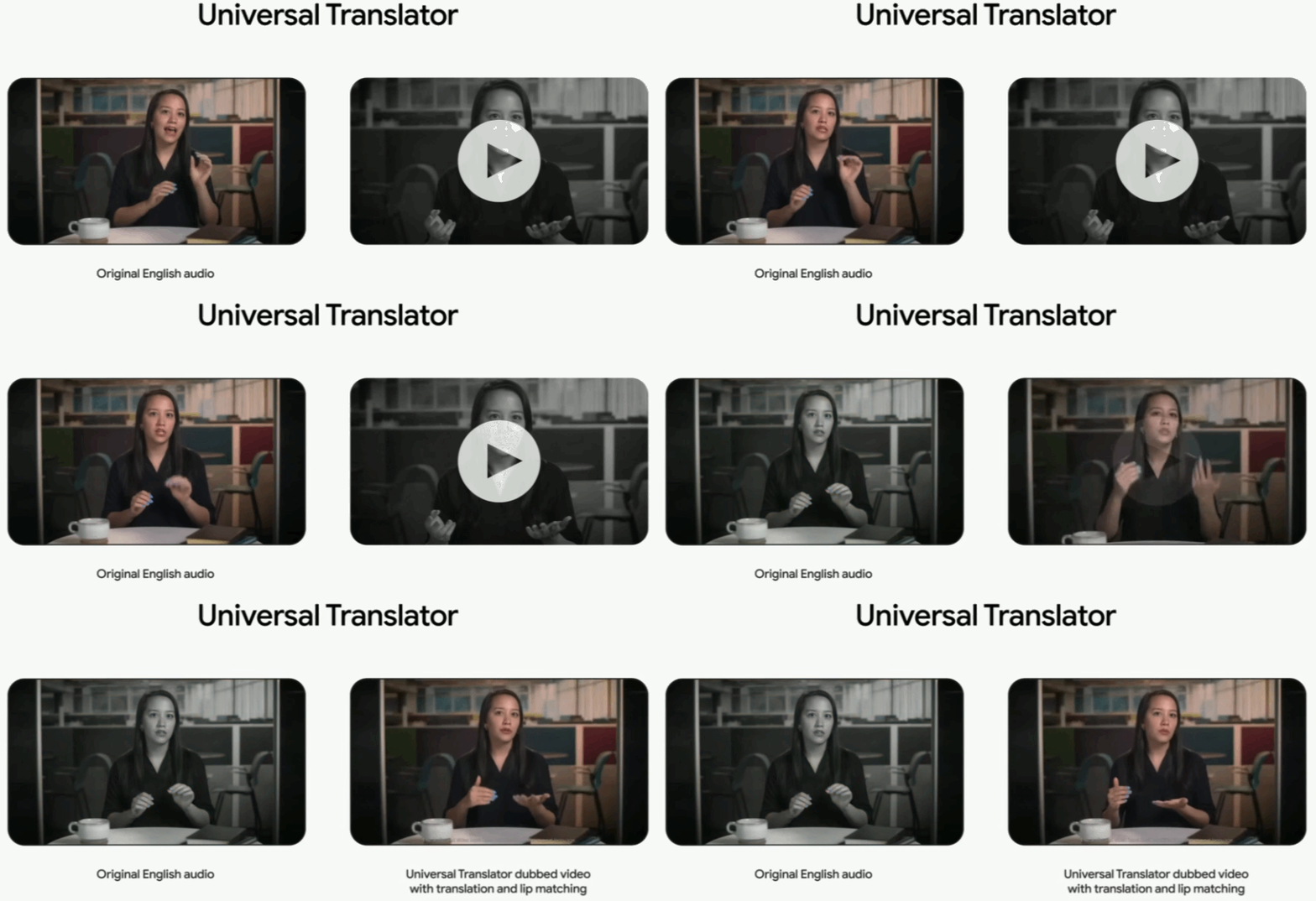
Google demoed a video translator that takes any video and creates a new version in another language; not just dubbing but making the speaker's lips move to the new audio.
MrBeast joined a YouTube pilot that dubs content in real-time. He said the new technology "supercharged the heck out of those videos."
🔄 2026 update: By 2026, routine document and content translation is almost entirely AI-handled. High-stakes translation (legal, diplomatic, literary) still involves humans; but that's a small fraction of the total market.
SDRs and other Sales Roles
While only 37% of sales organizations use AI today, over 60% of an SDR's role involves manual administrative tasks that AI can take over. Microsoft launched Viva Sales and Salesforce created Einstein GPT to automate this work.
🔄 2026 update: BCG classifies SDR-type roles as divergent; AI replaces routine tasks, but demand for new customers and relationships keeps expanding. Entry-level roles are shrinking while senior relationship roles persist and may grow.
Secretaries and assistants
AI technology can perform tasks commonly associated with secretarial work: note-taking, sending reminders, and arranging schedules. Platforms like MeetGeek, Fireflies, Microsoft Copilot, and Google's AI suite give everyone the personal assistant they always dreamt of. Box AI summarizes documents of hundreds of pages, highlights key points, and drafts follow-up emails.
Voice-Over Artists
As reported by CNA, voice-over artists say their business declined significantly. DeepZen offers rates at 25% of traditional audiobook production cost. Apple announced it would move to AI-narrated audiobooks. (Blinkist quickly sold to Go1 when this became clear.)
Financial Advisors
AI can identify market trends, evaluate portfolio performance, and forecast better investment mixes at a scale no human analyst can match. Routine, rules-based financial advice is highly automatable. Complex advisory involving relationships, life transitions, and trust remains distinctly human.
Project Managers
Gartner predicts that by 2030, 80% of project management tasks will be run by AI. Harvard Business Review reports we may soon think of project teams as groups of humans and robots. AI handles scheduling, status tracking, and reporting; humans focus on stakeholder alignment and escalation.
CEOs?
Not even CEOs are safe. NetDragon Websoft appointed an AI as CEO; named 'Ms. Tang Yu.' Since her appointment, stock performance increased significantly. (But who wants that job anyway.)
AI could drive down wages.
Dr. Carl Benedikt Frey, an economist at Oxford University, thinks AI may lower wages even for jobs that survive. "In my view, it's less about automation. It's more about democratization and competition; potentially leading to lower wages for people in some of these professions."
Sinead Bovell, futurist and founder of WAYE: "If you look at the history of technology, it is often quite deflationary when it comes to wages. In a world where a model can be in multiple places at once, we could see downwards pressure on prices."
🔄 2026 update: BCG's research reinforces this: as AI absorbs premium-commanding knowledge work, the "skill premium" erodes across entire professions; even for workers who keep their jobs. As Sangeet Paul Choudary put it: "AI won't eat your job, but it will eat your ability to charge a premium for it."
Downsizing or more firepower?
Given that AI can level up junior employees and people can do more in less time, the question is whether companies should downsize or add more firepower in the form of highly AI-capable employees. By eliminating the middleman, teams can operate more efficiently with fewer AI-powered employees producing the same quality and quantity of work.
According to a Resume Builder survey reported by HR Brew, 90% of companies want workers with AI experience. Uizard's CEO noted that business owners and marketing managers now use his AI website builder directly; using plain language to get the work done without a specialized hire.
Could AI create jobs?
The Goldman Sachs report anticipates that workers displaced by AI will eventually reemploy in new occupations. They cite previous IT innovations that introduced new occupations like webpage designers, software developers, and digital marketing professionals.
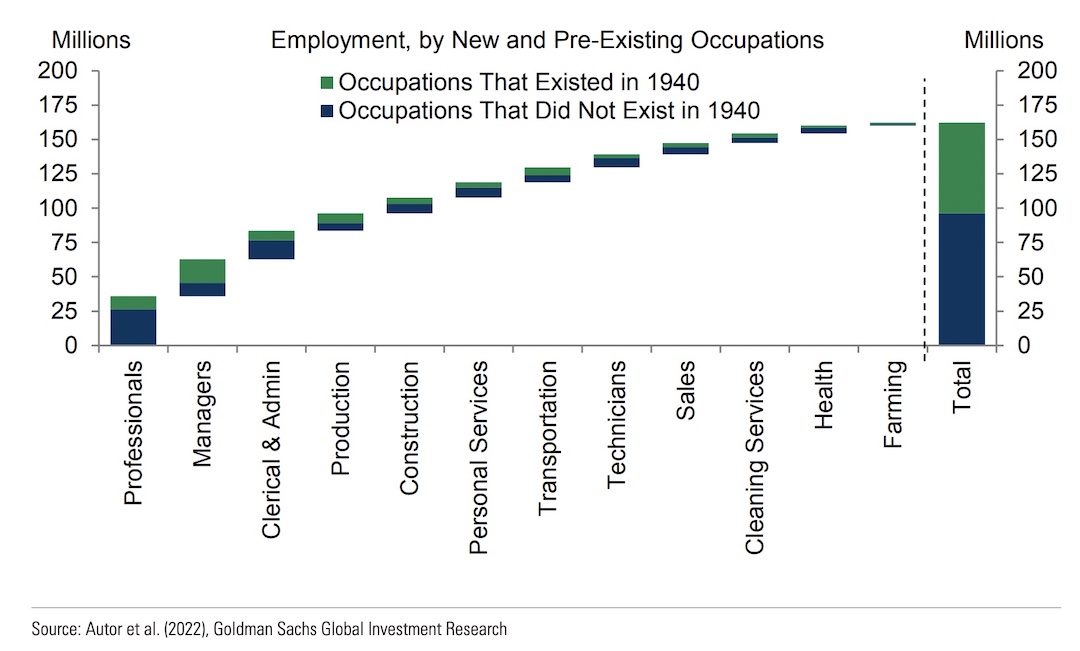
The iPhone App Store made app development a new job no one could have predicted; paying developers $60 billion in 2022. We don't know what we don't know. One thing is sure: AI is already impacting many jobs and will continue to do so.
🔄 2026 update: BCG's 2026 research identifies AI systems integration as a fast-growing new role; forward-deployed engineers, systems integrators, and project managers who tailor AI tools to specific organizational contexts. Supply of this talent remains far below demand.
What Jobs Will AI Replace? FAQ
The following questions are the most-searched on this topic, based on Ahrefs keyword data.
What jobs will AI replace first?
AI is replacing the most structured, repeatable work first: routine customer service, document-heavy legal and financial support, standard content translation, audio narration, and administrative scheduling. Their tasks are well-defined, require no interpersonal judgment, and the volume of output doesn't expand when the cost falls.
What type of jobs will AI replace?
Jobs most likely to be replaced share three characteristics: structured, repeatable tasks; limited need for emotional intelligence; and output demand that doesn't grow when the price falls. A credentialed financial analyst doing routine modeling is more at risk than an electrician doing contextual on-site problem-solving.
What jobs will AI not replace?
The MIT EPOCH framework identifies five categories AI can't replicate: Empathy, Physical dexterity, Original creativity, Complex judgment, and Human connection. Most durable: physicians, teachers, therapists, skilled tradespeople, senior executives, and artists.
What white collar jobs will AI replace?
White collar roles face high exposure because the work is information-based and repeatable. Most at risk: routine data and financial analysts, entry-level legal associates, standard-content translators, administrative assistants, call center agents, and junior marketing and copywriting roles.
What jobs will AI replace by 2030?
BCG's 2026 model estimates 10-15% of current US jobs will be eliminated by around 2030: routine customer service, standard document processing, entry-level data analysis, voice and translation production, and administrative coordination. If agentic AI advances faster than expected, that figure could be higher.
What jobs will AI replace by 2050?
By 2050 AI will likely handle the majority of information-processing and rule-based work. If humanoid robotics matures, physically protected jobs could also be at risk. Most durable: relational work, senior leadership, complex negotiation, care work, and trust-based advisory.
What do you think will be the future of work and the role of AI in it? Join the discussion on LinkedIn.
For more on AI, check out my other articles:
- Overview: AI in the Workplace
- AI in Management: How AI will change the way we manage
- 6 AI Recruiting Software tools for smart AI Recruiting
- Best AI Accounting Tools
- 10 AI Marketing Tools
- The 10 best AI Productivity Tools
- Best AI Presentation Generators
- Top 10 Free AI Websites
- Barriers to AI adoption
- Women and AI
- 18 Ways How To Use AI at Work
- 7 Free AI Tools to Make Your Life 10x Easier
Daan
PS: AI tools used to research and write this article:
- ChatGPT: Brainstorming, research, headline generation.
- GrammarlyGO: Editing, rewriting, tone adjustment.
- Midjourney: Header visual.