

Most large companies now run AI training. Employees get a course on the approved tools, a module on data rules and, at some companies, a workshop with the vendor.
The training reaches people, but too often the work stays the same. In BCG’s 2026 AI at Work survey of close to 12,000 employees, only 36% said they had received adequate upskilling.
So what does AI training that changes the work look like? We studied how the 150 largest companies in our AI Strategy Index train their people, alongside what we see in our own programs. Five moves separate training that sticks from training people forget:
- Set a minimum for everyone. Your output is a one-page AI standard tied to tool access.
- Test first, then train by role. Your output is a target fluency level for every role.
- Build skills on real work. Your output is one working AI solution per participant.
- Let leaders and peers carry it. Your output is a leadership commitment and a champion network.
- Keep the curriculum live. Your output is a curriculum map with owners and review dates.
What Is AI Training for Employees?
AI training for employees is the structured effort to give every person the skills, rules and habits to use AI well in their own work, and to keep those skills current as the tools change.
It covers more than tool tutorials. Good programs teach judgment, such as when to trust an AI answer, alongside the company’s data rules and how to redesign a workflow around AI. Training is also one lever of AI change management, next to leadership, incentives and communication.
Our working principle is that training starts with the work and the tool comes second. People learn fastest when they apply AI to a task they already own, and they keep the skill when it saves them time the following week.
Why Most AI Training Does Not Stick
Most of what makes training stick was known before AI. Kirstin Austin, an Impact Partner at Lead with AI and former Chief Learning Officer at the IRS, told a Lead with AI session that “all of the frameworks you learned pre-AI about learning and development, adult learning, and change management still apply.”
In her framework for AI training that sticks, training fails when “nothing has changed in the environment” around it. In practice, AI training tends to fail in four predictable ways.
Training teaches the rules and stops there. In our AI Transformation Pulse of 410 professionals starting a program in Q3 2026, people sent by their employer were far more likely to know the rules on tools and data: 81%, against 48% of people in open programs.
Yet only 10% of employer-enrolled people worked with AI at Level 2 or higher, against 28% of those who signed up on their own. (People in open programs chose to come, so they start ahead.)
AI Transformation Pulse, Q3 2026
People sent by their employer know the rules better, yet fewer of them work with AI beyond one-off prompts
Know the rules on tools and data
Work with AI at Level 2 (Collaborating) or higher
Source: Lead with AI, AI Transformation Pulse, Q3 2026. Intake answers from 410 professionals at 136 organizations starting a program between July 1 and September 30, 2026. Levels are inferred from intake answers, and people in open programs chose to come.
Everyone gets the same course. A single module bores the expert and loses the beginner. Philippe Rambach, chief AI officer of Schneider Electric, told CIO Dive in October 2026 that AI training cannot take a one-size-fits-all approach.
Policy outranks practice. In Charter’s AI Pulse, based on more than 5,000 surveys of AI users and released in October 2026, hands-on training was the most helpful resource, yet fewer than 40% of users receive it. AI policies and guidelines ranked least useful.
The content goes stale. Schneider Electric found that building and maintaining its own training content could not keep pace with the technology, according to a Coursera case study (vendor-published). A course written in January can describe the wrong screens by summer.
What the 150 Largest Companies Do
Our Index tracks how the S&P 100 and STOXX Europe 50 companies approach AI, including how they train their people. Only 22 of the 150 publish a baseline of AI use that covers every employee. The other 128 publish none.
Required training is the most common baseline, used by 10 of the 22, either for all staff or as a condition of tool access. The rest give everyone the tools, run broad training programs, point to high participation or rely on leaders’ expectations.
Only Meta sets its baseline above basic use. The Meta AI strategy puts AI-driven impact into every employee’s performance review from 2026, HR Grapevine reported.
AI Strategy Index, November 2026
Only 22 of the 150 largest companies publish an AI baseline for every employee
How the 22 companies set their baseline
Source: Lead with AI, AI Strategy Index. Public disclosures of the S&P 100 and STOXX Europe 50 companies, coded November 24, 2026. Only Meta, through performance reviews, sets its baseline above basic use. The other 128 companies publish no baseline for every employee.
The five moves below draw on the companies that go furthest beyond it.
1. Set a Minimum for Everyone and Tie It to Access
A minimum gives every employee the same starting point: the data rules, the approved tools and the habit of checking AI output. Tying it to tool access is the simplest way to enforce it, because nobody gets the tool without the training.
The Mastercard AI strategy started with mandatory training on its data policies. Its chief technology officer for operations told The Stack in 2025 that people needed a base level of data knowledge before they were granted access to the tool.
BBVA opened Gemini only to employees who had completed internal training, Google Cloud announced in July 2025. Its Gemini Express course became the most attended training in the bank’s history in its first week, and more than 105,000 employees have taken it, according to BBVA.
The Pfizer AI strategy adds a personal goal. Every colleague can take on an AI Fluency Development Goal that sits alongside their yearly performance metrics. Four months after launch, 98% of eligible colleagues had taken the first course, Pfizer reports.

A minimum also gets people onto the approved tools. When Bryn Austin, a professor at the Harvard T.H. Chan School of Public Health, ran an AI fluency pilot with us for 35 people in her department, two-thirds of the volunteers were not using Harvard-approved AI tools at all, as her case study describes. After the three-week course, their knowledge of when to use the approved tools had improved by 33%.
Completion figures show exposure to AI and say little about daily use, so treat the minimum as the start of the program. If it ends in an AI certification, tie it to the job, because job relevance decides whether a credential pays off.
Your output is a one-page AI standard: the course every employee completes, the rules it covers, the tools people get once they finish and the date by which everyone finishes.
2. Test First, Then Train by Role and Level
People arrive at very different levels, so the fastest programs test what people already know and train only the gap.
The Citigroup AI strategy builds this into required training for about 175,000 employees in 80 locations. Citi’s head of learning told Fortune that experts finish in under 10 minutes while beginners take about 30, because the platform adjusts to what each person knows.
Schneider Electric splits its curriculum into four tiers. The first is mandatory for all 160,000 employees, and the others serve senior managers, the experts who build AI software and the people leading transformation.
Our own programs start with an AI intake interview. For a university careers team of 32 people, the interviews surfaced 142 work needs and gave each person five recommended workflows to start with. Although 78% of the team already used AI daily, few had redesigned a workflow.
We map the levels with our AI Fluency Matrix, from Level 0 (Avoiding) to Level 4 (Transforming). Most knowledge workers need Level 2, Collaborating, where they create great work with AI. People who own recurring workflows need Level 3, and a small group of builders needs Level 4.
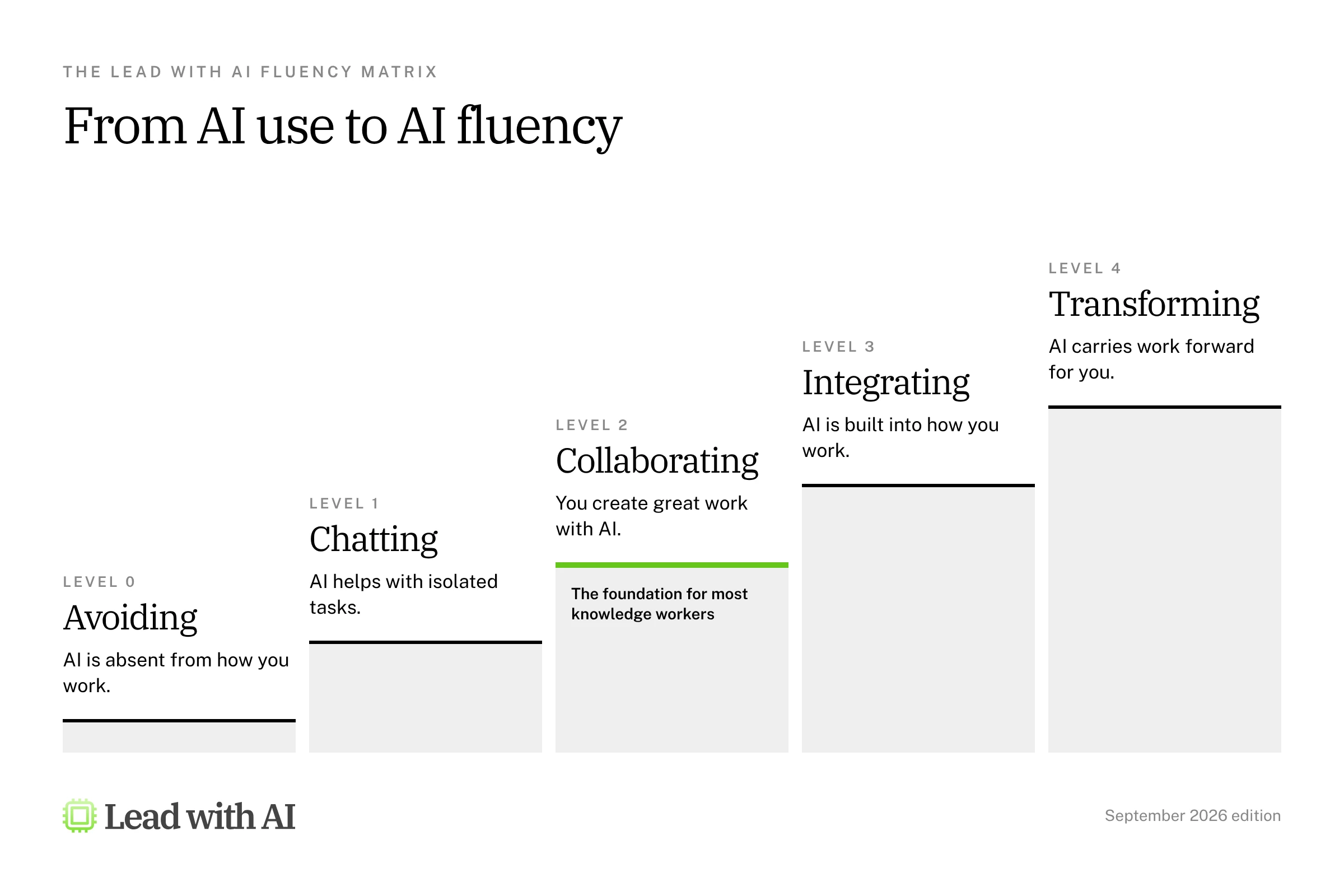
Training tracks can follow the same levels. In one enterprise academy we run, employees choose among three tracks with help from an assessment and a track advisor: safe AI fundamentals, reusable assistants for recurring work, and automation and agents.
Your output is a role map that gives every role a target fluency level, plus a short diagnostic that places each person before training starts.
3. Build Skills on Real Work
Skills form when people use AI on a task they own and see it save time that same week.
The Microsoft AI strategy shows why. A pilot of Camp AIR, its AI program for engineers, found that tools and training alone were not enough, Kathleen Hogan, Microsoft’s chief strategy and transformation officer, wrote in September 2026.
Lasting change came when teams learned and experimented together, and Camp AIR has since scaled to more than 3,000 engineers.
Our programs work the same way, because AI transformation starts with the people doing the work. Every participant picks tasks from their own job, and our GED-RT framework helps them decide which to hand to AI first.
In a pilot with 30 leaders at a global industrial manufacturer, 25 qualified and together built more than 72 assistants. They covered work such as lease accounting, contract comparison, safety communication and turning process videos into draft instructions for expert review. In the Harvard pilot, 88% built at least one assistant for their own job.
People also need a safe place to practice. Kirstin Austin calls it a “corporate sandbox,” a judgment-free place where a group learns together, for example through guided 30-minute daily sessions that build on each other.
Your output is one working AI solution per participant, built on their own workflow and in use by the end of the program.
4. Let Leaders and Peers Carry It
People learn most from colleagues they respect. In the BCG AI strategy, nearly all employees reached level 1 of its AI Fluency Ladder voluntarily within four months, the firm reported in November 2026. Global People Chair Alicia Pittman said a respected colleague’s example is “more persuasive than any training program you can run.”
Citi built a volunteer network of about 4,000 AI Accelerators, led by 25 to 30 Champions, who help colleagues apply AI in their own teams, Business Insider reported in January 2026.
Citi now reports an AI adoption rate above 87% across employees with its tools, as of September 2026.
The Lloyds Banking Group AI strategy relies on about 1,000 volunteer “flight instructors” who coach colleagues on Copilot, Microsoft reported in 2025. By June 2026, 97% of colleagues with one of its 40,000 Copilot licenses were active users, according to Microsoft (supplier-claimed).
Our guide to AI champion programs covers how to set one up.
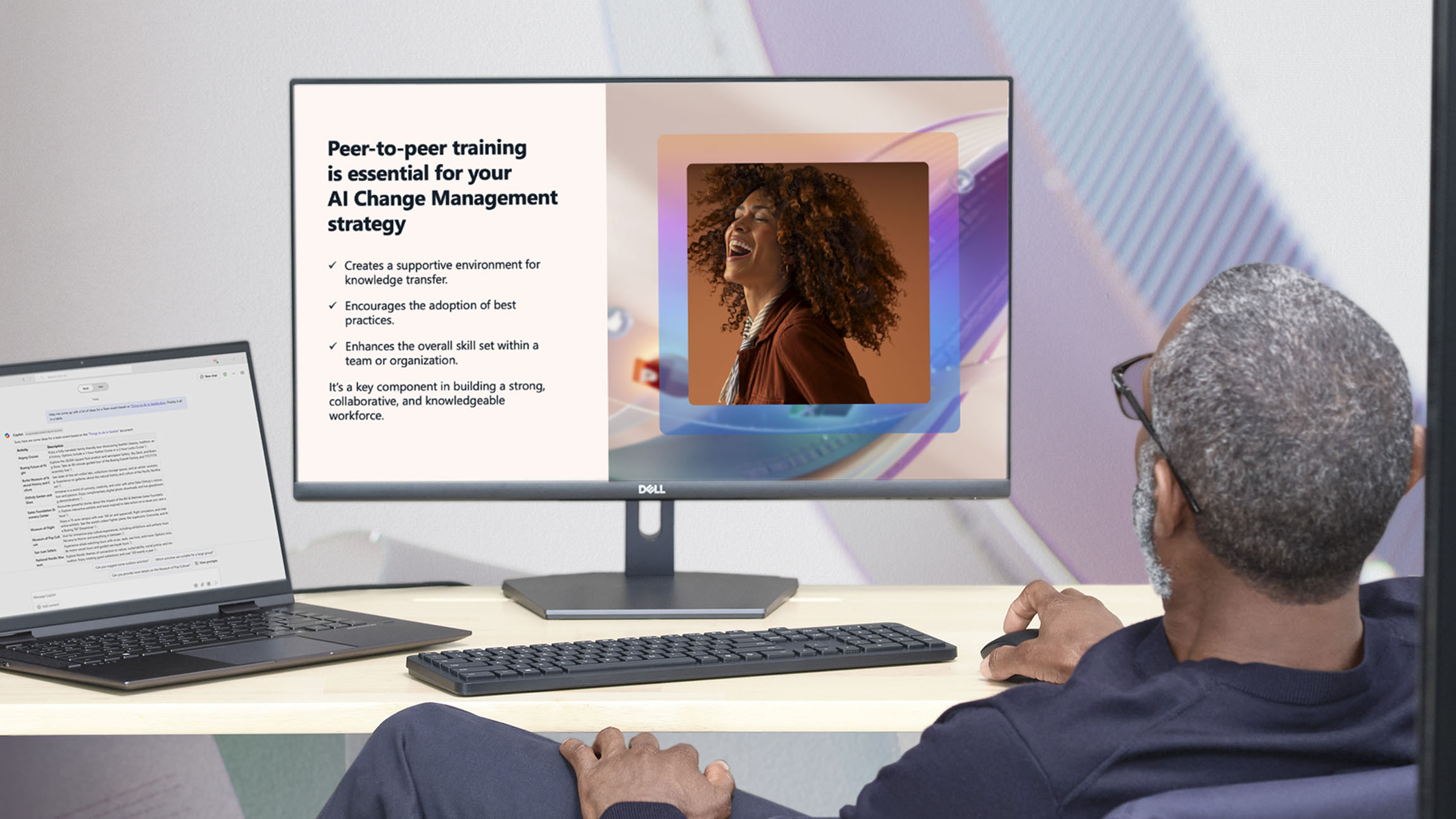
Leaders have to go first, in public. Pfizer CEO Albert Bourla took the same foundational course as his colleagues, and he said afterward:
“I saw huge difference in my ability.”
Rambach is just as direct about Schneider’s senior managers: “They need to lead by example.”
In our programs, leaders show what they built at a Demo Day. At one financial services company, the CFO built an assistant for board-meeting preparation, performance analysis and challenge discussions, and demonstrated it to fellow executives.
Some companies now write AI use into how people advance. The Accenture AI strategy tells associate directors and senior managers that promotion to leadership roles requires “regular adoption” of AI, the Irish Times reported in February 2026. (Staff in 12 European countries are exempt.)
What leaders notice spreads. “You’re gonna get the behavior you pay attention to,” Kirstin Austin says, and teams where sharing AI experiments is normal produce more of them.
Give frontline managers more than a mandate. Kirstin Austin warns that organizations often ask managers to support a rollout without giving them the resources to do it. She recommends a separate track that shows leaders how to model the change and talk about it, with a peer group of other leaders to compare notes with.
Your output is a leadership commitment and a champion network. Every executive completes the same training first and shares one real use in public, and every team has at least one champion with protected time.
5. Keep the Curriculum Live
AI training content ages in months, because the tools underneath it keep changing. We published two new editions of our own Fluency Matrix in 2026 for that reason.
The FedEx AI strategy treats its role-based program, built with Accenture, as a “living curriculum” that refreshes monthly and quarterly, Chief Data and Information Officer Vishal Talwar said in March 2026 (TechRadar).
The fix is to split the curriculum into three layers that age at different speeds, and give each its own review cycle:
- Judgment and workflow, reviewed yearly. How to judge AI output with a check such as our DRAFT Framework, protect data, choose tasks for AI and redesign a workflow. This layer barely moves.
- Capabilities, reviewed quarterly. What AI can do for a role, from research and analysis to reusable assistants and agents. New capabilities arrive a few times a year.
- Product how-tos, reviewed monthly and after every major release. Where a feature sits in ChatGPT, Copilot, Claude or Gemini this month. Keep these short, dated and separate from the core lessons.
Our own lesson library runs this way. We update it daily, and when a major model or feature ships, we write it up and link it into the lessons it affects.
Three habits keep the cycle running. Give one person ownership of each layer, and date-stamp every lesson so stale ones are easy to find. Use your champions as sensors, because they hear first when a lesson no longer matches the screen.
Then reassess people about every six months. Fluency decays as the tools move, even for daily users who feel ahead.
Learner feedback should reshape the next cohort. After our pilot at the industrial manufacturer, the main barrier shifted from awareness to time and team habits, so the follow-on cohort was built around protected application time, accessible tools and live reinforcement.
Practice should continue after the course ends. After the Harvard pilot, Bryn Austin’s department formed Summer Sprint Pods of four to six people, each building one shared assistant for a specific role, such as grants management.
Your output is a curriculum map that tags every lesson by layer, with an owner, a review date and a trigger for updates between reviews.
Your 90-Day AI Training Plan
- Days 1 to 30: Set the standard and place people. Write the one-page standard, give every role a target level and run the diagnostic.
- Days 31 to 60: Train on real work. Run the baseline course, then role-based cohorts in which every participant builds a solution on their own workflow. Recruit champions from the first cohort.
- Days 61 to 90: Measure use and refresh. Track weekly use, solutions in use and time saved, beyond course completions. Update or retire every lesson that no longer matches the tools.
10 Questions to Ask About Your AI Training Program
If you can answer all ten with evidence, your program is built to last.
- Does every employee have a published minimum, and is tool access tied to it?
- Do we test people before we train them?
- Does every role have a target fluency level?
- Does every participant build something on their own work before the program ends?
- Have our executives completed the same training, and do they share how they use AI?
- Does every team have a champion with protected time?
- Is AI use part of how we develop and promote people?
- Does every lesson have an owner and a review date?
- Do we measure weekly use and time saved, beyond course completions?
- Do we reassess people at least every six months?