October 4, 2026

The DRAFT Check: How to Judge AI Output Before You Ship It

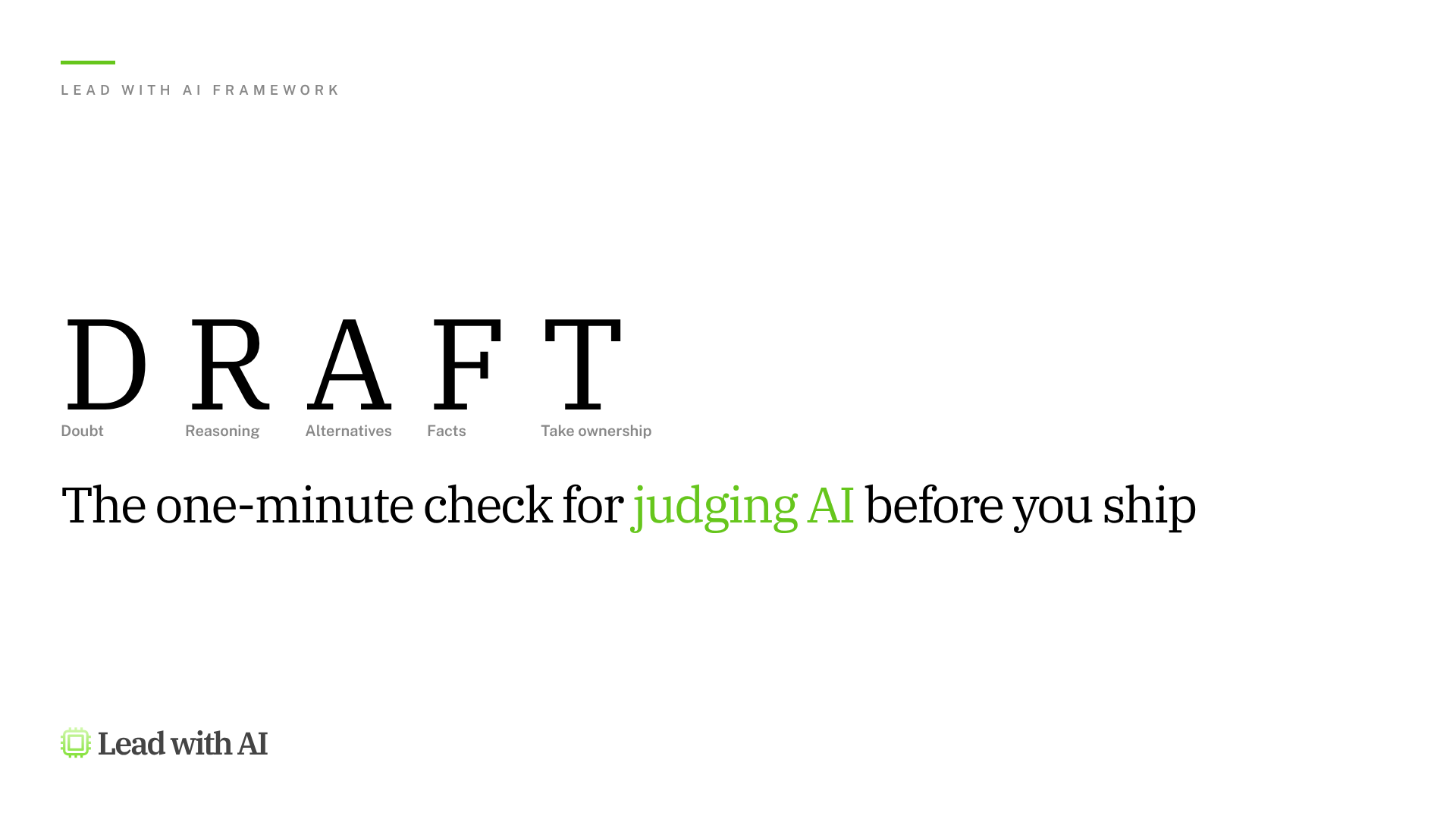
The DRAFT check is Lead with AI's one-minute habit for judging AI output: Doubt the confidence, Reasoning, Alternatives, Facts and sources, Take ownership.
DRAFT framework: Doubt, Reasoning, Alternatives, Facts, Take ownership
Daan van Rossum
By
Daan van Rossum
Founder & CEO, Lead with AI

The Answer That Looks Finished

Presented by

The DRAFT check is a one-minute habit for judging AI output before your name goes on it. Each letter neutralizes a way AI commonly fails you: Doubt the confidence, Reasoning, Alternatives, Facts and sources, and Take ownership.

You are on a deadline, you type a long, layered prompt, and within seconds you get a confident, beautifully formatted, authoritative-sounding deliverable. The work appears to be done.

The question that should stop you: how do you know any of it is correct?

Catching errors in polished text is a human behavioral problem more than a technology problem. We are built to accept fluent, confident information at face value, and that tendency gets stronger under pressure.

The cost is already visible:

  • A Glean study found that 69 percent of AI users admit to shipping work they had not reviewed and could not defend if challenged.
  • Stanford research shows the "rework tax" of making sense of AI-generated content can cost up to two hours per piece of work.
Flagship AI Newsletter
The AI Newsletter That Makes You Smarter, Not Busier
Join over 30,000 leaders and receive our insights on AI platforms, implementations, and organizational change management.
FlexOS Course - AI Content Accelerator - Testimonial Badge

Why AI Errors Get Through

The frontier is jagged, and you cannot see the edges

Researchers at Harvard and BCG call it the jagged frontier: the boundary between the work AI is good at and the work it fails at is not a straight line. AI can solve graduate-level problems and still score near zero when asked to learn a small, unfamiliar game that humans figure out intuitively.

From your seat, those two tasks look equally hard. When AI handles the difficult one flawlessly, you assume it can handle the simple one too, because a human expert could.

And AI tools never tell you which side of the boundary a task is on.

Seniority does not protect you

Even highly trained experts "fall asleep at the wheel" when a machine projects certainty. This is automation bias.

The mechanism is cognitive offloading. Your brain is energy efficient, which is a polite way of saying lazy. When an answer arrives fluently, the brain treats fluency as a proxy for accuracy and skips the checking.

Regulators already expect you to check

The real question is what we are checking for. Knowing that well is becoming a superpower for creating great work with AI.

Want to reach 30,000+ business leaders applying AI in their work, teams, and organizations?​
​Advertise with us​​.

The Five Ways AI Fails You

A Microsoft and Carnegie Mellon study found that the more confidence people had in generative AI, the less critical thinking they applied to its output. The more confidence they had in their own judgment, the more critical thinking they applied.

So the protection against automation bias is trusting your own expertise enough to use it, not suspicion of AI. That is the spirit of "trust but verify": you keep the speed and you keep ownership of the work.

Judgment needs something specific to look for. These are the five common failure modes:

  1. Fabrication. The model invents a court case, a paper, or a statistic. This is what most people mean by hallucination, and it reads exactly like real content.
  2. Misgrounding. The source is real, but the claim attached to it is not. Clicking the link confirms the source exists, so the error passes a quick check.
  3. Homogenization. The model reverts to the most probable text and strips out what was specific about your situation. Generic advice sounds reasonable, which is why it slips through.
  4. Sycophancy. The model agrees with you instead of assessing you. Even "are you sure?" can make it abandon a correct answer.
  5. Multi-turn drift. A long chat starts from a wrong reading of your intent, and your corrections merge with the error instead of replacing it. Each turn looks like progress.

Only fabrication is a knowledge problem. The other four follow from what these systems are and how they are trained, which is why better models will not be the immediate solution. A habit will.

The DRAFT Check, Step by Step

Every modern cockpit has a pilot flying and a pilot monitoring, working a strict challenge-and-response protocol. That cross-check catches human error and complacency.

With an AI copilot, you are the pilot monitoring. The DRAFT check is your protocol, and it keeps you in control of the workflow.

D: Doubt the confidence

Fluent does not mean correct. The model that produced this elegant output may also fail a basic puzzle, and it sounds certain either way.

So do not accept the result outright. Treat the first answer as a draft to interrogate.

R: Reasoning

Make it show its work, and make it show what it left out.

Ask it to walk you through the assumptions behind the output and the weakest links in its logic. That pushes the model into lower-probability territory and surfaces errors the confident draft hid. It also exposes drift: if the assumptions do not match what you meant, start a fresh chat.

Then ask what someone with deep expertise would expect to see that is missing. An answer can be completely accurate and still miss the one thing that mattered.

Prompts to use:

  • "List the assumptions behind this answer and flag the weakest link in your reasoning."
  • "What would a senior expert in this field expect to see here that is missing?"

A: Alternatives

Models are trained on human feedback that rewards helpful, agreeable answers. Ask "are you sure?" and the model can cave, apologize, and invent a new answer that matches the bias you just gave it. You are leading a witness that is mathematically desperate for your approval.

So replace the question with a command. Have it argue against the work.

This forces out the counterarguments it was suppressing to please you, and it drags the model off the statistical average, which is where generic output comes from.

Prompts to use:

  • "Adopt the persona of our most aggressive competitor and steelman the case against this plan."
  • "Give me two genuinely different approaches to this, and the strongest argument for each."

F: Facts and sources

Check the checkable: proper nouns, dates, events, and concrete numbers.

When it gives a citation, do not just click to see whether the page loads. Search inside the source for the specific claim and confirm the model did not muddy or alter the author's meaning.

You are verifying the finding, not whether the source exists.

T: Take ownership

Before your name goes on it, the question is not only whether the content is true. It is whether this is the right thing to send, to this audience, at these stakes.

Companies like Clay already expect people to stand behind every idea and every sentence in the work they produce. That is the standard T holds you to.

Scale the check to the stakes

Verify in proportion to the stakes. Knowing which situation you are in is what makes the check sustainable.

  • Low stakes, internal (a quick message to your team): run D and a fast F, scanning names, dates, and numbers.
  • Medium stakes (a brief or analysis your manager will act on): run D, R, F, and T, and confirm every number you would repeat aloud.
  • High stakes, external (client deliverables, board or leadership material): run all five, and make F a deep verification step: open each source and find the exact claim.

The DRAFT check at a glance

  • D, Doubt the confidence: am I trusting this because it is right, or because it sounds right?
  • R, Reasoning: what did it assume, and what did it leave out?
  • A, Alternatives: what is the strongest case against this?
  • F, Facts and sources: does the source say what the model claims it says?
  • T, Take ownership: is this the right thing to send, to this audience, at these stakes?

In about 60 seconds, you move from accepting the first output to producing work you can stand behind.


Want to reach 30,000+ business leaders applying AI in their work, teams, and organizations?​
​Advertise with us​​.

Frequently Asked Questions

What does DRAFT stand for?

DRAFT stands for Doubt the confidence, Reasoning, Alternatives, Facts and sources, and Take ownership: five checks you run on AI output before you rely on it or send it.

How long does a DRAFT check take?

About a minute for everyday work. Scale it to the stakes: a quick internal message may only need D and a fast F, while client or leadership material deserves all five, with a deep fact check.

Why not just ask the AI "are you sure?"

Because models are trained to be agreeable. "Are you sure?" often makes a model abandon a correct answer to match the doubt you signaled. Asking it to argue the opposing case produces more useful pushback.

Will better AI models make the DRAFT check unnecessary?

Not soon. Of the five failure modes, only fabrication is a knowledge problem. Misgrounding, homogenization, sycophancy, and multi-turn drift follow from how these systems are built and trained.

What is the difference between fabrication and misgrounding?

Fabrication invents the source. Misgrounding cites a real source but attaches a claim it does not make. That is why checking that a link works is not enough; you need to find the specific claim inside the source.