

Every business leader we work with wants to use more AI, but almost none of them know where to actually put it.
That's the real problem: not a lack of enthusiasm or tools, but knowing which part of your job to hand over first.
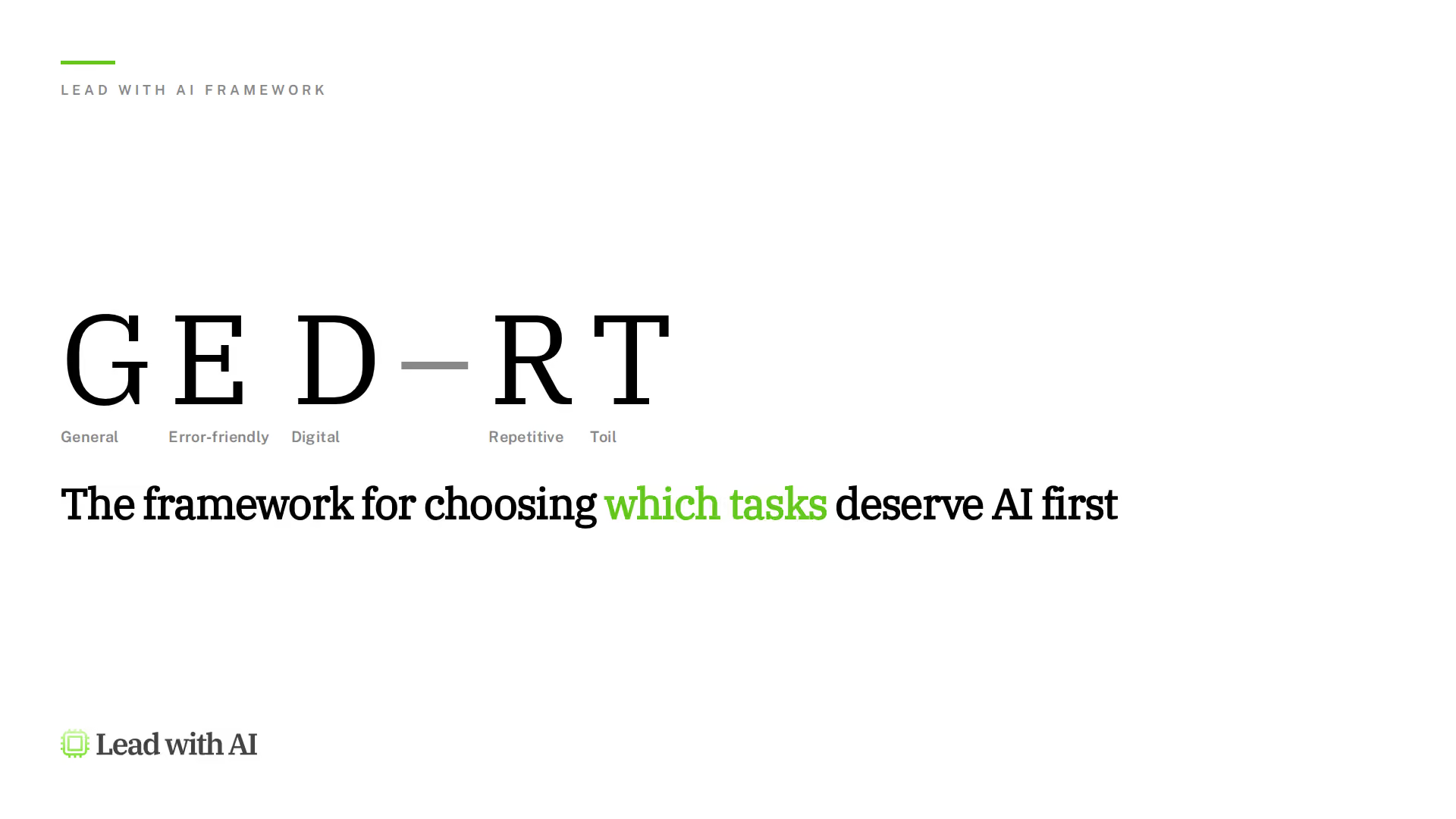
GED-RT is the framework we use to answer that question.
Lead with AI has coached thousands of senior leaders, at companies including Microsoft, Apple, McKinsey, BCG, Atlassian, and Supercell, on how to build practical AI fluency into their day-to-day work.
Most AI workflow prioritization frameworks focus on what AI can do, but that's the wrong starting point.
Just because AI can do something doesn't mean it should.
GED-RT looks at two things instead: where a task is actually costing you time, and what kind of work you don't particularly like doing.
GED-RT starts by looking at the task, not the tool. Applied consistently, it's one of the clearest levers for raising your Impact per Hour, our guiding metric for AI-augmented leadership.
What Does GED-RT Stand For?
A task is a strong candidate for AI when it is:
General
It relies on broadly understood context, rather than hidden or highly specialized knowledge.
Error-friendly
Mistakes are reviewable and editable without serious consequences.
Digital
The work already lives in documents, messages, spreadsheets, or systems.
Repetitive
It shows up often, or it eats an outsized share of your time.
Toil
It's low-joy work that you wouldn't miss doing yourself.
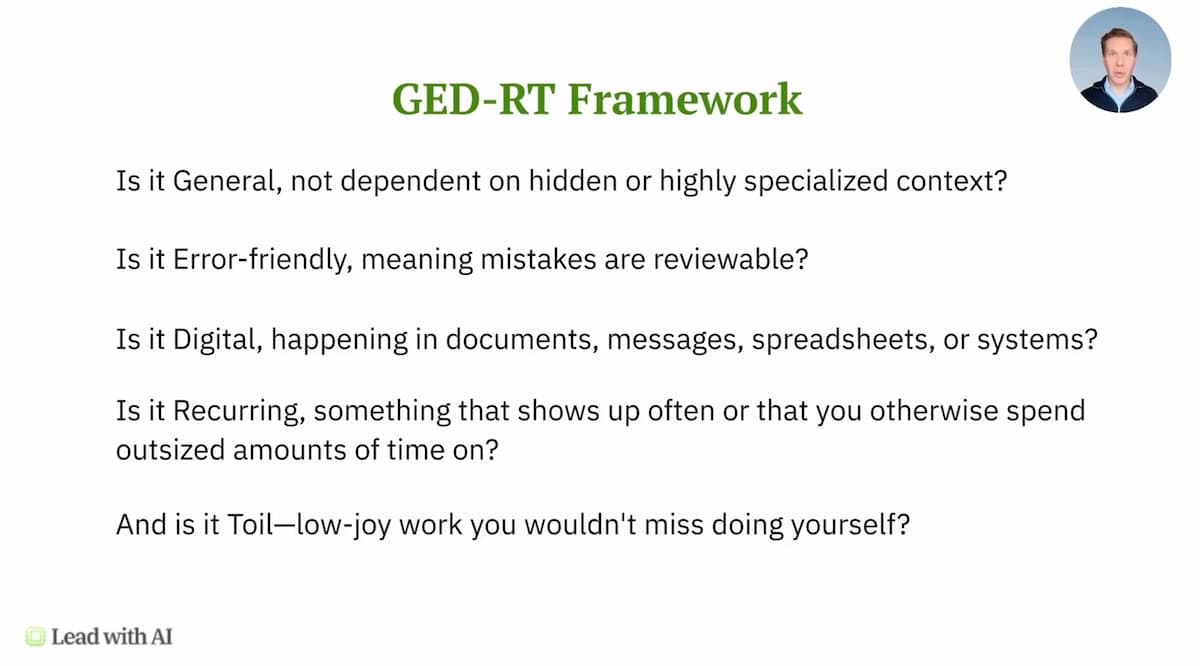
How many boxes does a task need to check?
- If a task checks 3 out of 5 boxes, it's worth testing AI on it.
- If it checks 4 or 5, there's no good reason to keep doing it yourself.
- If it checks 2 or fewer, it stays with you for now.
Worked example: sending meeting follow-ups
- General: it draws on your meeting notes and everyday follow-up language, not specialized knowledge.
- Error-friendly: you'll read it before you send it.
- Digital: the notes and the email already live in your inbox or notes app.
- Repetitive: it happens after every meeting.
- Toil: nobody enjoys writing the same recap over and over.
This task checks every box, which makes it an easy one to hand to AI first.
Why Tasks Come Before Tools
Most AI adoption stalls on the same question, asked in the wrong order: "Which AI tool should I use today?"
The better question is: "Which part of my work deserves AI support, and what kind of AI is best suited for it?"
GED-RT flips the order, so tasks come first and tools follow.
That shift takes two mindset changes.
1. AI as a team member, not a one-off utility
It's something you collaborate with regularly, not something you only open occasionally.
2. A team of AI, not a single AI tool
High-fluency leaders build a small set of AI assistants, each with a clearly defined role. For example: a research assistant that pulls competitive intelligence, a drafting assistant that turns bullet points into client-ready copy, and a scheduling assistant that handles calendar coordination and follow-ups. That gives you three clearly defined roles, rather than five different subscriptions.
Matching a GED-RT Task to the Right AI
Once a task clears the filter, the tool choice gets simple.
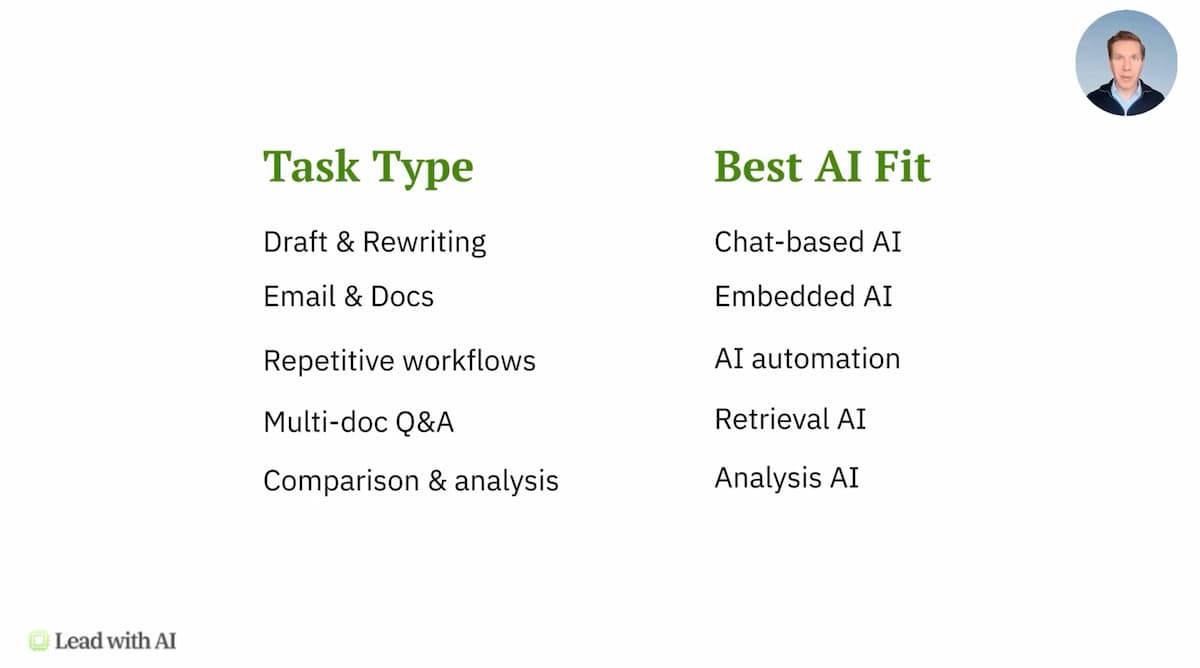
Fast thinking, drafting, rewriting → a chat-based AI like ChatGPT or Claude
Work inside email or documents → AI embedded directly in that environment, like Gemini or Copilot
Anything that repeats weekly or monthly → AI-powered automation
Answering questions across many internal documents → a retrieval-style AI like NotebookLM
Heavy comparison or structured analysis → an analyst-style deep research tool
(See our guide to the best AI websites for where each of these fits.)
This is the shift from Level 1 to Level 2 on the Lead with AI Fluency Matrix: from occasional experimentation driven by curiosity, to AI genuinely built into how work gets done.
At Level 2 fluency, AI is consistently placed into GED-RT-qualified work. It prepares, organizes, and accelerates the early steps, so the leader can step back in to apply judgment and give feedback.
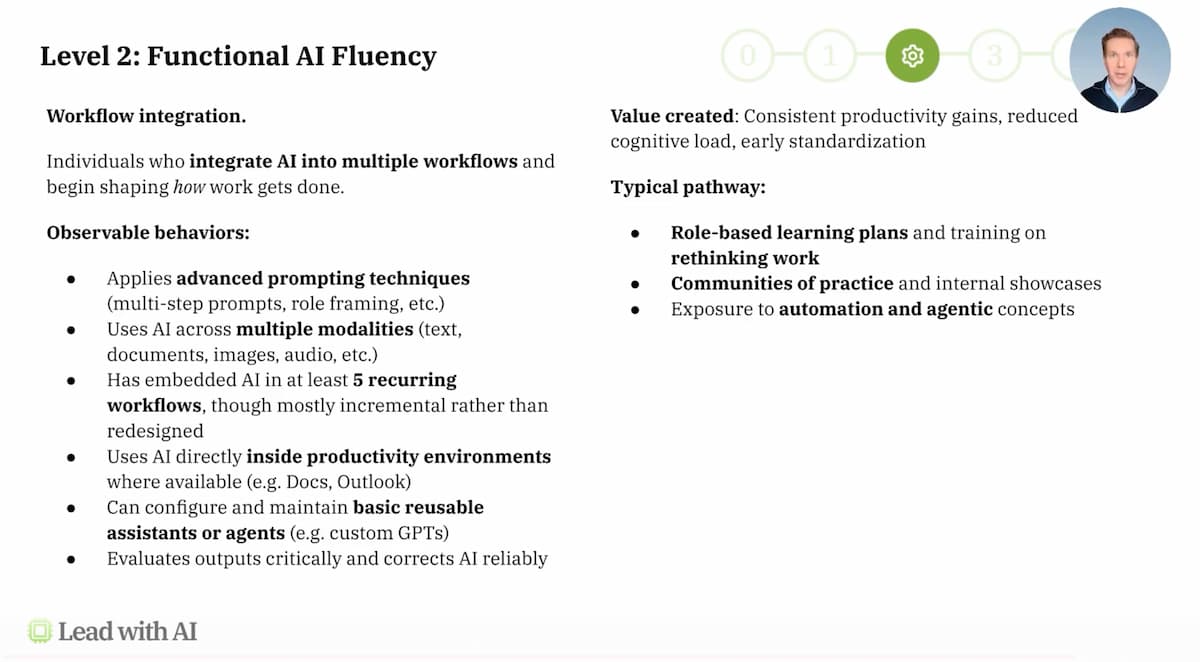
From there, the next shift is rethinking entire workflows now that AI is part of the system.
Recent Stanford and Carnegie Mellon research on Workflow Literacy makes the same point: AI succeeds when your team understands the structure of the work, not just the desired outcome.
That's exactly what we cover in AI Leader Advanced.