
The short answer is yes. New research analyzing 37.7 million U.S. worker resumes confirms that the right AI certification delivers real, measurable wage returns. The caveat is that the market is full of programs that don't qualify as "the right one." Knowing the difference is what the research makes clear.
What the Largest Credential Study Ever Conducted Found
A December 2025 working paper from the Brookings Institution, the first large-scale analysis of its kind, studied 37.7 million U.S. worker resumes and 54.3 million credentials to answer a question that has long resisted rigorous evidence: do non-degree credentials actually pay off?
The core finding: yes.
A worker's first job-relevant credential is associated with a 3.8% wage premium compared to workers with no credentials at all. Each additional job-relevant credential adds roughly 1.0% to wages on top of that.
The researchers, Eduardo Levy Yeyati, Ian Seyal, and Sophia Henn, describe the mechanism directly: accumulating job-relevant credentials "reflects genuine skill complementarity that enhances productivity."
The caveat is relevance. A credential that is not connected to a worker's actual job delivers less than half the premium: 1.8% versus 3.8% for a first credential, and no measurable benefit at all for accumulation. Credential quality and alignment matter more than credential quantity.
Job Relevance Is the Deciding Variable, Not the Credential Itself
The Brookings study introduces a specific measure of job relevance: how concentrated a given credential is in a specific occupation relative to the overall workforce.
A JavaScript certification is 10.66 times more prevalent among software developers than among workers at large. That's highly job-relevant. The same certification held by a marketing executive is not.
This framing has direct implications for AI training decisions. The credential market has grown rapidly. Over 1.5 million unique non-degree credentials now exist in the United States, and the share of workers listing at least one grew 35% in a single year between 2024 and 2025.
Not all of that growth represents value. A separate analysis of 23,000 credentials cited in the Brookings paper found that only 12% deliver significant wage gains.
The question every leader should apply to any AI certification: does this program build skills I will actually use, in work I actually do?
The Type of Credential Determines How It Works in the Market
The Brookings research separates credentials into five types: badges, certificates, certifications, licenses, and microcredentials. Each operates through an entirely different mechanism.
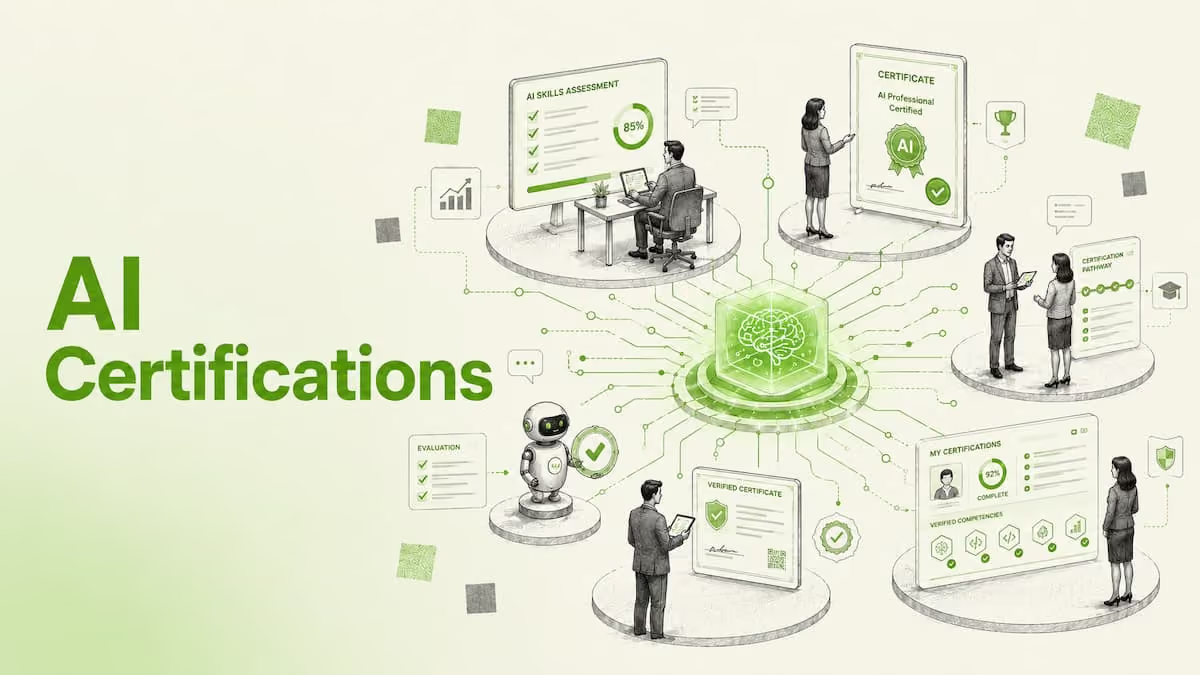
Certifications, which typically require proctored exams, third-party validation, and ongoing renewal, show returns consistent with genuine skill-building. Each additional relevant certification adds wages. The researchers describe this as consistent with human capital accumulation: the credential is doing something, not just signaling something.
This is exactly the standard the Lead with AI Advanced AI Leader certification is built around. Certification is not awarded on completion of coursework. Lead with AI proctors manually verify real-world AI fluency by checking that each participant has implemented at least six AI assistants in their actual work. One of those assistants is presented live to a peer group on demo day.
That distinction matters. AI fluency is not the same as AI literacy. Literacy is knowing about AI. Fluency is having embedded AI into real workflows, with demonstrated output. Leaders who want to build AI native organizations need the latter, not the former.
Most university-backed AI programs, including those from Stanford and MIT, are designed around evergreen frameworks precisely because they cannot keep pace with how quickly the tools themselves change. Participants in Lead with AI cohorts frequently arrive having already completed one of those programs and looking for something that goes further.
Badges and certificates show the opposite pattern. Their value comes from initial possession: the first one signals quality and learning orientation to employers. But returns to accumulation are either flat or negative, regardless of relevance. The researchers call this "signaling saturation": once the signal is conveyed, acquiring more of the same type adds limited marginal information.
For AI training specifically, this distinction matters enormously. The market is saturated with low-barrier digital badges and completion certificates from passive video courses. Those may provide an initial signal.
What builds on itself is structured, validated, practice-based training tied directly to real work. That is what the Brookings research predicts will compound.
Returns Are Highest for Professionals Who Need to Prove New Capability
One of the most consistent findings in the study: credentials do their best work when a professional's existing track record doesn't yet tell the full story.
Workers without a bachelor's degree see a 6.8% wage premium from their first job-relevant credential, nearly double the 3.4% premium for college graduates. Early-career workers see a 6.1% premium from their first job-relevant credential, versus 2.8% for experienced workers.
For credential accumulation, the gap is even wider: early-career workers gain 2.32% per additional relevant credential, while experienced workers gain just 0.52%.
The researchers explain why: "NDCs play a critical role in the early stages of a career, in part by increasing productivity and in part by signaling competence; in both cases helping them differentiate themselves in the absence of a long track record."
For senior leaders, this reframes the question. A credential alone won't move a needle already set by decades of experience. What moves the needle is demonstrated capability: evidence of having actually integrated AI into real work, built systems that run on real workflows, and led others doing the same.
What Job-Relevant AI Training Looks Like in Practice
The Brookings findings predict that AI programs delivering real returns share specific characteristics:
- They are tied to a participant's actual occupation and tasks
- They require building something, not just watching something
- The skills they develop compound rather than plateau
The AI Leader Advanced program from Lead with AI is built on exactly this logic. Participants spend three weeks applying AI to their real work, not studying AI in the abstract, and complete the program having built functional AI assistants running on their actual workflows.
Phil Kirschner, a Lead with AI facilitator, described the output from one cohort: "Non-technical leaders built this in two weeks. I watched it happen."
The assistants participants built included web page quality review for branding and SEO, client onboarding automation for medical prosthetics, sales call retrospective analysis, and podcast transcript pipelines feeding directly to social media content. All were built by self-described non-technical leaders, across industries, in a single cohort.
Real tasks, real workflows, real outputs. That is exactly what the Brookings research predicts will generate returns that accumulate. For organizations looking to scale this beyond individual certifications, team AI training and AI champion programs follow the same principle: skills that compound only when applied to real work.
Why Program Design Matters as Much as Content
The Brookings paper notes that program design is frequently what determines whether skills actually transfer. Most programs are not designed with this outcome in mind.
Philip, a UK business owner who completed Lead with AI, described the result: "The course was immediately practical. I saw a return on investment while still taking it: saving time, improving workflows, and learning to use AI tools I would never have found on my own."
Kirstin Austin, a participant from the United States, identified what made the design work: "The lessons build on one another, so that the learner develops skills step by step in a structured, confidence-building way. The course concludes with practical, hands-on projects that were especially powerful. Having the opportunity to produce real work tied everything together."
That scaffolding, with lessons building on each other and culminating in real work product, is consistent with what the Brookings research identifies as the mechanism behind credentials that compound: genuine skill complementarity, not one-time signaling.
How to Spot Programs That Won't Deliver
The Brookings paper closes with a policy warning that applies directly to anyone navigating the current AI training market.
The researchers write that in the absence of quality assurance mechanisms, "imperfect information in the credential market may expose individuals to low-value or even exploitative programs."
The AI training market in 2025 and 2026 fits this description closely. Credential proliferation has outpaced quality assurance. Awareness-level courses, those that explain what AI is without requiring participants to use it, are marketed alongside rigorous programs that build genuine AI fluency. The research on AI in the workplace consistently confirms the same gap: most organizations have adopted AI tools without ensuring their people have the skills to use them well. For companies trying to close that gap at scale, enterprise AI training designed around real application is the only approach the research supports.
The research predicts that awareness-level programs deliver at best a one-time signal. For senior leaders, that's not enough.
Dr. Lakshmi Ramachandran, an executive coach, Harvard Business Review faculty member, and Lead with AI participant, described what separates programs that build something durable:
"What it gave me was not just a toolkit. It gave me a framework for thinking about AI before touching it: how to get clarity on what you actually want to build, which problems you are trying to solve, and which tools are worth your attention. The leaders who get the most from AI are not the ones who adopt it fastest. They are the ones who do the thinking first."
Erick Razon, a Global Senior Marketing Manager at Freudenberg who returned to Lead with AI for a second certification, described what sustained application looks like:
"I now effectively have a team of AI assistants helping me work more efficiently, as well as a sparring partner for important initiatives, helping me challenge assumptions and spot blind spots. I've also made a personal commitment that every Friday, I'll spend one hour identifying mundane tasks I can delegate to AI so I can focus more of my time on high-impact strategic work."
That ongoing practice, not the credential itself, is what the research identifies as the source of compounding returns.
Key Takeaways
- AI certifications are worth it. The Brookings analysis of 37.7 million resumes confirms positive, measurable wage returns for workers holding job-relevant credentials.
- Job relevance is the deciding variable. A first job-relevant credential delivers more than double the wage premium of an irrelevant one. Accumulating irrelevant credentials delivers no benefit.
- Credential type matters. Certifications that require validated assessment build skills that compound. Badges and completion certificates deliver a one-time signal that saturates quickly.
- For senior leaders, demonstrated capability does the work. Returns to credential accumulation approach zero for workers with long track records. The AI skills you apply every day are what compound.
- AI learning is not a one-time event. Multiple Lead with AI participants returned for a second certification for one reason: the field moves too quickly for a single program to remain sufficient. For leaders ready to go deeper into autonomous AI systems, the agentic AI course covers what comes next.
Lead with AI is an executive AI training and transformation company. The AI Leader Advanced program is rated 4.9/5 across verified reviews from senior leaders across the US, UK, Europe, and Asia. Ongoing learning is available through the Lead with AI PRO membership.