July 17, 2026

How Adobe Drives AI Adoption in Sales: Amy Wowak's 6-Step Playbook

Amy Wowak, who leads Adobe's sales AI rollout, shares a 6-step playbook for driving AI adoption in sales: start from the work, not the tool.
AI is a skill, not a tool. Amy Wowak, Adobe, Lead with AI PRO session
Pawel Gorski
By
Pawel Gorski
Co-founder, Chief Growth Officer

Why AI Is a Skill, Not a Tool

Presented by

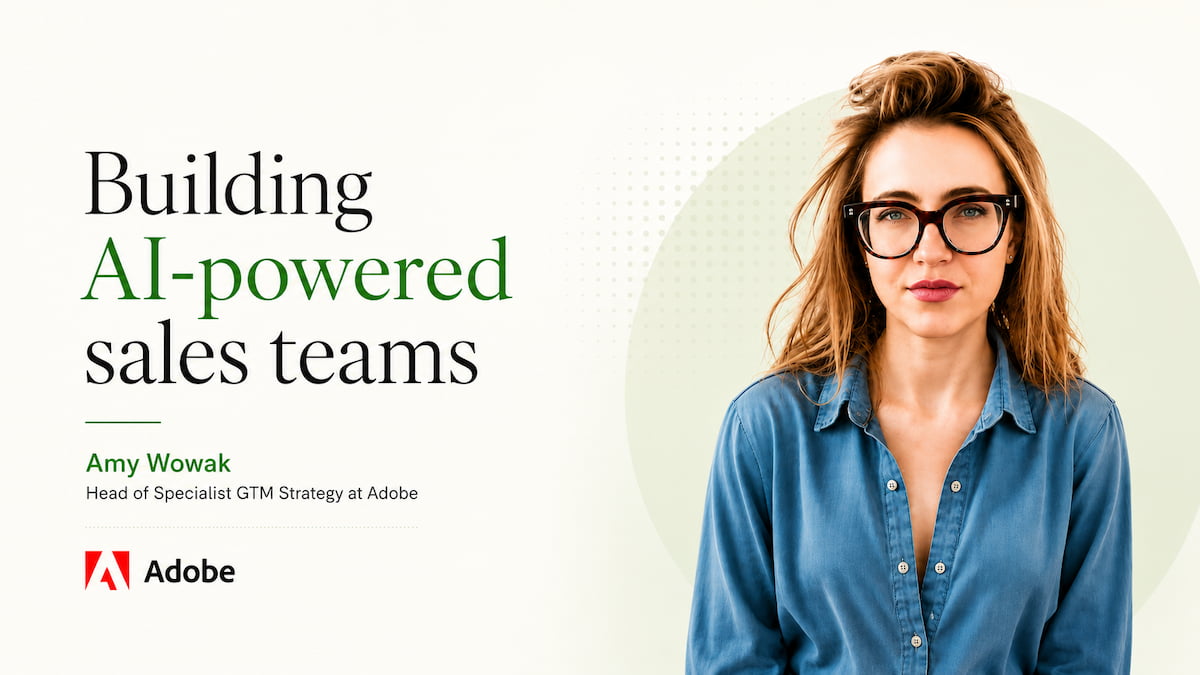
By Pawel Gorski, Chief Growth Officer at Lead with AI. Based on the July 16, 2026 Lead with AI PRO live session I hosted with Amy Wowak, Head of Specialist GTM Strategy + Practice at Adobe. Watch the full recording here.

When I interviewed Amy Wowak for our members, she gave me the sharpest line of the session in the first few minutes. She grew up on a multi-generational farming family on the North Fork of Long Island, and she used that to explain why most sales AI rollouts stall. "I can give you a tractor, but that doesn't make you a farmer."

AI adoption fails when leaders treat it as a tool instead of a skill. A farmer knows soil science, irrigation timing, and how to pivot on a dime when a blight hits or the corn comes in late, she told me. AI works the same way: it has to be built into how you work, not bolted on beside it.

That is also why she is emphatic about where to begin. "You need to start from the work and not the tool." If you lead with the tool, she said, you hand your team a portfolio without giving them a way to wield it to drive impact. Amy's instinct to begin with the work rather than the tool is what we call Workflow Literacy, and it is the skill that separates leaders who get value from AI from those who only collect tools.

Her practical version is to audit three or four moments where AI actually changes the outcome, then choose the tools that push those forward. The alternative, in her words, is "just dropping a bunch of things on your team and expecting them to figure it out."

I asked Amy why sales specifically, and she believes sales is the best place to start the AI transformation because sales is tied to a number. You can see whether deal velocity goes up, how long deals sit in each stage, and whether reps are closing faster. Those metrics are far easier to read than in a function like marketing, where success is harder to pin down.

Flagship AI Newsletter
The AI Newsletter That Makes You Smarter, Not Busier
Join over 30,000 leaders and receive our insights on AI platforms, implementations, and organizational change management.
FlexOS Course - AI Content Accelerator - Testimonial Badge

Get in the Game and Find Your AI Renegades

A sales leader does not need to be the tip of the spear on AI, but they do need to be in the game. You do not have to know the latest model or the newest law being passed, Amy said. You just need to be in the first third: using tools in your own work and learning out loud.

Her reasoning is that AI arrived fast, with no structured learning path, so everyone's knowledge is uneven. "Our ability to understand or work with AI is all incredibly jagged," she said, sharp in some areas and thinner in others. Learning in public normalizes that.

She borrows the idea from sales itself. In deal deconstructions, teams love to celebrate the wins, but "you always learn more from the deals that didn't close." The same holds for AI: show your team the agent that took four hours to build and broke three times before it worked.

The people who will carry your AI adoption are rarely the ones you expect. Amy calls them the cowboys or renegades: the genuinely curious sellers who push toward the edge of what AI can do. In sales, they are usually not the reps closing the monster deals, but the steady performers who hit their number every year.

Her rule for working with them is precise. "Work with them. Don't build on them." They are a roadmap for what the team needs next, not free labor to be exhausted. To find them, she uses AI to spot whose opportunities are progressing faster and listens to the seller grapevine, because "sellers love things that make their lives easier and gossip."

Here is a hack we use at Lead with AI for the reality Amy raised, which is that your best builders often have no time to teach. Every agent we build stores its instructions as an MD file in a shared folder. A separate company agent reads that folder and posts summaries to Slack about the new agents people have built, so the knowledge spreads even when the builder never gets on a call.

On motivation, Amy said it comes from access and recognition, not just money. She gives champions first access to the tools she is considering and lets them shape the AI strategy. And she is honest about a smaller lever: "Swag works." A branded jacket or backpack that nobody else has genuinely helps. Turning that curiosity into something durable is what AI champion programs are built to do, giving your renegades a real role instead of leaving their energy to chance.

Give It Structure, and Measure With AI Not Surveys

The fastest way to lose your experimenters is to make reporting back a chore. Amy warned against a 40-question form standing between a curious seller and sharing what they built. "You want to make sure you're clearing that friction away."

So she lets people report back in whatever form fits them: a written summary, a recorded video, a quick demo. The killer ideas get governance and a central repository for agents and prompts, but the act of reporting stays ungated, often just a message in a Slack channel the team already uses.

Once something looks promising, the pilot gets rigor. When she built her compelling event agent, she started with 10 sellers over six weeks, met once a week, and ran office hours. That structure is what let the tool travel, and it paired renegades with more novice users so the feedback reflected the whole team.

Measurement is where I shared what we have been exploring, because a customer told me their people get angry when they send yet another survey. My favorite low-effort method is to ask every user to have their AI describe their own usage patterns, at the baseline and again a few weeks later. No person will ever hand you as much context as their AI can pull from all that history.

Amy agreed that surveys are overused and unreliable, since the same small group tends to respond every time. Her alternative is to let AI comb Slack, email, and other signals to surface how the team is actually using AI, then validate that read with her champions. She also runs AI fitness checks twice a year, used as gating before a rep gets access to a new tool. The point of those checks is not to score people but to build AI fluency across the team over time.

None of this works on a shaky foundation. An agent is only as good as the data underneath it, Amy said, and for an organization the size of Adobe, cleaning up decades of siloed data is the unglamorous work you cannot skip. Stack AI on top of bad data and "your teams will start not to trust the AI," which is far harder to rebuild than to earn.

Her practical starting point, and something I push customers toward, is identifying the low-hanging fruit: the data already reliable enough to plug into an agent, while leaving the messy data alone until it is cleaned. The bright spot is that your first agents can be the ones that keep your data clean going forward.

The Agents We Built Without an Engineering Team

You do not need engineers to build agents that change how sellers work, you need curiosity. Amy is quick to point out she went to school for theater design. "I am not an engineer," she said, yet she built a compelling event agent in Microsoft Copilot that pulls from the web to identify what might drive a deal to close, such as a new C-suite hire issuing a mandate.

A rep on her team built a deal review agent that turns messy review transcripts into CRM-ready notes, taking the admin burden off sellers after the meeting. That one resonated with me, because people hate populating the CRM and leaders hate forcing them to.

I built something similar at Lead with AI: an agent that interviews the team in plain natural language, then drops the answers into the right fields in our systems. The side effect surprised me. It coaches people by asking the same questions every time, like what the picture of success looks like for this client, or whether they confirmed a start date. When those questions come from an agent instead of me, nobody feels nagged, and it quietly changes the team's capabilities.

We take it a step further with meetings. Because most calls are already recorded and transcribed, we have an agent that starts from the transcript, so nobody has to repeat information. Humans then add the judgment on top: is this what we actually wanted, or is something missing? It hands the toil work to AI and elevates what the humans do.

Adobe also runs bespoke tools. The most popular is an internal LLM named Mr. Fluffy Jaws, built by an engineer whose mascot is a dapper steampunk shark with a bow tie, a top hat, and a monocle. It crawls internal product marketing and field readiness content and distills it, so a search does not surface something vaguely relevant from 1987. A second tool, the Deal Sensei, combs every opportunity and surfaces the deals most at risk, often the smaller ones or those where a rep has been on parental leave.

Your durable asset is not which model you pick, it's the layer around it. Whether a team lands on Claude, ChatGPT, Copilot, or Perplexity matters far less than the allocation logic, the orchestration, and the governance, Amy argued. "The guardrails aren't really overhead. They're the thing that makes the whole system trustworthy enough to scale."

That framing shapes how she thinks about build versus buy, which I hear from leaders at 50-person and 500-person companies alike. The real question is not whether you can build something, but who owns it afterward. "Who's going to do the maintenance, who's going to do the updates?" If you build in-house, you need a team whose whole job is to keep those tools current and governed. If you want to go deeper on building agents like these, our Agentic AI course walks through the practical patterns behind them.

Decide What the Recovered Time Is For

Time saved is not time captured. This was Amy's final and most pointed idea, and it stuck with me. If a leader does not decide where recovered hours go, the admin of a busy day quietly takes them back, and the promise of AI evaporates. This is why we treat Impact per Hour as the metric that matters, rather than raw hours saved.

She treats this as a leadership choice with a retention payoff. If she gives sellers hours back, she wants some of that time to go to them. "I've always wanted to learn Gaelic. I'm going to go learn Gaelic with the two hours I've gotten back." For the right person in the right seat, that is exactly the outcome she wants.

The economics back her up. At Adobe it takes 12 to 18 months to fully ramp a new hire, so keeping a strong employee engaged, in their work and their life, is worth protecting.

Her closing advice tied the playbook together: build structured, rigorous governance everyone can find, and lean hard on the peer-to-peer network. "You can issue all the mandates you want, but unless it's being built into the culture, it's not going to stick." Adoption has to come from the top down and the bottom up at once. For leaders who want to build these habits deliberately, our AI Leader Advanced program is built around exactly this kind of playbook.

A few moves follow from all of this:

  • Start from the work, not the tool. Audit three or four moments where AI actually changes the outcome, then pick tools that push those forward.
  • Get in the game and learn in public. Share the agents that broke before they worked, so your team feels safe experimenting too.
  • Find and platform your renegades. Spotlight the curious steady performers, give them first access to tools, and work with them rather than building on them.
  • Measure with AI, not more surveys. Ask people to have their AI describe their own usage patterns at the start and again later.
  • Clean your data before you build on it. An agent is only as good as the data underneath it, and your first agents can be the ones that keep it clean.
  • Decide where recovered time goes. Give some of it back to your best people, because time saved is not time captured until you make it a choice.