

For the past three years, companies have tried and almost universally failed to implement AI and achieve positive ROI.
Corporate AI strategy has largely consisted of bolting generative tools onto decades of legacy tech to make human workers marginally more productive. It's like buying a rocket and trying to attach it to a broken bicycle.
Becoming a truly AI-native enterprise requires tearing down that structure entirely. Instead of viewing AI as a productivity tool, the shift is to reimagine any company as a set of recursive, self-improving AI loops.
This guide covers the core frameworks: self-improving architectures, the evolution of human capital, enterprise-grade governance, and building genuinely defensible moats.
Why the "Roman Legion" Model Is Broken
Y Combinator General Partner Tom Blomfield recently noted that the traditional org structure is a fundamentally broken way of thinking about AI.
Historically, companies have been organized like a "Roman Legion", nested hierarchies where "human beings are the conduit for information flowing up and down" the chain of command.
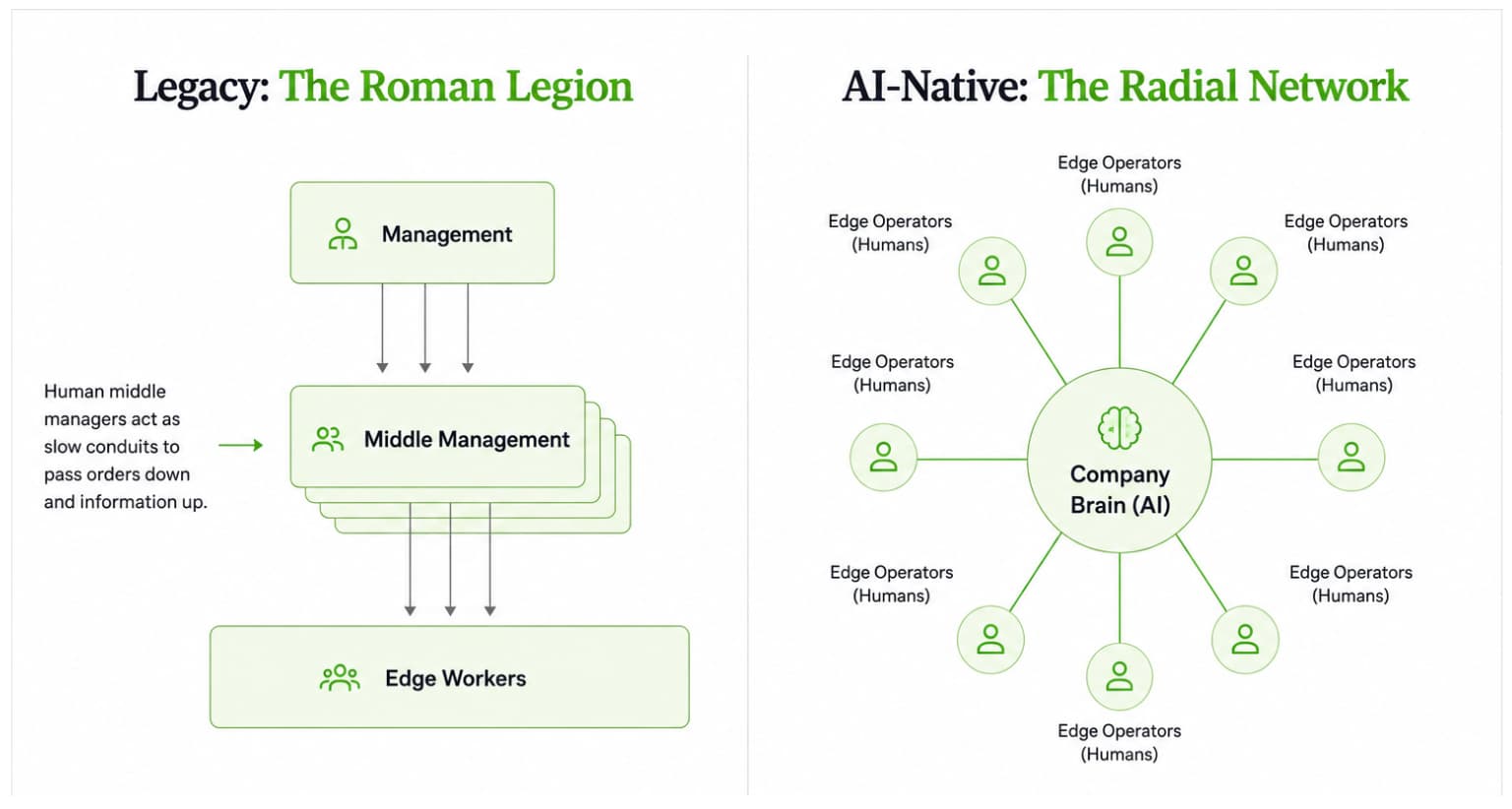
The problem is structural, not technical.
Standard Capital founder Dalton Caldwell and Paul Buchheit describe the "turkey graph startup", a business that appears successful today but is ultimately building temporary middleware to fix the limitations of current models.
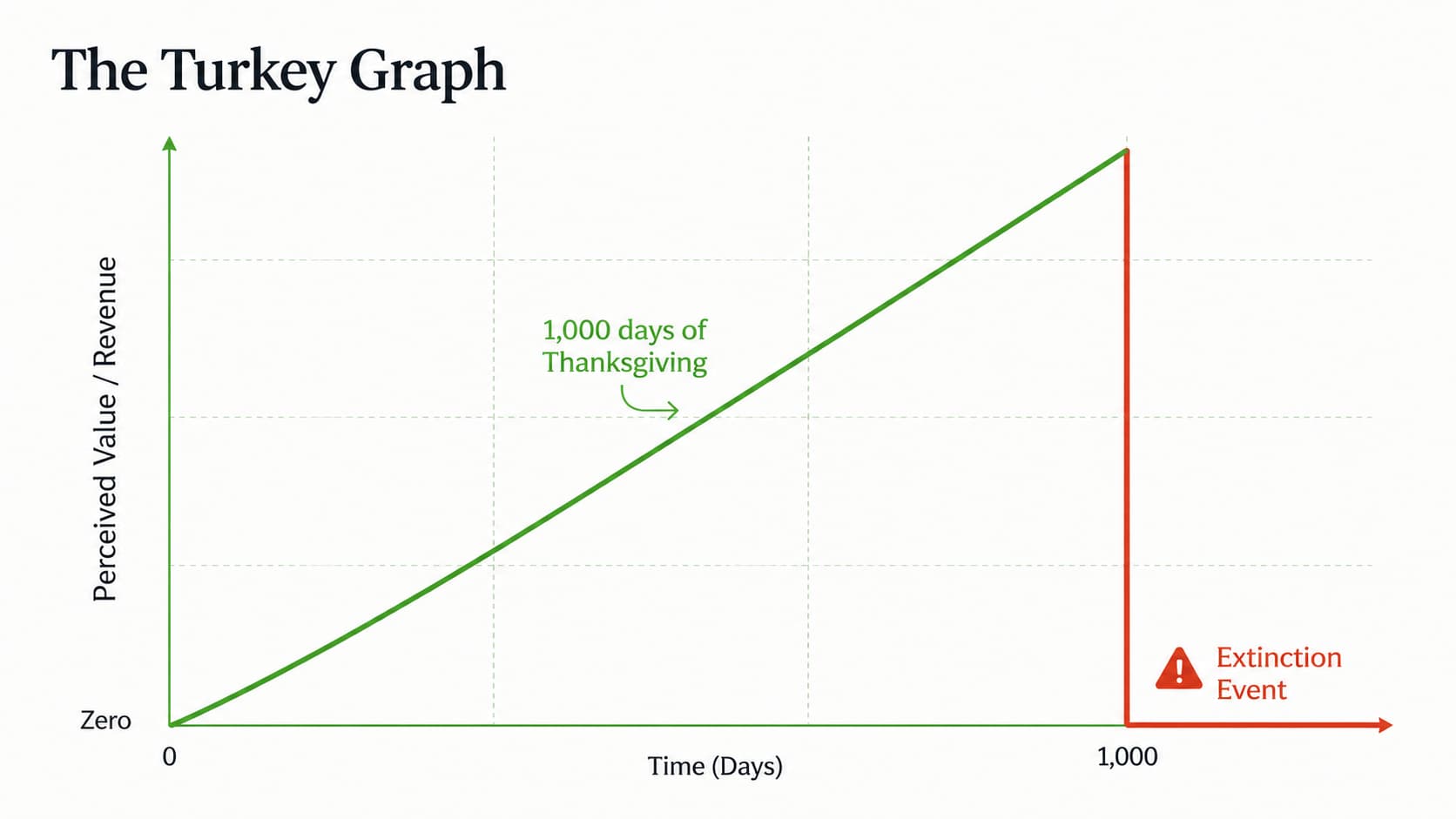
As Dalton warns:
"If you build all this bread middleware to make the models work in certain use cases because they're deficient, that is the definition of a turkey startup because there's going to be a new model that drops and it's game over."
The primary bottleneck to transformation is rarely technical.
It is often psychological and tied to executive identity.
Many corporate leaders subconsciously block AI adoption because their value is tied to holding meetings and managing large teams. If an AI agent can drive an outcome instantly, these leaders feel their jobs and identities are threatened. Overcoming this requires redefining leadership value: from managing mechanics to managing vision.
This is where AI fluency becomes foundational. It is not a technical skill, but a leadership capability that determines how confidently executives can redesign their organizations around AI.
To survive the coming paradigm shift, enterprises must stop building simple software wrappers and focus on defensible moats: network effects, workflow lock-in, and proprietary organizational data.
Core Framework: The Self-Improving Organizational Loop
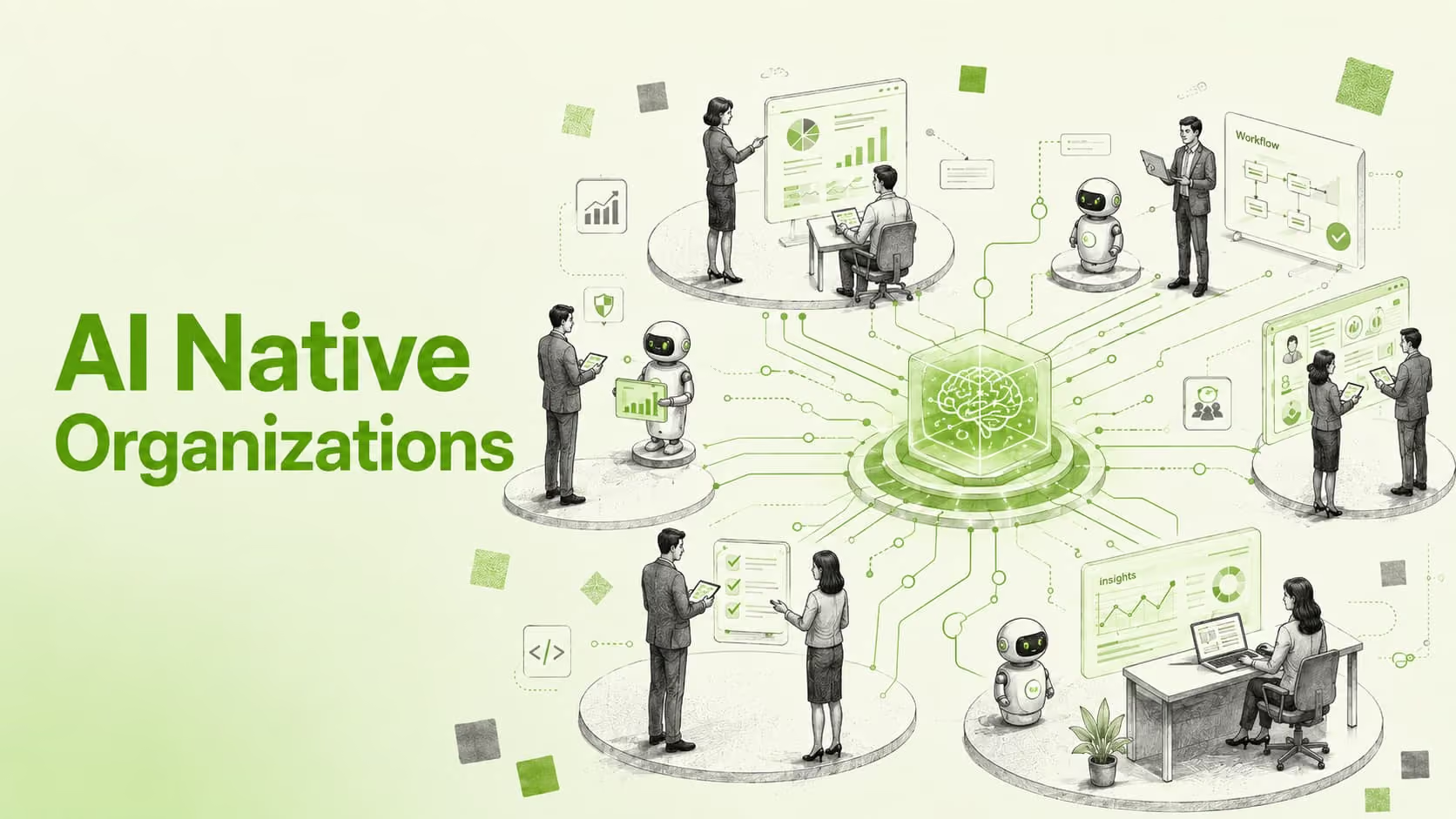
The way to think about AI is that it should not be a tool your company just uses. It should be the operating system your company runs on.
As YC's Diana Hu puts it, an AI-native organization should be "queryable, artifact-rich, and legible to an AI, with almost no human middleware."
Making the Organization "Legible"
The foundational step for any AI-native company is making the organization "legible" to AI.
Tom Blomfield emphasizes that the collective knowledge trapped in employees' heads, Slack messages, and emails must be captured.
The rule is simple:
"If it is recorded, it happened to the AI. If it did not get recorded... it did not happen to your intelligence."
Once a company's operations are legible, they can be processed by language models to form a living, self-improving "company brain."
The 5-Step Continuous Improvement Loop
Instead of static human workflows, an AI-native company operates on recursive loops that allow the organization to improve while its employees sleep.
The old world ran on open loops: decisions made, executed, and rarely measured against outcomes. The result was inherently lossy.
Every important process must instead be captured by an intelligent closed loop that continually learns and improves.
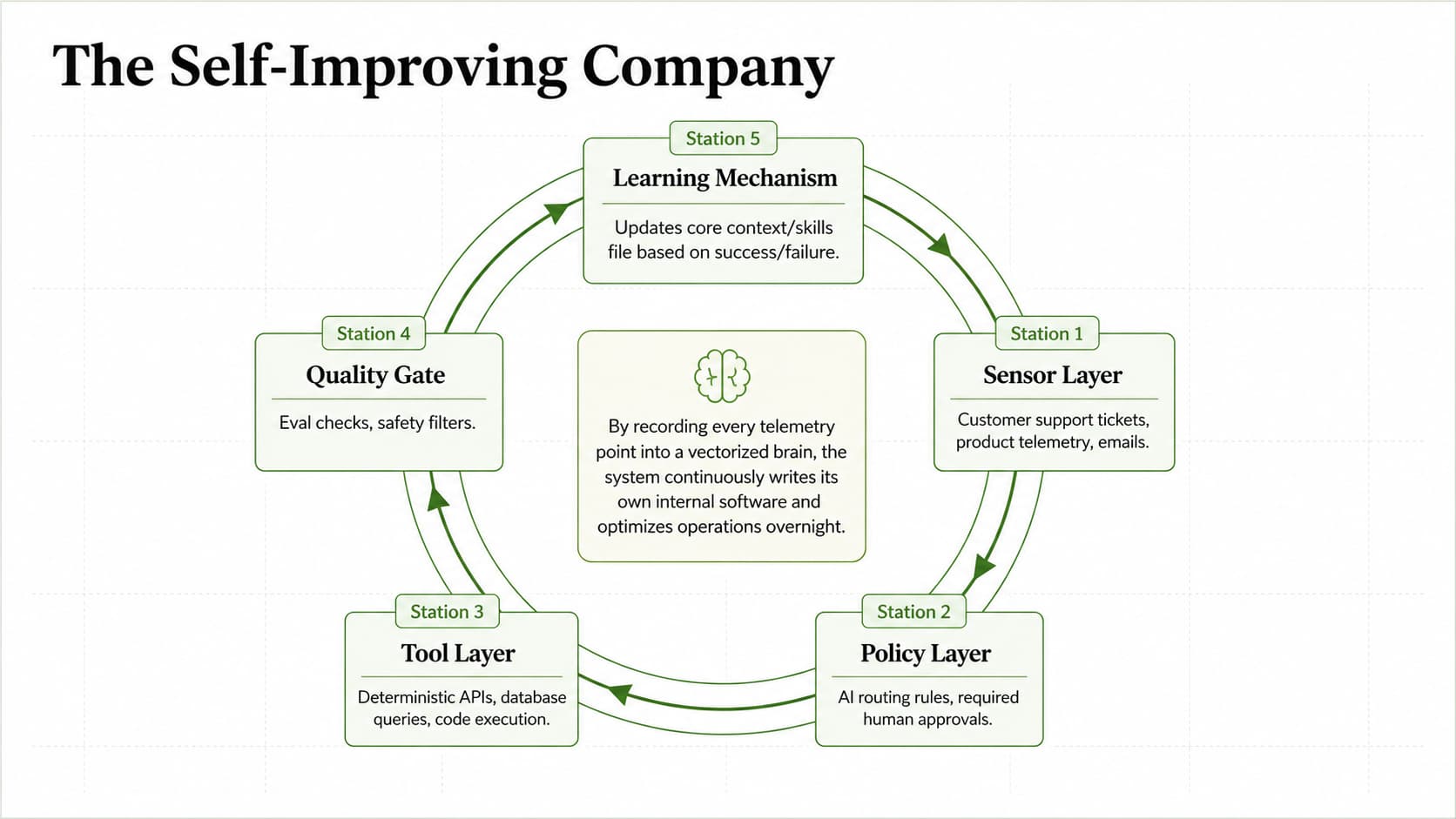
This loop has five distinct layers:
- Sensor Layer: Ingesting data from the outside world — customer emails, support tickets, product telemetry.
- Policy Layer: The rules governing what the AI can do autonomously and what requires human permission.
- Tool Layer: Deterministic APIs and coding skills that allow the AI to execute work.
- Quality Gate: Safety filters, evaluations, and human review for high-risk actions.
- Learning Mechanism: The system monitors failures, writes code to fix its own errors, and deploys updates overnight — preventing the same failure from recurring.
Burn Tokens, Not Headcount
By operating on this continuous loop, AI-native companies decouple revenue growth from headcount.
In Silicon Valley, for some time, the new operational mandate seemed to be to measure success by token usage, not employee count.
Traditional middle management, whose primary role was passing information up and down the hierarchy, is largely eliminated, replaced by individual builders who orchestrate AI tools.
So Meta built an internal leaderboard ranking employees by token consumption, awarding titles like "Token Legend." Amazon had its own informal version. Sequoia Capital partner Sonya Huang told the Wall Street Journal that every founder she advises should adopt the same mindset.
As YC's Diana Hu puts it: "run an uncomfortably high API bill because it's replacing what would have taken a far more expensive and inflated headcount."
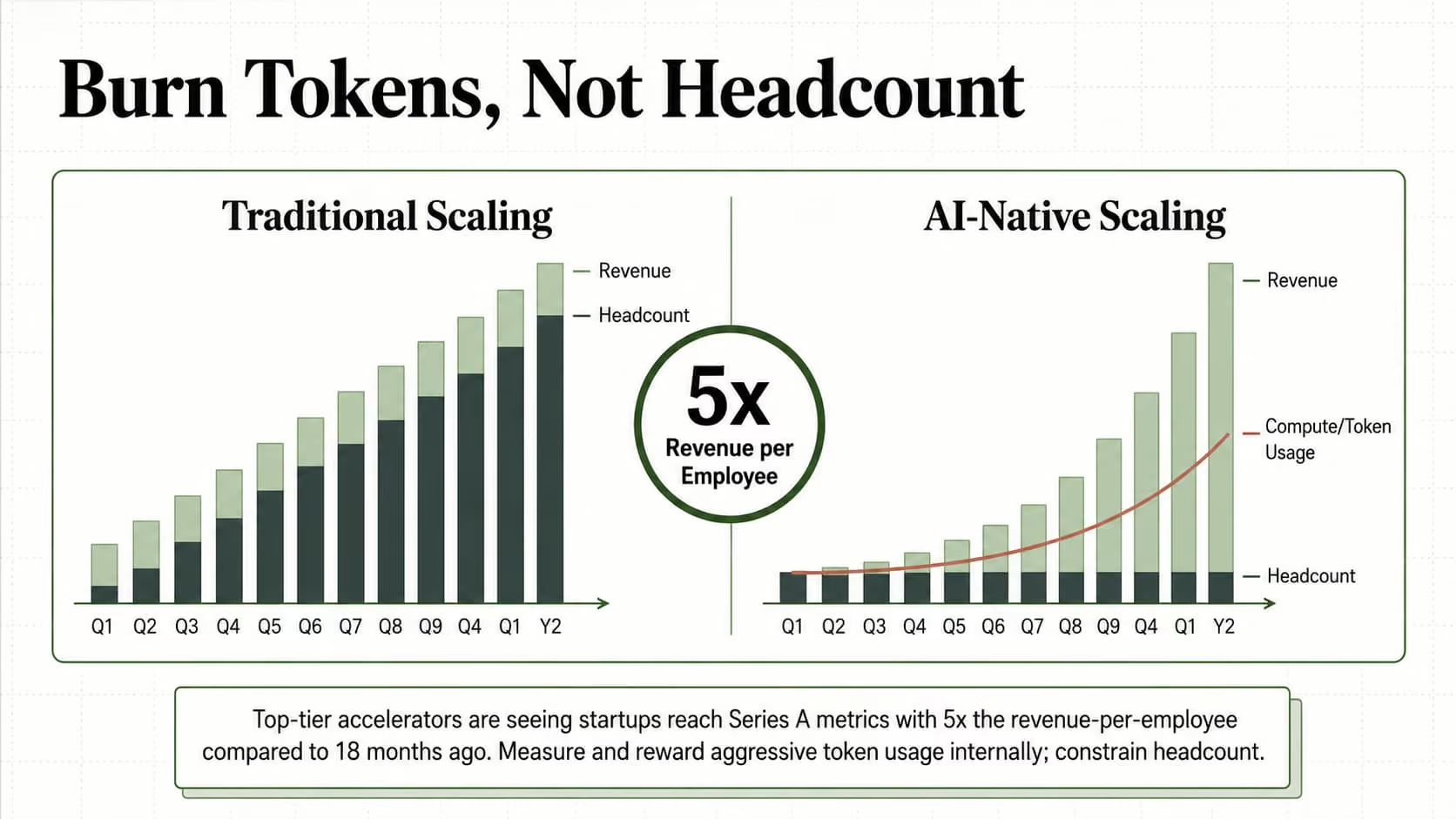
That may still be the case for the edgiest of startups, but most enterprises are already hitting the brakes on unchecked token spend.
Uber burned through its entire annual AI budget in three months and capped developer usage at $1,500 per month. GitHub Copilot switched to usage-based billing, with developer bills jumping from around $50 to $3,000 overnight. And an NBER working paper tracking more than 100,000 GitHub developers found that AI coding tools increased lines of code by 741%, but actual software releases rose by only 20%.
As Quartz recently reported, companies are moving from the AI spending binge into a new phase: caps, dashboards, and the hard search for ROI. Finance teams that once treated AI as a discretionary experiment are now building dedicated forecasting models, spend governance frameworks, and hard budget controls.
The new mandate is cost-per-outcome, not cost-per-call, and every agent deployment needs a clear answer to three questions: what process does this replace, what does it cost to run, and what is the measurable value it returns.
From "Doer" to "Director": The Human Element
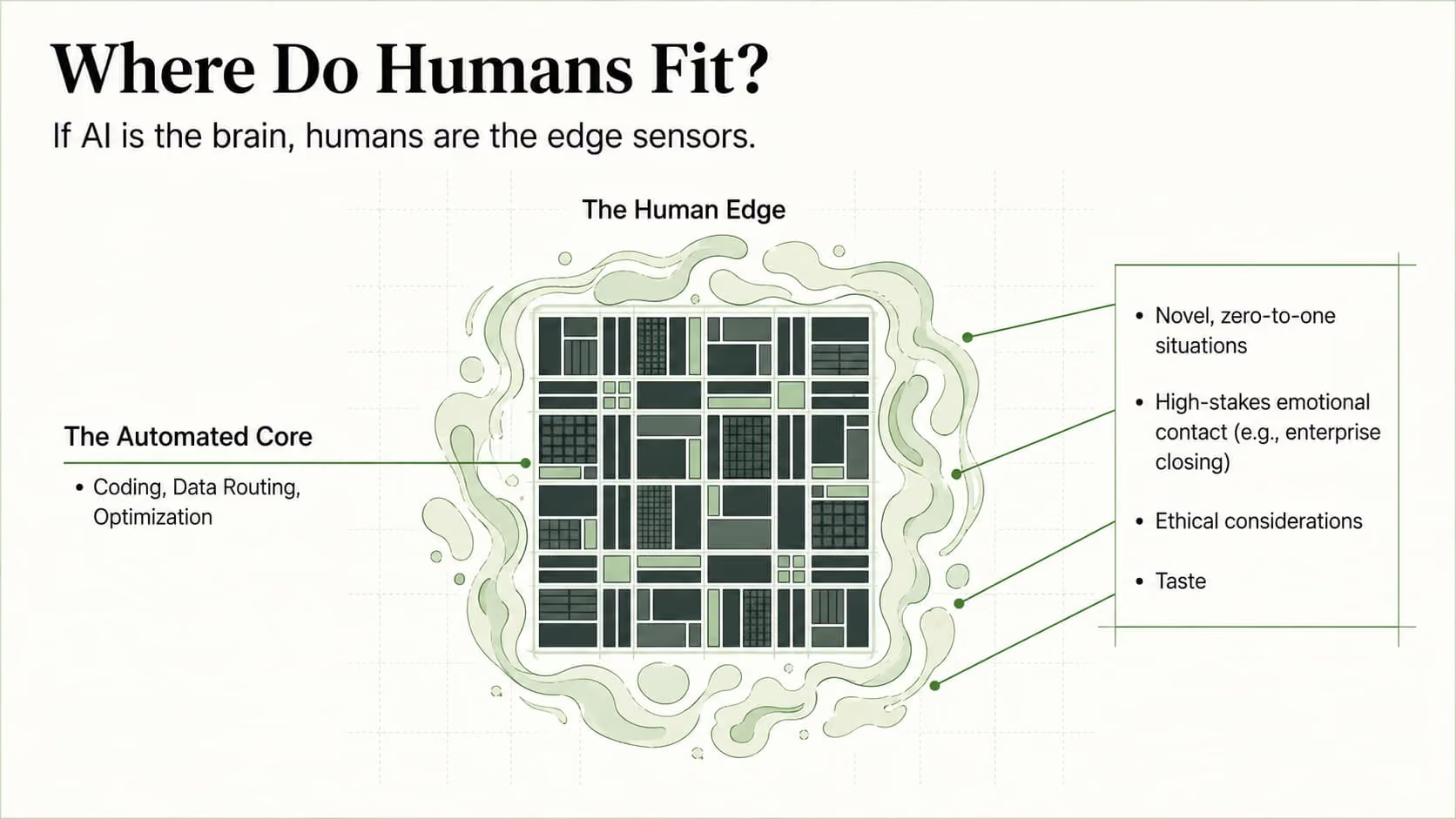
With AI automating the mechanical execution of software and workflows, the role of the human worker must fundamentally evolve.
So much of our lives, we've always had to be doers. The people who will succeed in this new paradigm will be directors — upgrading their thought process from "I'm a doer" to "I'm a director and decision-maker."
The Anthropic Founder's Playbook captures this shift precisely:
"Historically, founders spent the bulk of their time in execution mode: writing code, managing people, handling day-to-day operational work. In an AI-native startup, the founder role becomes much less individual contributor and much more orchestrator of agents — specialized AI assistants that can read files, run commands, execute code, and even browse the web. The founder's attention shifts up the stack toward the higher-order work: generating ideas and directing the systems that carry those ideas out."
In an AI-native organization, human attention shifts up the stack. Humans become orchestrators, delegating rote activities to an automated fleet while preserving their time and energy for pattern recognition and strategic judgment.
The leaders who get this right tend to start from the same place: a workforce X-ray.
ServiceNow's Chief People and AI Enablement Officer Jacqui Canney mapped every role inside the company before touching a single tool: assessing AI readiness, building personalized learning paths, and even having the board take the same capability assessment.
The message it sent: learning is everyone's job, not a mandate passed down. That clarity is what turned AI from an abstract initiative into a company-wide shift.
Building these skills across an organization requires intentional team AI training that goes beyond tool familiarity and into the workflow redesign that makes the director's mindset operational.
Many organizations do this through structured AI champion programs that embed capability-building into the teams closest to the work.
Three New Employee Archetypes
The classic management hierarchy with human middleware no longer makes sense.
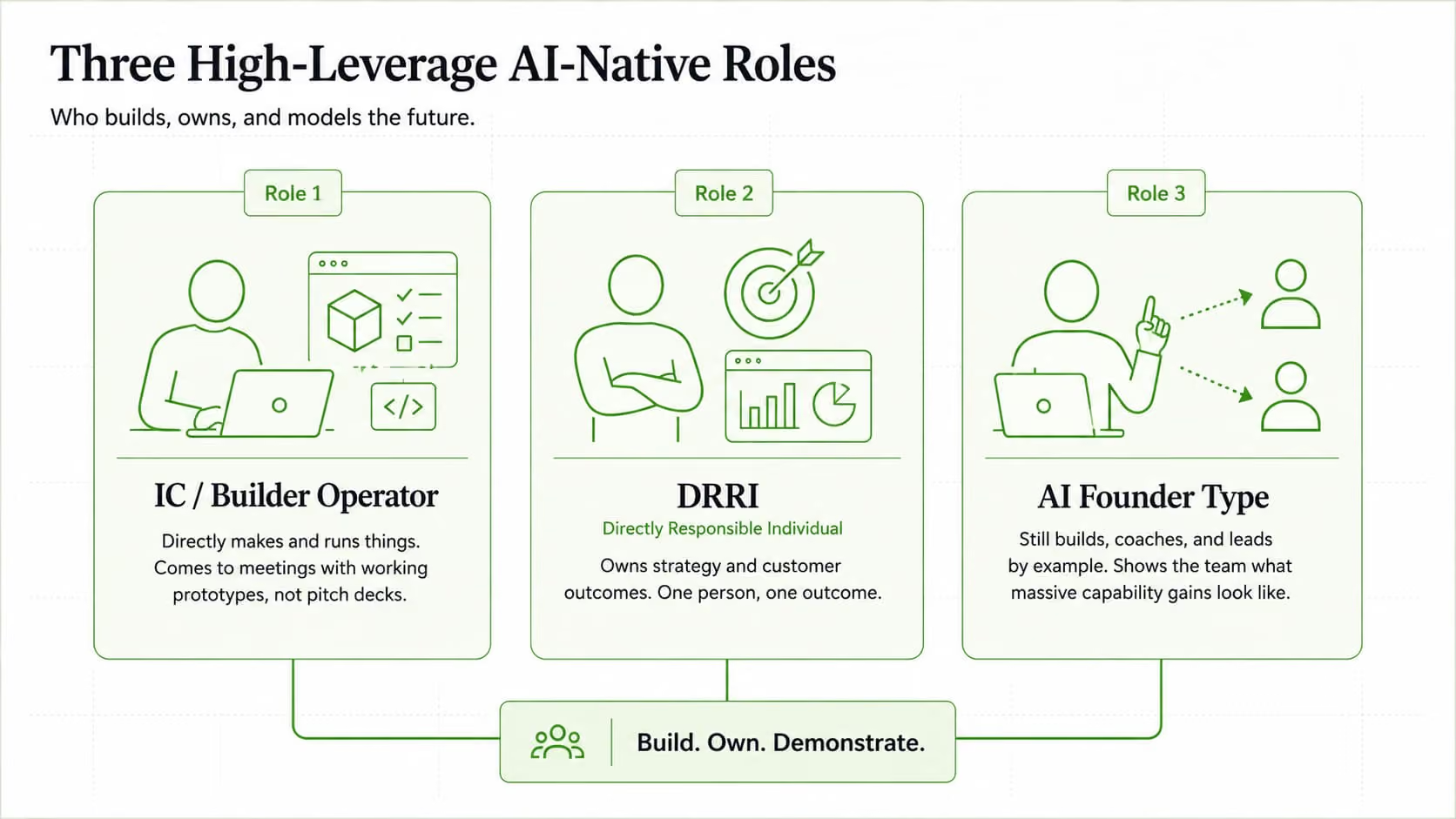
Jack Dorsey suggests every company will feature three employee archetypes:
- Individual Contributor (IC) / Builder Operator: Someone who directly makes and runs things, often coming to meetings with working prototypes rather than pitch decks.
- DRRI (Directly Responsible Individual): The person focused on strategy and customer outcomes, with clear responsibility for the result: one person, one outcome.
- AI Founder Type: The person who still builds, coaches, and leads by example, actively showing their team what "massive capability gains look like" rather than delegating the AI strategy.
Human "Taste" as the Ultimate Differentiator
If AI handles the execution, what makes the human irreplaceable? The answer is taste.
Matt Gray describes taste as your unique combination of references, data, judgment, intuition, and an innate sense of what is beautiful and good. It sits at the intersection of two traits:
- The Right Brain (Creative Expression): How a person authentically expresses themselves, which forms the foundation of a brand.
- The Left Brain (Logical Insight): The ability to spot unmet consumer needs or macro-environmental shifts that an AI cannot independently deduce.
During a panel on the future of content, ComfyUI founder Yanik Marek reinforced this limitation:
"AI doesn't really have any taste, so AI doesn't create good content. It creates content but not excellent content. You still need someone with taste to direct the AI." — Yanik Marek, founder, ComfyUI
In a world where AI can clone almost any piece of software cheaply and instantly, a leader's unique taste, authentic voice, and ability to foster human trust are the only elements an algorithm cannot easily replicate.
The Execution Layer: Enterprise Governance, Security, and Moats
While frontier models reason exceptionally well, they still struggle to execute reliably across fragmented enterprise environments.
Modern enterprise systems are a patchwork of individual portals, APIs, and undocumented legacy workflows. To become autonomous, enterprises need an "execution layer" that can automatically ingest data from their APIs and provide a no-code environment in which custom agents can run end-to-end operations across the full technology stack.
But blind trust in autonomous agents is a severe enterprise vulnerability.
At the AI Native Developers Conference, Pokee AI founder Bill Zhu highlighted the catastrophic risks posed by malicious prompt hijacking:
"All of these cases are extremely sensitive when you're talking about real enterprise cases ranging from financial institutions to legal firms... all of these companies require a complete on-prem VPC solution, air gap security and none of that is being addressed today." — Bill Zhu, founder, Pokee AI
Ran Li, a co-creator of Google's agent platform, pointed to a deeper accountability problem:
"Accountability and the task delegation between human agents is quite messy. People don't know what they are delegating." — Ran Li, AI Builder, Google
We see the consequence in the rise of "AI slop" — a growing backlash in which people actively ignore low-effort, AI-generated corporate documents to maintain authentic human-to-human communication.
The Danger of Moving Too Fast: Navigation vs. Execution
The sheer speed at which AI enables execution creates its own distinct risks.
Artur Kiulian, CEO of Principal, put it plainly:
"The biggest risk is the actual speed at which we're moving... most companies right now are focused on the execution layer, but very few companies are focused on navigation."
Without proper navigation, an autonomous agent can wipe out massive value simply by confidently executing a flawed strategy.
Take vibe coding. Because AI allows individuals to "vibe code" working software in hours, teams often mistake a high-fidelity prototype for strategic alignment. Rapidly generated software is excellent for brainstorming — but actual organizational alignment still requires rigorous human conversation and problem definition.
Building Defensible Moats Through Workflow Lock-In
To survive what many are calling the "SaaS apocalypse" — in which coding is commoditized — companies must build strategic moats that rely on deep industry know-how and compounding network effects.
The Anthropic Founder's Playbook stresses the importance of "workflow lock-in." The longer users run a product inside their daily operations — building automations on top of it, training teams, standardizing outputs around it — the harder it becomes to replace.
Additionally, AI-native companies must capitalize on their proprietary interaction data.
As users interact with an AI product, they generate behavioral signals that natively refine the product's accuracy and edge-case handling. This proprietary, time-locked behavioral data is impossible for a copycat competitor or a generalized AI lab to recreate — forming a highly defensible organizational moat in an era of limitless software.
Understanding how AI in the workplace is already reshaping competitive dynamics helps leaders identify where their moats are strongest and where they remain exposed.