

Most people get generic answers from AI because they ask generic questions.
They type a quick request, get a flat and unremarkable response back, and conclude that AI just isn't that good. The problem usually isn't the AI. It's the prompt.
CODO is the framework we teach to fix that.
Lead with AI has coached thousands of senior leaders, at companies including Microsoft, Apple, McKinsey, BCG, Atlassian, and Supercell, on how to get consistently strong output from AI instead of settling for the first generic draft.
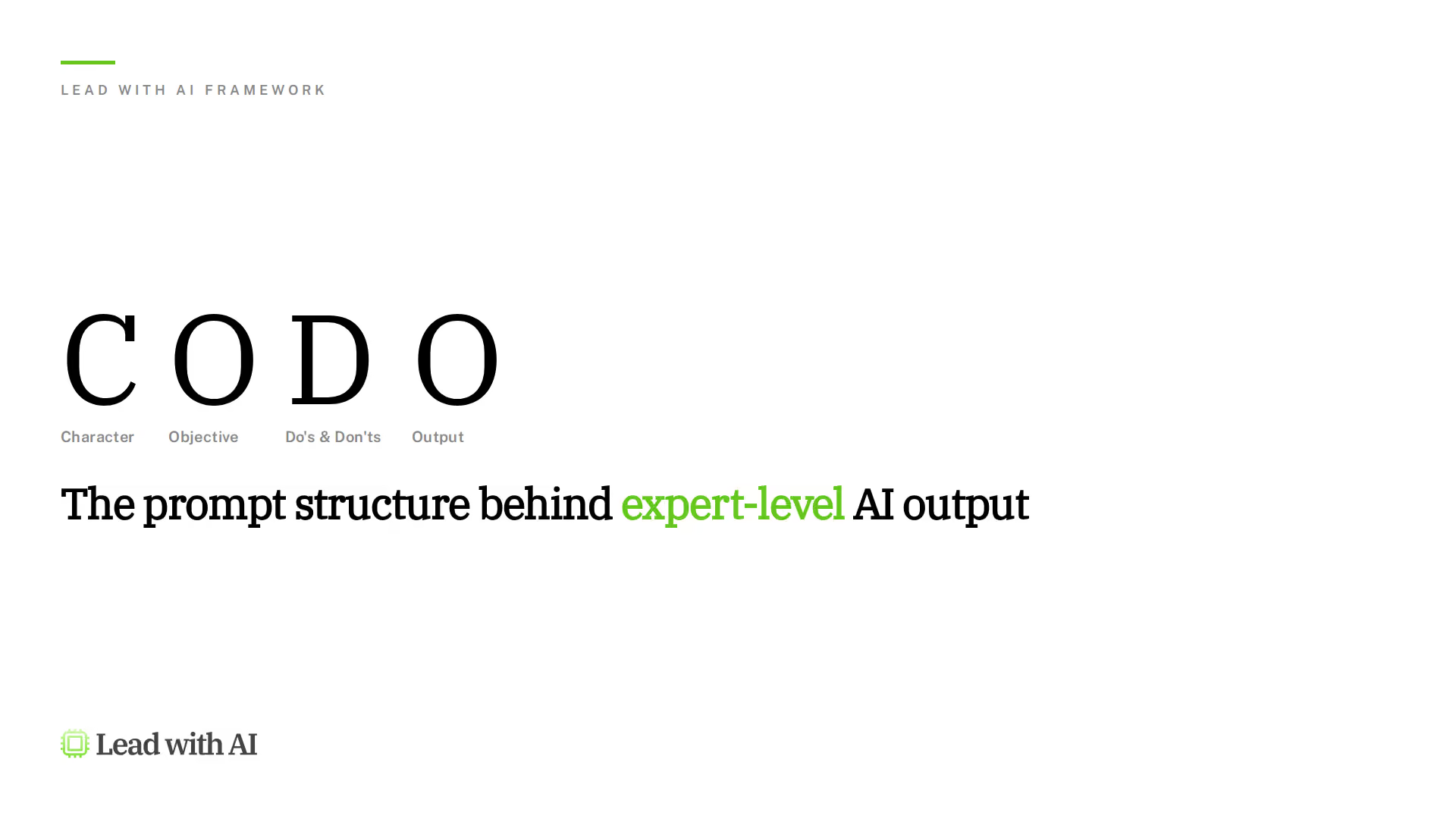
CODO stands for Character, Objective, Do's and Don'ts, and Output. Each part gives the AI something a plain question leaves out, so the model has enough to work with before it starts generating. It's one of the practical building blocks of prompt engineering, the broader skill of turning a vague request into instructions AI can actually use.
What Does CODO in the CODO Prompting Framework Stand For?
C: Character
Tell the AI who it should become. Assigning a character activates a specific body of knowledge, a tone, and a way of making decisions, all before the AI writes a single word.
O: Objective
State your actual goal, not just the deliverable. The objective tells the AI why the output matters, so it can shape the response around your real intention instead of just the format you asked for.
D: Do's and Don'ts
Add your own guardrails. This is where your experience enters the prompt: what has worked before, what hasn't, and what should be avoided.
O: Output
Specify exactly what you want back: the format, the length, the tone, and ideally an example of what "good" looks like.
Why Character Comes First, and Why You Should Aim High
Most people who try CODO get the Character step wrong in the same way: they aim too low.
They ask AI to act as a junior analyst or a research assistant, and then they wonder why the output feels flat.
Here's the part that most leaders don't think about yet: AI doesn't charge by the hour, and it doesn't care how senior the role sounds.
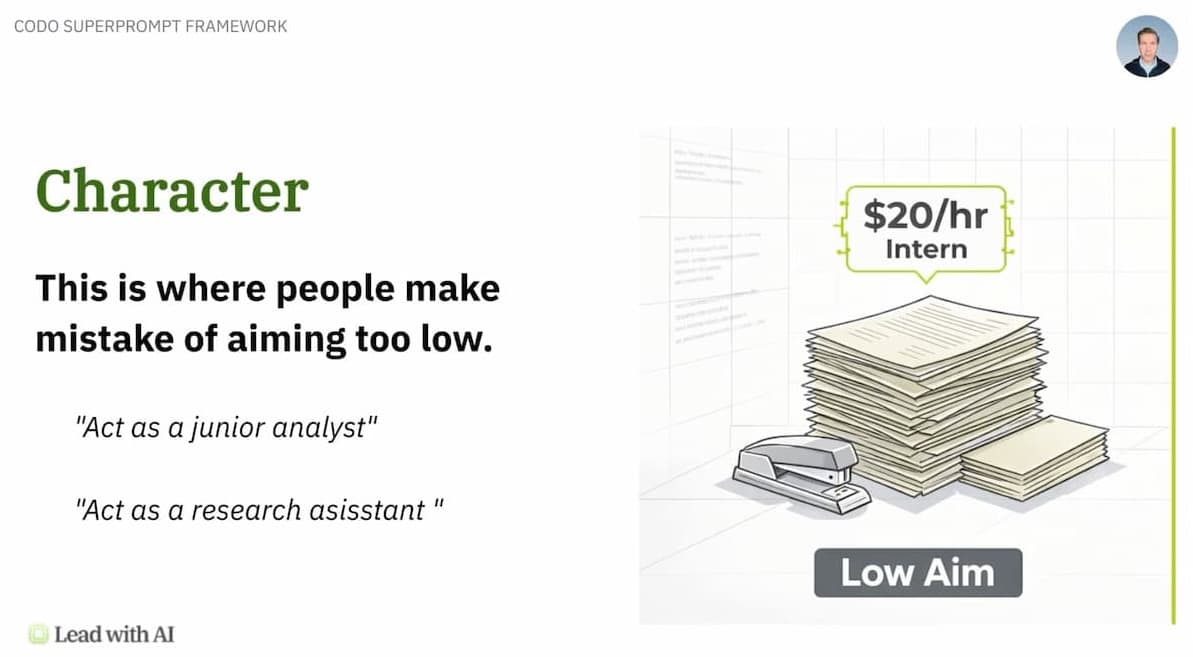
Whether you ask it to think like a $150,000-per-engagement strategy advisor or a $20-per-hour intern, the computing cost is the same, but the output is worlds apart.
Some examples of a well-set Character:
- "Act as the world's leading ghostwriter for Fortune 500 CEOs."
- "Be Oprah Winfrey, advising me on how to tell my story."
- "Emulate a top-tier business coach guiding me through a strategic pivot."
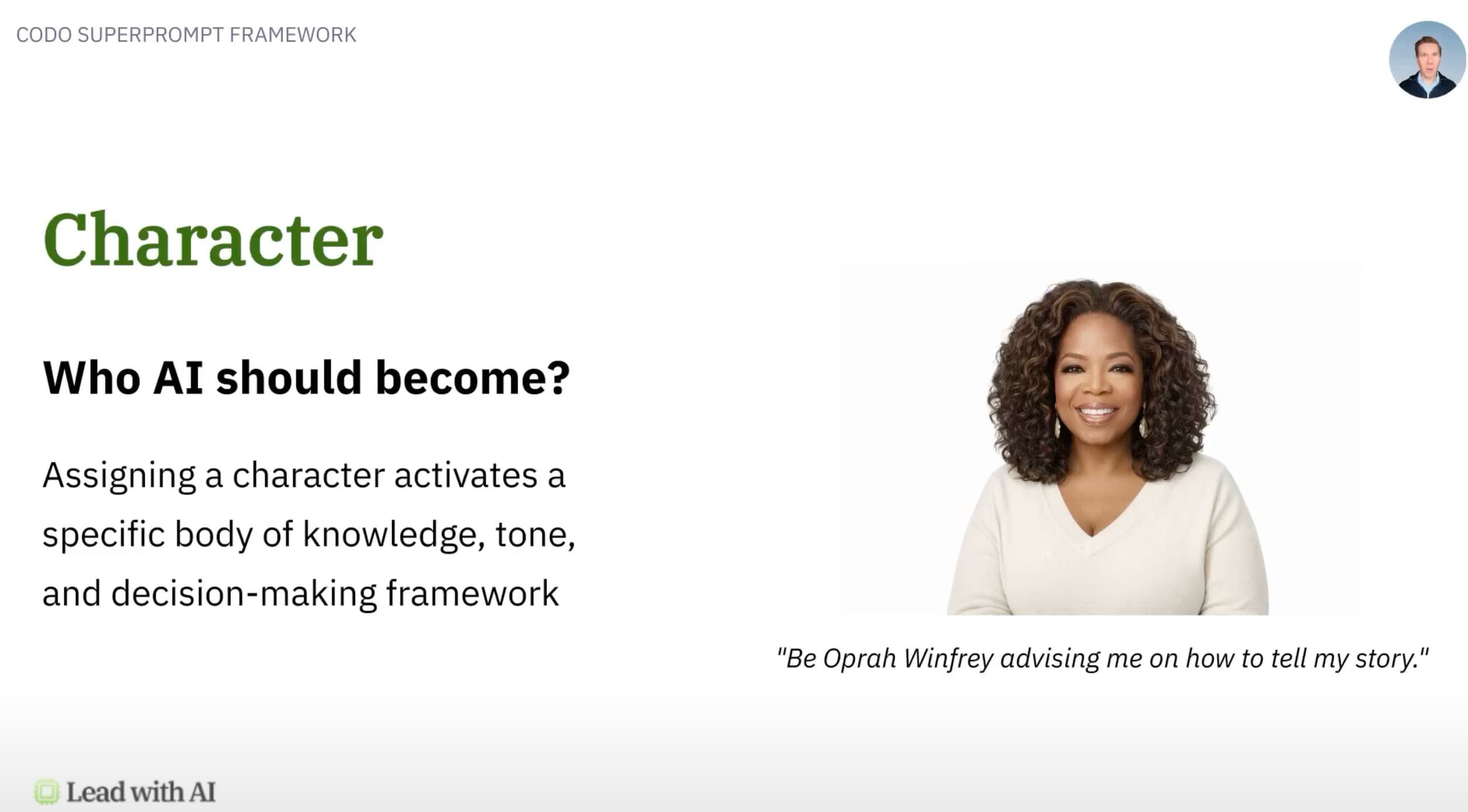
Set the bar high. Every time.
Objective: The Step Most People Skip
If you only tell AI what deliverable you want, it can produce that deliverable and still miss the point entirely.
The Objective step closes that gap.
It tells the AI why you need this, not just what it looks like.
- "I'm preparing this talk to persuade our board to increase investment."
- "I'm writing this post to help shift how our customers view this product."
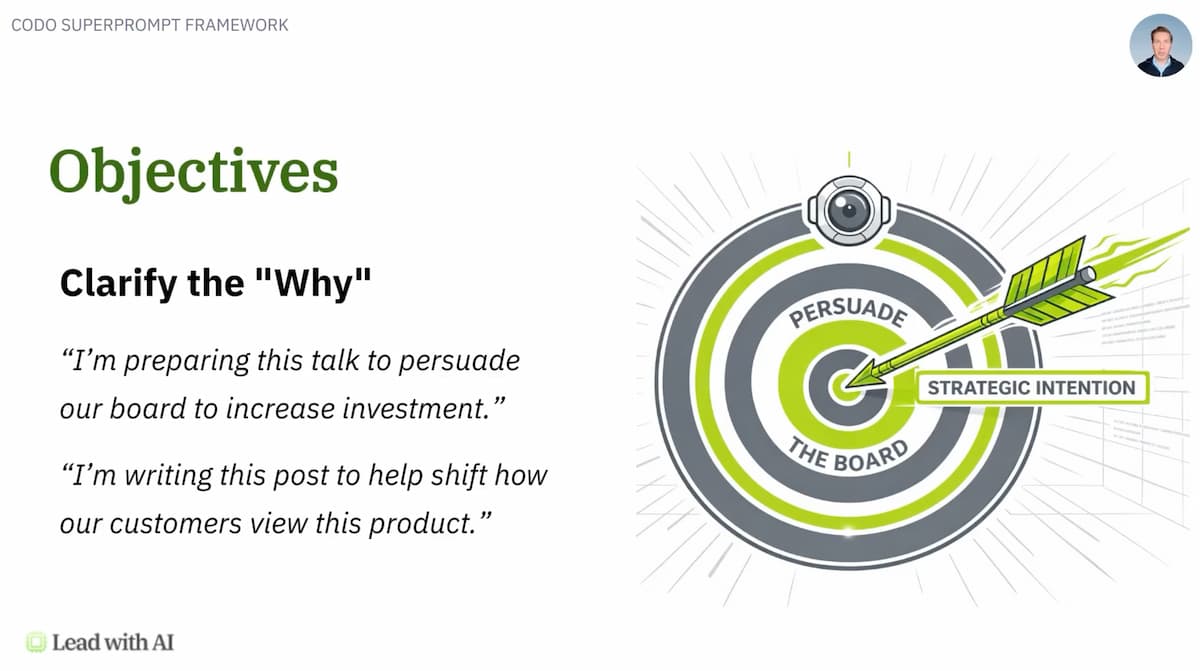
Without the objective, the AI is left to guess your deeper intention, and it usually guesses wrong.
Do's and Don'ts: Where Your Experience Comes In
AI knows a great deal, but it knows nothing about you, your business, or the judgment you've built over years of doing this work.
The Do's and Don'ts step is where you hand that judgment over.
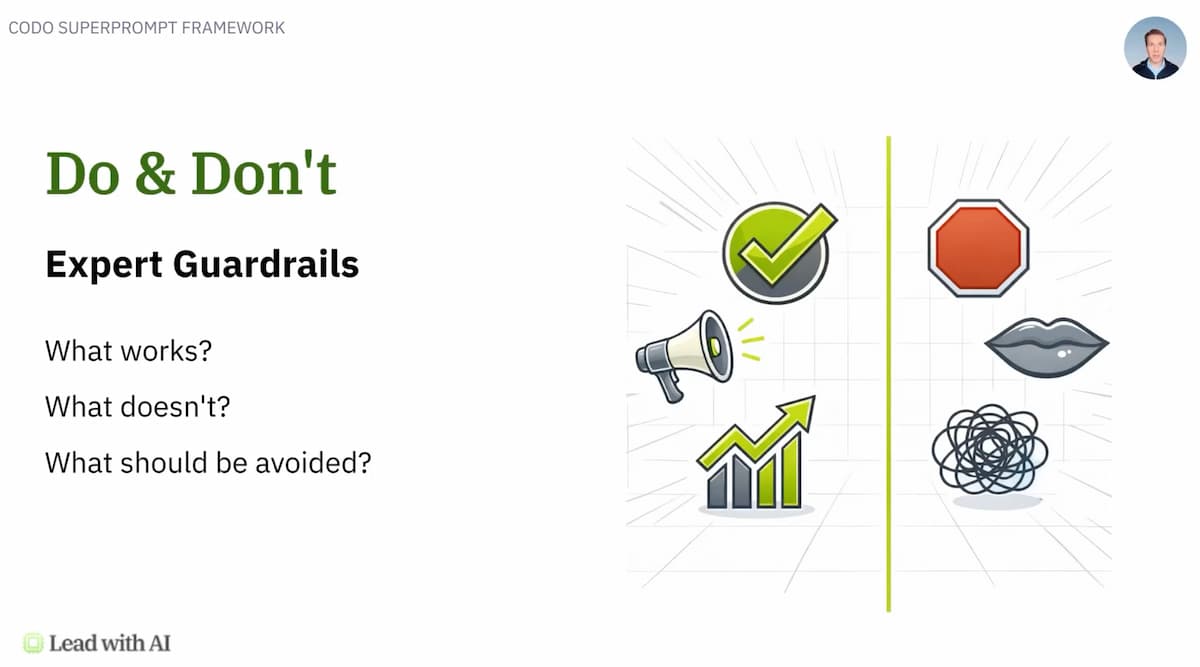
- "Don't use jargon or buzzwords."
- "Keep it under $5,000."
- "Avoid comparing us to competitors."
These constraints are what turn a technically correct answer into one that actually fits your real-world situation.
Output: Be as Specific as You Would Be With a New Hire
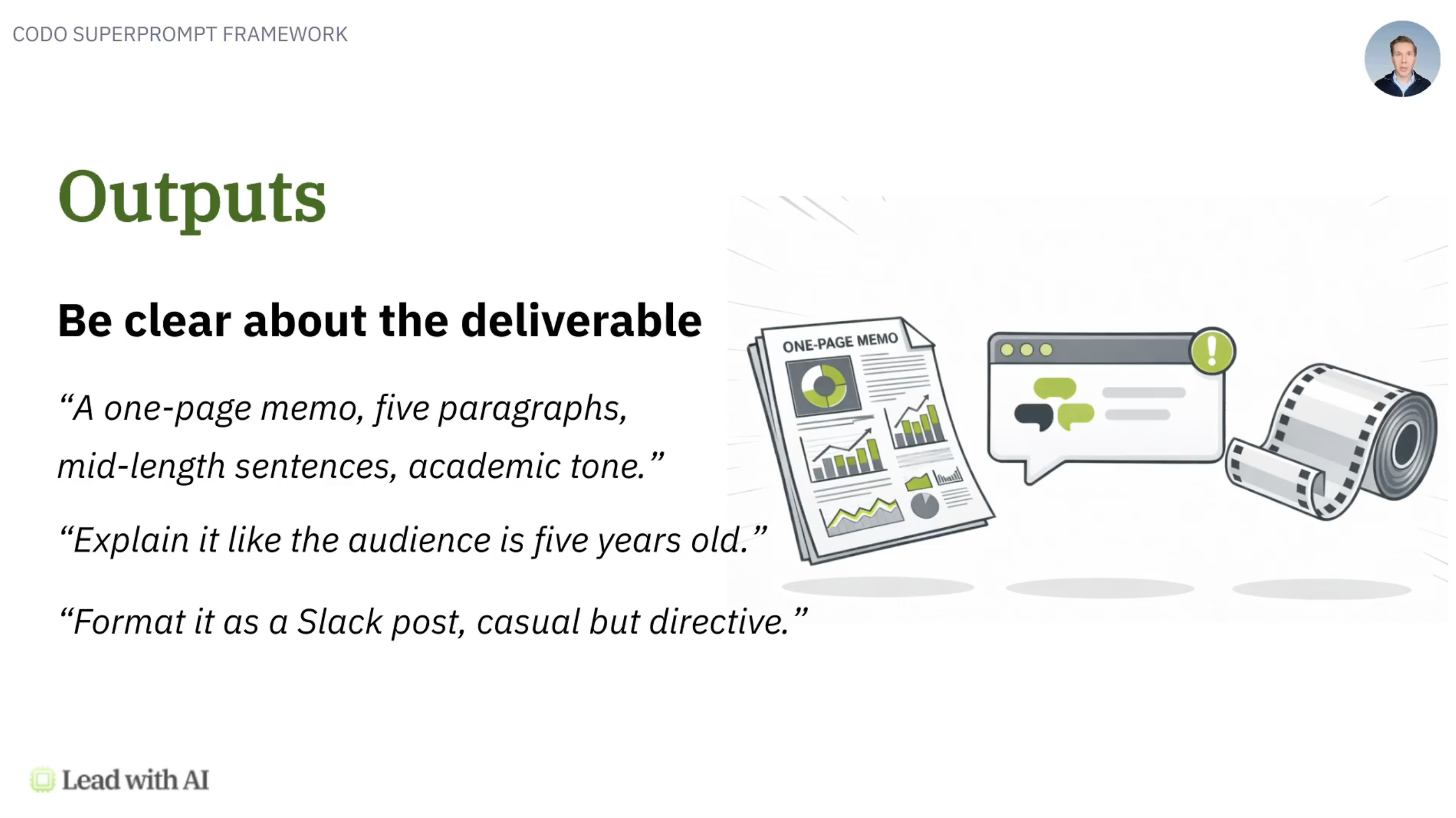
The last step is describing exactly what you want delivered.
- "A one-page memo, five paragraphs, mid-length sentences, academic tone."
- "Explain it like the audience is five years old."
- "Format it as a Slack message: casual but directive."
The strongest move here is including examples.
Past reports, emails, or templates you've used before show the AI what "good" looks like in your world, the same way you'd onboard a new hire.
Working Example: Drafting a Client Proposal
So what does this look like in the real world?
In our AI Leader Advanced program, we generate custom prompt tailored to each participants' role, department, organization, industry, KPIs, goals, and level of AI fluency.
For the lesson on CODO prompting, here is an example of a 'standard' prompt versus a CODO prompt:
Example Standard Prompt
I'm Sarah Mitchell, the Chief Operating Officer at Northstar Medical Supply.
My biggest current challenge at work: Northstar Medical Supply has grown faster than our operating systems. Too many workflows still rely on manual coordination, scattered spreadsheets, and knowledge in people’s heads. I need to modernize with AI without hurting service quality, employee trust, or human judgment.
Help me explore: what would I do if I had 10x the agency I have today?
Example CODO Prompt
- Character: You are the world's most respected expert in AI-enabled operating model transformation for healthcare supply chain and distribution companies.
- Objective: I am Sarah Mitchell, the Chief Operating Officer at Northstar Medical Supply in the healthcare supply chain and distribution industry. My challenge is that Northstar has grown faster than our operating systems: too many critical workflows still rely on manual coordination, scattered spreadsheets, and knowledge in people’s heads, and I need to modernize with AI without hurting service quality, employee trust, or human judgment. Advise me what I'd do if I had 10x agency.
- Do's and Don'ts:
- Do:
- First ask: is this the real problem? If there's a deeper need beneath what I've described, name it and solve that instead.
- Then deeply research as many times as needed to find one real, named leader or company who faced this exact problem and solved it. This case study must be specific and doable for someone in my position. If this topic is fast-moving or time-sensitive, the example must be from the last 6 months.
- Keep it simple enough that I can act on it today with zero ambiguity, zero decisions left to make.'
- Don't:
- Give obvious or surface-level advice
- Add to my cognitive load
- Sugarcoat
- Do:
- Output: In 2–3 sentences, tell me how you read my situation, what you noticed, whether you reframed the problem, and why you're giving the advice you're about to give.
- Precedent: Share the precedent you found through your research.
- The Move: Based on that precedent, give me the single most important action I should take in up to two sentences. Close with one plain sentence that is the solution, written as if you're a trusted friend who's been in the room with me.
That single prompt gives the AI a role, a reason, a set of constraints, and a target, which is the difference between a usable first draft and one you have to rewrite from scratch.
(Feel free to try both prompts in your AI platform of choice and see the difference!)
CODO Matters Even More With Frontier Models
Some have said that prompt engineering won't be relevant as the models get better.
Well so far, we're only seeing evidence of the opposite: the more capable the model, the more a loose prompt wastes its ability.
Frontier models like GPT-5.5, Claude Opus 4.8, and Claude Fable 5 can reason more deeply and hold far more context than earlier models, but they still build on whatever Character, Objective, guardrails, and Output you give them.
See our guide on how to prompt GPT-5.5, Claude Opus 4.8, and Claude Fable 5 for model-specific adjustments on top of the CODO structure.