
July 9, 2026

People-Centric AI Transformation: Why Work Is Broken, and What We're Doing About It

People-centric AI transformation means designing AI adoption around real work, real workflows, and real leadership behavior, not tools or headcount cuts.
Daan van Rossum
By
Daan van Rossum
Founder & CEO, Lead with AI

Why Work Is Broken, and What We're Doing About It

Presented by

Work is broken, and it does not have to be.

Gallup's 2026 State of the Global Workplace put global employee engagement at 20%, the lowest in five years and the second straight year of decline. Four out of five workers are not engaged. Not thriving, not doing their best work and feeling good about it. Just present.

AI is a turning point, and there is nothing inevitable about which way it turns.

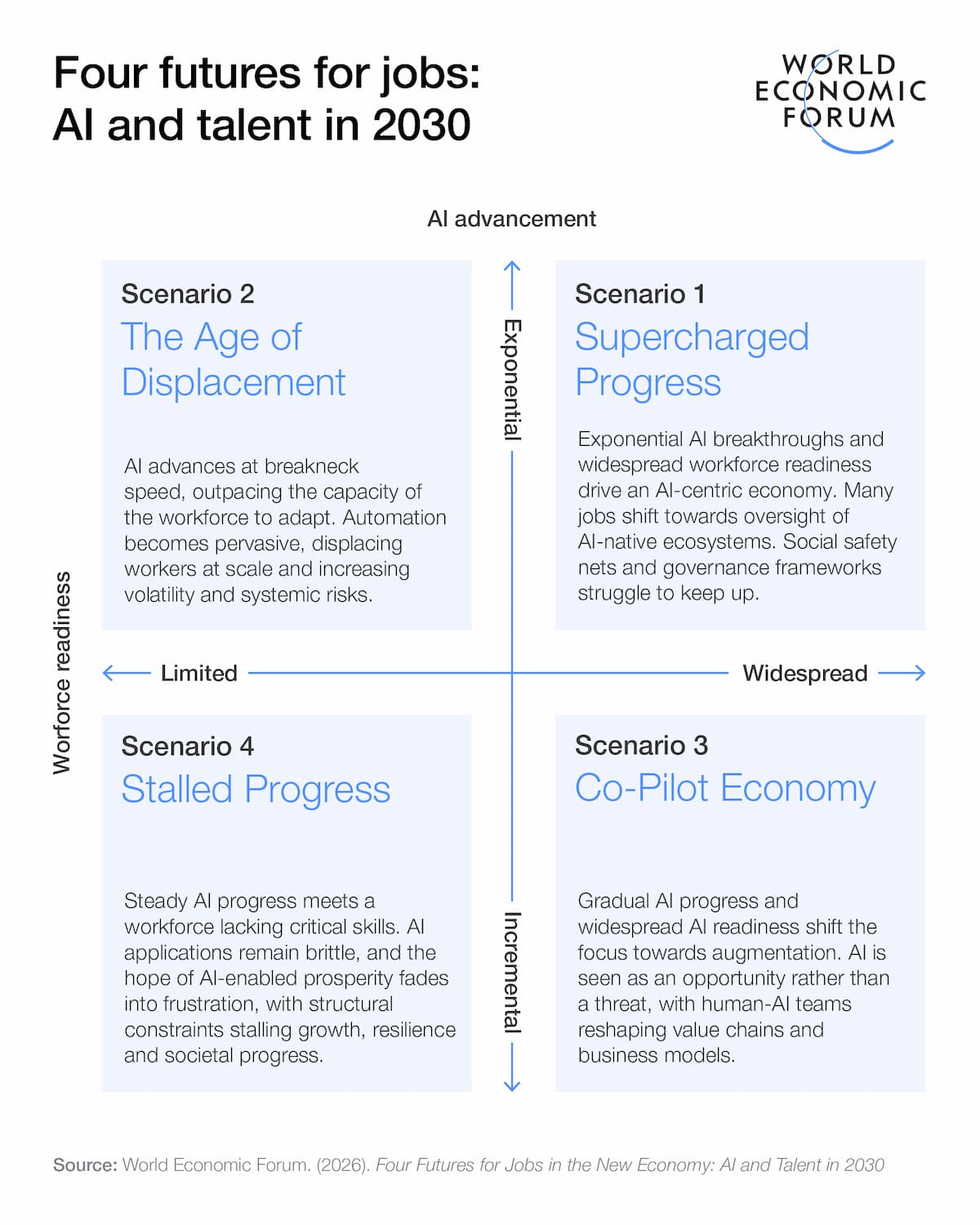
The World Economic Forum lays out four plausible futures for how AI reshapes work by 2030, shaped by two forces: how fast AI capability advances, and how ready the workforce is to meet it.
__wf_reserved_inherit
The World Economic Forum's Four Futures

These are not futures that happen to us.

They are futures we choose, every day, through how AI actually gets deployed inside organizations.

Deployed without intent, AI displaces people faster than they can adapt. Adopted without changing how work actually happens, it stalls and frustrates everyone. And where readiness is uneven, a small group pulls ahead while everyone else falls behind.

As Lead with AI, we build for the Co-Pilot Economy, because it is the only one of these four futures that preserves productivity, dignity, and resilience at the same time.

Our Role: Impact Per Hour

Our answer to a broken world of work is to increase human impact per hour, deliberately, practically, and at scale.

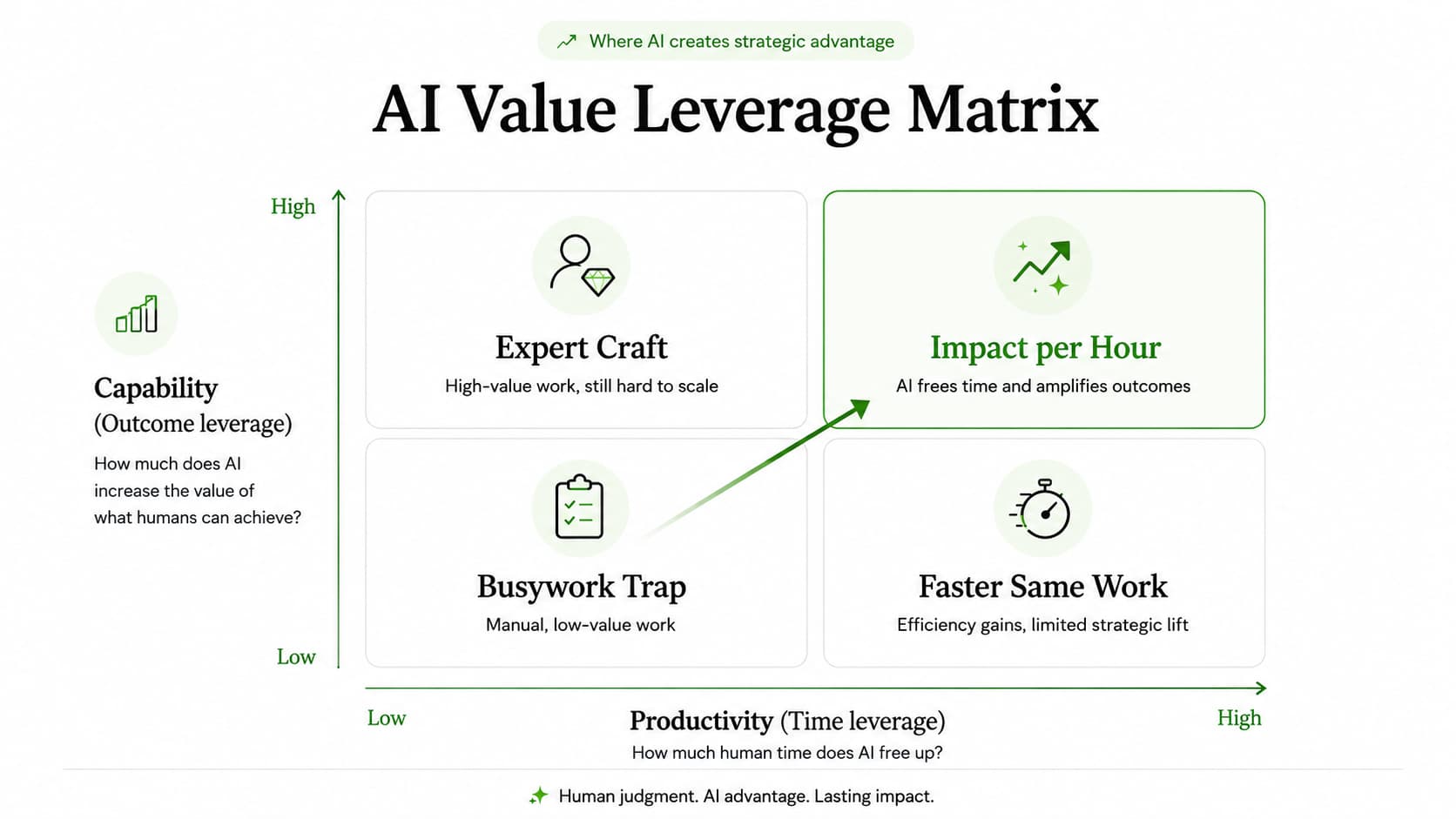
Impact per hour measures the value someone creates in an hour of work, not the hours they log, and it grows along two distinct dimensions.

The first is capacity: freeing people from the roughly 30 to 40 percent of their time typically lost to low-value, repetitive tasks. This does not just mean doing the same work faster. Often it means redesigning the workflow itself so the low-value part disappears entirely.

But freed capacity is not the same as captured capacity. Time you reclaim and never direct behaves like budget nobody allocates, which is to say it leaks away in small pieces and produces no return. This is why we ask every leader to set a North Star for the time AI gives back before that time arrives, deciding in advance what the reclaimed day is actually for.

The second is capability: AI enabling people to do things they simply could not do before. Someone who is not a strong writer produces strong writing. Someone who never learned design creates good design. Someone who struggles to craft presentations now builds excellent ones. Capability is an expansion of what a person is able to do at all, not of how much time they have.

OpenAI surveyed 9,000 workers across almost 100 enterprises and found that 75 percent could complete tasks they previously could not perform at all. The list runs well past writing and design into code review, spreadsheet automation, and building custom agents.

Several studies find AI has an equalizing effect, helping lower-performing workers disproportionately. OpenAI's own data is consistent with that. Capability expansion is where the people-centric case gets strongest, because this is AI making individual people more able, not making them redundant.
__wf_reserved_inherit

Increase capacity and capability together, and a person's overall impact grows faster than either change would deliver on its own.

We do not achieve this by teaching people AI tools. We help leaders continuously redesign work around judgment, better systems, and AI-native execution, in alignment with their own personal and professional goals, beliefs, and values.

Transformation succeeds when it starts with real work, real workflows, and real leadership behavior. It fails when it starts anywhere else.

There are three ways this goes wrong, ranked by how much damage each one does. People-centric AI transformation is our answer to all three.

Flagship AI Newsletter
The AI Newsletter That Makes You Smarter, Not Busier
Join over 30,000 leaders and receive our insights on AI platforms, implementations, and organizational change management.
FlexOS Course - AI Content Accelerator - Testimonial Badge

Front One: The Top-Down "Must AI" Mandate, With No Path to Get There

Companies declare AI mandatory. Sometimes usage gets tied to performance reviews. And then leadership walks away, having confused the announcement for the transformation.

Belief was never the problem. A mandate without a bridge to cross it just produces fear, quiet resistance, or box-checking.

And this is not an abstract risk.

The same Gallup report referenced above notes that manager engagement has fallen nine points since 2022, largely because managers are being asked to lead their teams through an AI transition nobody prepared them for. Yet Gallup found that employees whose manager actively supports the team's AI use are 8.7 times more likely to say AI has transformed how work gets done.

Fewer than one in three US managers at AI-adopting companies say they are providing that support. Handing an unsupported, already-struggling manager a "must AI" mandate and calling it a strategy is close to the worst version of this front.

Two separate mechanisms fix this, and they work at different points in the process.

The first is where the plan comes from. Moderna built more than 3,000 custom GPTs. Johnson & Johnson tested 900 individual use cases before narrowing its focus. Neither number came from a strategy team's roadmap.

They came from letting employees closest to the work discover what actually helped, then having leadership pattern-match and scale the roughly 10 to 15 percent of ideas that drove most of the value. Leadership's job in this model is recognition and scaling, not authorship.

The second is how adoption spreads once something works. Citi built a network of more than 4,000 AI Accelerators across 182,000 employees and reached over 70 percent adoption of approved tools. Not because of a policy announcement, but because people watched colleagues they trusted turn a two-hour task into fifteen minutes.

Our guide to AI Champion Programs covers this in more depth: people copy people, not memos.

Between those two mechanisms sits a gap most companies never fill.

We call it the AI Implementation Sandwich: top-down strategic clarity, bottom-up team experimentation, and a connective middle layer of AI Labs and cross-functional "Bridgers" who translate between the two.

Without that middle layer, the vast majority of companies stay stuck between executive ambition and scattered, disconnected pilots.

Want to reach 30,000+ business leaders applying AI in their work, teams, and organizations?​
Advertise with us​​.

Front Two: Chasing Productivity by Cutting Headcount

The second fight is against treating AI transformation as a headcount problem. Burn tokens instead of salaries. Decouple growth from people. Measure success by cost takeout, or by how much content gets produced, rather than by whether any of it is good.

The numbers do not support this shortcut.

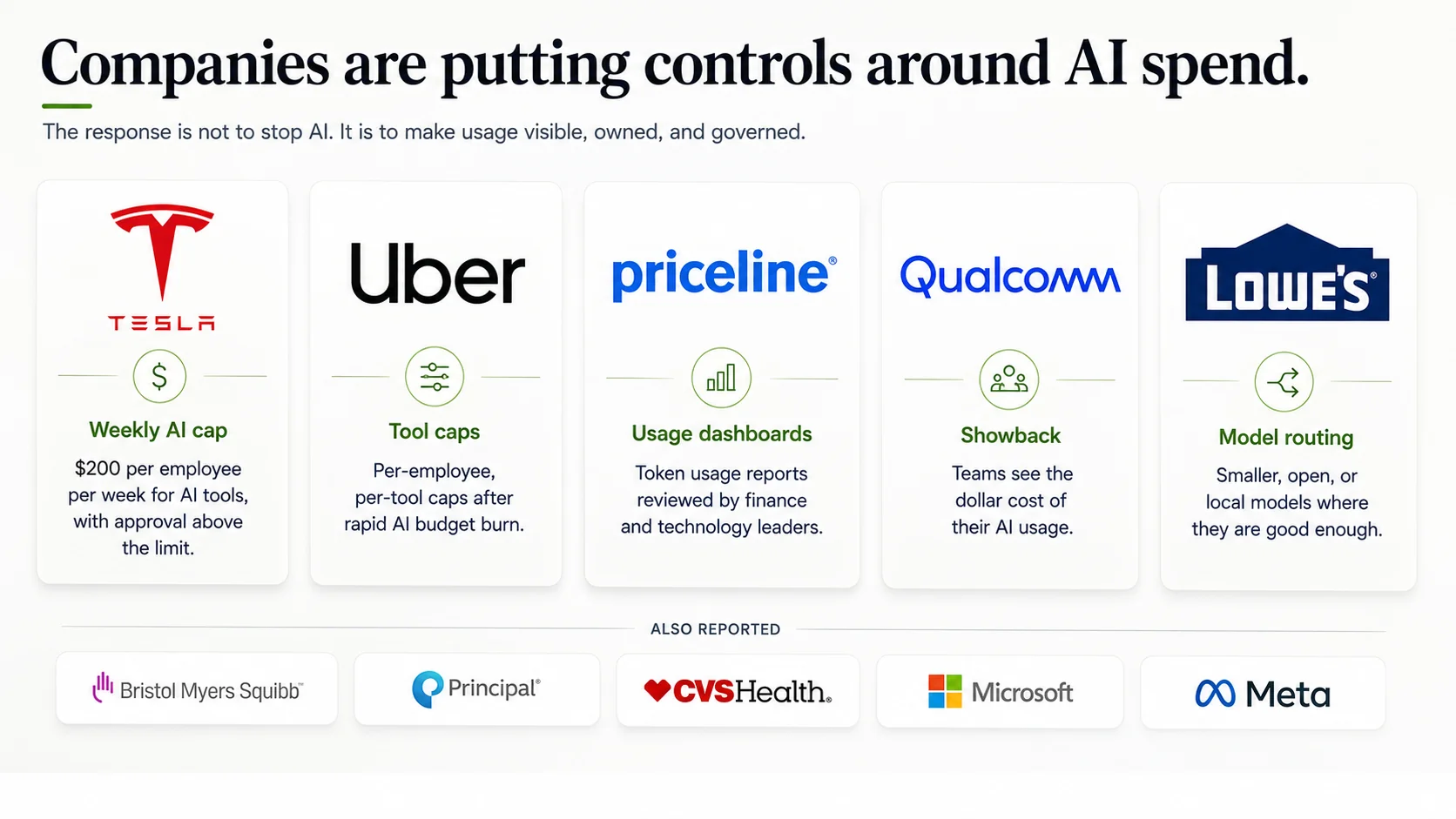
As my colleague Gary C. Tate shared in his session on "Token Maxing", Uber burned through its entire annual AI budget in three months and had to cap developer usage. One study tracking more than 100,000 developers found AI coding tools increased lines of code by 741 percent, while actual software releases rose by only 20 percent.

__wf_reserved_inherit
Token Maxing vs. Budget Maxing

Volume is not value. AI has no taste. It generates content, not judgment about what is excellent, appropriate, or true to a brand. Stripping out the people who carry that judgment does not produce an AI-native company. It produces a company that generates a great deal of AI slop very quickly.

Reducing headcount is not automatically disqualifying on its own, but the bar for calling it people-centric is real. Automating a task is different from discarding the person who used to do it.

IKEA's parent company Ingka is the clearest public example. Its chatbot, Billie, began resolving 47 percent of customer service inquiries. Instead of laying off the affected call center staff, the company reskilled all 8,500 of them into remote interior design advisors, a channel that now generates well over a billion euros a year.

Same task automated. Zero people discarded, because the company treated the automation as a signal to build something new rather than a reason to cut.

It is worth being precise about the limits of that example. Our practical reach is augmenting the people who are still inside an organization, not architecting exit or severance procedures for people on their way out. IKEA's case matters as proof that automation does not have to mean disposal. The commitment is to the people in front of us, while they are still here.

It is also worth noting that in 2026, Ingka and its franchisor separately cut roughly 1,650 corporate roles for unrelated reasons, citing declining sales and tariffs. The reskilling story still holds as a proof point. It is not proof that a people-centric company never has layoffs for other business reasons.

This front also requires us to be precise about our own language. We want to be a blueprint for what an "AI-native" organization looks like. That word gets used by the headcount-cutting camp too, and it means something different when we use it.

AI-native, to us, means workflows redesigned around judgment and better systems, arrived at through real work and real leadership behavior, not through fewer people running more tokens. Same word, two different ideas. The distinction matters.

One belief runs underneath this entire front: there is no fixed ceiling on how much can be automated, but there is a hard line on accountability. Automation should expand wherever work is predictable and standardized. Humans stay accountable for judgment, coordination, and trade-offs in the loops that actually matter.

The real danger is not autonomy itself. It is an organization automating itself into fragility, losing the ability to sense failure and adapt when something breaks. This is the Co-Pilot Economy from the opening, applied at the level of a single automation decision rather than the whole economy.

Front Three, and What People-Centric Also Requires

Front Three: Chasing Tools Before Understanding the Work

The third failure mode is smaller in scale than the first two, but it is where most individual AI efforts quietly waste their potential. Someone asks which AI tool is best, before asking which task is even worth automating.

Start with tasks, not tools. Work has to be broken down to the atomic task level before AI can be applied to it well, and understanding your own work at that level is a skill in itself.

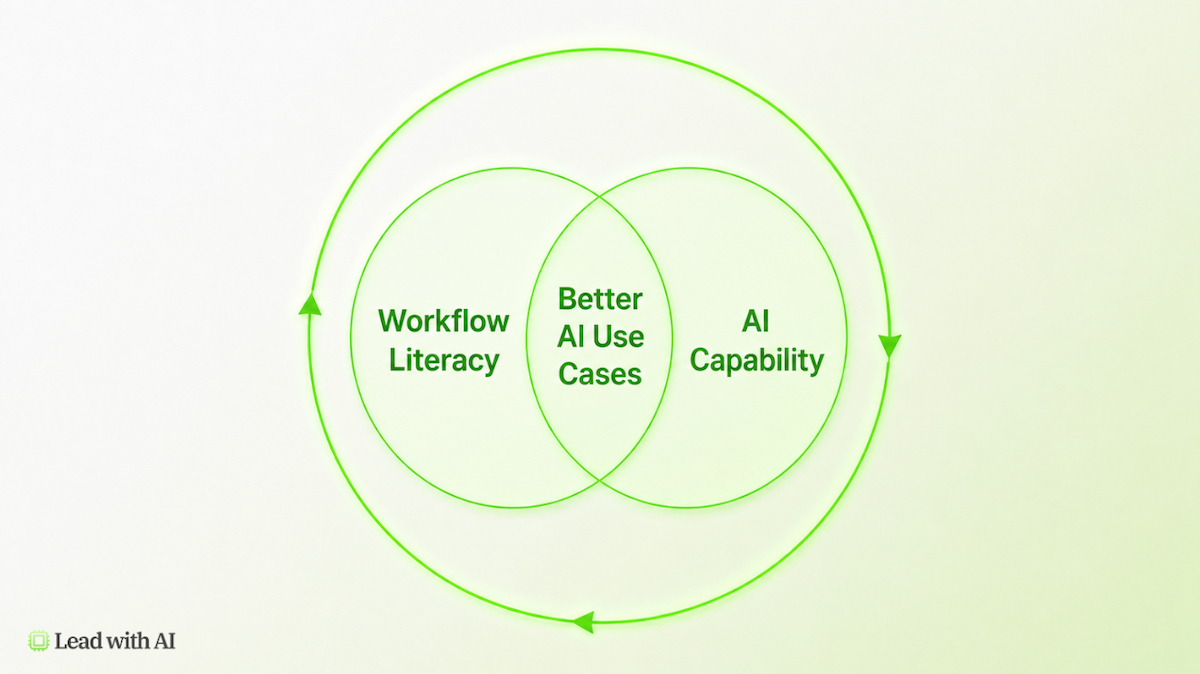
We call it workflow literacy, and it compounds: the clearer you see your own work, the more AI opportunities you notice, and the more you understand what AI can do, the more you see in your work that you missed before.

This is precisely why AI training cannot be a one-time event. It has to be a continuous cycle, run every few months, because both the work and the tools keep changing underneath you.

__wf_reserved_inherit
Implementing AI is a continuous process combining Workflow Literacy with AI Capability

The data backs the sequencing.

Standalone AI tools, adopted without this groundwork, plateau at 30 to 40 percent adoption. Tools embedded into a real, understood workflow reach 60 to 80 percent. AI used to augment a task keeps the underlying workflow 76.8 percent intact and speeds people up by 24.3 percent.

AI used to automate the whole task without this understanding drops workflow alignment to 40.3 percent, and people actually slow down.

What People-Centric Also Requires

Beyond the three fronts, four commitments round out what this actually looks like in practice.

Redeployment only works if people bring agency and ambition.

This is a two-way obligation, not a one-way protection. Our job is building the bridge: training, safety, and a real opportunity on the other side. The individual's job is walking through it. People-centric does not mean nobody's role ever changes. It means nobody gets discarded, and everybody is expected to bring initiative when a real path forward is offered.

This applies directly to the time AI frees up. A reclaimed day only becomes real impact for the people who bring the agency to claim it and the ambition to spend it on something that matters. Without that, the freed-up hours quietly fill back up, and nothing about the work actually changes.

That said, agency is not something we assume people already have. Agency is something an organization helps build in people who do not yet have it, not just a trait it screens candidates for.

Transparency has to be safe before it can be expected. More than half of employees quietly hide their AI use at work. Ethan Mollick calls them Secret Cyborgs. This is not laziness. It is a rational response to vague policies, no reward for revealing an edge, and a well-founded fear that productivity gains will be used to justify someone's own layoff.

That fear connects directly back to the headcount front above. If people reasonably suspect their efficiency will be used against them, they will hide the very thing that could make honest redeployment possible in the first place.

Using ChatGPT at work should be a compliment, not something people hide, and that culture starts with leaders modeling open use themselves. Teams with AI-engaged managers are four times more likely to adopt AI tools than teams whose managers stay on the sidelines.

Protecting imperfect human thinking is a separate and easily missed requirement. This is not about people hiding their AI use. It is about people going quiet in front of AI. When AI produces an answer that looks complete and confident, people hesitate to offer input that might sound unpolished, wrong, or half-formed by comparison.

A people-centric culture has to protect the willingness to contribute exploratory, imperfect human thinking, even when AI's fluency makes staying quiet feel safer. Curiosity, and the willingness to risk sounding a little silly, is a genuinely "robot-proof" skill. It matters more than any specific technical fluency.

None of this works without leaders who model it themselves. What real AI leadership looks like is not a leader who mandates AI use from a distance. It is a leader who redesigns their own role first, treats AI as a teammate rather than a tool, and rewards outcomes over effort, so that using AI well becomes something people are proud to be seen doing.

Doing Well by Doing Good

Our operating belief is that we need to be the blueprint for what we are asking of others, both as an organization and as leaders, focused on doing well by doing good.

That is not a slogan we put on a slide because it sounds nice. It is a testable claim. BCG's research found that employee-centric organizations are seven times more likely to succeed with AI than those that are not.

People-centric is not a values statement layered on top of the real strategy. It looks like the actual mechanism for the strategy to work at all, and the companies treating their people well during AI transformation are the ones actually succeeding at it.

Work does not have to be broken. But fixing it will not come from a mandate, a headcount spreadsheet, or a better tool.

It comes from real work, real workflows, and real leadership behavior, applied consistently, to every person an organization is responsible for, not just the ones at the top.

Want to reach 30,000+ business leaders applying AI in their work, teams, and organizations?​
Advertise with us​​.

Doing Well by Doing Good, and Frequently Asked Questions

Frequently Asked Questions about People-Centric AI Transformation

What is people-centric AI transformation?

It is an approach to AI adoption that designs around human behavior, workflow, and judgment first, treating the choice of tool and the question of headcount as downstream decisions rather than the starting point.

Is people-centric AI transformation slower or less competitive than an aggressive, headcount-focused approach?

The evidence points the other way. Gallup and BCG research both show that employee-centric organizations are significantly more likely to succeed with AI, not less. Skipping the people-centered approach appears to be a leading reason AI transformations fail, not a shortcut to faster ones.

Does this mean headcount can never be reduced?

No. It means a task can be automated without the person who did it being discarded. Organizations that treat displacement as a demand signal to build something new, rather than as a reason to cut, are the ones getting this right.

Why do AI mandates fail even with strong executive support?

Because a mandate is not a bridge. Belief at the top does not automatically produce workflow redesign, peer-level trust, or a realistic path for people to get from where they are to where the mandate expects them to be.