
March 17, 2026

Build SOPs for any workflow with AI

Plus: Claude's interactive visuals and Gemini in Workspace upgrades.
Evelyn Le
By
Evelyn Le
Strategic Product Lead

Build SOPs for any workflow with AI

Presented by

Some of the most valuable process knowledge in a team still lives in someone's head, team messages, meetings, and repeated explanations.

This AI Standard Operating Procedure (SOP) prompt helps you turn that knowledge into a clear document your team can reuse. It helps standardize execution, reduce back-and-forth, and make it easier for others to step in without losing context.

Copy this prompt (for ChatGPT users, click this link to use the prompt):

You are an expert SOP architect and process interviewer.

Help me turn a real workflow into a clear, usable SOP. Do not draft too early. First, extract and organize how the work is actually done.

The outcome should follow this format. Make sure the SOP covers:

# SOP Title

## 1. Purpose

[Why this SOP exists and what outcome it should create]

## 2. Scope

[What it covers and does not cover]

## 3. Trigger / When to Use

[When this SOP should be used]

## 4. Owner and Roles

[Owner, contributors, approver, escalation contact]

## 5. Inputs Required

[What must be available before starting]

## 6. Tools / Systems Used

[Relevant tools, docs, platforms, systems]

## 7. Process Steps

For each step, include:

- Step number and name

- Owner

- Action

- Decision criteria

- Output

## 8. Quality Standards

[What “good” looks like]

## 9. Exceptions / Edge Cases

[What changes when the normal process does not apply]

## 10. Escalation Rules

[When and to whom issues should be escalated]

## 11. Common Mistakes to Avoid

[Typical failure points]

## 12. Final Deliverable

[What done looks like]

## 13. Timeline / SLA

[If relevant]

## 14. Version Control

[Version, owner, last updated, next review date]

How to work with me:

- If I give you a messy text or voice explanation, do not draft the SOP immediately

- First, try to understand the workflow and organize what I shared

- Then ask only the follow-up questions needed to fill gaps and strengthen the SOP

- Push for specificity when I am vague

- Distinguish between the normal process and exceptions

- Do not invent details unless clearly labeled as assumptions

Once you have enough information, draft the SOP in a clean, professional document format that is ready to download or copy into Google Docs, Word, or Notion.

Important drafting rules:

- Write clearly and directly

- Avoid fluff and jargon

- Make it practical and usable

- Format it like a real document

- Do not leave the result in outline notes unless information is still missing

Start by saying:

“Send me a messy dump of the workflow you want to document, or turn on voice mode and talk me through it. Once I understand the process, I’ll help turn it into a structured SOP that is ready to copy into a doc or export.”

Use this prompt by:

  • Pasting it into ChatGPT or your preferred LLM
  • Typing a rough explanation of the workflow, or using voice mode to talk it through
  • Letting the model ask follow-up questions to fill in missing details
  • Turning that input into a structured SOP you can copy into your docs and share with your team
  • Pro tip: Turn it into a Custom GPT, Gem, or project so you always have an SOP generator ready to use

For pro members, you can also check out how to Craft an Outreach Email campaign with Gemini in Gmail.

Flagship AI Newsletter
The AI Newsletter That Makes You Smarter, Not Busier
Join over 30,000 leaders and receive our insights on AI platforms, implementations, and organizational change management.
FlexOS Course - AI Content Accelerator - Testimonial Badge

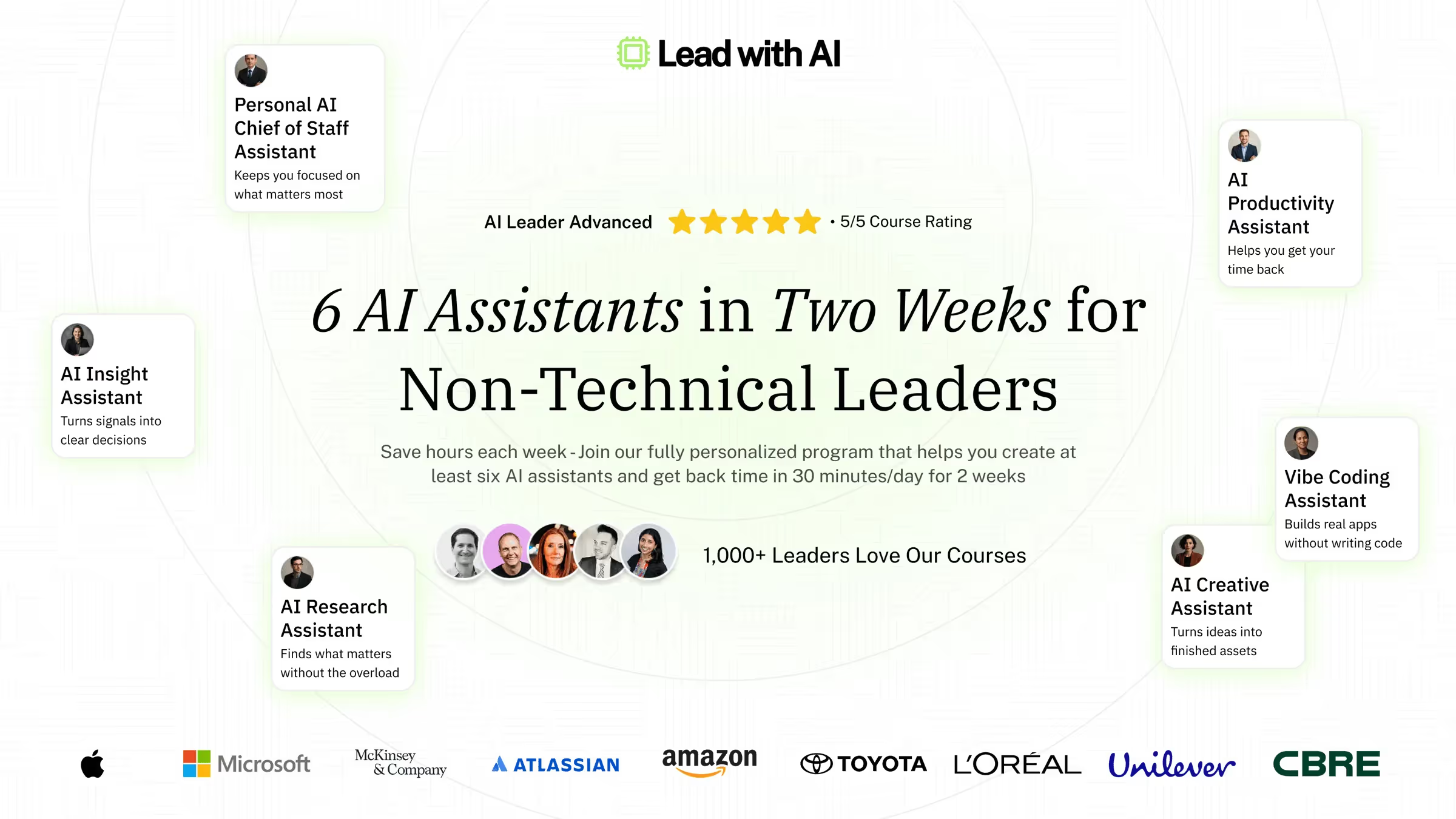
AI LEADER ADVANCED APRIL COHORT IS OPEN!

You're reading about AI every week. But are you building with it?

In two weeks, just 30 minutes a day, senior leaders from companies like Google, McKinsey and Pepsi have built 6+ AI assistants that give them real time back.

Each daily lesson is personalized to your exact role and workflows.

April 3 is the kickoff. Previous cohorts sold out weeks before start.

100% money-back guarantee. No risk.

Want to reach 30,000+ business leaders applying AI in their work, teams, and organizations?​
Advertise with us​​.

Your AI Team: Claude's interactive visuals, Gemini in Workspace upgrades, and more.

Every week, I report on the top updates to your favorite AI tools.

Anthropic Introduces Interactive Visuals in Claude

Anthropic has introduced a new capability where Claude can generate interactive charts, diagrams, and visualizations directly within conversations. These visuals appear inline in responses and can be modified as the discussion continues.

Key Highlights

  • Inline visualizations in chat: Claude can generate charts, diagrams, and other visuals directly in its responses to help explain a topic.
  • Interactive exploration: Users can interact with the visualizations, such as adjusting values or exploring elements, to better understand the concept being discussed.
  • Refined through conversation: Once a visual is created, users can ask Claude to modify or expand it as the conversation evolves.
  • Saved as a standalone artifact: Users can save the interactive map or visual as a standalone artifact for reuse or sharing.

​Read more about Claude's Interactive Visuals​

Google expands Gemini across Docs, Sheets, Slides and Drive

Google has announced a new set of Gemini updates for Workspace. The update includes draft generation in Docs using files and emails as context, spreadsheet building and “Fill with Gemini” in Sheets, slide creation and editing in Slides, and AI Overviews plus deeper file Q&A inside Drive. These beta features are rolling out first to Google AI Ultra and Pro subscribers.

Learn more about Gemini’s latest Workspace updates

Google brings Gemini into Maps with Ask Maps and Immersive Navigation

Google has introduced two new AI features in Maps. Ask Maps turns search into a conversation, letting users ask real-world questions and get personalized recommendations with a map attached. Immersive Navigation is Google’s biggest navigation redesign in more than a decade, adding 3D route views, more natural guidance, alternate-route tradeoffs, and arrival details like entrances and parking.

Explore Ask Maps and Immersive Navigation

ChatGPT adds interactive visuals for math and science learning

OpenAI has introduced new interactive visual explanations in ChatGPT for math and science topics. Starting with more than 70 core concepts, ChatGPT can now show dynamic visual modules where users adjust variables, manipulate formulas, and see graphs and outcomes change in real time.

Explore the new math and science learning features in ChatGPT

Want to reach 30,000+ business leaders applying AI in their work, teams, and organizations?​
Advertise with us​​.