
Claude Sonnet 5 makes agentic AI cheaper to run at scale

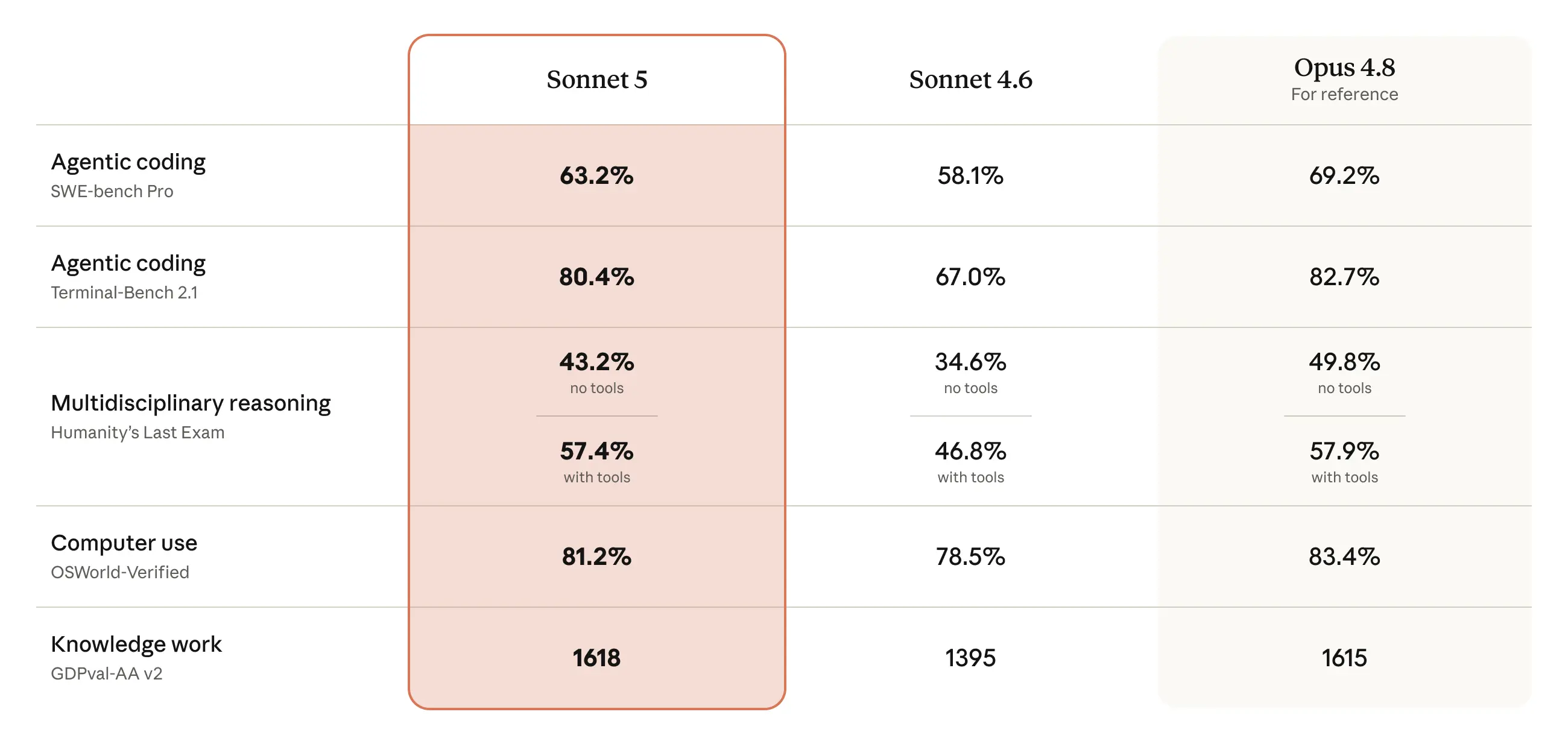
Anthropic has launched Claude Sonnet 5, its latest workhorse model for Claude users. Sonnet 5 is designed to make plans, use tools like browsers and terminals, and run more autonomously through longer workflows. Anthropic says it gets closer to Opus 4.8 on some agentic tasks, while offering a stronger cost-performance profile for everyday use.
Here are the key updates:
- Stronger agentic execution: Sonnet 5 can stay on task longer, use tools, and complete multi-step workflows that earlier Sonnet models were more likely to stall on.
- Better coding and debugging: Anthropic highlights stronger performance across coding, reasoning, tool use, and knowledge work, making it especially relevant for software, operations, research, and workflow automation.
- Lower-cost scaling: Sonnet 5 is positioned as a more affordable execution layer for agentic work, helping teams move from occasional AI experiments to repeatable workflows.
- More flexible effort levels: Users can adjust effort levels depending on the task, choosing lower-cost execution for routine work and higher-effort performance when the task needs more reasoning.
Sonnet 5 matters because it brings agentic execution closer to the cost profile teams need for real deployment, such as triaging information, drafting first versions, checking work, updating systems, debugging issues, and coordinating multi-step workflows.
The redeployment of Fable 5 and Mythos 5 adds useful context. Anthropic is not making every capability equally open or equally cheap. Instead, the market is moving toward a layered model strategy: efficient models for daily execution, stronger models for complex judgment, and more controlled models for sensitive work.
Try Claude Sonnet 5 for your next multi-step workflow
Read more AI news after this: