This step-by-step guide is exclusively available for Lead with AI PRO membership. 🚀 With Lead with AI PRO, you’ll get: ✅ Access to expert-crafted step-by-step guides ✅ AI-powered workflows to boost productivity ✅ Exclusive tools and resources for smarter work Upgrade to Lead with AI PRO and access all premium content instantly.
OpenAI's GPT-Live Turns Voice Into a Real Thinking Partner
OpenAI launched GPT-Live, a new full-duplex voice model that now powers ChatGPT Voice. Here is what leaders need to know and how to use voice to think better.
By
Daan van Rossum
Founder & CEO, Lead with AI
Presented by
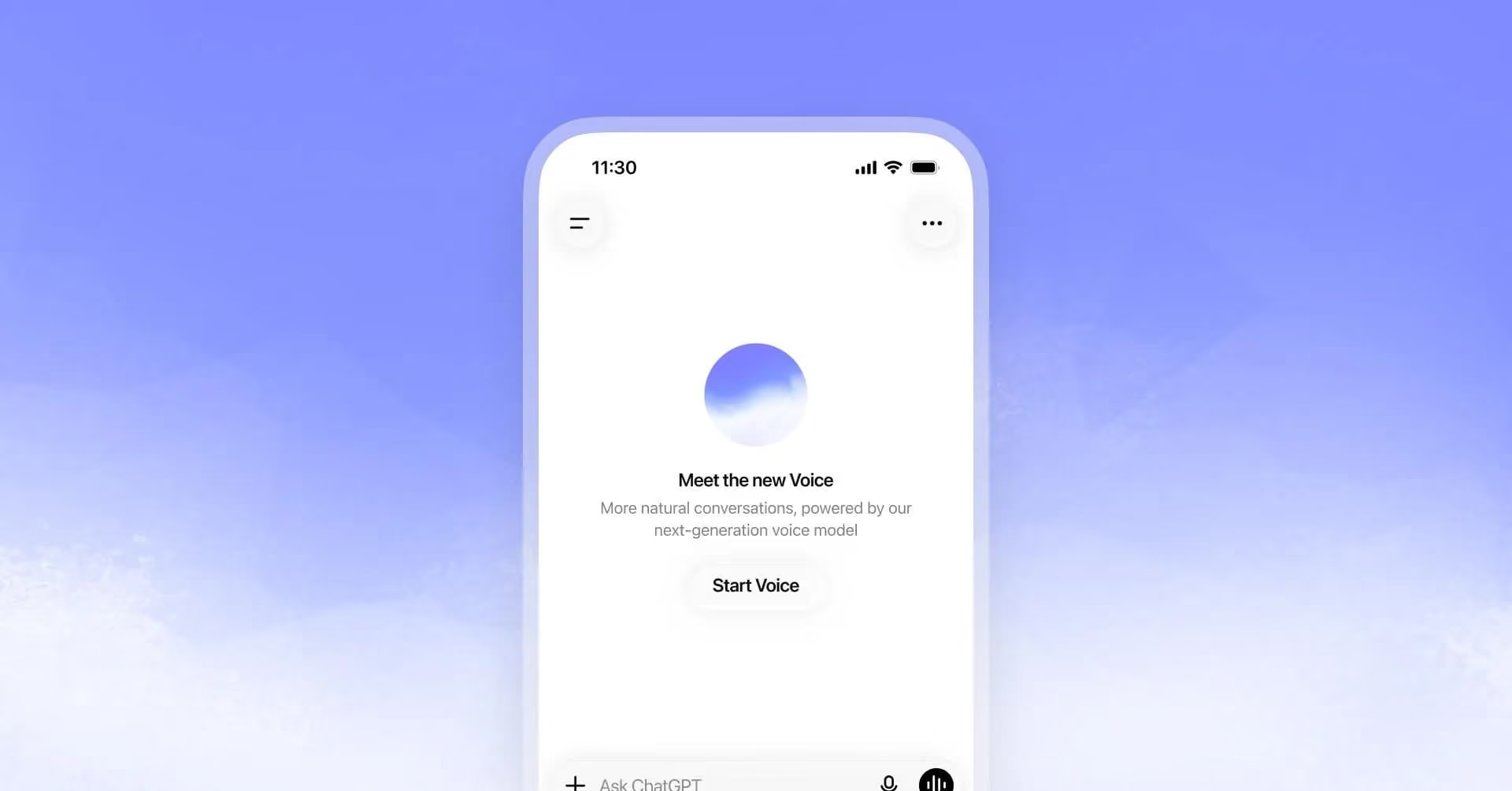
OpenAI just replaced the voice engine behind ChatGPT. A new model called GPT-Live now powers ChatGPT Voice across iOS, Android, and the web, and it is rolling out globally.
If you have used ChatGPT's voice mode before, you have felt the problem this fixes. You talk, then you wait. It answers, then you wait again. Every exchange had a small, awkward gap where the app was clearly "thinking" and you were just standing there.
GPT-Live is built to close that gap. It can listen and speak at the same time, which means it can react to you mid-sentence instead of only after you stop talking.
Two versions are shipping. GPT-Live-1 becomes the default for paid ChatGPT users on the Go, Plus, and Pro tiers. GPT-Live-1 mini becomes the default for free users.
Flagship AI Newsletter
The AI Newsletter That Makes You Smarter, Not Busier
Join over 30,000 leaders and receive our insights on AI platforms, implementations, and organizational change management.
What Actually Changed
Here is what stood out to me once I looked past the "more natural" marketing line and into the mechanics.
It listens while it talks. This is the core shift. Older voice modes worked in strict turns, where you speak, it processes, it replies, and then you speak again. GPT-Live runs continuously and decides many times per second whether to keep listening, respond, pause, or interrupt. That is why it can say a quiet "mhmm" while you are still mid-thought, the same way a person on a call would.
It hands hard questions to a smarter model behind the scenes, without breaking the conversation. If you ask something that needs a web search or real reasoning, GPT-Live does not freeze. It quietly delegates the task to OpenAI's frontier model, which is GPT-5.5 at launch, and keeps talking with you while that model works. When the answer is ready, GPT-Live weaves it back into the conversation. You experience one smooth exchange, but behind it, two models are actually running.
You can pick how much thinking you want. There are three reasoning levels. Instant is for fast, casual answers, and Medium or High are for when you want ChatGPT to actually sit with a harder question before responding.
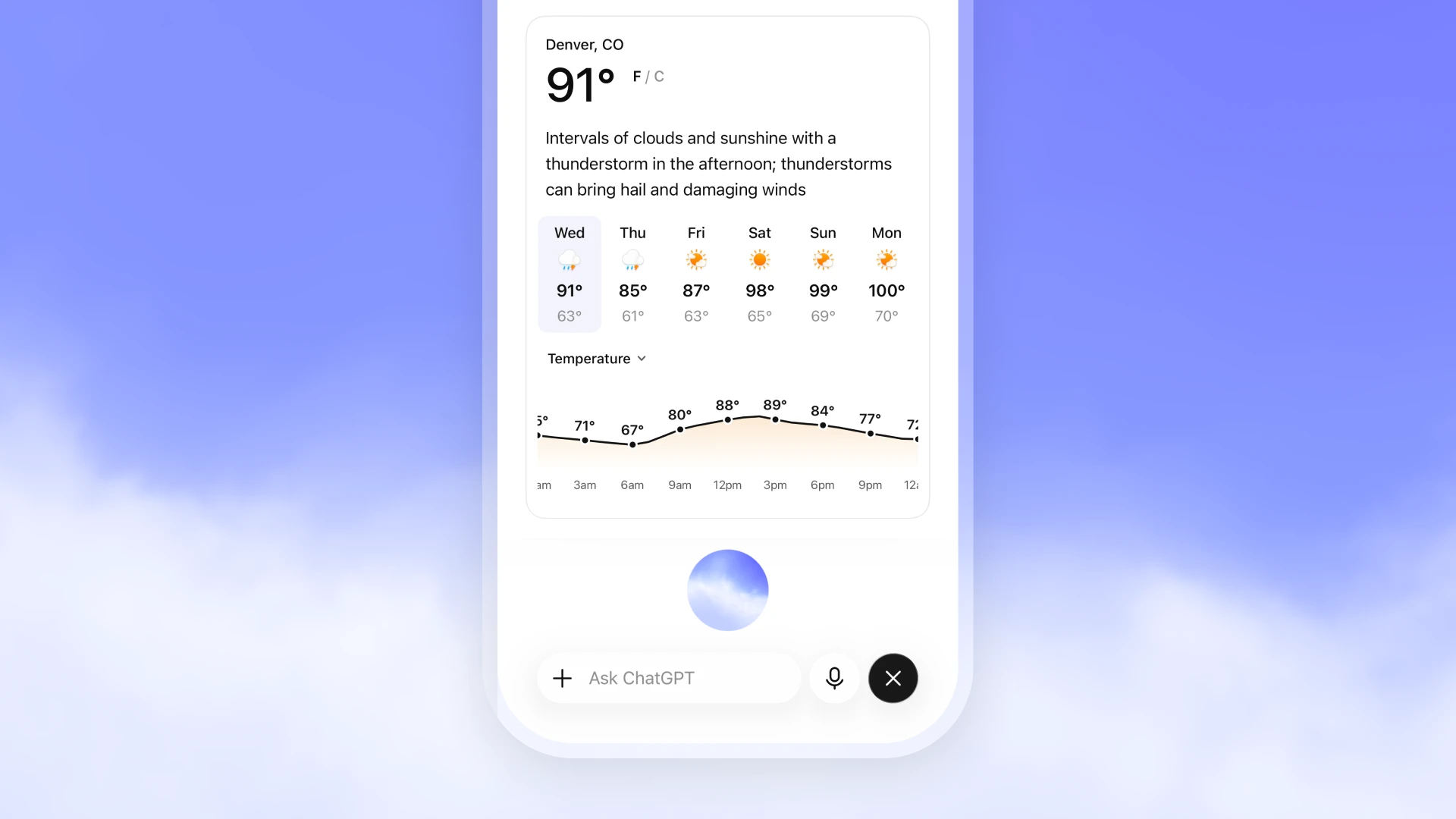
It shows you things while it talks. Voice conversations can now surface visual cards mid-conversation, such as a weather forecast, a stock chart, sports scores, or a map. You stay in voice mode and glance at the screen only when it helps.
A GPT-Live visual answer card showing a live weather forecast during a voice conversation.
It is better at knowing when you are actually done talking. The old system used silence to guess when your turn ended, so a pause to think or a bit of background noise could trigger an unwanted interruption. GPT-Live is built to tell the difference between "I am thinking" and "I am finished," and it will stay quiet if you explicitly ask it to just listen.
OpenAI reports it is strongly preferred over the old system. In head-to-head testing, GPT-Live-1 was preferred over the previous Advanced Voice Mode roughly 76% of the time, and the smaller mini version roughly 69% of the time, across measures like naturalness, interruptions, and conversational flow.
How This Actually Changes What You Can Do With Voice
Every week, more than 150 million people already talk to ChatGPT through Voice or Dictation. That scale is exactly why the old friction mattered, and why fixing it is not a cosmetic update.
The real difference is not that it sounds nicer. It is that voice stops being a slower version of typing and starts being a genuine second way to work.
Here are a few concrete examples of what that looks like in practice.
Prepping for a meeting during your commute. Instead of typing a question and reading a wall of text at a red light, you talk through your agenda out loud. When you ask something that needs current information, like a competitor's latest earnings, GPT-Live keeps the conversation going while the real research happens quietly in the background, and then it delivers the answer as part of the same exchange.
Using voice as a thinking partner. This is the use I am most interested in with the leaders we train. When an idea is still forming, typing forces you to compress and polish it before it is ready. Talking lets you work at the speed of thought. You think out loud, the model responds, and you interrupt and redirect without losing momentum, and the act of talking it through is often what produces the clarity. A full-duplex model that can react while you are still mid-sentence is what finally makes that back-and-forth feel real.
Live translation in a mixed-language conversation. Because the model processes speech continuously rather than in blocks, it can support real-time translation in a way a turn-based system could not do smoothly.
This is a genuinely different use of AI than typing a prompt and reading a reply. You are not issuing a command and waiting for output. You are having a working conversation, and the thinking happens invisibly in parallel.
The reason this matters to a leader is not the novelty. It is that voice unlocks the roughly one-third of your time that typing never could, such as the commute, the walk between meetings, and the ten minutes in a waiting room.
That is the capacity side of raising your Impact per Hour, and it is exactly the kind of low-value dead time that people-centric AI adoption is meant to give back to you. This is much closer to how we believe people-centric AI transformation should actually work, where the technology earns its place by fitting real work and real workflows rather than by being impressive in a demo.
Flagship AI Newsletter
The AI Newsletter That Makes You Smarter, Not Busier
Join over 30,000 leaders and receive our insights on AI platforms, implementations, and organizational change management.
The Bottom Line
OpenAI launched GPT-Live, a new full-duplex voice model that replaces Advanced Voice Mode. It now powers ChatGPT Voice globally on iOS, Android, and the web.
The real story here is architectural. OpenAI separated the "talking naturally" part from the "being smart" part.
That matters more than it sounds. It means the voice experience can keep getting smarter every time OpenAI ships a new frontier model, without ever having to retrain how it actually talks.
For a leader, the practical payoff is simpler. Voice can now turn commutes, walks, and waiting time into real thinking time. That is exactly the kind of shift that raises your Impact per Hour rather than just your screen time.
Trying it takes no setup. Open ChatGPT on your phone or at chatgpt.com and tap the Voice button.
The tool itself is not the point, though. A better voice model makes it tempting to talk to AI for everything, but the more useful question is which of your workflows are actually better spoken than typed.
That judgment about which task suits which modality is the real skill. It is what we mean by starting with tasks, not tools, and it is exactly the kind of workflow thinking we build hands-on with leaders inside AI Leader Advanced.