

Almost every conversation about AI and productivity stops at the same place: how much time it saves you. That might be twenty percent, thirty percent, or a full day a week. The number is real, and if you do the work, you will get it.
Here is what I have learned after being in the room with thousands of senior leaders. Saving the time is the easy part. Keeping it is where almost everyone fails.

That is why the most consequential question in our program is not about tools or models.
We ask it in the intake interview, point blank: if AI gave you back real time, what would you actually do with it?
It is the first thing we work through in AI Leader Advanced, before anyone touches a prompt.
Why we keep bringing up a 1955 essay from The Economist
Most people know Parkinson's Law as a one-liner: work expands to fill the time available for it. It gets passed around as a tidy tip about setting shorter deadlines.
C. Northcote Parkinson published it in The Economist in 1955, and he was not writing about your calendar. He was writing about bureaucracy. His finding was that British Admiralty administrative staff grew by nearly 80 percent over fourteen years, in a period when the Navy had fewer ships and fewer sailors to manage. The work had shrunk, and the headcount kept climbing anyway.
He found that the amount of work and the number of people doing it are barely related. Officials generate work for each other, so capacity, once created, gets absorbed by activity that looks like work but produces nothing.

This is exactly the trap AI sets.
Free up capacity without a plan, and the system around you will manufacture busywork to fill it. It fills with more meetings, more messages, and more email, and we all know that for every email you send, you get ten back.
This is why so much AI investment shows no return
The pattern is already in the data. MIT's widely cited 2025 study found that 95 percent of enterprise AI pilots delivered no measurable return, and only a small share produced real value. The failure was rarely the model, and much more often it was how the work around the tool was designed. The broader set of AI statistics tells the same story, which is that the tools rarely fail on their own and the work around them decides the return.
The individual version of this is quieter but just as costly. The time gets saved, and then it gets reinvested in being more online rather than in anything that moves the business or the person forward.
Anyone who has managed a budget understands this instantly. When money gets freed up and nobody allocates it, it does not compound. It leaks away in small amounts, everywhere, and you never see it again. Reclaimed time behaves the same way.
This is the capacity half of what we call impact per hour, which is freeing people from the 30 to 40 percent of their time lost to low-value work. But capacity you never direct is not a gain. It is a gain that evaporates.
Set the North Star before you spend the time
Understanding your own work at the task level still comes first. That is the "how," and we call it workflow literacy. The North Star sits on top of it as the "why." It is the thing you decide before the freed-up time arrives, so you are ready to claim it the moment it does.
The answers are the point of the whole exercise.
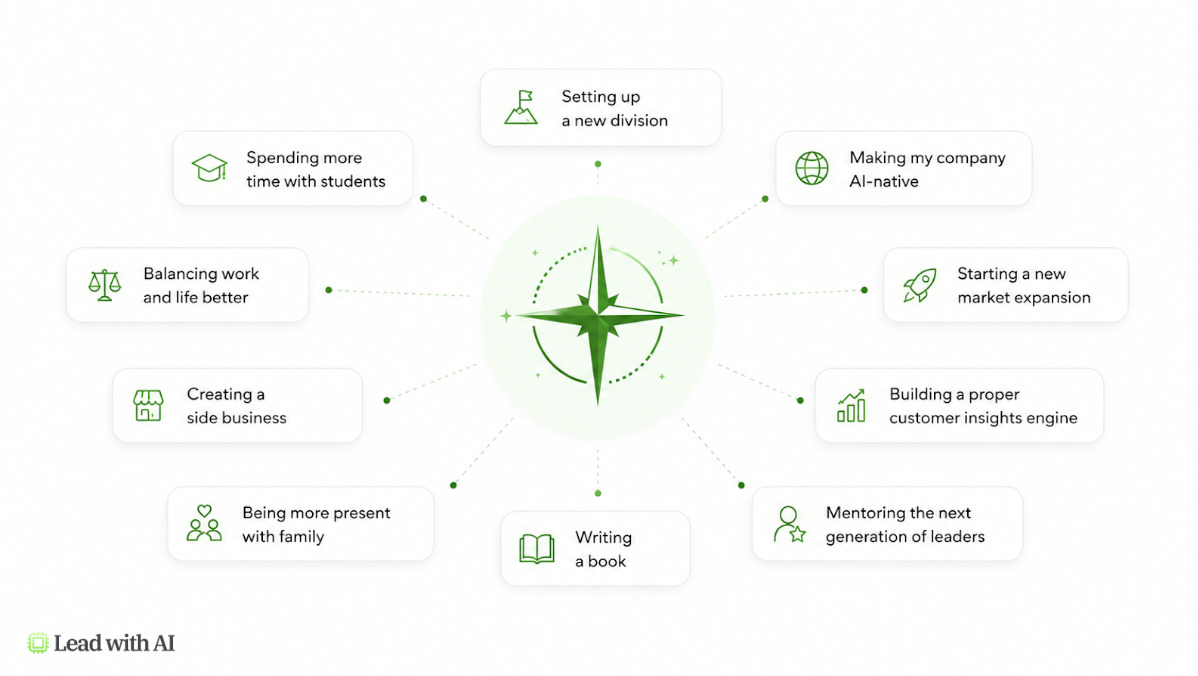
Some leaders use the time to grow the business instead of only running it. Others launch a new service or product line, spend real time with clients and customers again, or finally do the high-value work they are actually best at. For larger organizations, that often looks like standing up a new division, entering a new market, or mentoring the next generation of leaders. These are the things a full week crowds out, and they are exactly what a reclaimed day is for.
Nietzsche put it better than any management book has, which is that someone with a strong enough "why" can bear almost any "how." When you know what the time is for, you protect it, and you push through the friction of changing how you work.
There is a practical reason this comes first, too.
Your North Star becomes an input to everything downstream.
It shapes your priorities, what you choose to automate versus keep, and even which workflows to tackle first, which is the whole point of a method like GED-RT.
This is the difference between AI that adds to your day and AI that finally changes it, and it is how one leader at a time actually builds the Co-Pilot Economy instead of just more noise.
The bridge can be built for you, but you still have to walk across it.
Reclaiming your time takes agency and ambition, not just better tools.
So if you want to finally get a return on your AI investments, write down the single most valuable thing you would do with a reclaimed day per week.
That sentence is your North Star. Everything else is in service of it.
The bottom line
- The time savings are real and easy to get, and holding onto them is the hard part, which is where most AI efforts quietly fail.
- Parkinson's Law was never a productivity hack. It was a warning about systems that manufacture busywork to consume any capacity you create.
- Unallocated time behaves like unallocated budget, because it leaks away in small pieces and produces no return.
- Understand your workflows first, then set your North Star on top of them, and decide where the reclaimed time goes before it arrives.
- A clear "why" is what makes the whole thing stick, and claiming it takes agency, not just tools.