

Micron AI Strategy: Halving Chip Development Time with AI
How Micron uses AI on its own work: AI agents that halve chip development time, AI inspection across its factories and 1 million work hours saved a year. Updated November 2026.
Memory and storage chips, including DRAM, high-bandwidth memory and NAND
Micron sets out its internal AI use and results in its October 2026 technology webinar and a December 2025 company blog on smart manufacturing. No dated targets.
Read the company sourceWhere Micron Is Going with AI
Micron is using AI to cut the time from invention to volume production in half. At its October 2026 technology webinar, Micron described “industry-leading use of AI across development teams.” Micron has published how it uses AI in development and manufacturing, with results, so this profile treats the strategy as published.
AI runs through the factories as well as the labs. Koen de Backer, corporate vice president of Smart Manufacturing and Artificial Intelligence, said in a December 2025 company blog:
“This is about transforming the enterprise, not just the shop floor.”
The focus has four parts.
- Chip and product development: AI agents for chip design and verification, AI-generated firmware and AI root-cause analysis
- Manufacturing: computer vision and deep learning that find and classify wafer defects, plus sound and heat monitoring that flags failing equipment
- Yield and planning: yield analytics and digital twins built on data from 590,000 factory sensors
- Enterprise functions: predictive analytics in sales, HR and R&D
What It Takes: A Smart Manufacturing Team, Factory Data and Agents for Engineers
A corporate vice president leads smart manufacturing and AI together. De Backer’s role covers both, and Micron’s yield management platforms have more than 14,000 users.
Factory data is the foundation. Micron stores 77 petabytes of data, captures 58 terabytes more each day and runs 100 million wafer images a week through AI models (company blog).
Engineers work with AI agents in development. On a new data center SSD controller, Micron used AI agents for logic design and verification, AI physical design and AI root-cause analysis. On a new SSD product, it used AI-generated firmware, smart test selection and coverage agents.
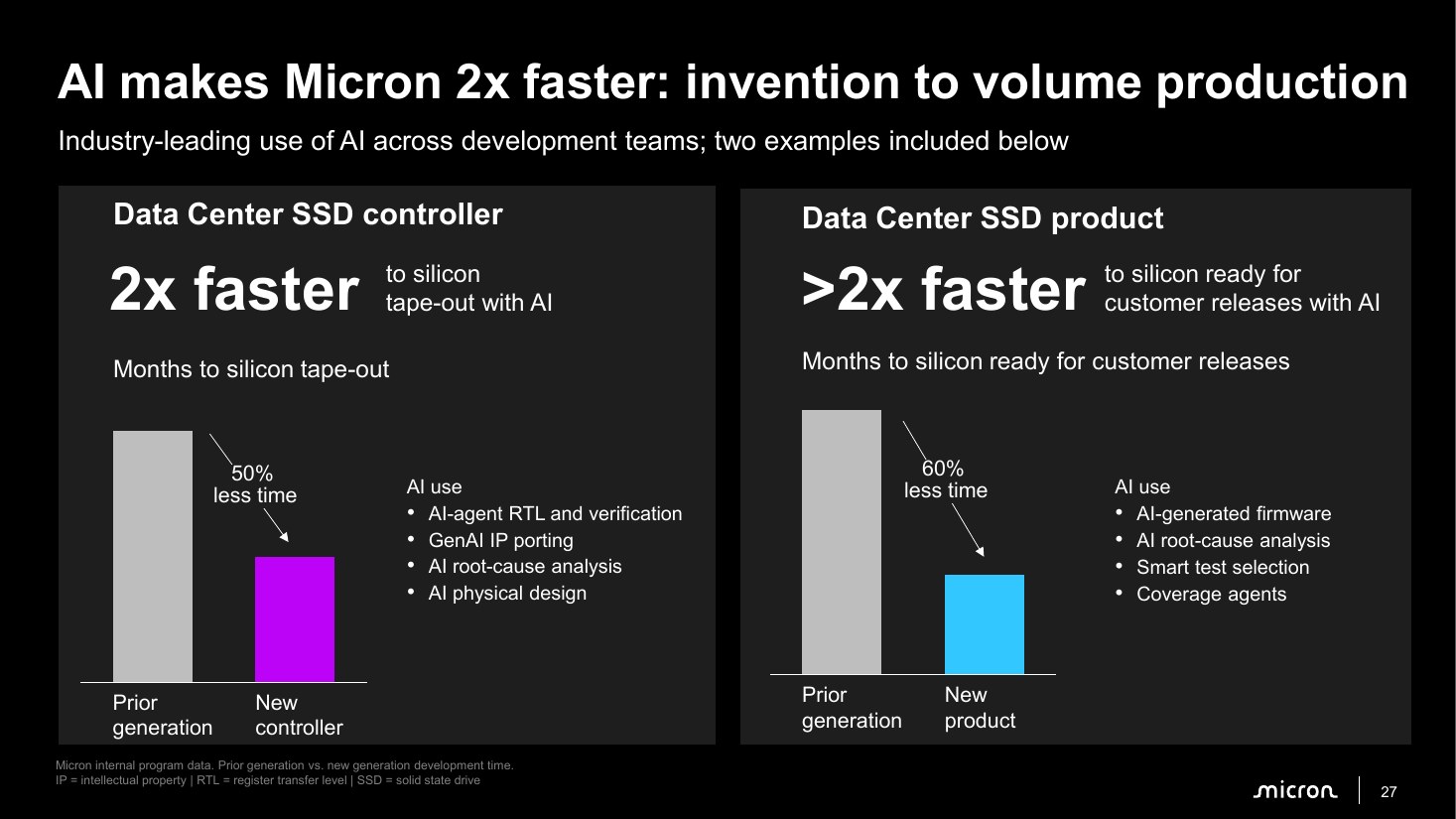
The next step is agents across more programs. Micron showed two examples, and spreading agent-based development across all programs is the work of closing the gap between chat and agents.
Micron is hiring as it grows. Headcount rose from about 53,000 to about 61,000 in fiscal 2026 as revenue more than tripled. The sources reviewed do not link Micron’s headcount to AI.
AI fluency, coded against the Lead with AI Fluency Matrix (September 2026 edition):
- Fluency floor: Not published. Micron has set no AI training requirement or usage standard for all staff.
- Highest level evidenced: Level 3 (Integrating), company-claimed. AI is built into chip development and manufacturing with measured results. Micron showed agent-assisted development in two programs, but not agent-run workflows across development, so Level 4 is not evidenced.
- Portfolio design: Micron puts its largest bets on chip development and manufacturing, where speed and yield drive results.
How Micron Measures Results
Micron reports results by program and by plant. All figures below are company-claimed:
- Development: 50% less time to tape-out for a data center SSD controller, and 60% less time to customer-ready silicon for a data center SSD product (October 2026)
- Time to market: 50% shorter (company blog, December 2025)
- Labor: about 1 million work hours saved a year
- Quality: 50% less product scrap and a 4% gain in tool availability
The results are strong but not yet summed. Micron has not published a company-wide value figure or how it counts the hours saved. A clear total is the step from AI adoption to AI value.
Next markers: development time on more programs, a company-wide AI value figure, yields on new memory generations, and headcount for fiscal 2027.
Change log
- December 2025: Micron describes AI across its factories, with about 1 million work hours saved a year.
- September 2026: Fiscal 2026 ends with record revenue of about $133 billion and about 61,000 employees.
- October 2026: Micron says AI cut development time by half or more on two data center SSD programs.
The Bottom Line
- Disclosure: 4 of 4. Micron answers all four questions, with results by program and by plant.
- Development time fell by half or more on two SSD programs that used AI agents and AI-generated firmware.
- AI inspects wafers and listens to machines across Micron’s factories.
- About 1 million work hours are saved each year, by Micron’s count.
- The say-do gap is the total. Micron reports strong program results but no company-wide figure.
- Watch the next programs. The test is whether halved development times repeat across products.
Revenue, Headcount and Revenue per Employee
What the numbers show: Revenue rose more than eightfold from fiscal 2023 to fiscal 2026 while headcount rose 42%, so revenue per employee rose about sixfold, to about $2.18M. The swing mostly reflects memory prices, which were low in fiscal 2023 and rose sharply in fiscal 2026. These figures do not show that AI caused any change.
Revenue, headcount and revenue per employee, FY2023 to FY2026
- FY2023: $15.54bn revenue, 43,000 employees, $361k per employee
- FY2024: $25.11bn revenue, 48,000 employees, $523k per employee
- FY2025: $37.38bn revenue, 53,000 employees, $705k per employee
- FY2026: $133.2bn revenue, 61,000 employees, $2.18M per employee
Change, FY2023 to FY2026: revenue up 757% (8.6x), headcount up 42%, revenue per employee up 504% (6.0x).
Notes: Revenue is as reported. Headcount is approximate, at fiscal year-end (late August or early September). Fiscal 2026 had 53 weeks. Memory revenue moves with memory prices, which were low in fiscal 2023 and rose sharply in fiscal 2026.
These figures give context on scale and productivity. They do not show that AI caused any change. Sources: Micron 10-K filings.
Frequently Asked Questions
What is Micron’s AI strategy for its own work?
Micron uses AI to speed up chip development and to run its factories more efficiently. AI agents help design and verify chips, and AI inspects wafers and monitors equipment.
Who leads AI at Micron?
Koen de Backer, corporate vice president of Smart Manufacturing and Artificial Intelligence, leads AI in Micron’s factories. Chairman, President and CEO Sanjay Mehrotra sets the company’s direction.
How much faster does AI make Micron’s development?
Micron says AI cut development time by 50% for a data center SSD controller and by 60% for a data center SSD product. Both figures compare a new program with the previous generation.
Is Micron cutting jobs because of AI?
The sources reviewed show no AI-linked job cuts at Micron. Headcount rose from about 53,000 to about 61,000 in fiscal 2026.
How is this profile put together?
Lead with AI profiles use public sources only, such as annual reports, earnings materials, filings and on-record interviews, dated at the time of writing. AI fluency is coded against the Lead with AI Fluency Matrix, and company figures are marked as company-claimed unless they have been independently verified.
About the AI Strategy Index
The Lead with AI AI Strategy Index profiles how the largest companies in the US and Europe approach AI, starting with the S&P 100 and the STOXX Europe 50. Each profile answers four questions: where the company is going with AI, where it will focus, what it will take and how it will know it is working. AI Pacesetters and notable companies outside the two indexes are profiled for contrast and are not counted. Profiles use public sources only, and AI fluency is coded against the Lead with AI Fluency Matrix.
See all company profiles