
September 22, 2026

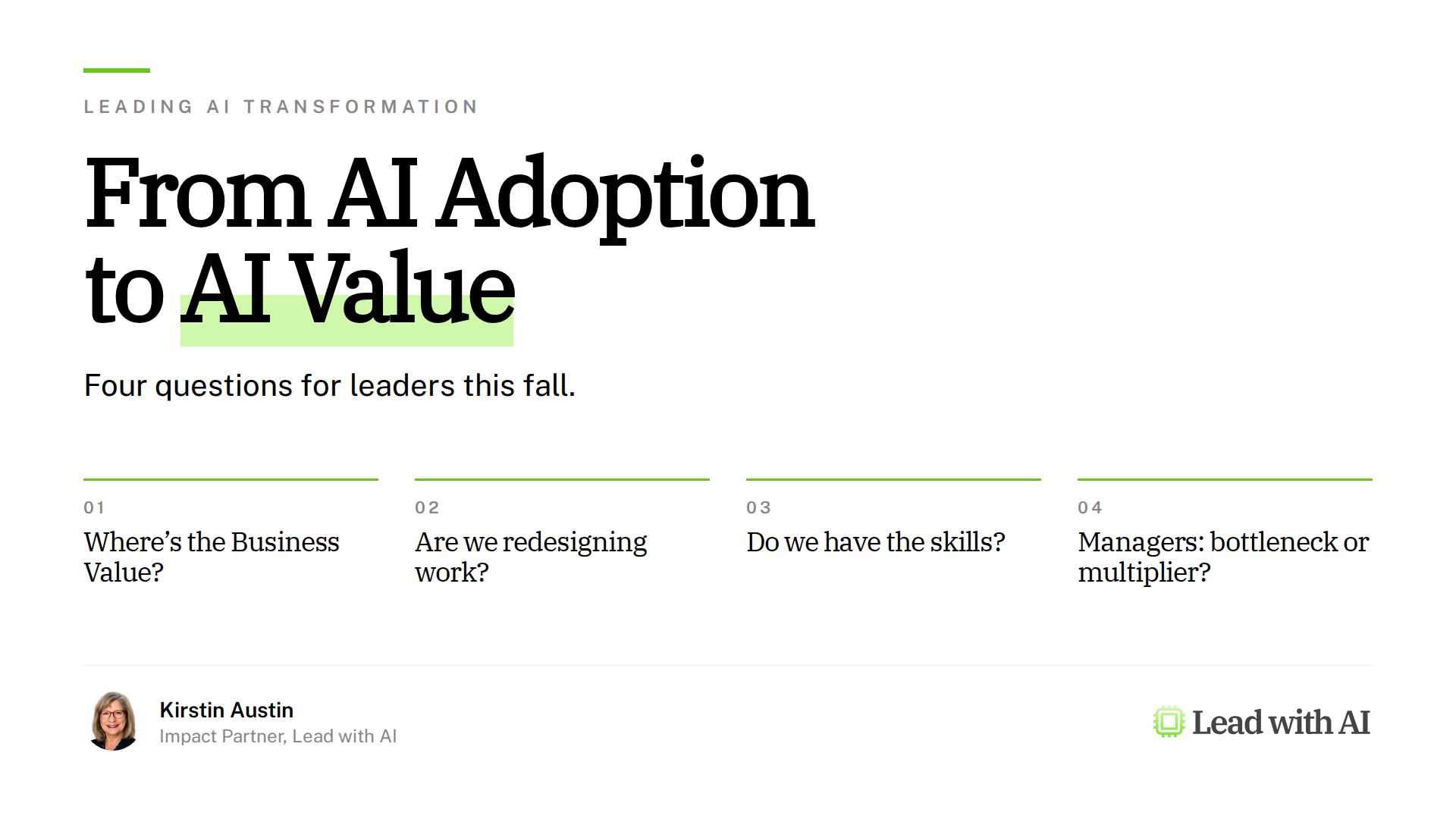
From AI Adoption to AI Value: Four Questions for Leaders This Fall

Usage is a metric, not an outcome. Four questions leaders should ask this fall to turn AI adoption into measurable business value, with Gallup and Gartner data.
From AI Adoption to AI Value: four questions for leaders this fall, by Kirstin Austin
Kirstin Austin
By
Kirstin Austin
Impact Partner

Presented by

The first half of 2026 was about getting AI into the organization. The second half needs to be about getting value out of it.

From January through July, most leadership teams focused on adoption: AI skills training, governance boards, usage and completion targets.

That work mattered, but it isn't the whole story. Individual AI use is not the same thing as organizational performance, and that gap is where the real work of the fall begins.

Here are four questions worth asking as you head into the fall.

1. We Invested in AI. Where Is the Business Value?

Leaders are moving beyond "Should we adopt AI?" to "What are we actually getting for it?"

Gallup just reported that 65% of employees in organizations using AI say it improves their own productivity, but only 12% strongly agree that AI has transformed how work gets done organizationally.

This fall, move beyond adoption metrics and start measuring business results. The point is simple: usage is a metric, it isn't an outcome.

Depending on your organization, outcome metrics might include:

  • Labor hours saved, and what that capacity was used to accomplish.
  • Savings from eliminating redundant systems or processes.
  • Improvements in production, cycle time, or quality.
  • Customer service improvements.
Flagship AI Newsletter
The AI Newsletter That Makes You Smarter, Not Busier
Join over 30,000 leaders and receive our insights on AI platforms, implementations, and organizational change management.
FlexOS Course - AI Content Accelerator - Testimonial Badge

2. Are We Redesigning Work, or Just Adding AI to Old Workflows?

Organizations are starting to ask which tasks should be automated, augmented, eliminated or redesigned, and consequently what jobs should look like.

Gartner reports that just over half of organizations have already redesigned or redefined roles because of AI.

The interesting question for a leader isn't "Did everybody take AI training?" It's "Are people actually working differently afterward?"

This fall, pick one or two workflows that are ripe for redesign and identify willing teams to pilot the new approach.

Help them rethink the work first, then determine where AI assistants or agents can add value.

Support those early adopters, measure what happens, and showcase their successes so other teams can learn from them.

3. Do Our People Actually Have the Skills We Need?

Executive ambition is running ahead of workforce capability.

Gartner says 88% of CEOs are increasing AI investment, even as skills and talent gaps are becoming increasingly visible and workforce readiness is becoming a major bottleneck.

The goal is to move from AI literacy to applied capability to changed behavior to business results, rather than simply providing more courses.

This fall, get a clear picture of the AI capabilities your workforce has today and what the business will need next. Then target development accordingly.

Some employees may still need basic AI literacy. Others may need advanced, role-specific skills or individualized learning paths.

Most organizations will need a blend.

4. Are Managers the Bottleneck, or the Multiplier?

Gallup's current AI research finds that manager support has the strongest association with measurable differences in how employees use and value AI.

Organizations can give employees tools and training, but the manager determines whether people experiment, share practices, change workflows and make the new behavior normal.

This fall, give supervisors and managers a practical AI toolbox: conversation guides, coaching questions, workflow-redesign prompts, examples of good use cases, and clear guidance about when and where to escalate problems.

Give managers what they need to coach and problem-solve in the flow of work.

The AI conversation is changing.

Adoption still matters, but it is no longer enough.

The organizations that make the most progress this fall will be the ones that connect AI to business value, redesign work rather than simply automate it, build the capabilities their people actually need, and equip managers to lead the change.

Don't just ask how much AI your organization is using. Ask what is actually different because of it.