

UnitedHealth Group AI Strategy: A $1.5 Billion Bet Across 1,000 Use Cases
How UnitedHealth Group uses AI on its own work: about $1.5 billion invested in 2026, 1,000+ use cases, AI in 80% of member calls and daily AI use tracked. Updated November 2026.
Health insurance through UnitedHealthcare and health services, pharmacy care and technology through Optum
UnitedHealth has no standalone AI strategy document. Its approach comes from its January and April 2026 earnings calls and July 2026 executive remarks.
Read the company sourceWhere UnitedHealth Group Is Going with AI
UnitedHealth Group is spending about $1.5 billion on AI in 2026 to change how it organizes, operates and works. CEO Stephen Hemsley said on the April 2026 earnings call that the company is “leaning into this,” while staying “very measured” about expectations. UnitedHealth has no standalone AI strategy document, so this profile draws on earnings calls and reporting.
AI is meant to cut costs and speed up care. UnitedHealthcare CEO Timothy Noel said in January 2026 that the company expects “operating cost reductions of nearly $1 billion in 2026,” many of them AI-enabled. The company projects a 2:1 return on its AI investment, with many tools paying back within 12 to 18 months.
More than 1,000 AI use cases are active, according to company leaders in July 2026.
The focus has four parts.
- Member service: AI tools in more than 80% of member calls, plus an AI assistant called Avery
- Prior authorization: fewer authorization requirements, with 80% of prior authorizations processed in real time by the end of 2027
- Clinicians: AI ambient listening for employed providers and AI support for care managers
- Claims: real-time claims processing through OptumReal
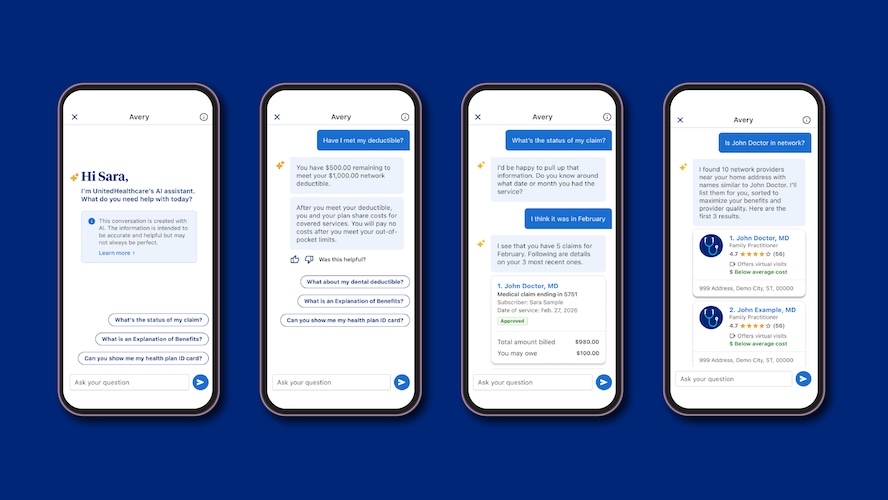
What It Takes: $1.5 Billion, an AI Studio and Daily AI Use
UnitedHealth runs AI on its own platform. United AI Studio, a proprietary secure platform, finds use cases and works across several AI vendors. About a third of the 2026 AI investment goes to making Optum Insight an AI-first business, and the rest to processes across the company.
Some staff are expected to use AI every day. Bloomberg reported in May 2026 that UnitedHealth tracks whether some Optum workers make at least one query a day in ChatGPT or Microsoft Copilot, using a dashboard of usage and training progress (BenefitsPRO). An AI training program called AI Dojo is open to employees and customers.
A review board checks AI for accuracy, safety and fairness. It includes clinicians, data scientists, business leaders, privacy and security experts and ethicists. Noel said: “If services are not authorized, that decision will ultimately be made by a clinician.”
Contact centers keep people. Noel said contact centers are “getting far more efficient, but they will never be fully automated.” Headcount fell to about 390,000 at the end of 2025, and the company has not tied the decline to AI.
AI fluency, coded against the Lead with AI Fluency Matrix (September 2026 edition):
- Fluency floor: Not published for all staff. Some Optum teams are expected to use ChatGPT or Copilot at least once a day, which points to Level 1 for those groups.
- Highest level evidenced: Level 3 (Integrating), company-claimed. AI is built into member calls, prior authorization and claims, across more than 1,000 use cases. The figures have not been independently verified.
- Portfolio design: UnitedHealth runs a large portfolio of use cases on one internal platform, with its biggest bets in administrative work such as prior authorization and claims.
How UnitedHealth Group Measures Results
UnitedHealth reports AI results across several areas. All figures below are company-claimed:
- Member service: more than 15 million calls avoided, and AI used in over 80% of member calls
- Clinical work: care managers about 40% faster, and 69,000 administrative hours saved, according to Optum Insight CEO Sandeep Dadlani
- Engineering: more than 150 million lines of code contributed with AI
- Returns: a projected 2:1 return on AI investment
Gaps remain. UnitedHealth links AI to nearly $1 billion in cost cuts for 2026 but does not say how much of that comes from AI. Separating that figure is the step from AI adoption to AI value.
Next markers: the AI share of 2026 cost cuts, progress on prior authorization, results from Avery and headcount for 2026.
Change log
- January 2026: UnitedHealthcare expects nearly $1 billion in operating cost cuts in 2026, many of them AI-enabled.
- April 2026: Hemsley says the company is investing about $1.5 billion in AI.
- May 2026: Bloomberg reports that UnitedHealth tracks daily AI use among some Optum staff.
- July 2026: Company leaders say more than 1,000 AI use cases are active.
The Bottom Line
- Disclosure: 4 of 4. UnitedHealth answers all four questions, with results by area and a projected return.
- The bet is large, at about $1.5 billion in 2026.
- More than 1,000 use cases run on one internal platform.
- Level 3 is evidenced in member service, prior authorization and claims, on company-claimed results.
- The say-do gap is measurement. UnitedHealth ties AI to cost cuts without separating the AI share.
- Watch prior authorization. The test is whether AI cuts requirements and delays as promised.
Revenue, Headcount and Revenue per Employee
What the numbers show: Revenue rose 38% from 2022 to 2025 while headcount fell 3%, so revenue per employee rose 42%, to about $1.15 million. Headcount peaked at about 440,000 in 2023 and has fallen since. These figures do not show that AI caused any change.
Revenue, headcount and revenue per employee, FY2022 to FY2025
- FY2022: $324.2bn revenue, 400,000 employees, $810k per employee
- FY2023: $371.6bn revenue, 440,000 employees, $845k per employee
- FY2024: $400.3bn revenue, 400,000 employees, $1.00M per employee
- FY2025: $447.6bn revenue, 390,000 employees, $1.15M per employee
Change, FY2022 to FY2025: revenue up 38%, headcount down 3%, revenue per employee up 42%.
Notes: Revenue is total revenues, as reported. Headcount is approximate, at December 31.
These figures give context on scale and productivity. They do not show that AI caused any change. Sources: UnitedHealth Group 10-K filings.
How UnitedHealth Group Compares with Medical Technology and Health Services Peers
We looked at how UnitedHealth Group compares with other medical technology and health services companies in the index. Here is how they stack up.
| Company | Disclosure | AI owner | Fluency floor | Governance | AI value reported | Revenue per employee |
|---|---|---|---|---|---|---|
| Abbott | 3 of 4 | CIO; executive steering committee on generative AI | Not published; AI education for leaders | Steering committee; financial test for each AI investment | IT results committed, no figure | $385k |
| CVS Health | 4 of 4 | Chief Experience and Technology Officer | Not published | CEO sets where AI will and will not be used; no published framework | $1B+ savings from technology and AI, AI share not split | $1.34M |
| Danaher | 3 of 4 | CEO links AI to the Danaher Business System | Not published | Through DBS; AI listed as a risk factor | None published | $409k |
| EssilorLuxottica | 2 of 4 | No named AI owner | Not published | Little published | None published | $206k |
| Intuitive Surgical | 2 of 4 | VP of Enterprise Data, Analytics and AI | Not published | AI Governance Committee; published principles | None published | $591k |
| Medtronic | 4 of 4 | IT leads hyperautomation; no single AI leader | Not published; heavy Copilot use | Central oversight of grassroots AI; no published framework | Vendor-reported savings, no total | $383k |
| Thermo Fisher Scientific | 3 of 4 | CIO runs AI platform and governance | Not published; enterprise-wide AI literacy a priority | Responsible AI Framework; AI Technology Council | None published | $356k |
| UnitedHealth Group | 4 of 4 | CEO; Optum Insight CEO leads the AI build | Not published; daily AI use tracked for some Optum staff | AI review board of clinicians, data scientists and ethicists | Results by area and a 2:1 return target, no total | $1.15M |
Disclosure counts how many of the four strategy questions (where it is going, where it will focus, what it will take and how it will know it is working) a company answers in public. Fluency floor is the lowest level of AI fluency a company expects of all its people, on the five levels of the Lead with AI Fluency Matrix: Avoiding (0), Chatting (1), Collaborating (2), Integrating (3) and Transforming (4). The other columns summarize each company’s profile. Revenue per employee is for each company’s latest fiscal year, in US dollars. See all companies in the AI Strategy Index.
Frequently Asked Questions
What is UnitedHealth Group’s AI strategy for its own work?
UnitedHealth Group is investing about $1.5 billion in AI in 2026 to change how it organizes, operates and works. It runs more than 1,000 AI use cases, many in administrative work such as prior authorization and claims.
Who leads AI at UnitedHealth Group?
CEO Stephen Hemsley sets the direction, and Sandeep Dadlani, CEO of Optum Insight, leads much of the AI build. A review board oversees AI for accuracy, safety and fairness.
Does UnitedHealth require employees to use AI?
UnitedHealth tracks whether some Optum workers use ChatGPT or Copilot at least once a day, according to Bloomberg. It has published no AI requirement for all staff.
Is UnitedHealth cutting jobs because of AI?
UnitedHealth has not tied job cuts to AI. Headcount fell to about 390,000 at the end of 2025, and leaders say contact centers will never be fully automated.
How is this profile put together?
Lead with AI profiles use public sources only, such as annual reports, earnings materials, filings and on-record interviews, dated at the time of writing. AI fluency is coded against the Lead with AI Fluency Matrix, and company figures are marked as company-claimed unless they have been independently verified.
About the AI Strategy Index
The Lead with AI AI Strategy Index profiles how the largest companies in the US and Europe approach AI, starting with the S&P 100 and the STOXX Europe 50. Each profile answers four questions: where the company is going with AI, where it will focus, what it will take and how it will know it is working. AI Pacesetters and notable companies outside the two indexes are profiled for contrast and are not counted. Profiles use public sources only, and AI fluency is coded against the Lead with AI Fluency Matrix.
See all company profiles