

Most large organizations have plenty of AI activity by now. Employees use ChatGPT, the company has rolled out Microsoft Copilot, a few teams are building agents, and leadership has approved an AI policy.
Ask the leadership team how AI will change the business over the next three years, though, and the answers get vague.
That gap separates AI adoption from AI transformation, and it shows up in the results. In BCG's 2026 AI at Work survey of nearly 12,000 employees, a clear AI strategy lifted AI's measurable impact by about 25 percentage points. Better tools without strategy and redesign added about 5.
So what does a clear strategy contain? We build it around four questions, and each one ends in a concrete output:
- Where are we going? A one-page AI ambition statement.
- Where will we focus? Ranked value areas and workflows, plus a "not now" list.
- What will it take? An implementation model with named owners.
- How will we know it is working? An executive AI scorecard.
Every company profile in our AI Strategy Index answers the same four questions.
What Is an Enterprise AI Strategy?
An enterprise AI strategy defines how an organization will use AI to achieve its business ambitions, where it will invest, how its people and operations must change, and how it will measure success.
It sets direction for your AI policy, technology roadmap and implementation plan. Without it, the policy tends to default to restriction, and the roadmap follows vendor release cycles.
Our working principle is that the workflow is the unit of transformation. Leadership sets ambition, priorities and accountability from the top. The people doing the work find opportunities and redesign workflows from the bottom, and the value appears where the two meet.
1. Set an Ambition That Changes the Business
Before asking where AI can speed up today's processes, ask how it changes the business itself. How is AI changing your industry, your customers and your competitive advantage? What kind of organization do you want to become?
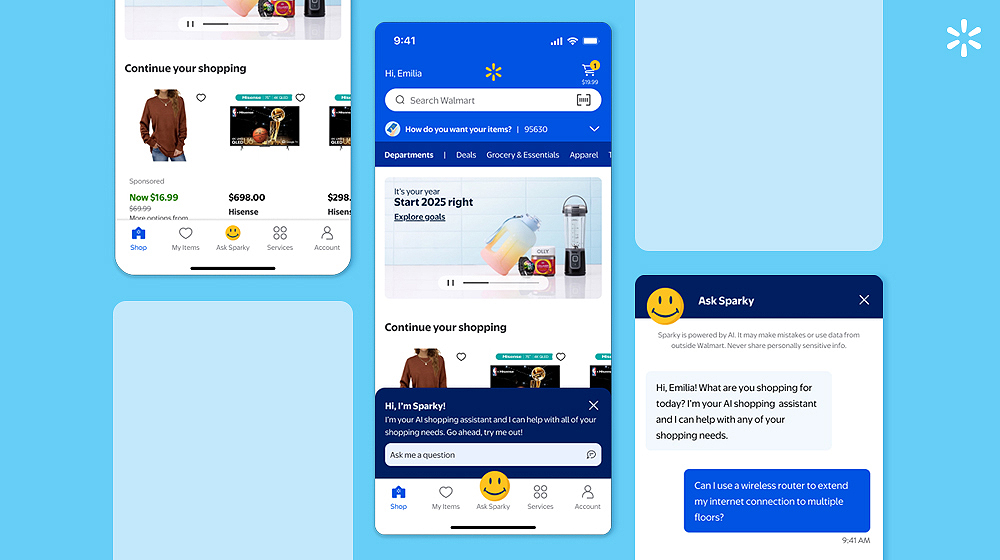
Walmart gives the clearest answer in our Index. It expects AI agents to change how people find and buy products, and CEO John Furner calls "agent-led commerce" the next great evolution in retail (January 2026).
Its shopping agent, Sparky, already works inside ChatGPT, and Walmart has built a shopping experience for Gemini while keeping checkout and the customer account. That is a decision about where Walmart will meet its customers, and a productivity program would never have produced it.
FedEx shows an operational version. It has said it will have AI in more than half of its core operational workflows by 2028.
Your output is a one-page ambition statement. It names the business position you intend to hold, three to five outcomes, and the assumptions you are making about your market, which you revisit whenever the technology moves.
2. Choose a Few Priorities and a "Not Now" List
Focus means choosing a few value areas and saying what you will not do yet. Value comes from new growth, better customer experiences, stronger operations or a more capable organization.
Infosys splits its strategy into AI-first services that capture new demand and AI-augmented services that reinvent existing ones. Lloyds Banking Group has named five focus areas for agentic AI, from customer interactions to engineering.
The "not now" list is rarer. Bank of America is the first company in our Index to state a deprioritization publicly. Its technology chief, Hari Gopalkrishnan, is less interested in AI tools that save a few minutes on simple tasks, and the bank backs AI that works across all eight of its business lines.
Then look at whole workflows. AI can draft a sales proposal in minutes, yet the proposal still waits on finance, legal and delivery. Redesigning the handoffs between those teams can shorten the entire sales cycle. Gopalkrishnan describes the same move:
"You start to pick apart that process and reimagine it."
That takes Workflow Literacy: knowing a process well enough to redesign it.
A field experiment with 515 startups shows what that knowledge is worth. Firms shown how others had reorganized production around AI found 44% more use cases and were 18% more likely to win paying customers than firms with the same tools. (It is a startup sample and a working paper.)

Your output is a ranked list of value areas and workflows, plus a "not now" list. Rank opportunities on strategic relevance, potential value, feasibility, risk and effort, and use GED-RT to decide which tasks to hand to AI first.
3. Make Six Capability Decisions
Buying licenses is the easy part. The harder decisions are how work is organized, who owns it and what happens to the time AI frees. Six of them carry most of the weight.
Operating Model
Decide where AI supports judgment, where it takes on bounded tasks and who stays accountable. Redesign before you automate. The CFO of American Express said:
"You don't want to automate processes that are not optimally structured."
The company is removing management layers before it automates more work. At BNY, each of more than 140 "digital employees" has a human manager.
Technology and Data
Decide what to build, buy or develop with partners. Walmart builds its customer agents largely through partnerships with OpenAI and Google.
Resolve data access early, because it decides whether a prototype can ever reach production. Our AI tools directory shows what today's business tools can already do.
People and AI Fluency
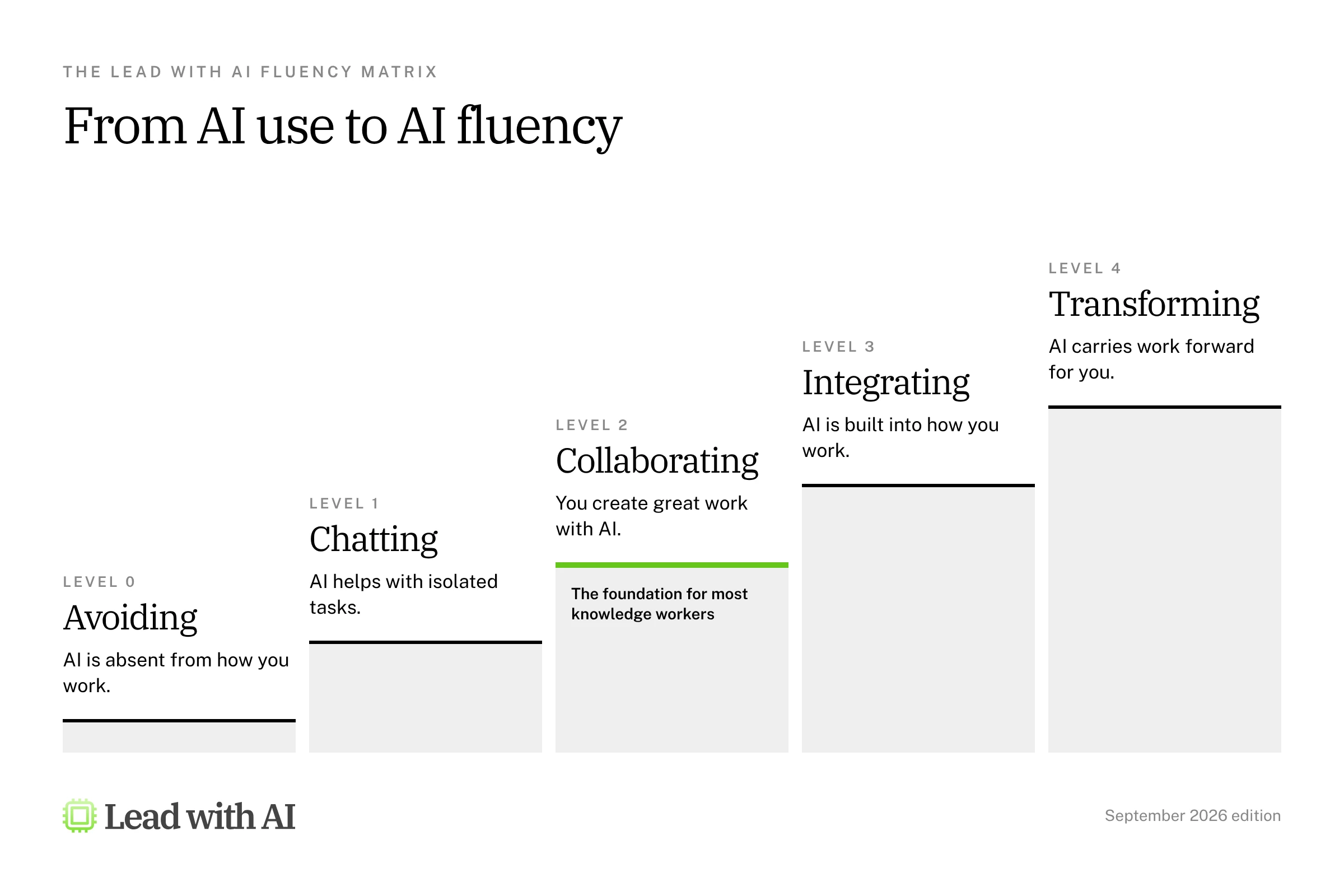
We map AI fluency on five levels in our Fluency Matrix, from Level 0 (Avoiding) to Level 4 (Transforming), where people design and supervise agentic systems.
In a study of 5,172 support agents, Erik Brynjolfsson, Danielle Li and Lindsey Raymond found an AI assistant raised productivity 15% on average, with the biggest gains for less experienced workers. We call the gap between what the tools can do and what people do with them a capability overhang.
Build skills on real work. Walmart associates have built an agent that teaches bakery staff cake decorating from a photo and an app that helps drivers find loads that get them home on time. BBVA makes training mandatory before staff get access to Gemini.

Governance
Set boundaries for data, privacy, security, human oversight and accountability, so people know what they can do safely.
Iberdrola wrote its rulebook before scaling: a board-approved AI policy since 2022 and ISO/IEC 42001 certification in 2026, ahead of nearly 500 agents. Our DRAFT Framework gives teams a shared way to check AI work before they rely on it.
Ownership
Give the strategy an executive sponsor, and give every priority workflow a named business owner, with technology and HR in support. Structures vary: Moderna merged HR and IT into one function, while Wells Fargo has a Head of AI who reports to the CEO.
Below the executive team, managers decide whether people get time to redesign their work, and peers spread the change. Citi's version of AI champion programs is a network of more than 4,000 AI Accelerators inside its teams.

Investment and the Time Dividend
Budget for experimentation, capability, solutions and adoption. Publicis committed €300 million over three years and split its first year evenly between people and technology.
Then decide what happens to the time AI saves. Bank of America CEO Brian Moynihan said the bank is 10% more efficient, "so next year we get 10% more work for the same cost." Netflix expects AI savings to go back into content.
Many employees never hear that decision. In the BCG survey, 66% of frontline employees said they get limited or no guidance on what to do with the time they save.
Our AI Transformation Pulse shows what is at stake. If AI freed ten hours a week, 45% of 410 people would give some or all of it to their personal lives, and only 17% would put it into more core delivery work.

Setting your AI North Star means deciding where that time goes before it arrives.
Your output is an implementation model with named owners for each of the six decisions.
4. Prove the ROI in the P&L
Your strategy is working when priority workflows improve against a baseline, at a cost that justifies them. License counts and active users are early signals.
Lloyds shows the difference. In October 2025, 93% of its Microsoft 365 Copilot license holders were active users. Separately, it reports about £50 million of AI value in 2025, with more than £100 million targeted for 2026 (company-claimed).
Measure at five levels, from activity to value:
- Access and adoption: employees actively using approved AI tools.
- Demonstrated capability: employees applying AI reliably to real work.
- Workflow transformation: redesigned workflows in sustained use.
- Operational outcomes: cycle time, quality, throughput and customer experience.
- Business impact: revenue, costs, margin and capacity.
For each priority workflow, set a baseline, target, owner, total cost and evaluation method, then calculate ROI:
ROI = (Benefits − Costs) ÷ Costs × 100%
Time saved does not automatically equal money saved. Say a redesigned proposal workflow saves 300 sales hours a month. At $80 an hour that is $288,000 a year, and against $120,000 in costs the headline ROI is 140%.
Unless those hours become more deals won, hiring avoided or spending cut, the $288,000 is released capacity. Boards expect more: Gartner found that 77% of board members expect AI to deliver productivity and cost savings, yet just 3% of organizations exceed their cost savings goals through productivity.
Report verified financial value, estimated capacity and quality gains separately. Booking Holdings can point to a line in its P&L: generative AI helped cut customer service cost per booking by 10% in 2025 while bookings grew 10% (company-claimed). Shell says openly that its agentic AI savings are not yet banked.

Your output is an executive AI scorecard. It lists each initiative's owner, baseline, target, cost and confidence, with a decision to scale, change or stop. Most teams skip the baseline: in our Pulse, only 25 of 410 people had set a 90-day AI goal with a number or named metric.

How to Turn Your AI Strategy into a 90-Day Roadmap
The first 90 days turn the four questions into decisions and evidence, though many initiatives need longer to reach production.
- Days 1 to 30, understand and prioritize. Align leadership on ambition and outcomes, interview employees, assess AI fluency, shortlist workflows, and confirm technology and governance constraints.
- Days 31 to 60, redesign and validate. Map the chosen workflows and handoffs, build bounded prototypes with the people who do the work, and set baselines, owners and quality standards.
- Days 61 to 90, commit and scale selectively. Fund the solutions with measured results, enable Champions, launch the scorecard, and stop initiatives without a business case.
Then repeat the cycle as results and AI capabilities change.
From AI Strategy to Enterprise Transformation
Strategy is the first of five connected parts of our Transformation System: AI Strategy, Employee Intelligence (learning how work really gets done from the people doing it), Fluency Activation, Solutions Building, and Adoption and Change.
We have found that transformation becomes much more practical when we start with the people who understand the work. Zapier combined leadership commitment, internal champions and redesigned workflows. Its support team cut average ticket handling time in half while keeping customer satisfaction steady, as Chief People Officer Brandon Sammut told us.
The 10 Questions Every AI Strategy Should Answer
Any question your leadership team cannot answer is your next piece of strategy work.
- How is AI changing our industry and competitive position?
- What business position and measurable outcomes are we pursuing?
- Where will we prioritize AI investment?
- What will we stop, postpone or avoid?
- Which workflows and handoffs must change?
- What work should AI do, and what should stay human?
- What technology, data, capabilities and governance do we need?
- Who owns implementation and business results?
- How will employees help build and adopt new ways of working?
- How will we measure value and decide what to scale?