November 11, 2026

AI Is Changing Work. How Can Leaders Keep Teams Engaged?

U.S. employee engagement hit 29%, a 15-year low. Kirstin Austin on how leaders can rebuild it through connection, alignment and recognition.
AI Is Changing Work. How Can Leaders Keep Teams Engaged? Article by Kirstin Austin, Impact Partner at Lead with AI, beside her portrait, with the three drivers Connection, Alignment and Recognition
Kirstin Austin
By
Kirstin Austin
Impact Partner

Presented by

U.S. employee engagement just fell to 29%, its lowest point since 2011, according to Gallup's latest quarterly data. That is about 3.2 million fewer engaged workers in a single quarter, and roughly 11 million fewer since 2020.

Line chart of U.S. employee engagement from 2000 to Q3 2026, ending at 29% engaged and 18% actively disengaged.
U.S. employee engagement fell to 29% in Q3 2026, down from 31% in Q2 and 36% in 2020. Source: Gallup (October 28, 2026).

It's easy to blame AI when the steepest declines appeared in organizations adopting it. But after over 30 years of leading learning and change in large organizations, I read this data differently.

Leaders need to explain what AI means for each role and respond to employees’ concerns.

Too many organizations are treating AI as a technology rollout. It is an organizational change effort, and employees experience it that way whether leaders plan for it or not.

Flagship AI Newsletter
The AI Newsletter That Makes You Smarter, Not Busier
Join over 30,000 leaders and receive our insights on AI platforms, implementations, and organizational change management.
FlexOS Course - AI Content Accelerator - Testimonial Badge

What the data actually shows

Gallup traced the drop in engagement to two items:

  • Only 46% of employees strongly agree they know what is expected of them at work, down from 61% in 2015.
  • Only 37% strongly agree that someone at work cares about them as a person, down from 47% in March 2020.

Neither of those is a technology problem. Both are leadership and communication problems.

Gallup found the sharpest declines among fully remote and hybrid employees and suggests physical distance may be turning into psychological distance.

That said, the principles for creating positive engagement apply to every worker, whether on-site, hybrid, or remote.

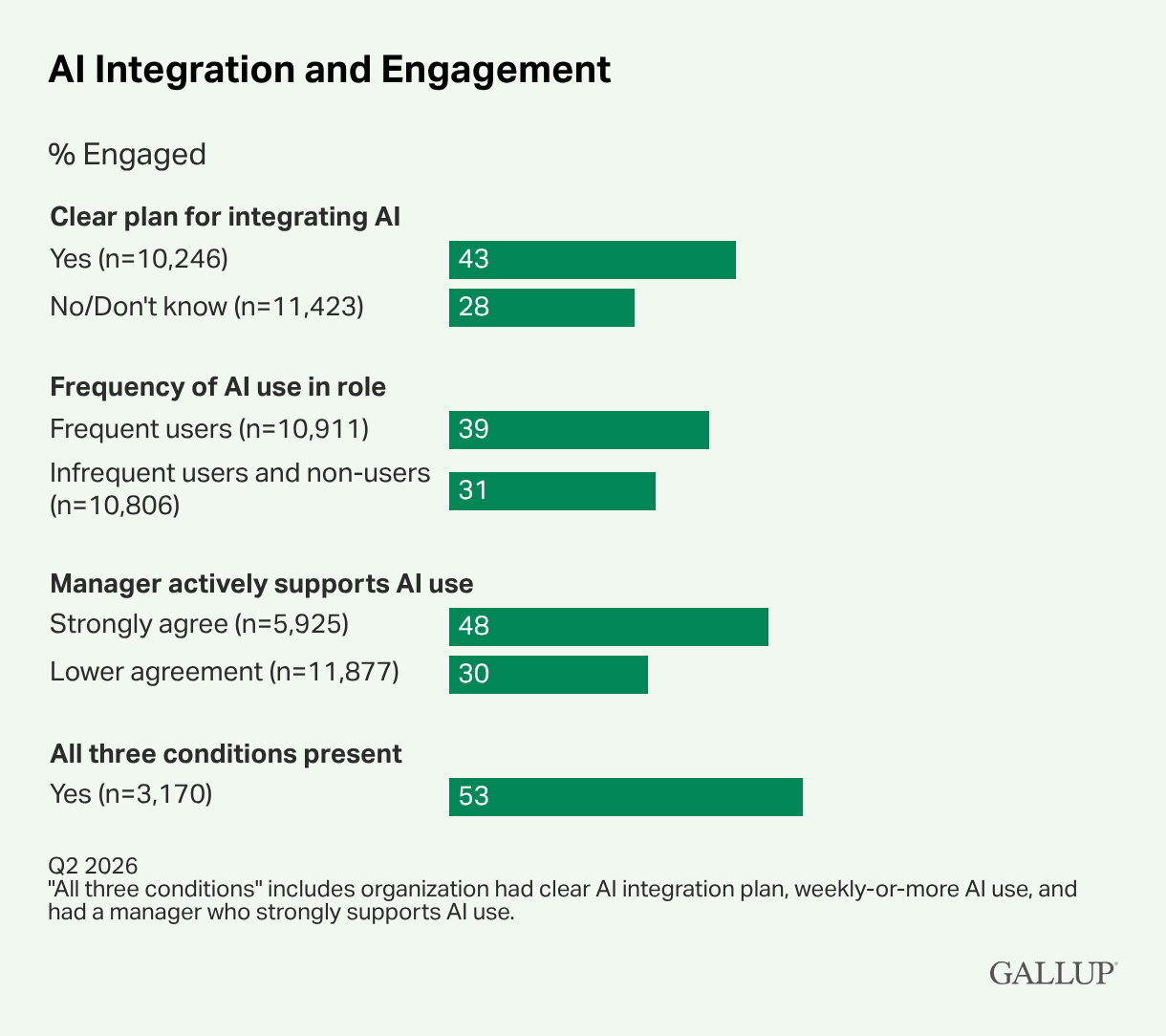
Gallup's July analysis found engagement was 15 points higher in organizations that communicated a clear AI plan and 18 points higher where managers actively supported AI use.

When frequent AI use, a clear plan, and manager support were all in place, engagement reached 53%.

Bar chart showing 53% engagement among employees with at least weekly AI use, a clear AI plan and strong manager support.
In Q2 2026, 53% of employees with frequent AI use, a clear AI plan and strong manager support were engaged. Source: Gallup (July 21, 2026).

In my work with organizations adopting AI, three drivers explain most of what I see: connection, alignment, and recognition.

Connection - People need to feel seen while the work changes

When AI arrives as a login and a self-paced course, people learn alone. They may also have quiet questions about what AI means for their role.

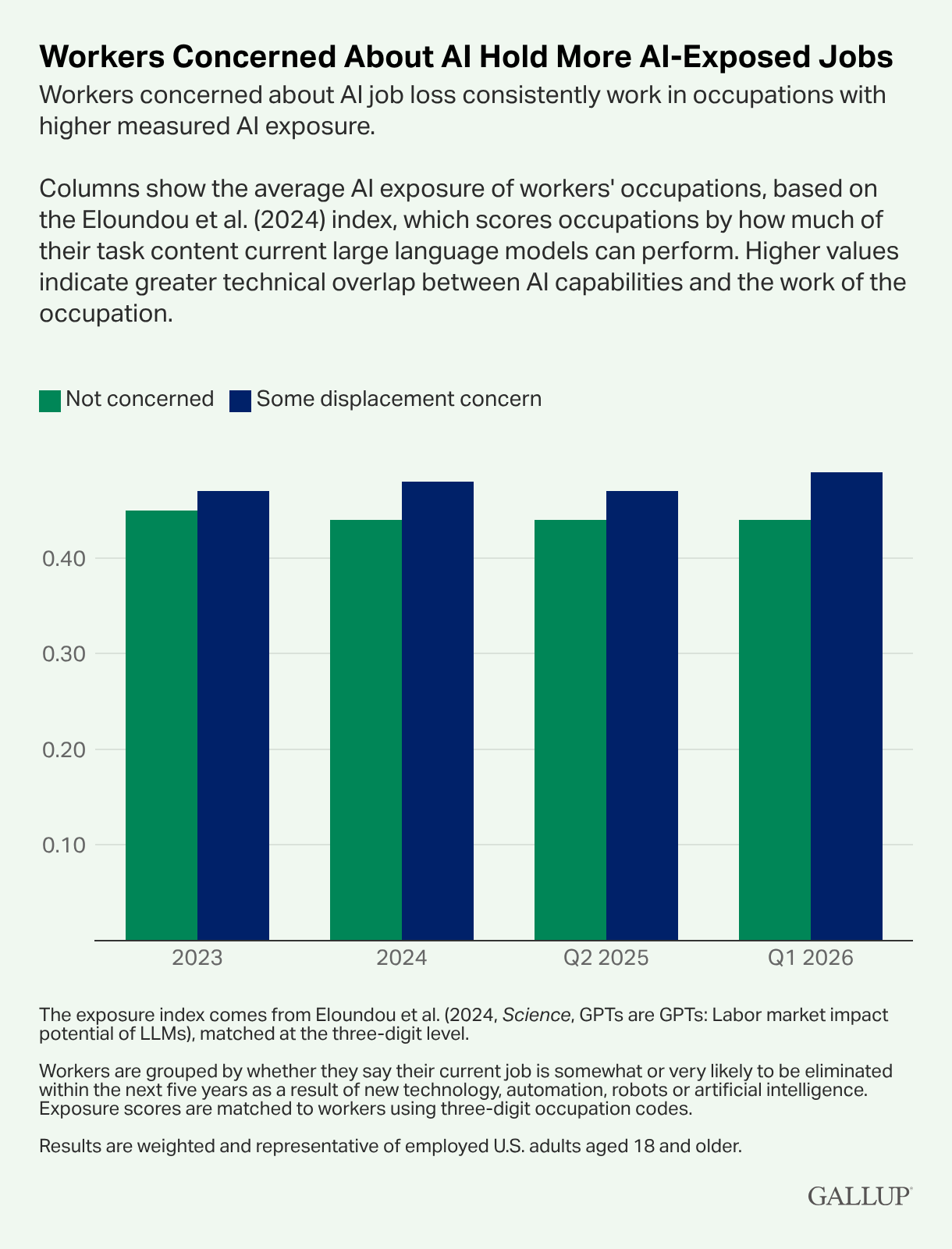
Gallup's September research found that frequent AI users are twice as likely to fear job displacement, and that supportive managers substantially reduce those fears.

Grouped bar chart comparing average occupational AI exposure among workers with and without concerns about technology eliminating their jobs, from 2023 to Q1 2026.
Workers concerned about job loss held more AI-exposed jobs in every period shown (Q1 2026 exposure index: 0.49 vs. 0.44). Source: Gallup (September 9, 2026).

I saw this with one client whose employees were skeptical of the initial AI training. Their concerns were legitimate, yet no one was listening.

Once leadership listened to and addressed those concerns, the group became advocates for the training and even asked for more.

Alignment - AI changes the job, so redefine the job

When AI changes how work gets done, people lose their sense of what "good" looks like. Gallup's first recommendation is to clarify AI expectations by role: how AI applies to each person's work, when to use it, and how performance will be judged.

Managers cannot hand this off to IT or a training team. They must translate strategy into daily expectations through concrete examples.

In one organization I worked with, a manager joined the AI sessions alongside her team. She named which tasks to try AI on first and opened each weekly meeting with one example of how someone had used it. Her team became much more productive than peer teams whose managers did not actively participate in AI integration and adoption.

Recognition - Make progress visible

Gallup advises leaders to share examples of effective AI use. When sharing an example, acknowledge the person behind the idea and explain how it helped.

Recognition does not have to come from the top. Peer learning cohorts provide encouragement and support from colleagues in similar situations.

At a recent demo day, participants showed the workflows they had built. One person who had been hesitant from the start presented a simple assistant that saved her team time every week.

Her colleagues were inspired by the project and asked to learn from it. She wasn’t sure she belonged in the room when she walked in, yet she left as the person others wanted to learn from.

How Lead with AI builds for engagement, not just adoption

Our programs at Lead with AI combine self-paced learning with live sessions and peer groups.

  • Peer learning: People learn in cohorts and guided peer groups. They work through real problems together and build relationships along the way.
  • Lots of practice: Participants continuously apply AI to their own work until it becomes a habit rather than a one-off.
  • Self-directed learning: On-demand content lets people go at their own pace, while live sessions keep them connected and accountable.
  • Demos and showcases: Participants demonstrate what they have built and discuss it with their peers.
  • A shared language for progress: Clear fluency levels help leaders and employees define what "good" looks like at each stage.
  • Measuring what matters: We track impact, starting with the “time dividend,” or the amount of time that AI frees up, so progress is visible to everyone.

What leaders can do now

  1. Connection: Check in on people, not just usage. Ask managers to hold short conversations about how AI is changing each person's work and what worries them. Then act on what they hear.
  2. Alignment: Define AI expectations by role. Write down which tasks AI should support, when to use it, and how success will be measured. Revisit it as the work changes.
  3. Recognition: Create a regular place to show progress. Use a team meeting, a channel, or a demo day where people share what they tried, including what did not work.

Engagement didn't drop because of AI, but because the human side of change is falling behind the technology’s pace of advancement.

Leaders who close that gap will get both adoption and engagement.

To learn how Lead with AI helps organizations build AI fluency that sticks, visit Lead with AI.

Kirstin Austin is an Impact Partner at Lead with AI and Chief Learning Strategist at Meadow Consulting. A former federal executive and Chief Learning Officer, she has over 30 years of experience leading learning and organizational change and holds a Certified AI Leader credential.