

Build an AI agent that runs one of your real workflows, without code.
A four-week live program for non-technical leaders who already build AI assistants. You redesign one real workflow, build an agent that runs it within limits you set, and prove it creates value before you scale it.






Build an agent that runs one real workflow, in four weeks.





Join the waitlist to hear the dates first and get first access to seats.
Agents are scaling faster than the people who can design them.
The tools are no longer the barrier. ChatGPT Work, Microsoft Copilot Studio and Claude Cowork let leaders build agents without writing code, and large companies are already scaling them.
The scarce skill is design and supervision. Poorly designed autonomy creates more checking and risk than it removes, so this program teaches that judgment first and the build second.
of respondents at large organizations report scaling AI agents in at least one function, up from 27% a year earlier.
of knowledge workers are estimated to be at Level 4, able to design and supervise agentic systems.
For leaders who already build their own AI assistants and do not write code.
You have been working with AI for a while and want to go a level deeper. You do not need a technical background to get there.
Hand a recurring operational workflow to an agent and put the time back into judgment, people and decisions.
Build the first governed agents your colleagues can see working, then help them design their own.
Run more of your business on agents you designed and can explain to clients.
Four live weeks, about three hours a week, from one real workflow to a working agent.
A 15-minute interview with Lexi, our AI interviewer, maps your role, suggests workflows worth delegating and checks that your workflow fits the tools your company allows, so the agent you build can actually run. You bring one real workflow to the first live session.
- How an agent works: it gathers context, decides, acts and checks the result. (The agent loop)
- Pick the right workflow: one that is bounded, testable and possible on your platform. (Agentic Fit Check)
- Decide how much to trust it: five levels of authority, set for each action by what a mistake would cost. (The autonomy dial)
- Decide who does what: each step goes to the agent, a fixed automation or a person. (O.V.E.R. mapping)
- Create your agent in ChatGPT Work, Microsoft Copilot Studio or Claude Cowork.
- Write instructions that hold up, using AI to get the know-how out of your head. (CODO)
- Connect only the knowledge and tools the agent needs.
- Set approvals and stop rules, then test one boundary on purpose.
- Make it dependable: fixed automation for repeatable steps, and AI only where judgment is needed.
- Test it like a manager would: real cases that check the result, the process and the limits.
- Test, inspect, improve and retest until the results hold.
- Prove it is worth it: time saved minus setup, review and fixing time. (Net value)
- Present your agent: what it handles, what still needs approval, your test evidence and one failure you fixed.
- Decide whether to scale, hold, redesign or retire it.
- Plan the next 30 days and pick your next workflow.
Every week includes about 30 minutes of lessons on learning days, one 90-minute live session offered in two time zones, and recordings of everything.
Joining as a group? You follow the same four weeks on one shared workflow. You map it together in week 1, build your parts in week 2, test the full run in week 3 and present together on Demo Day.
Agents you could build, with a human in charge.
Swipe through twelve agents across industries and roles. Each card shows what the agent does, the result it is built to deliver and the skills you pick up building it. In the course, you build one for your own work.
Partner meeting briefer
Before every partner call, it pulls the account history, open support cases and roadmap commitments, and posts a one-page brief in Teams an hour before the meeting.
Returns resolver
It reads each return request, checks the order against your returns policy and settles routine refunds on its own, day and night.
Stock-out watcher
Every morning, it reads yesterday's sales and stock for each store, spots best-sellers about to run out and drafts stock transfers for the regional manager to approve.
Applicant reply agent
It drafts a reply to every prospective student from your approved program pages, fees and deadlines, and books advisor calls for applicants who are ready.
Monday campaign analyst
Every Monday, it pulls the week's ad, web and pipeline numbers, explains what moved and why, and proposes where to shift budget.
Variance commentary drafter
It compares actuals with budget, finds every variance over your threshold, pulls the invoices and emails behind it and drafts the month-end commentary.
Board pack builder
It collects the latest numbers and updates from each team's folder, builds the board deck draft in your template and checks every figure against its source.
New-joiner coordinator
When an offer is signed, it requests the laptop and system access, books the first-week meetings and chases any missing paperwork.
Inbound lead researcher
It researches each demo request, scores the fit against your ideal customer and drafts a personal reply for the right rep to send.
Student feedback analyst
It reads every end-of-term comment across all courses, groups the themes, compares them with last year and drafts action notes for each program head.
Newsletter results check
It pulls the latest newsletter results in Copilot Studio and sends a go or no-go card in Teams.
Weekly deal follow-up sweep
It reads the week's deal updates, checks each one against the CRM and creates the missing follow-up tasks.
Each card shows a possible workflow. Its target result is worked out from the volumes on the card, not from a client. In the course, you build a version of your own workflow that fits your system access and the four weeks, then work out its net value.
Bring 3 or 4 colleagues, redesign one shared workflow, and save 20% per seat.
Most workflows cross more than one desk, and that is where the waiting happens. Bring the 3 or 4 colleagues who share one workflow, from your department or across functions. You map it together, each build the part you own, and the agent takes over the handoffs.
An agent gathers the contract details and drafts the handover note.
A person reviews it, and the agent flags non-standard clauses first.
A fixed automation creates the account and the first invoice.
An agent drafts the kickoff plan and books the meeting once you approve.
In week 1, you map the whole workflow and decide which steps go to the agent, an automation or a person.
You build your part in week 2 and test the full run together in week 3.
On Demo Day, the group shows the workflow before and after, and each of you earns the certificate.
Groups get 20% off per seat. Choose Me and a few colleagues in the form to join as a group. Join the waitlist
Leave with a working agent and test results that show what it saves.
It carries one real workflow forward on a trigger or schedule, within the limits you set.
Test results that show the agent gets the right result and stays inside its limits, plus a before-and-after count of the time it saves after review and upkeep.
The fit check, the autonomy dial and the build plan work for every agent your team builds next.
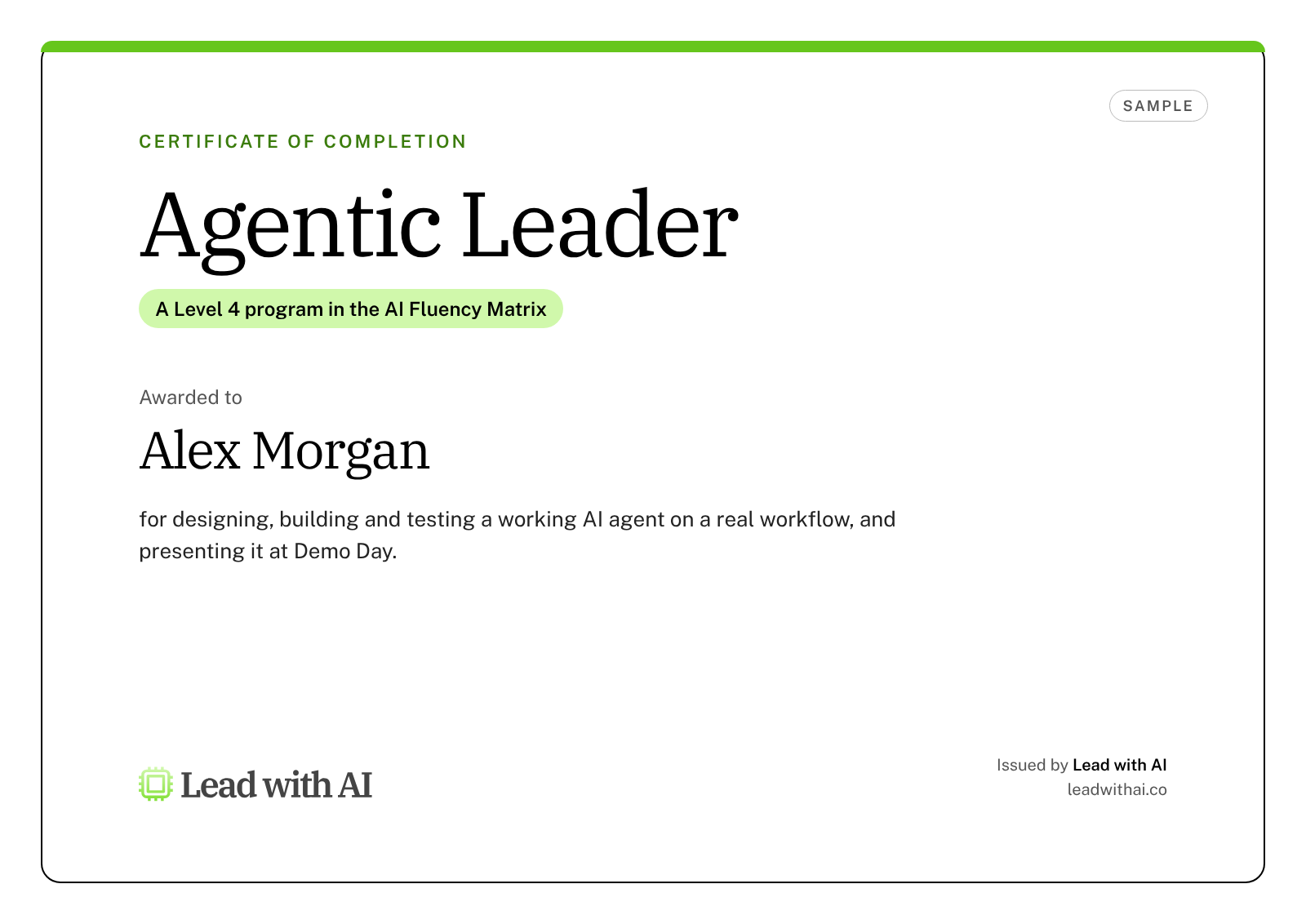
Finish the four weeks and present your agent on Demo Day to earn your Agentic Leader certificate, awarded for completing a Level 4 program in the AI Fluency Matrix. Add it to your LinkedIn profile and show the agent behind it.
Taught by a team with careers at McKinsey, Sodexo and WeWork, who run their own work on agents.
Every facilitator builds and supervises agents in their own work. Each live session is led by one or two of them, so you learn what holds up in practice.
Leads the design of this agentic curriculum. He runs about ten scheduled agents in ChatGPT, from one that keeps his priorities current to a research agent for his book, plus a Claude agent that screens his LinkedIn invitations against his own rules.
LinkedIn Top Voice. Research cited by Harvard Business Review and Fast Company.
Runs a weekly Claude agent that turns the team's deal updates into follow-up tasks, and leads Lead with AI's own internal AI transformation.
Previously CEO of Tribee AI.
Runs a chief of staff agent and 16 automations across his part of the business, including a morning brief that triages a 21-meeting day before he wakes up. His own estimate is about 16 hours a week handed back.
20+ years in strategy and operations, including Sodexo's 65,000-person European operation.
Facilitates the agentic block of a champions program at a global pharmaceutical company, where participants build agents in Copilot Studio. He tells people plainly when a workflow is not worth an agent.
20+ years at McKinsey, WeWork, JLL and Credit Suisse.
Leads the team building LeadOS, the platform that interviews every participant and matches them to the workflows worth delegating. He taught our earlier Agentic AI cohorts.
35+ years in technology across AI, cybersecurity and SaaS.
One leader took both courses, then brought them to about 200 colleagues.
A director of people analytics at a global semiconductor company took AI Leader Advanced and our agentic course himself. Then his company booked a private cohort that combines both. In 2027, about 200 people in its People group go through it.
AI agents built by Catawiki teams and now used in daily workflows.
“Lead with AI delivered high-impact, tailored programs across our Leadership, People/IT, Legal, Finance, and Marketing teams.”


Leaders from these companies have trained with Lead with AI. Source: Lead with AI program data.
Join the waitlist for first access to seats, backed by a 30-day money-back guarantee.
Frequently asked questions
Do I need to know how to code?
No. You build in ChatGPT Work, Microsoft Copilot Studio or Claude Cowork with instructions, connected knowledge, tools and approval steps. The skill this program teaches is designing and supervising an agent, and that skill carries over to whichever tool you use next.
Do I need to take AI Leader Advanced first?
It is the best preparation. If you already build reusable assistants, such as custom GPTs, ChatGPT Projects or Copilot agents, you are ready. Your intake interview confirms the fit before the program starts.
Which platforms does it cover?
ChatGPT Work, Microsoft Copilot Studio and Claude Cowork, with demos for each. You build on the platform your organization approves. If you work in another platform, mention it in your intake interview and we will advise you.
What if my company has not switched on agent features?
In week 1 you check that your platform can reach the information and tools your workflow needs. If a capability is not available to you, we help you design a version that works within what is approved.
What if I get stuck building my agent?
Bring it to the weekly live session. Weeks 2 and 3 are build clinics, where facilitators help you fix what does not work yet. Between sessions, you can send a facilitator your build questions in writing.
Is this safe for company data?
You build only with the tools, data and connectors your organization approves. Every agent you design has explicit approval steps and stop rules, and you test its boundaries before you rely on it.
How much time does it take?
About three hours a week for four weeks. That is roughly 30 minutes on learning days and one 90-minute live session. Every live session is recorded.
What if I miss a live session?
Every session is recorded, and you can ask questions in the cohort community between sessions.
Can we run this privately for our team or company?
Yes. The same program runs as a private cohort on your platform, with your policies, approved tools and examples. Choose a team or organization option in the form and we will reply within one business day.
Can my company pay?
Yes. After you join the waitlist, you get an approval email to send your manager. If your company needs an invoice, reply to our email and we will send one.
Can we join as a group?
Yes. Bring 3 or 4 colleagues who share one workflow, from one department or across functions. You all need the same platform and access to the workflow's data, and one of you owns the workflow and signs off on what the agent may do. Groups get 20% off per seat. Choose Me and a few colleagues in the form.
What happens after I join the waitlist?
You pay nothing now. You hear the dates first and get first access to seats. If you chose a team or organization option, we contact you within one business day.
What if the program is not right for me?
Every seat comes with a 30-day money-back guarantee.
Which workflow would you hand over first?
Bring it to week 1. Join the waitlist to hear the dates first.