
September 1, 2026

The Lead with AI Fluency Matrix, Third Edition: Five Levels From AI Use to AI Fluency

The third edition of the Lead with AI Fluency Matrix: five levels from Avoiding to Transforming, and what changed since the second edition.
The Lead with AI Fluency Matrix, third edition, with five levels from Avoiding to Transforming
Daan van Rossum
By
Daan van Rossum
Founder & CEO, Lead with AI

Presented by

We have rebuilt the Lead with AI Fluency Matrix. The third edition, which we finalized in September 2026, has five levels: Avoiding, Chatting, Collaborating, Integrating, and Transforming.

The second edition came out in January. We rebuilt it within months because the products and ways of working underneath it changed:

  • Models got substantially better, and they now handle work that required careful human architecting a year ago.
  • New products moved AI from a chat box into a workspace, including ChatGPT Work, Copilot Cowork, and Claude Cowork.
  • AI moved inside the tools people already use, such as ChatGPT in Sheets and Claude in PowerPoint.
  • Agents became reachable for non-technical leaders, as better models and easier interfaces removed most of the engineering prerequisite.

Work that looked advanced in January has become an everyday expectation. A matrix built on January's definitions would tell people they are further along than they really are.

AI Fluency Shows Up in the Work

AI fluency is the ability to work effectively, efficiently, ethically, and safely with AI.

Literacy means understanding what AI is. Fluency shows up in what people actually do with it: the context they give it, how they judge what comes back, and where they build it into their work.

That is why usage numbers tell you very little. Frequent use can create the feeling of fluency long before the capability arrives. People can prompt AI every day while still accepting weak output or handing over judgment they should keep.

Regulators now expect organizations to show this capability, too. The EU AI Act's AI literacy obligation has applied since February 2025, and national authorities began enforcing it on August 2, 2026.

The Matrix turns that definition into five levels you can observe. Each one answers a single question: what does this person become capable of, and how does that benefit them and their organization?

The Five Levels of the Third Edition
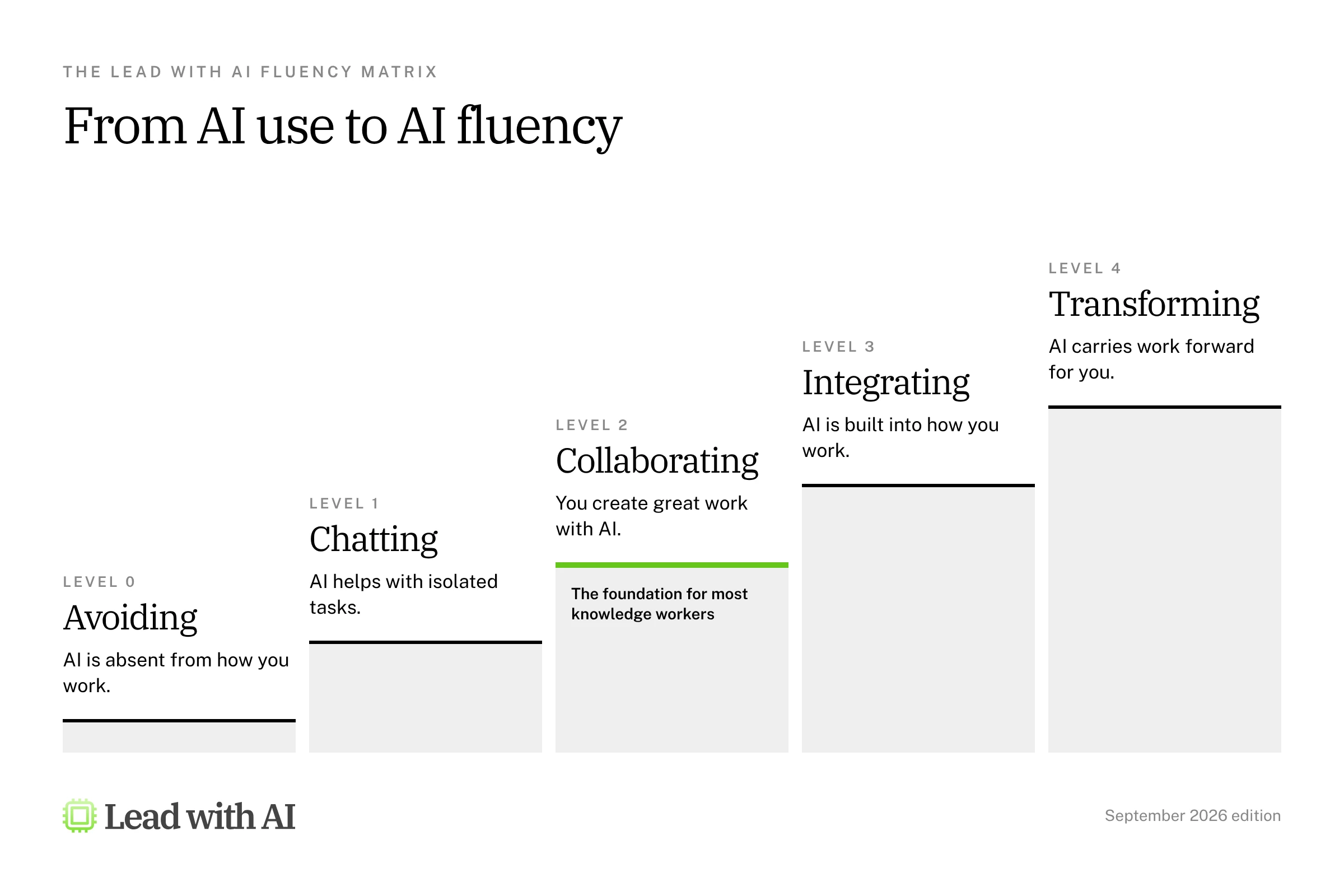
The Lead with AI Fluency Matrix, third edition: Level 0 Avoiding, AI is absent from how you work; Level 1 Chatting, AI helps with isolated tasks; Level 2 Collaborating, you create great work with AI; Level 3 Integrating, AI is built into how you work; Level 4 Transforming, AI carries work forward for you
  • Level 0: Avoiding. AI is absent from how you work.
  • Level 1: Chatting. AI helps with isolated tasks, much like a better search engine.
  • Level 2: Collaborating. You create great work with AI, routinely and safely.
  • Level 3: Integrating. AI is built into recurring, human-led workflows that create measurable value.
  • Level 4: Transforming. AI carries work forward for you through agentic systems with bounded autonomy.

Read together, the levels describe one changing relationship between a person and AI. AI moves from absent, to helping with isolated tasks, to improving individual work, to running inside recurring workflows, and finally to carrying work forward within limits you set.

The human leads at every level. The goal is the right division of responsibility between people and AI, and maximum automation is never the point. (Our AI Fluency guide covers the behaviors behind each level in full.)

Flagship AI Newsletter
The AI Newsletter That Makes You Smarter, Not Busier
Join over 30,000 leaders and receive our insights on AI platforms, implementations, and organizational change management.
FlexOS Course - AI Content Accelerator - Testimonial Badge

What Changed Since the Second Edition

The second edition also had five levels, but the bar has moved up. Its labels, such as Foundational, Integrated, and Advanced Fluency, read like stages in a training curriculum. The new names describe a lived relationship with AI.

Here is roughly how the old levels map onto the new ones:

  • Old Level 1 (a safe pair of hands) now spans Chatting and Collaborating.
  • Old Level 2 (AI embedded in recurring workflows) is now Integrating, Level 3.
  • Old Level 3 (redesigned workflows and agentic automations) is now closest to Transforming, Level 4.
  • Old Level 4 (setting enterprise AI strategy) is no longer an individual fluency level.

Collaborating Is the New Foundation

Safe use on its own no longer clears the bar. Collaborating asks for work that is noticeably better and faster. People at this level direct AI with real context, use it as a thinking partner, judge and improve what comes back, and stay accountable for the result.

This level removes shallow habits, shadow AI, and blind trust. It also builds the skills people need before they integrate AI into recurring workflows, which is why it is the critical level for most knowledge workers.

Level 4 Now Means Agentic Systems

In the second edition, Level 4 described executives shaping their organization's AI strategy. Transforming now describes hands-on capability: designing, governing, and supervising agentic systems that execute multi-step work, use live company sources, and run on triggers or schedules.

Coding is optional. Transformers may build in ChatGPT Workspace Agents, Copilot Studio, Claude Cowork, Google Workspace Studio, or code where it is warranted. In their systems, autonomy is granted, never assumed, and every system is tested, monitored, and bounded.

Level 0 Starts With Understanding Why

The second edition described Level 0 as people who intentionally do not adopt AI. The third edition describes Level 0 by what is missing, because the reasons vary.

Some people have legitimate concerns about privacy, quality, or AI's effect on work. Others were never given access, training, or permission. Finding out which applies comes before any judgment.

Every Level Is Defined by Evidence

From Collaborating upward, each level now has five observable behaviors and a clear threshold for when someone has reached it. The evidence differs by level: the quality of the work at Level 2, repeatable workflows and their value at Level 3, and working agentic systems and their results at Level 4.

Safety, policy, judgment, and accountability are part of fluency at every level. Someone who produces impressive output while exposing sensitive information or skipping verification on consequential claims is not demonstrating advanced fluency.

Fluency Is Still a Portfolio

One idea carried over unchanged: fluency is a portfolio. The goal is the right mix of levels across an organization, and pushing everyone toward Level 4 is a mistake.

What moved is the default. The second edition said most employees needed to be solidly at Level 1. Now, most knowledge workers should reach Collaborating, a meaningful group should reach Integrating where recurring workflows offer repeatable gains, and a much smaller group needs Transforming.

We would rather see an organization where 60% of knowledge workers create great work with AI than one where 5% build impressive agents on top of an untrained base.

AI Champions now sit at every level. The second edition placed teaching others at Level 3. In the third edition, Level 2 champions model safe, high-quality everyday use, Level 3 champions redesign recurring work and build reusable systems, and Level 4 champions design and supervise governed agentic systems.

Where People Sit Today

We estimate that nearly nine in ten knowledge workers have not yet reached Collaborating:

Bar chart of the estimated share of knowledge workers at each AI fluency level: Avoiding about 40%, Chatting about 49%, Collaborating about 10%, Integrating about 0.8%, Transforming about 0.2%
Chart: Lead with AI estimate, September 2026, synthesizing Gallup, EY, Eurostat, Microsoft, OpenAI, Ipsos, Stanford, and Anthropic data
  • ~40% are Avoiding.
  • ~49% are Chatting.
  • ~10% are Collaborating.
  • ~0.8% are Integrating.
  • ~0.2% are Transforming.

The good news is that fluency is trainable.

The Bottom Line

  • The third edition has five levels: Avoiding, Chatting, Collaborating, Integrating, and Transforming.
  • The bar moved up. What the second edition called Level 2 is now Integrating, and Collaborating is the new foundation.
  • Level 4 is now hands-on. Transforming means designing and supervising agentic systems with bounded autonomy, with or without code.
  • Every level rests on evidence of real work, with safety and accountability built in.
  • Fluency is still a portfolio. Aim for most people at Collaborating, a meaningful group at Integrating, and a small group at Transforming.

Where do you see yourself on the new Matrix, and where does your team need to be?

Frequently Asked Questions

What are the levels of the Lead with AI Fluency Matrix?

The third edition, from September 2026, has five levels: Level 0 Avoiding, Level 1 Chatting, Level 2 Collaborating, Level 3 Integrating, and Level 4 Transforming. Each level is defined by what someone can reliably do with AI, and it is assessed through evidence of real work.

How is the third edition different from the second edition?

The second edition, from January 2026, used labels such as Foundational, Integrated, and Advanced Fluency. In the third edition, embedding AI into recurring workflows moved from Level 2 to Level 3, and Collaborating became the new foundation at Level 2. Level 4 moved from setting enterprise AI strategy to designing and supervising agentic systems.