

PepsiCo AI Strategy: Agentic AI in Every Part of the Business
How PepsiCo uses AI on its own work: agentic AI everywhere by the end of 2026, Salesforce agents in sales and AI digital twins of plants. Updated November 2026.
Snacks and beverages, including Lay’s, Doritos, Pepsi, Gatorade and Quaker
PepsiCo has no standalone AI strategy document. Its approach comes from announcements in 2025 and 2026, its April 2026 earnings call and executive interviews.
Read the company sourceWhere PepsiCo Is Going with AI
PepsiCo wants agentic AI in every part of its business by the end of 2026. Athina Kanioura, Global Chief Strategy and Transformation Officer, told Salesforce’s Dreamforce in October 2025: “We will be agentic in every part of the business by the end of 2026.” PepsiCo has no standalone AI strategy document, so this profile draws on public statements.
The CEO ties AI to cost transformation. Chairman and CEO Ramon Laguarta said on the April 2026 earnings call that PepsiCo is “leveraging technology in a very holistic way and AI and data to drive efficiency and transformation of cost.”
The focus has four parts.
- Sales: AI agents built on Salesforce Agentforce, plus auto-ordering for store owners, so salespeople spend less time taking orders
- Customer service: people and AI agents working together on support
- Supply chain: AI digital twins of U.S. plants and warehouses, built with Siemens and Nvidia
- Marketing: unified customer data and automated campaigns and promotions
What It Takes: Salesforce Agents, Digital Twins and a Transformation Chief
A transformation chief owns the agenda. Kanioura leads strategy and transformation across PepsiCo and also runs its Latin America Foods business. She describes the aim as “amplification of the human centricity,” according to a PepsiCo interview in August 2026.
Salespeople get a new job. Kanioura said more than half of a salesperson’s store visit goes on taking the order. With AI, “the salesperson now becomes a business development and relationship manager.”
Partners supply the platforms. PepsiCo is one of the first large food and beverage companies to deploy Salesforce’s Agentforce at scale, according to Beverage Industry. Siemens and Nvidia supply the digital twin tools.
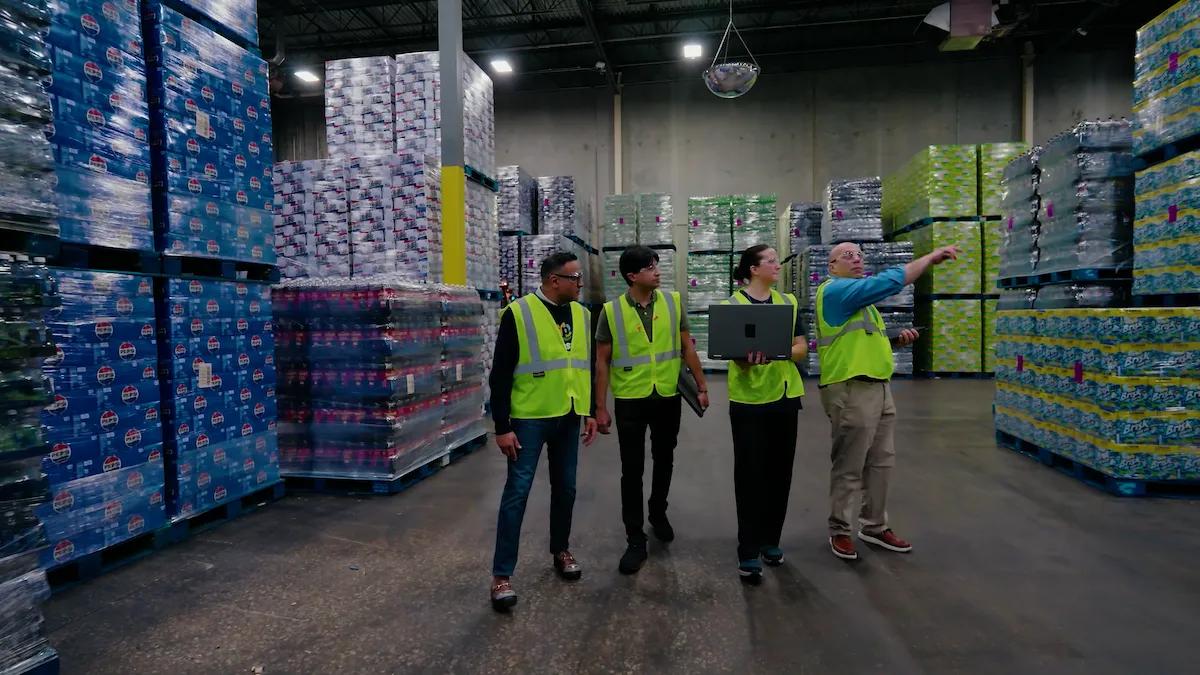
Digital twins test factory changes before any physical work. PepsiCo turns select U.S. plants and warehouses into 3D models in which AI agents test changes. Early pilots are under way, and PepsiCo plans to scale the approach globally.
Headcount fell in 2025. PepsiCo had about 306,000 employees at the end of 2025, down about 13,000 in a year, and CFO Stephen Schmitt listed reduced headcount and plant closures among its productivity moves. The sources reviewed do not tie the cuts to AI.
AI fluency, coded against the Lead with AI Fluency Matrix (September 2026 edition):
- Fluency floor: Not published. PepsiCo has set no AI training requirement or usage standard for all staff.
- Highest level evidenced: Level 3 (Integrating), company-claimed. AI agents handle parts of sales and customer service, and AI agents test plant changes inside digital twins. The figures have not been independently verified.
- Portfolio design: PepsiCo spreads agentic AI across every function, with its deepest bets in sales and the supply chain.
How PepsiCo Measures Results
PepsiCo reports results from its digital twin pilots. All figures below are company-claimed:
- Throughput: up 20% on the first deployment
- Problem finding: up to 90% of potential issues found before any physical change
- Capital spending: 10% to 15% lower
Gaps remain. PepsiCo reports no figures for its AI agents in sales or customer service and no total value from AI. Reporting them is the step from AI adoption to AI value.
Next markers: evidence of agentic AI in every part of the business by the end of 2026, results from Agentforce in sales and service, digital twins beyond the U.S. and headcount for 2026.
Change log
- June 2025: PepsiCo announces it will deploy Salesforce Agentforce.
- October 2025: Kanioura says PepsiCo will be agentic in every part of the business by the end of 2026.
- January 2026: PepsiCo announces AI digital twins with Siemens and Nvidia.
- April 2026: Laguarta describes AI and data as drivers of efficiency and cost transformation.
- August 2026: Kanioura says AI is now in every part of the business.
The Bottom Line
- Disclosure: 4 of 4. PepsiCo answers all four questions, the last one only in part.
- The target is bold: agentic AI in every part of the business by the end of 2026.
- Salesforce agents and factory digital twins carry the plan.
- Level 3 is evidenced in sales, service and plant design, on company-claimed results.
- The say-do gap is scale beyond pilots. Results so far come from early digital twin pilots.
- Watch the end-2026 deadline. The test is whether PepsiCo shows agentic AI at work in every function.
Revenue, Headcount and Revenue per Employee
What the numbers show: Revenue rose 9% from 2022 to 2025 while headcount fell 3%, so revenue per employee rose 12%, to about $307k. Headcount fell by about 13,000 in 2025, a year of plant closures and job cuts that PepsiCo counts among its productivity moves, and fiscal 2022 had 53 weeks. These figures do not show that AI caused any change.
Revenue, headcount and revenue per employee, FY2022 to FY2025
- FY2022: $86.39bn revenue, 315,000 employees, $274k per employee
- FY2023: $91.47bn revenue, 318,000 employees, $288k per employee
- FY2024: $91.85bn revenue, 319,000 employees, $288k per employee
- FY2025: $93.93bn revenue, 306,000 employees, $307k per employee
Change, FY2022 to FY2025: revenue up 9%, headcount down 3%, revenue per employee up 12%.
Notes: Revenue is net revenue, as reported. Headcount is approximate, at year-end. Fiscal 2022 had 53 weeks.
These figures give context on scale and productivity. They do not show that AI caused any change. Sources: PepsiCo 10-K filings.
How PepsiCo Compares with US Consumer Goods Peers
We looked at how PepsiCo compares with other US consumer goods companies in the index. Here is how they stack up.
| Company | Disclosure | AI owner | Fluency floor | Governance | AI value reported | Revenue per employee |
|---|---|---|---|---|---|---|
| Altria | 3 of 4 | No AI leader named; a cost program carries the work | Not published | Not published | None published | $3.95M |
| Coca-Cola | 3 of 4 | Chief Digital Officer (from March 2026) | Not published | Not published | None published | $727k |
| Mondelez International | 4 of 4 | Chief Information and Digital Officer | Not published | Human review of AI content; banned content types | $10M from process intelligence; content savings targeted | $423k |
| PepsiCo | 4 of 4 | Chief Strategy and Transformation Officer | Not published | Not published | Digital twin pilot results, no total | $307k |
| Philip Morris International | 3 of 4 | Head of AI runs a generative AI factory in Portugal | Not published | Not published | None published | $479k |
| Procter & Gamble | 4 of 4 | CIO; enterprise data science runs an AI Factory | Not published; 20,000+ trained through Formula AI | Not published | Results by use case, no AI share of savings | $837k |
Disclosure counts how many of the four strategy questions (where it is going, where it will focus, what it will take and how it will know it is working) a company answers in public. Fluency floor is the lowest level of AI fluency a company expects of all its people, on the five levels of the Lead with AI Fluency Matrix: Avoiding (0), Chatting (1), Collaborating (2), Integrating (3) and Transforming (4). The other columns summarize each company’s profile. Revenue per employee is for each company’s latest fiscal year, in US dollars. See all companies in the AI Strategy Index.
Frequently Asked Questions
What is PepsiCo’s AI strategy for its own work?
PepsiCo aims to be agentic AI-first, with AI agents in every part of the business by the end of 2026. Its biggest bets are AI agents in sales and service and AI digital twins in the supply chain.
Who leads AI at PepsiCo?
Athina Kanioura, Global Chief Strategy and Transformation Officer, leads the AI agenda. She is also CEO of PepsiCo’s Latin America Foods business.
What are PepsiCo’s digital twins?
PepsiCo’s digital twins are 3D models of its U.S. plants and warehouses, built with Siemens and Nvidia. AI agents test changes in the model before PepsiCo changes the real site.
Is PepsiCo cutting jobs because of AI?
The sources reviewed do not tie PepsiCo’s job cuts to AI. Headcount fell by about 13,000 in 2025, a year of plant closures that PepsiCo counts among its productivity moves.
How is this profile put together?
Lead with AI profiles use public sources only, such as annual reports, earnings materials, filings and on-record interviews, dated at the time of writing. AI fluency is coded against the Lead with AI Fluency Matrix, and company figures are marked as company-claimed unless they have been independently verified.
About the AI Strategy Index
The Lead with AI AI Strategy Index profiles how the largest companies in the US and Europe approach AI, starting with the S&P 100 and the STOXX Europe 50. Each profile answers four questions: where the company is going with AI, where it will focus, what it will take and how it will know it is working. AI Pacesetters and notable companies outside the two indexes are profiled for contrast and are not counted. Profiles use public sources only, and AI fluency is coded against the Lead with AI Fluency Matrix.
See all company profiles