

Procter & Gamble AI Strategy: Scaling AI Across Brands, Labs and Plants
How P&G uses AI on its own work: ChatPG and AI tools for employees, AI in marketing and research, automated plants and plans for smaller teams. Updated November 2026.
Household and personal care brands, including Tide, Pampers, Gillette, Pantene and Crest
P&G has no standalone AI strategy document. Its approach comes from its 2025 and 2026 earnings calls, investor conference remarks and company stories.
Read the company sourceWhere Procter & Gamble Is Going with AI
Procter & Gamble is scaling AI across brand building, research and manufacturing, and it expects smaller teams as a result. President and CEO Shailesh Jejurikar said on the July 2026 earnings call that full use of these capabilities “will enable speed and execution, smaller teams.” P&G has no standalone AI strategy document, so this profile draws on public statements.
The focus has four parts.
- Brand building: AI-enabled tools from creative development to media activation
- Research: AI-enabled molecular discovery for new products
- Manufacturing: automation, with unattended shift operations live across nine categories
- Everyday work: ChatPG, an internal generative AI tool built on ChatGPT, alongside ImagePG for images and video, AskPG for company knowledge and InsightsPG for data analysis
What It Takes: Formula AI, a Data Foundation and Smaller Teams
P&G trains through AI champions. Its Formula AI program has taught more than 20,000 employees to use AI tools in daily work, and a 15-week Friends of Data Science course has certified hundreds of analysts. Jeff Goldman, VP of Enterprise Data Science, described both programs to CDO Magazine in May 2026.
Data comes first. Chief Information Officer Seth Cohen said in April 2026: “AI without data is simply ‘A’…artificial.” P&G says it has invested in its data foundation for more than a decade, and it builds models through an AI Factory operating model.
P&G’s own research found that teams do better with AI. In a 2025 study with Harvard Business School, P&G teams working with AI were about 12% faster, and AI helped people from different functions produce more balanced solutions.
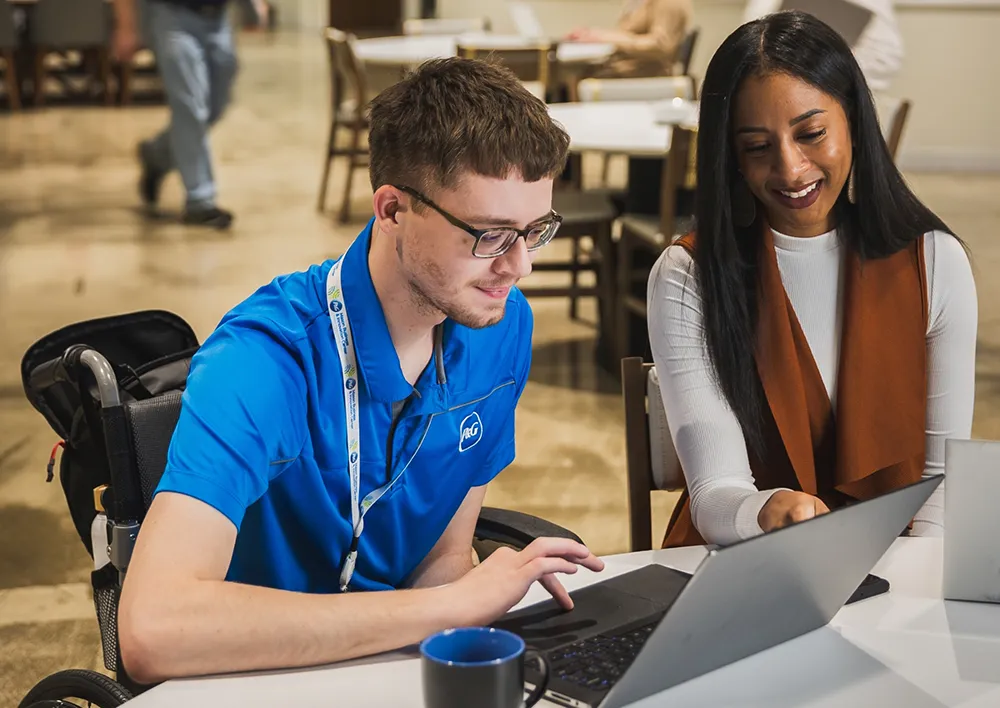
P&G is shrinking its teams as it automates. It is cutting up to 7,000 non-manufacturing roles, about 15% of that workforce, in a two-year restructuring built around broader roles, automation and digitization, according to Constellation Research. Headcount fell to about 104,000 in fiscal 2026, and CFO Andre Schulten said in July that half the planned reduction was done.
AI fluency, coded against the Lead with AI Fluency Matrix (September 2026 edition):
- Fluency floor: Not published. More than 20,000 employees have completed Formula AI training, but P&G has set no AI requirement for all staff.
- Highest level evidenced: Level 3 (Integrating), company-claimed. AI tools run inside workflows from creative development to media activation, and automated systems run some production shifts without staff on the line. The figures have not been independently verified.
- Portfolio design: P&G builds AI on one shared data foundation and scales it across marketing, research, the supply chain and everyday work.
How Procter & Gamble Measures Results
P&G reports AI results by use case. All figures below are company-claimed:
- Advertising: ads tested and optimized in a few days instead of weeks, at one-tenth of the cost
- Marketing: Pantene in Germany tripled its consumer reach while cutting media spend by about a fifth, using social media, influencers and AI-powered content tools, according to PYMNTS
- Product development: a Pantene product moved from insight to concept, packaging and communications in days instead of weeks
- Manufacturing: unattended shift operations live across nine categories
Gaps remain. P&G reported $2.8 billion in productivity improvement in fiscal 2026 but does not say how much came from AI. Separating that share is the step from AI adoption to AI value.
Next markers: the AI share of productivity savings, completion of the restructuring, the reach of Formula AI beyond 20,000 employees and headcount for fiscal 2027.
Change log
- April 2025: P&G publishes its study with Harvard Business School on teams working with AI.
- June 2025: P&G announces up to 7,000 non-manufacturing role cuts tied to automation and digitization.
- January 2026: Shailesh Jejurikar becomes CEO.
- April 2026: Schulten says P&G is in full scaling mode for its digital capabilities.
- July 2026: Jejurikar says AI capabilities will enable smaller teams.
The Bottom Line
- Disclosure: 4 of 4. P&G answers all four questions, with results by use case.
- AI spans brands, labs and plants, on a shared data foundation.
- Training runs through champions, with more than 20,000 employees reached.
- Level 3 is evidenced in marketing workflows and automated production, on company-claimed results.
- The say-do gap is people and jobs. P&G’s research shows teams do better with AI, while the company plans smaller teams and up to 7,000 fewer roles.
- Watch the productivity line. The test is whether P&G shows how much of its savings comes from AI.
Revenue, Headcount and Revenue per Employee
What the numbers show: Revenue rose 6% from fiscal 2023 to fiscal 2026 while headcount fell 3%, so revenue per employee rose 9%, to about $837k. Headcount fell by about 5,000 in fiscal 2026, the first year of a restructuring that cuts up to 7,000 non-manufacturing roles as P&G automates and digitizes work. These figures do not show that AI caused any change.
Revenue, headcount and revenue per employee, FY2023 to FY2026
- FY2023: $82.01bn revenue, 107,000 employees, $766k per employee
- FY2024: $84.04bn revenue, 108,000 employees, $778k per employee
- FY2025: $84.28bn revenue, 109,000 employees, $773k per employee
- FY2026: $87.03bn revenue, 104,000 employees, $837k per employee
Change, FY2023 to FY2026: revenue up 6%, headcount down 3%, revenue per employee up 9%.
Notes: Revenue is net sales, as reported. Headcount is approximate, at fiscal year-end on June 30. P&G began a two-year restructuring in fiscal 2026 that cuts up to 7,000 non-manufacturing roles.
These figures give context on scale and productivity. They do not show that AI caused any change. Sources: Procter & Gamble 10-K filings.
How Procter & Gamble Compares with US Consumer Goods Peers
We looked at how Procter & Gamble compares with other US consumer goods companies in the index. Here is how they stack up.
| Company | Disclosure | AI owner | Fluency floor | Governance | AI value reported | Revenue per employee |
|---|---|---|---|---|---|---|
| Altria | 3 of 4 | No AI leader named; a cost program carries the work | Not published | Not published | None published | $3.95M |
| Coca-Cola | 3 of 4 | Chief Digital Officer (from March 2026) | Not published | Not published | None published | $727k |
| Mondelez International | 4 of 4 | Chief Information and Digital Officer | Not published | Human review of AI content; banned content types | $10M from process intelligence; content savings targeted | $423k |
| PepsiCo | 4 of 4 | Chief Strategy and Transformation Officer | Not published | Not published | Digital twin pilot results, no total | $307k |
| Philip Morris International | 3 of 4 | Head of AI runs a generative AI factory in Portugal | Not published | Not published | None published | $479k |
| Procter & Gamble | 4 of 4 | CIO; enterprise data science runs an AI Factory | Not published; 20,000+ trained through Formula AI | Not published | Results by use case, no AI share of savings | $837k |
Disclosure counts how many of the four strategy questions (where it is going, where it will focus, what it will take and how it will know it is working) a company answers in public. Fluency floor is the lowest level of AI fluency a company expects of all its people, on the five levels of the Lead with AI Fluency Matrix: Avoiding (0), Chatting (1), Collaborating (2), Integrating (3) and Transforming (4). The other columns summarize each company’s profile. Revenue per employee is for each company’s latest fiscal year, in US dollars. See all companies in the AI Strategy Index.
Frequently Asked Questions
What is P&G’s AI strategy for its own work?
P&G is scaling AI across brand building, research, manufacturing and everyday work, on a data foundation built over more than a decade. Its CEO says the result will be speed and smaller teams.
Who leads AI at P&G?
President and CEO Shailesh Jejurikar sets the direction, and Chief Information Officer Seth Cohen leads data and technology. Enterprise data science teams build models through an AI Factory operating model.
What is ChatPG?
ChatPG is P&G’s internal generative AI tool, built on ChatGPT. It sits alongside ImagePG, AskPG and InsightsPG in P&G’s set of AI tools for employees.
Is P&G cutting jobs because of AI?
P&G is cutting up to 7,000 non-manufacturing roles as it uses automation and digitization to build smaller teams. Headcount fell to about 104,000 at the end of fiscal 2026.
How is this profile put together?
Lead with AI profiles use public sources only, such as annual reports, earnings materials, filings and on-record interviews, dated at the time of writing. AI fluency is coded against the Lead with AI Fluency Matrix, and company figures are marked as company-claimed unless they have been independently verified.
About the AI Strategy Index
The Lead with AI AI Strategy Index profiles how the largest companies in the US and Europe approach AI, starting with the S&P 100 and the STOXX Europe 50. Each profile answers four questions: where the company is going with AI, where it will focus, what it will take and how it will know it is working. AI Pacesetters and notable companies outside the two indexes are profiled for contrast and are not counted. Profiles use public sources only, and AI fluency is coded against the Lead with AI Fluency Matrix.
See all company profiles