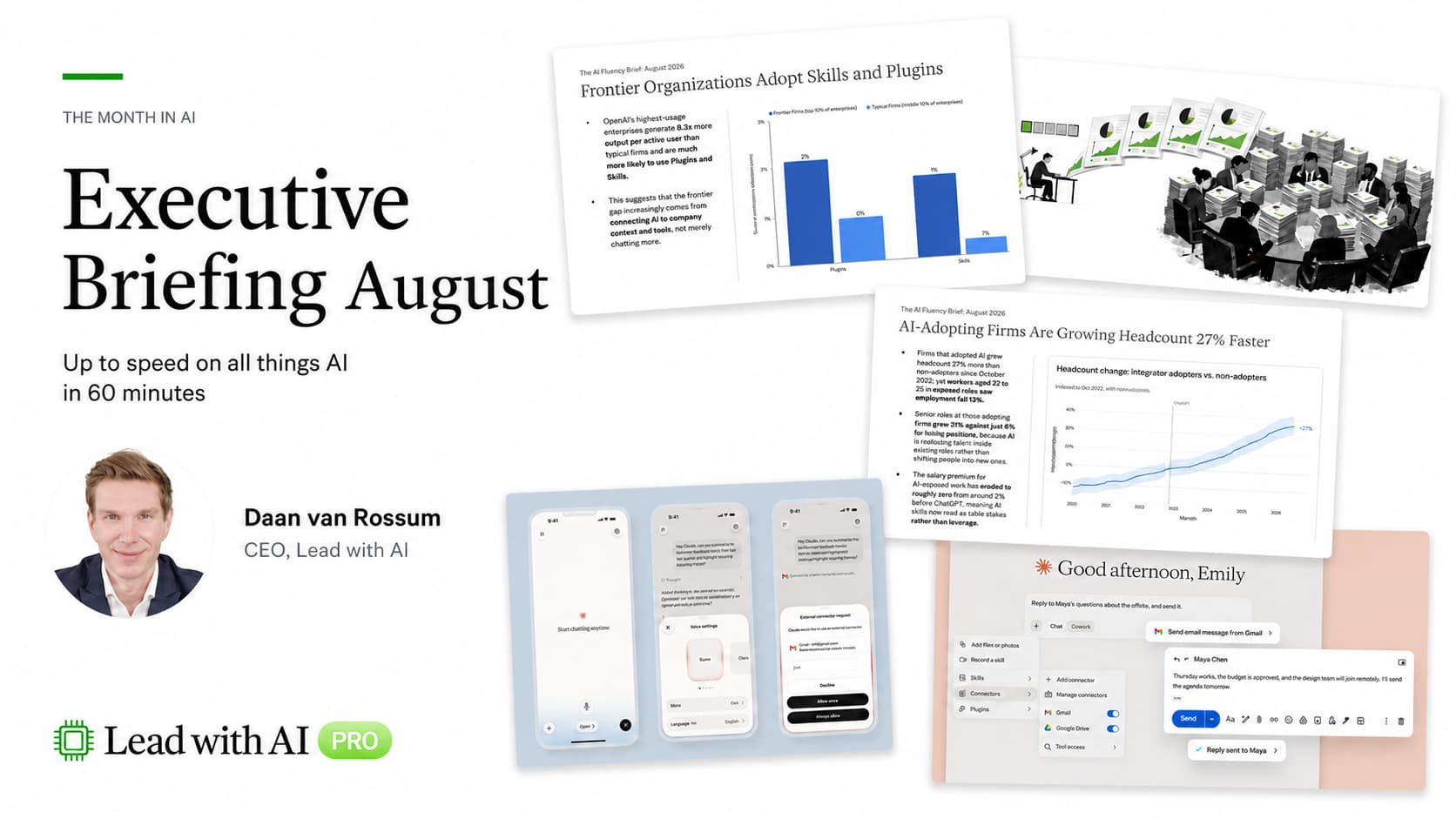


Based on the Lead with AI PRO Executive Briefing with Daan van Rossum, Founder and CEO of Lead with AI. Watch the full recording (PRO members only).
You could have ignored AI for the past month and come back today completely lost.
That's not because AI changed, but because the gap between what AI can do and what most executives are actually doing with it keeps getting wider.
If your AI fluency has slipped, here's everything you need to know to get back up to speed.
How Big Has AI Actually Gotten?
The numbers from the past few months are staggering.
According to Sensor Tower data, ChatGPT now has a billion monthly active users.
Google announced at I/O that Gemini has reached 900 million active users.
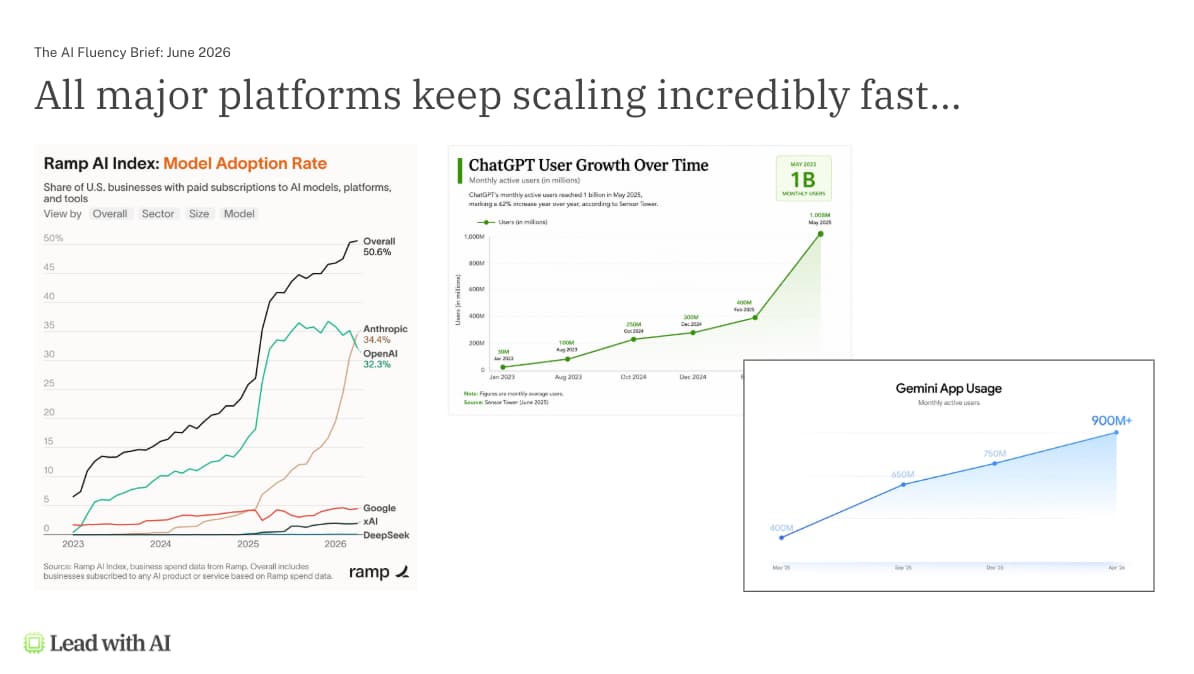
And for the first time, a notable spending shift has emerged: Anthropic has overtaken OpenAI on the Ramp Index, with business spending on Anthropic now exceeding spend on OpenAI. About half of US businesses are now using AI regularly.
The scale matters because it sets the baseline. If you're not using AI actively and iteratively, you're not at parity with your peers -- you're behind them.
Why Are People Not Getting ROI from AI?
This is the central question right now, and the Glean Work AI Index 2026 is the most rigorous attempt yet to answer it. The study surveyed 6,000 digital workers across the US, UK, and Australia, with researchers from Stanford, UC Berkeley, and five other universities.
The headline numbers are uncomfortable: 87% of digital workers use AI and report saving 11 hours per week. Yet only 13% say their organization is performing significantly better because of it. Where is all that saved time going?
The answer is two new terms worth adding to your vocabulary.
Botsitting is the 6.4 hours per week the average knowledge worker spends on the invisible labor of making AI usable: feeding it context, checking outputs, debugging mistakes, re-running prompts, and cleaning up confident-but-wrong answers. That is more time than they spend actually producing work with AI.
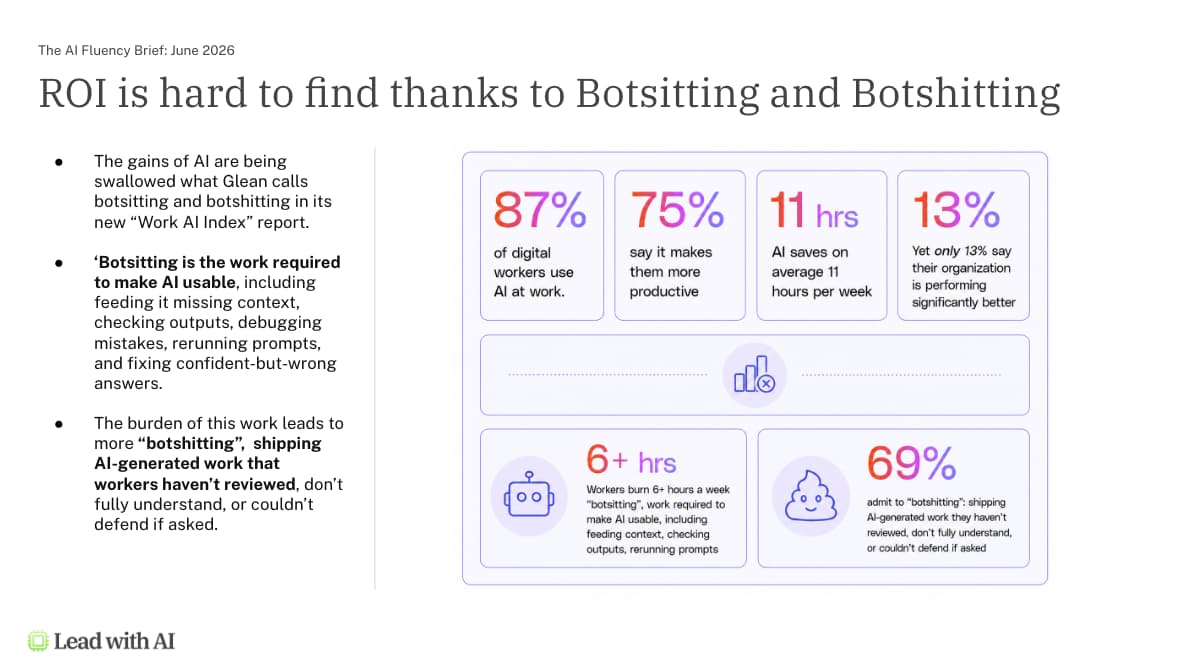
When the botsitting load gets heavy enough, workers stop checking. They ship work they haven't reviewed and couldn't defend if challenged. The study calls this botshitting -- and 69% of AI users admit to doing it. This is what others have called "work slop": the predictable output of giving people a button that generates work product without requiring them to understand it.
Here's the part that should concern every leader: the heaviest AI users do the most botshitting. The more people use AI, the more this behavior increases, not less.
The fix is not better prompting. It is work redesign.
Putting a rocket engine on a broken bicycle is not going to get you anywhere.
The only way to get real ROI is to sit with people individually, understand what their work actually looks like, find where AI creates genuine overlap, and build from there. This is what Stanford calls workflow literacy: do you actually know how your day breaks up, and where AI changes the equation?
I met Rebecca Hinds, one of the study's lead authors, in person while I was in Mountain View -- alongside two other professors. Their conclusion maps exactly to what we've been saying for three years: AI adoption is failing because we skip the redesign step.