
Sometimes the question is not what the internet says, but what the scientific research says.
Consensus is an AI research platform that searches academic papers and writes answers with citations to the studies behind them. It is useful when you want to check a claim, challenge an assumption or see where the evidence agrees and where it conflicts. Its coverage is not complete, and AI can misread a study, so the judgment stays yours.
Where to find Consensus
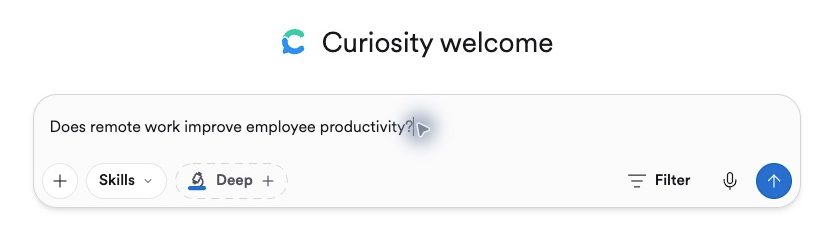
Go to consensus.app, sign in and type your question. The default mode searches the literature and writes a cited summary. Switch on Deep for a longer review across more studies.
What your plan includes
- Free: unlimited basic searches, a limited number of Pro answers and a few Deep reviews each month.
- Pro: from about $12 a month, with unlimited Pro answers and a monthly allowance of Deep reviews.
- Deep: a higher tier for people who run many literature reviews.
- Access to papers: a citation does not mean free access. Some papers still require a personal or institutional subscription.
Prices and allowances change, so check the Consensus pricing page before you buy.
When Consensus earns its place
There are four situations where Consensus pays off quickly:
- A claim in a strategy deck that sounds too good to be true.
- A people decision, such as hybrid work, a four-day week or a wellbeing program.
- A debate in your leadership team where everyone cites a different study.
- A policy or program design that should rest on evidence rather than opinion.
How to research a question, step by step
Step 1: Ask a precise question. “Does remote work improve employee productivity?” works better than “remote work.” A template is below.
Step 2: Choose the depth. Keep the default mode for a cited summary, or switch on Deep for a more extensive review.
Step 3: Read the answer and the meter. The Consensus Meter shows how many studies point to yes, possibly, mixed or no. The supporting papers appear in the References panel.
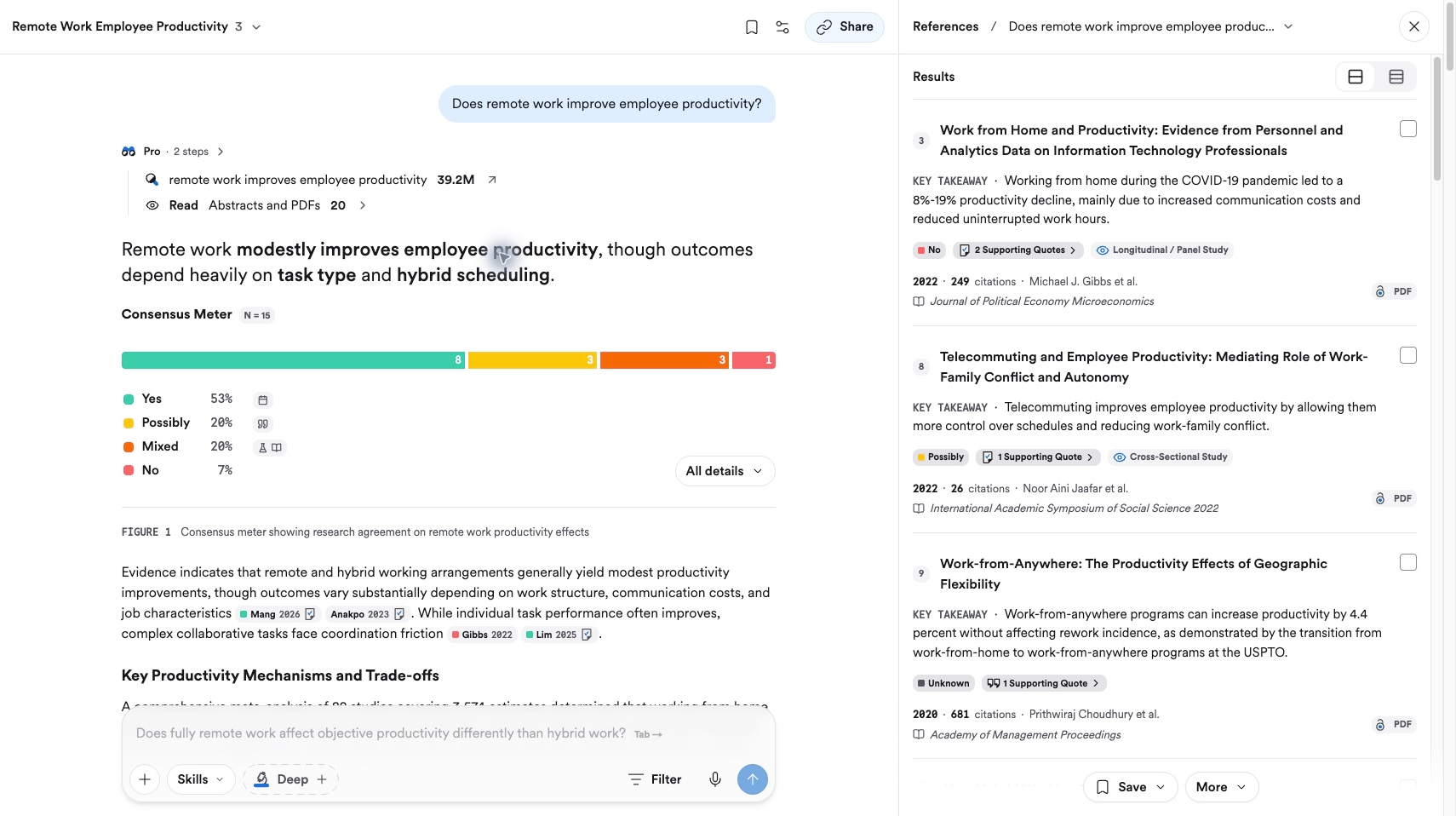
Step 4: Open the key papers. The Evidence tab shows the passages that support the answer. A Study Snapshot pulls out details such as the population, sample size, methods and outcomes. Some fields may be missing, so check the original paper for anything important.
Step 5: Filter the results. Narrow by publication year, study design or open access. Use the filter to exclude preprints, which have not finished peer review.
Step 6: Save and export. Save useful papers to Collections in your library, then export them as a spreadsheet, a reference file or a bibliography.
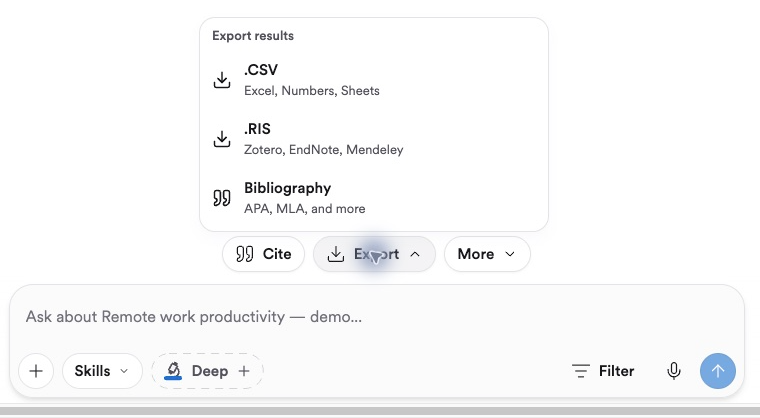
Step 7: Bring it into your AI assistant. Consensus connects to ChatGPT and Claude, so you can combine academic studies with business reports in one conversation.
A CODO prompt to start with
Use this structure, from our CODO framework, when you ask Consensus or connect it to your AI assistant, and replace the bracketed parts.
Character: You are a research advisor who summarizes academic evidence for senior leaders.

Objective: Tell me what the research says about [whether a four-day work week affects productivity] so I can decide [whether to run a pilot].

Do:
- Focus on studies from the last [10] years.
- Prioritize meta-analyses, systematic reviews and randomized trials.
- Show where the evidence agrees and where it conflicts.
- Note the sample size and setting of the key studies.

Don't:
- Don't overstate findings from small or single studies.
- Don't include preprints unless you label them clearly.

Output:
A short summary of the evidence, the three most relevant studies and what remains uncertain.
What should you watch for?
- Coverage is broad, not complete. Important studies can be missing.
- AI can misread research. Check the Evidence tab for any finding you plan to quote.
- Relevance matters as much as quality. A strong study in a different industry or country may not apply to your situation.
- Keep confidential details out of your questions. Ask about the topic, not about your company's internal data.
Consensus or another research tool?
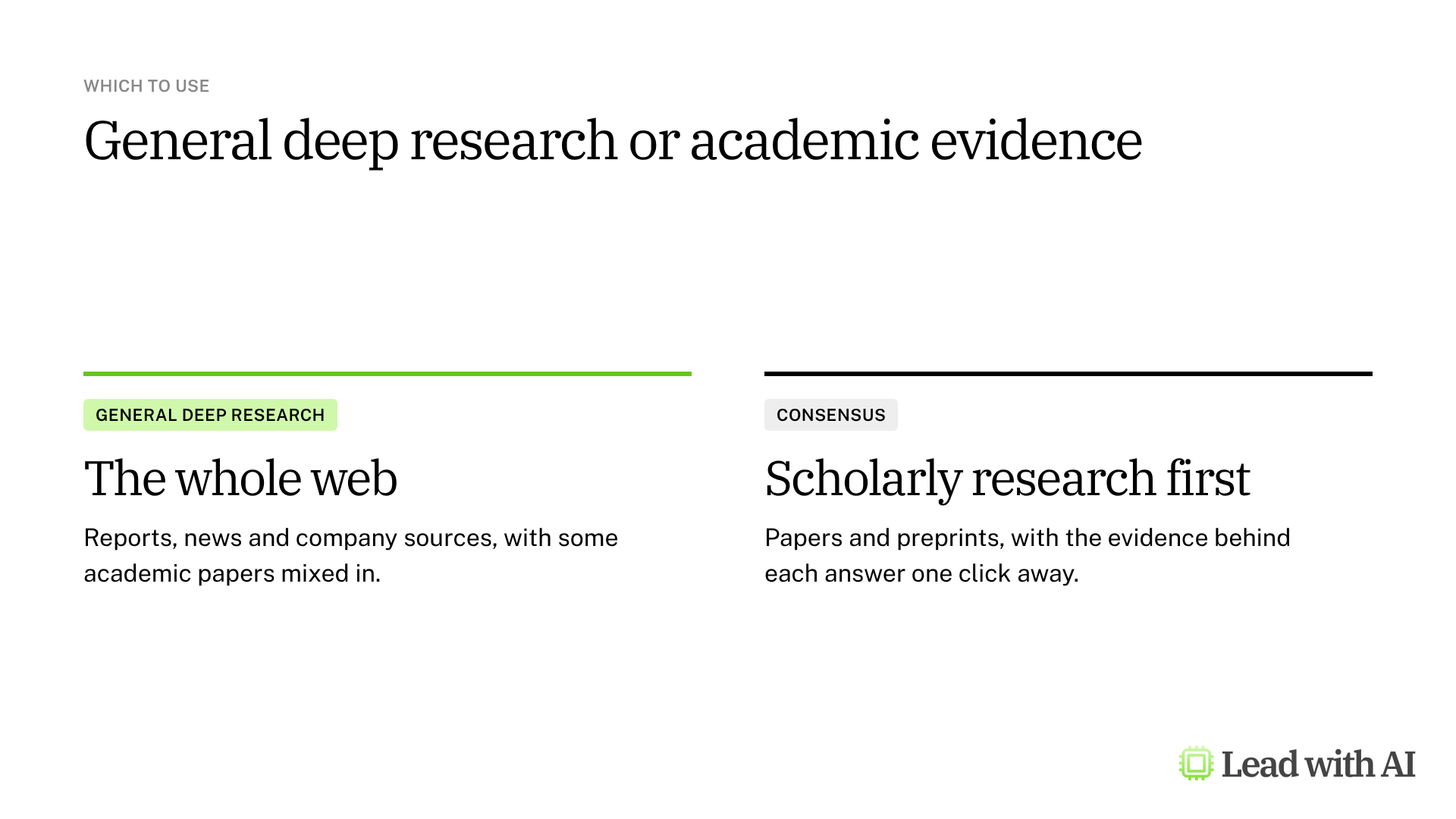
Consensus is the natural choice when the quality of the evidence matters more than its breadth.
For research that also covers news, company reports and your own files, use ChatGPT deep research, Gemini Deep Research, Claude Research or Copilot Researcher. Our overview of AI deep research tools compares all six options.
Key takeaways
- Ask a precise question, not a topic.
- Read the Consensus Meter, then open the key papers.
- Check the Evidence tab before you quote a finding.
- Filter out preprints when you need peer-reviewed work.
- Ask whether the evidence applies to your situation.