




If your company runs on Google Workspace, your meeting notes can write themselves into Google Docs.
Gemini in Google Meet takes notes, adds an optional full transcript and answers your private questions during the call. After the meeting, the notes arrive as an editable Google Doc, so your team can turn them into a working document.
Where to find Gemini in Google Meet
Before you join, select Use Gemini to take notes. During the call, select the Take notes with Gemini icon at the top right. The Ask Gemini button next to it opens a private side panel.

What your plan includes
- Google Workspace: Take notes for me and Ask Gemini are included in Business and Enterprise editions such as Business Standard and Plus.
- Personal accounts: since June 2026, Google AI Pro and Ultra subscribers can use Take notes for me too.
- Admin settings: your admin can turn note taking off for the organization.
- Devices: Ask Gemini works in Meet on a computer.
When Gemini in Meet earns its place
- Your meetings run on Google Meet, and you want notes without a separate tool.
- You join late and need to catch up quietly.
- Notes should become a working document, with owners and next steps added afterward.
- In-person meetings, which Meet can now take notes for from your phone or computer.
How to use Gemini in Google Meet, step by step
Step 1: Start taking notes. Select the Gemini notes icon, check the meeting language and tick Also transcribe the meeting if you want a full transcript. Then select Start taking notes.
Step 2: Check the settings. Choose the notes length and who receives the notes. You can pause or stop note taking at any time.
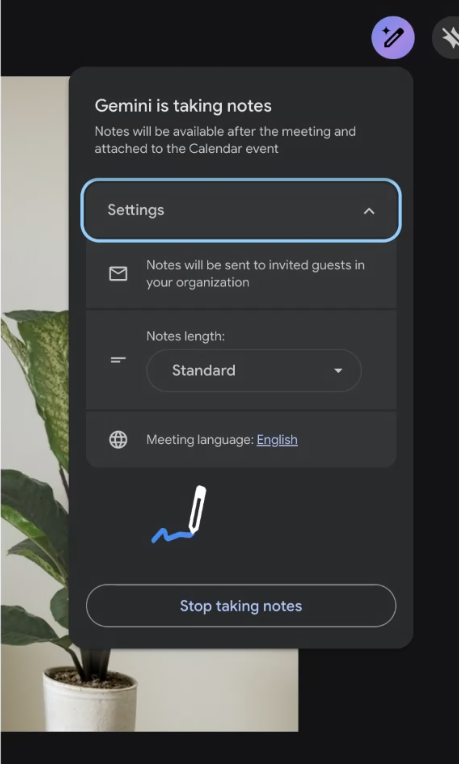
Step 3: Ask Gemini during the call. Open Ask Gemini and use a built-in prompt, such as Summarize the discussion so far, or ask your own question:
What did [name] say about [topic], and what is still undecided?
Gemini answers from what has been said in the meeting, and other participants do not see your questions.
Step 4: Open the notes. After the meeting, Gemini emails you a link. The notes are a Google Doc saved in Drive and attached to the calendar event, with a Notes tab and, if you chose it, a Transcript tab.
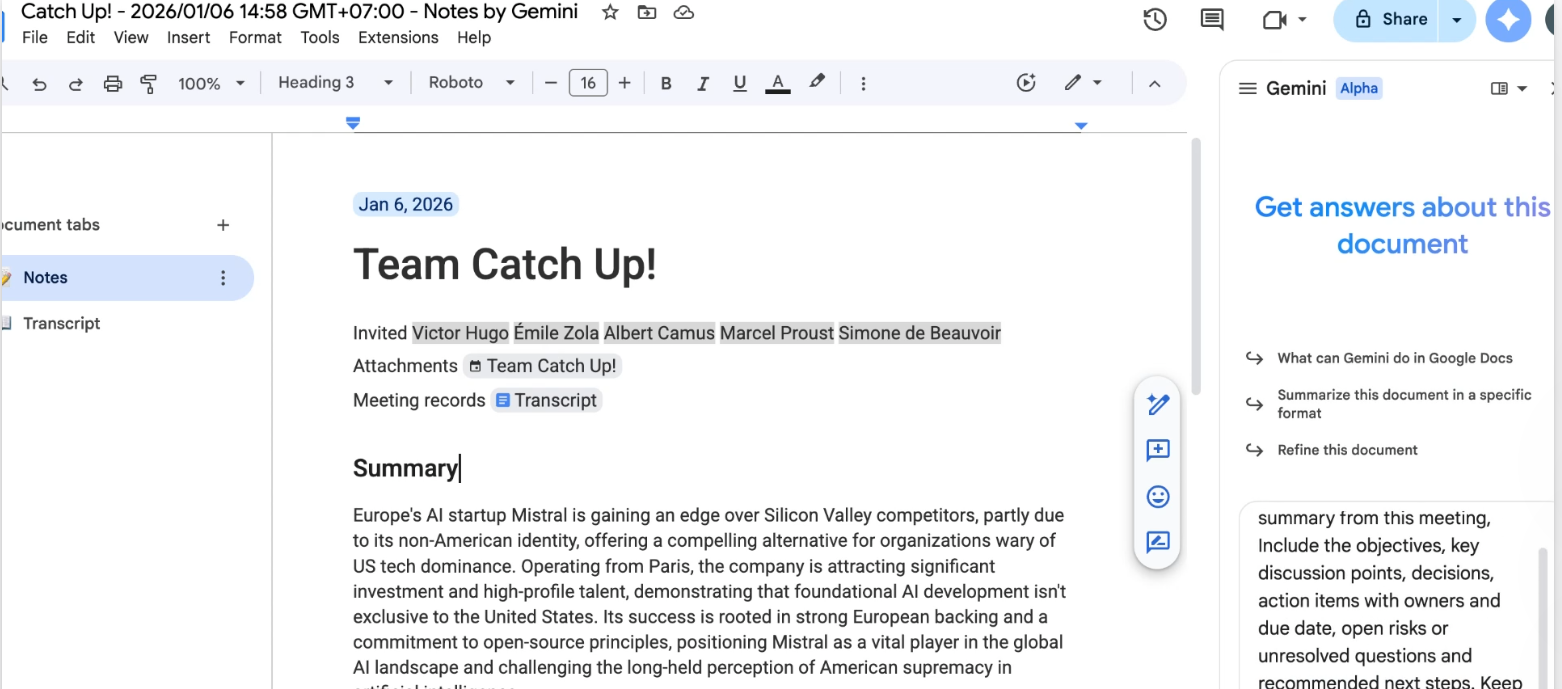
Step 5: Edit and share. Clean up the summary, tag owners and add context. Check who received the notes before you add anything sensitive.
Step 6: Turn the notes into a summary for leadership. Open Gemini in the Docs side panel and ask:
Create a one-page executive summary from this meeting. Include the objective, key discussion points, decisions, action items with owners and due dates, open risks or unresolved questions, and recommended next steps. Keep it concise, flag anything unconfirmed and do not invent missing details.
Notes for in-person meetings
Since August 2026, Gemini can also take notes for a meeting in a room. On the Google Meet home screen, on the web or on your phone, select Take notes and set the device nearby. Gemini creates the same Google Doc with a summary, action items and transcript, and your admin's note-taking setting applies here too.
A CODO prompt for the follow-up
The notes are only half the job. Use this prompt, built with our CODO framework, to turn any transcript into decisions, owners and a follow-up message. Replace the bracketed parts. Review the follow-up before you send it, and send it yourself.
Character: You are an experienced chief of staff who turns meeting transcripts into clear follow-up.

Objective: I am the [role] at [company]. Turn the attached transcript of [meeting name] into a post-meeting package I can act on today, for [the people who attended].

Do:
- Separate real decisions from things that only sounded like agreement.
- Use speaker names from the transcript for action items, and flag any item without a clear owner.
- Give every action item an owner, a next step and a deadline, and flag dates nobody actually stated.
- Keep it skimmable, with short headers and bullets.

Don't:
- Don't invent anything that is not in the transcript. If the transcript is thin, say so.
- Don't bury open questions. They are often the most valuable part.

Output:
A post-meeting package with five sections: a 3 to 4 sentence summary, decisions made, action items, open questions, and a follow-up message I can review and send myself.
Want to go further? These pages build on the same habits:
- How Jakob Knutzen (GM, Miro) uses AI before, during and after every meeting: a senior leader's routine for preparing, running and following up on meetings.
- Your meeting architecture is broken: decide which meetings should exist before you automate their notes.
- Our guide to reusable AI assistants: save the prompt above as an assistant you reuse after every meeting.
What will your IT and legal teams ask?
- Is our data used for training? Google states that Workspace content is not used to train its generative AI models without permission.
- Who can see the notes? The meeting host and the person who started the notes, plus anyone they share it with or your settings send it to.
- Do participants know? Yes. Meet shows everyone that Gemini is taking notes.
- Can we turn it off? Yes. Admins control note taking for the organization, and in-person notes follow the same setting.
Gemini in Meet or another meeting assistant?
Gemini is the natural choice if your meetings run on Google Meet, because the notes land in Drive with no extra tool.
If you also meet on Zoom or Teams, Granola takes notes on any call from your computer, with no bot. On Claude Team or Enterprise plans, Claude Meetings can join Google Meet calls and build documents while you talk. Our overview of AI meeting assistants compares all five options.
Key takeaways
- Start notes before you join or during the call.
- Tick the transcript option when you need a full record.
- Ask Gemini privately to catch up or check what was said.
- Edit the Google Doc before you share it.
- Use it in the room too for in-person meetings.




