
July 3, 2026

Inside Zapier's Golden Paths and Context Layer: The Infrastructure Behind 100% AI Fluency in Hiring

Zapier hires 100% of new candidates against a live AI fluency bar. Sammut and St.Dic break down the golden paths and context layer behind it.
Daan van Rossum
By
Daan van Rossum
Founder & CEO, Lead with AI

Presented by

Based on the Lead with AI PRO live session with Brandon Sammut, Chief People and AI Transformation Officer at Zapier, and Tracy St.Dic, Global Head of Talent at Zapier, hosted by Henrik Jarleskog, Cofounder and Managing Director, Europe, at Lead with AI. PRO Members can watch the full recording here.

Zapier now requires 100% of new hires to clear an AI fluency bar, scored across four separate touchpoints in the hiring process.

Sammut and St.Dic joined Lead with AI's Pro Community, in a session moderated by Henrik Jarleskog, Cofounder and Managing Director, Europe, at Lead with AI, to walk through the infrastructure behind that number: two new systems called golden paths and a company-wide context layer, plus a hiring philosophy St.Dic summed up as "slope over snapshot."

It's Sammut's second time with Lead with AI. He first joined in August 2025 as Chief People Officer; he now carries the added title Chief People and AI Transformation Officer, a small but telling signal that AI transformation has become a standing mandate at Zapier rather than a side project inside HR.

This time St.Dic joined him, bringing a level of hiring-mechanics detail the first session didn't cover.

What was Zapier's "Code Red" moment for AI?

Sammut opened with the story that anchors Zapier's AI journey, and that longtime Lead with AI readers may recognize from his first session: Zapier's Code Red began in March 2023, about six months after ChatGPT's first model hit the market.

"We started noticing that even that, you know, it's an ancient version of an LLM now, but even that version, 13 quarters ago, could use API documentation and write integrations like we build here at Zapier," - Brandon Sammut, Chief People and AI Transformation Officer, Zapier

He described the moment as a two-sided coin:

"On one hand, it's exciting, because that means we can use AI to do the things that we do best even better. The other side of the coin is that now a lot of other people, right, can do the same thing."

For a company whose mission is to make automation work for everyone, that cut both ways: AI was either the biggest opportunity Zapier had seen since 2011, or one of its biggest challenges.

St.Dic, on this call for the first time, added her own memory of the response: a company-wide hackathon that has since become a recurring, quarterly ritual.

"We wanted everybody hands-on keyboards experimenting with this technology. It wasn't just lip service, it was like, no, no, no, they are telling us it is okay to stop my day-to-day job." – Tracy St.Dic, Global Head of Talent at Zapier

Flagship AI Newsletter
The AI Newsletter That Makes You Smarter, Not Busier
Join over 30,000 leaders and receive our insights on AI platforms, implementations, and organizational change management.
FlexOS Course - AI Content Accelerator - Testimonial Badge

What are Zapier's "golden paths," and why do guardrails speed things up?

Sammut introduced a concept new to Lead with AI's coverage of Zapier: golden paths, documented and vetted ways of working with AI for a specific function, whether that's lead generation, QA for code, or a recruiting workflow St.Dic's team built.

He challenged a common assumption about governance. "There's one way of thinking about that where governance or guardrails, like, slow things down and really limit what people can do together," he said. "There's another way of thinking about governance and guardrails, and this is the way that we ultimately like to think about it, where it speeds things up."

His reasoning: without clarity on what's safe, most people simply won't start. "They can intuit that there's, like, an electric fence out there somewhere, they don't want to touch it, they just don't know exactly where it is." Clear boundaries, he argued, citing decades of research on creativity within constraints, actually enhance creativity compared to no boundaries at all. Golden paths are Zapier's answer: not just safe ways to use AI, but "some of the more efficient ones."

How did Zapier build a company-wide context layer for people and AI?

The single biggest infrastructure investment Zapier made in the first half of 2026 was what Sammut called a "genuine company-wide context layer," echoing another recent PRO session with Doist who built a similar "AI Brain."

The company, fully remote across 42 countries, already had a habit of documenting how things get done. The gap was that documentation built for humans didn't always work for agents. "We needed to kind of re-host and restructure some of our company knowledge to make it accessible to people and AI," he said.

The layer includes company strategy, values, goals, and standard operating procedures, but also something more personal: every employee's README, borrowed from the software engineering tradition of documenting a codebase:

"When you join the company, everyone writes their personal README. It's just a little bit about you, maybe your personal values, your preferred ways of working." – Brandon Sammut

That means a Zapian can query the knowledge layer to find, say, three people who list a particular skill as a strength and reach out to learn from them directly.

About 95% of the layer is open to the whole company, with sensitive HR and legal material locked down. Zapier built it in-house rather than waiting on the vendor market, because "a lot of it's still in progress, and we didn't want to wait around."

This is close to identical to a principle we have argued for in our guidance on building AI-native organizations: "If it is recorded, it happened to the AI. If it did not get recorded, it did not happen to your intelligence."

It's a foundational step toward making a company "legible" to AI, a precondition for everything else an AI-native organization does. Zapier's context layer is a working, in-production example of that exact principle, arriving independently at the same conclusion: undocumented knowledge doesn't exist to an agent, no matter how well it lives in someone's head.

How does Zapier's AI fluency rubric actually work in hiring?

St.Dic said Zapier measures AI fluency at four separate points in the hiring process: the initial application, an AI-powered interviewer at the recruiter screen, a live-iteration skills test, and the executive interview. That redundancy is deliberate.

"Our definition of AI fluency is not just based on technical skills or tools. It's a lot more related to behavioral aspects. How do you approach AI? How do you think about the future of your function?"

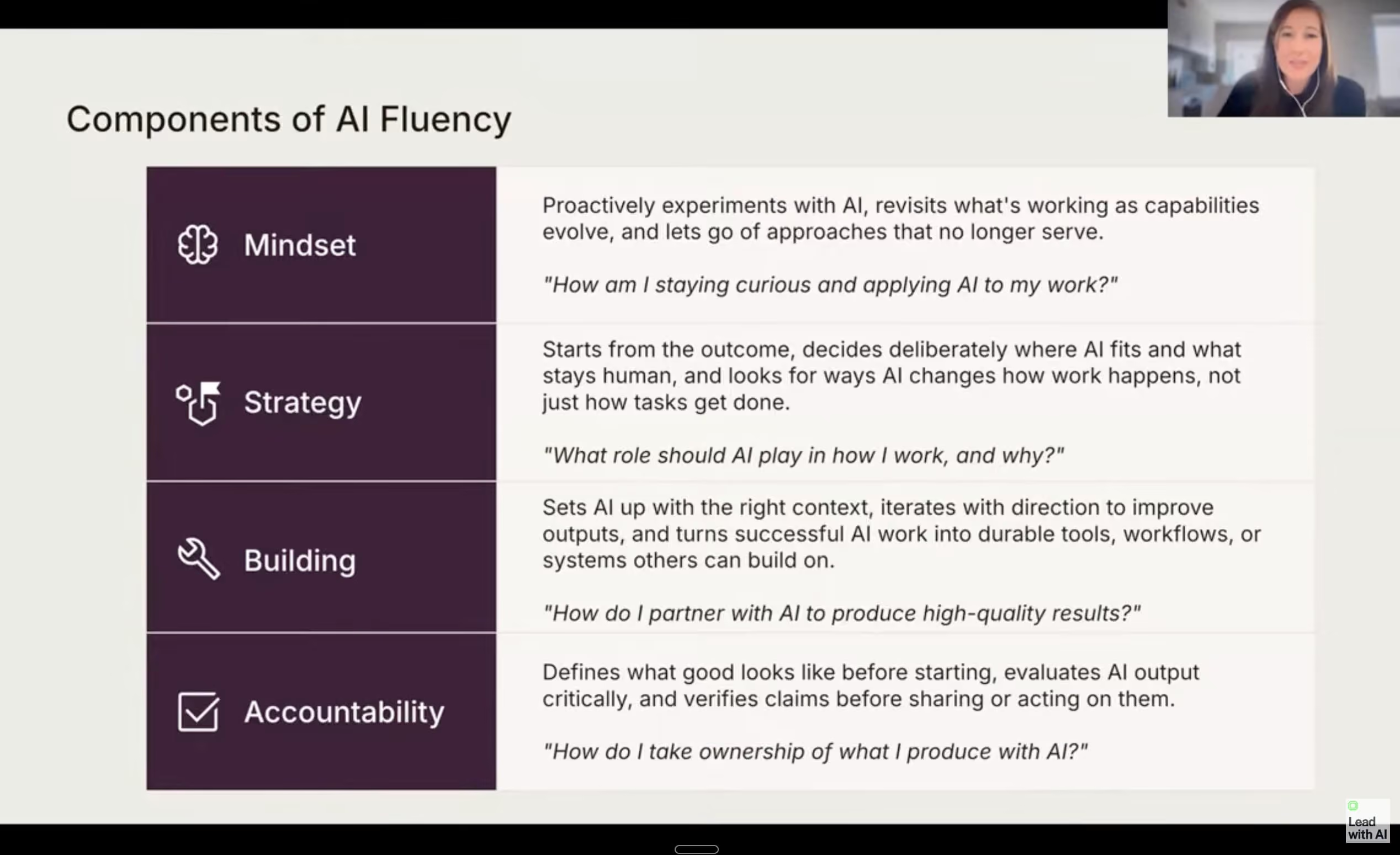
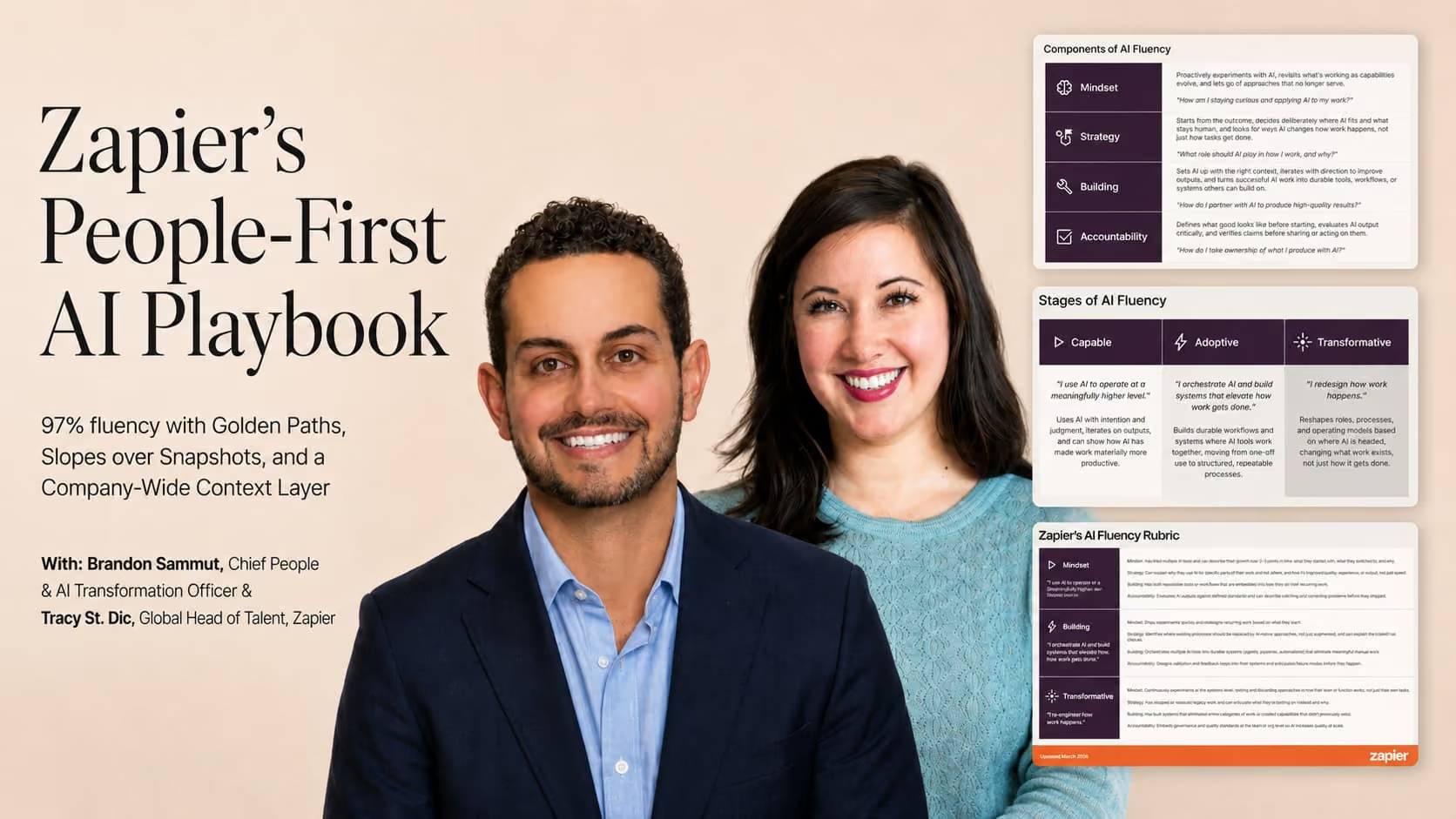
The rubric scores candidates across four components: mindset, strategy, building, and accountability, the last one a newer addition. Mindset is about how someone experiments and pushes the "art of the possible." Strategy asks candidates to articulate how their function will evolve.

Tracy St.Dic, Global Head of Talent at Zapier, presents the 'components of AI fluency"

Building is role-specific technical capability, informed partly by Anthropic's AI Fluency Index and behaviors.

Accountability, St.Dic said, has become critical "in a world of AI slop": understanding guardrails, responsible usage, and ownership. That fourth pillar traces to a line from Zapier's CTO, Brian Helmig, that the team repeats constantly: "You can delegate the task, but you can't delegate the accountability."

"You can delegate the task, but you can't delegate the accountability." – Brian Helmig, CTO, Zapier

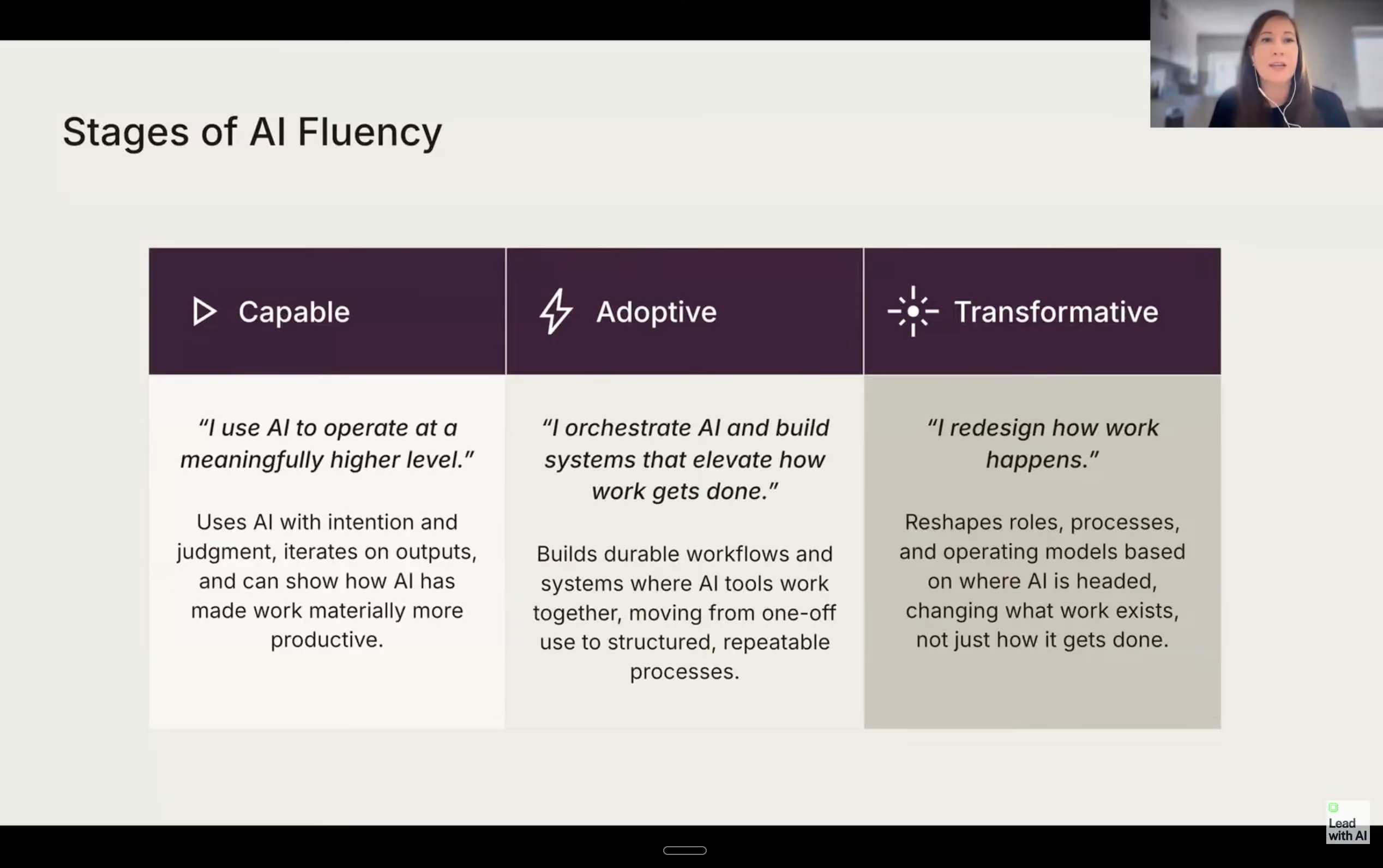
Candidates are scored against four levels, from unacceptable up through capable, adoptive, and transformative, a four-tier structure Lead with AI has covered before as a headline example of AI fluency driving company-wide adoption. "Transformative," St.Dic said, is rare: "Very rarely do candidates hit the transformative level, I would say less than 5%, for sure."

Zapier's three stages of AI Fluency

Lead with AI's own AI Fluency matrix maps similar territory with a five-level matrix built from work with more than 2,000 leaders, and lands on the same core idea that St.Dic independently echoed in this session: fluency is "a portfolio, not a ladder." That guide even quotes Sammut making this argument directly about Zapier's customer support team, that only two to five pioneers needed to reach the top tier while the rest needed to be merely adoptive.

Why does Zapier care more about "slope" than "snapshot"?

The session's most quotable line came from St.Dic: "One of the things that is one of the pillars of our fluency model is what we like to say is slope over snapshot." It isn't just how someone uses AI today that matters, but the trajectory: how they were using it six months ago, what changed, and how they evolved even during the hiring process itself:

"That gives us a meta-signal to understand how they learn, how they grow, how they're experimenting. And to me, that's a lot more indicative of their future growth in this area than a candidate who's used the same 3 tools for the same 3 past 3 years, and doesn't do anything else."

She contrasted a static candidate against someone actively evolving their approach, calling the trajectory itself the stronger predictor of future performance.

What does a workflow redesign look like when it's already working?

Sammut pointed to Zapier's customer support team as the clearest proof that AI transformation works.

He described the team's approach to redesigning ticketing workflows in less detail than his first session's account. This time, he folded the same example into a standing measurement framework Zapier now applies to any workflow redesign: efficiency, quality, and employee experience, together.

"We insist that we find measurable improvement in all three areas, not just faster, cheaper," he said. For people already inside the company, he added, what mattered wasn't scoring their individual fluency but whether the redesigned workflow actually worked and whether people could execute it.

Fluency rubric, golden paths, or context layer: where should a company start?

Asked which of the three to build first if starting this quarter, Sammut and St.Dic gave genuinely different answers, live, which they both flagged as useful in itself.

St.Dic argued the pieces are interdependent. "I don't think you can implement a fluency rubric unless you then have the golden paths, to like, once people get here, they know what to do with their skills," she said.

Absent a context layer, she added, even a fluent AI user just has "glorified chatbots." If pressed to pick one starting point outside the three options, she said she'd choose culture: "the culture and the safety around experimentation, which I really do think is the foundation of everything."

Sammut, by contrast, said the rubric mattered far less for Zapier's existing team than it did for hiring, pointing back to the customer support redesign as evidence that workflow-level results, not individual scoring, are what actually matter once someone is already inside the company.

What does leadership actually look like during an AI transformation?

Sammut's clearest message to the room: "Easily more than half of what we have learned is required to do this has nothing to do with AI." AI is a means, not the outcome.

When Zapier talks to customers who aren't getting results, the first question is rarely about AI. It's "what are the top two things within the organization that you need to be excellent at in this moment?" Many leaders, he said, don't have a clean answer. That absence of clarity, not a lack of tooling, is usually the real blocker.

The second half of leadership, he argued, is visible behavior.

Back in March 2023, Zapier created a public Slack channel where anyone, including the CEO, could post demos of what they'd built, alongside a companion channel for getting stuck and asking for help.

"Think about what it means to an organization when they see their leaders, including their CEO, being among the first and most often contributors to channels like that."

St.Dic added a concrete, recent example from her own team. Six months earlier, in early 2026, Zapier pushed its recruiting team to work inside agent harnesses like Claude Code, Codex, and Cursor. "Even my team was like, I can't believe he's asking us to learn this thing now, we're so busy, like, really?"

She said the company slowed down for three to four weeks to build golden paths and enable the team properly. The payoff: junior recruiters who had been "bordering on evidence of low performance" turned it around completely, and reported having more fun than ever.

Key Takeaways

  • Write down golden paths before scaling any workflow. Treat documented, vetted ways of working with AI as a form of clarity that speeds teams up rather than a restriction that slows them down.
  • Build a context layer that agents can query, not just people. Restructure company knowledge, including individual "READMEs," so AI systems can act on it, not just employees.
  • In hiring, score AI fluency on trajectory, not a single snapshot. Ask what someone was doing with AI six months ago and how their approach has changed, rather than only what tools they use today.
  • Add accountability as an explicit fourth pillar of fluency, alongside mindset, strategy, and building, especially as "AI slop" makes low-accountability AI use riskier.
  • Measure any workflow redesign on efficiency, quality, and employee experience together, not speed or cost savings alone.
  • Let leaders be visibly imperfect in public. A leader posting "I got stuck, can someone help me" in a company-wide channel does more for adoption than a mandate ever will.
  • Track how a role's title evolves, not just its headcount. Sammut's shift to Chief People and AI Transformation Officer is a signal worth watching for in your own org chart.

Brandon Sammut is Chief People and AI Transformation Officer at Zapier, and Tracy St.Dic is the company's Global Head of Talent.

This article is based on their July 2026 Lead with AI Pro Community session, hosted by Henrik Jarleskog.

Executives working through similar questions may also find Lead with AI's June 2026 Executive AI Briefing and guide to AI certifications useful next reads, and are welcomed to join our AI Leader Advanced program to guide their organization's AI fluency journey.